MLabs

1.5K posts

MLabs banner
MLabs

MLabs

@MLabs10

Blockchain and AI consultancy working across industries, including fintech and blockchain. 🙏 Support us in Project Catalyst 🔗 https://t.co/MjWDX8Q7bZ

UK Katılım Haziran 2021
347 Takip Edilen6.7K Takipçiler
MLabs retweetledi
TapTools
TapTools@TapTools·
Cardano Builder DAO is one of the clearest paths for treasury funding to reach active ecosystem teams. Round 2 builds on that progress with stronger governance, public KPI tracking, and improved accountability. Cardano’s builders are still here. They should have the resources to keep building. medium.com/tap-in-with-ta…
TapTools tweet media
English
5
23
119
3.5K
MLabs
MLabs@MLabs10·
@astroboysoup @_KtorZ_ Seeing some confusion here. Covenant is already being used by Konma for HaskLedger. The Solana/sBPF work reflects a real feature from that work, not "Solana" sprinkled in for hype. It also maps to Pillar 2, multi-chain tooling. Our CTO explains the scope here:
English
0
0
0
21
Pete | Beware of Scammers
Pete | Beware of Scammers@astroboysoup·
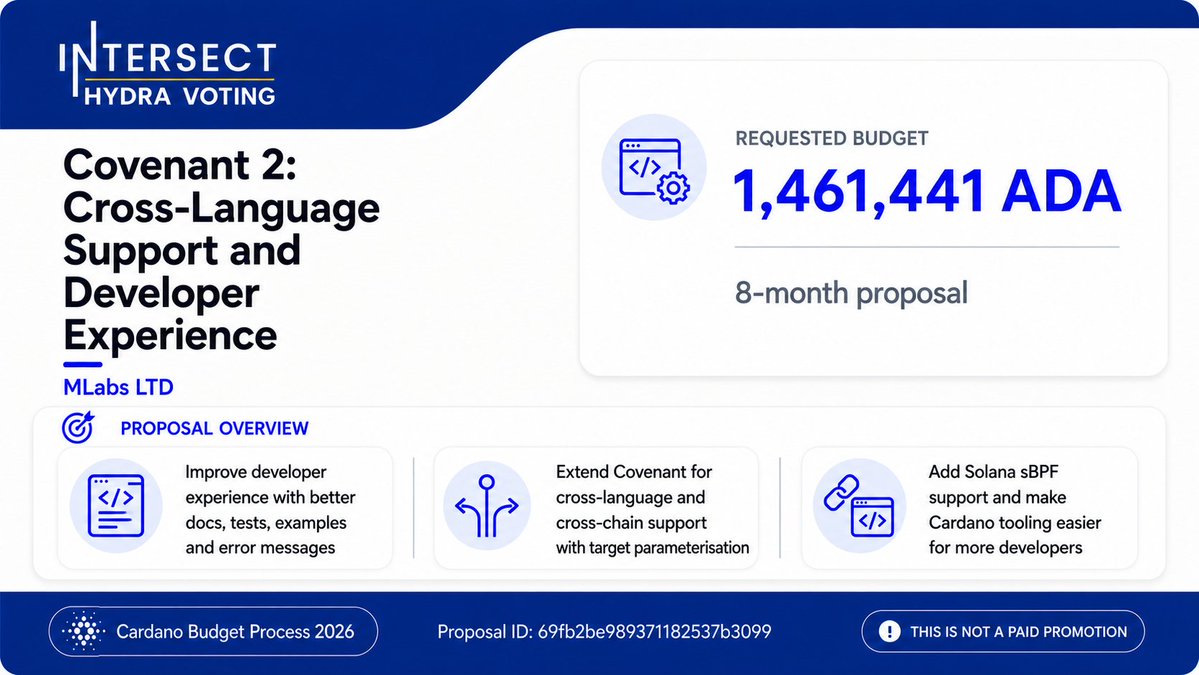
1.461M ADA for Covenant 2 by @MLabs10. Covenant sits between smart contract languages and blockchain bytecode. This proposal improves dev experience, docs, error messages and examples, while extending Covenant toward cross-chain compilation with Solana sBPF support. The aim: make Cardano easier for non-Cardano devs to reach. Worth funding? *Not a paid promotion
Pete | Beware of Scammers tweet media
English
7
0
13
1.2K
MLabs
MLabs@MLabs10·
@astroboysoup Different design, different tradeoffs, different integration story. Healthy ecosystems have more than one implementation of important primitives. Happy to discuss the technical differences with anyone interested. Here, our CTO gives an overview of the proposal scope:
English
0
0
0
29
MLabs
MLabs@MLabs10·
@astroboysoup Does that make FeesaSwap superior? Thats not our claim. FeesaSwap and Aquarium serve different roles in improving Cardano UX & growing usage beyond ADA holders. This proposal prioritizes the ecosystem (not an individual solution) and is aligned with Pillar 2 of the 2030 vision.
English
1
0
0
36
Pete | Beware of Scammers
Pete | Beware of Scammers@astroboysoup·
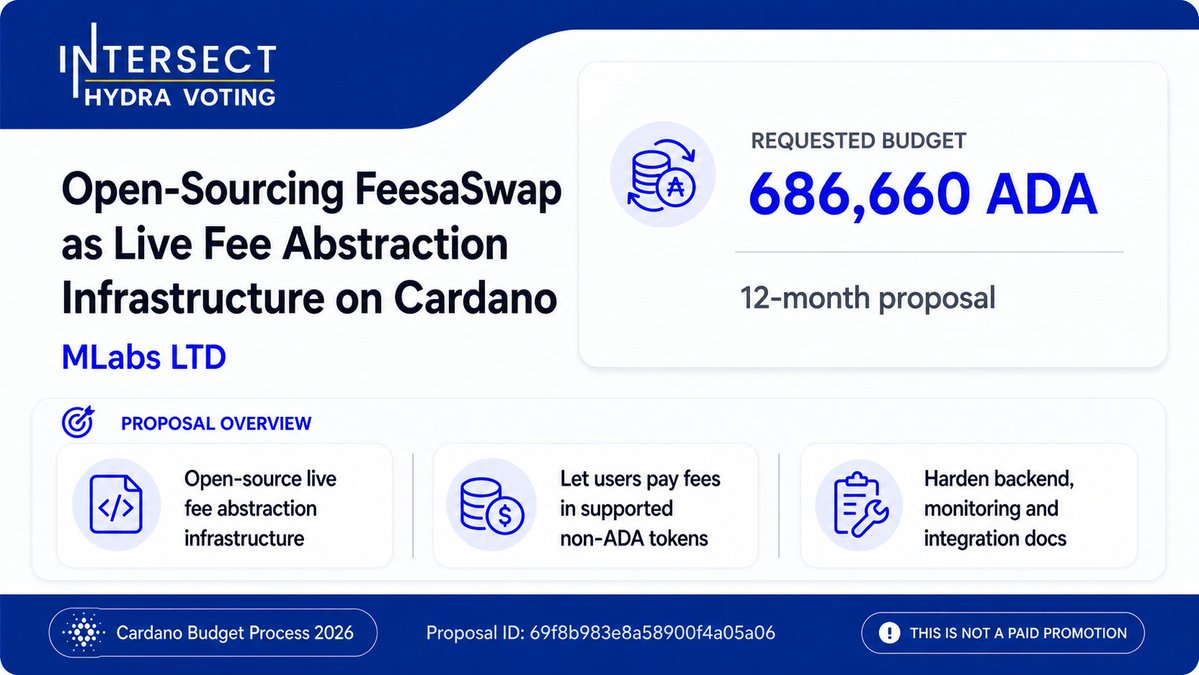
686K ADA to open-source Cardano fee abstraction. @MLabs10 wants to open-source and harden FeesaSwap, a live mainnet system that lets users pay fees in supported non-ADA tokens while ADA and collateral are handled behind the scenes. The upside: this attacks real UX friction. The concern: FeesaSwap already received Catalyst funding, so this needs to clearly deliver public infrastructure, not just product maintenance. Worth funding, or should wallets solve this themselves? *Not a paid promotion
Pete | Beware of Scammers tweet media
English
13
6
34
10.6K
MLabs
MLabs@MLabs10·
Hate to break it to you but we're bootstrapped, and we need to keep the lights on like any other business. We have won many grants it's true - because we have a reputation of delivering what we promise, and because we have ambitions for what this ecosystem is capable of. Delivering our work is costly, but we do feel it will have tremendous impact for years to come.
English
0
0
0
17
QU₳Z₳R
QU₳Z₳R@QuasarSure·
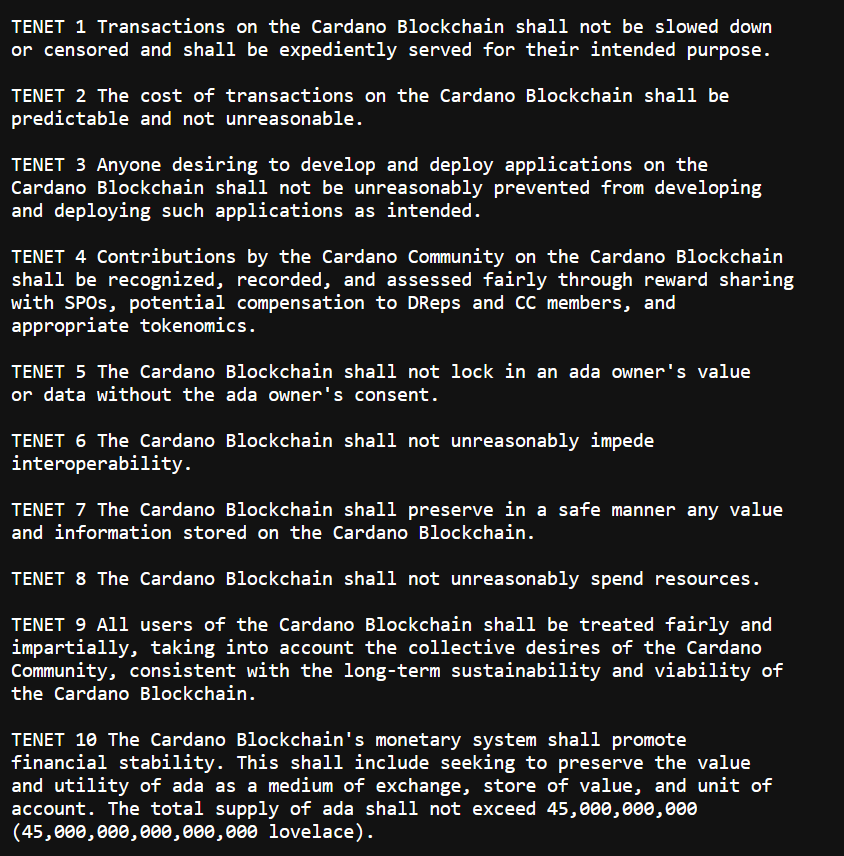
IMO, the fee violates or ignores TENETS 3, 8, and 9, if not a couple others. If the fee is UnConstitutional, then so are these 55 proposals and will have to be resubmitted minus the fee. If they want to donate to the treasury, then do so, but it doesn't reduce the number of proposals well funded groups will submit like @MLabs10 with 10.
English
1
0
1
46
QU₳Z₳R
QU₳Z₳R@QuasarSure·
The 1000 cardano:native Proposal Fee @IntersectMBO & @IntersectCBC implemented to submit a budget request to the treasury ✅IS✅ or ❌IS NOT❌ Constitutional? How many of the "TENETS" does this requirement not uphold, ignore, or disregard? Do these actions meet requirements in the By-Laws, Membership Agreement, and Code of Conduct? Repost and tag your DREP and the Cardano Blockchain Ecosystem Constitutional Committee(s) and its/their members if these items are of concern. Yes, the reduction of spam proposals is very important. There are other ways to achieve this without placing a financial burden any stakeholders. COC Page is broken BTW. docs.intersectmbo.org/legal/policies…
QU₳Z₳R tweet media
QU₳Z₳R@QuasarSure

Funny what we call spam these days. No proposal to fix cardano from me.

English
6
2
8
1.4K
MLabs
MLabs@MLabs10·
Keep in sync with our latest Plutarch updates, part of our Core Tool Maintenance & Enhancement project. This video covers new type instances, plutarch-ledger-api updates, performance improvements, API cleanups, and more 👇
English
2
0
5
490
MLabs
MLabs@MLabs10·
MLabs just delivered more reliable infra with Cardano.nix v1.3.0, including: 🔹Refreshed dependencies 🔹CI/integration validation 🔹Bug fixes 🔹Updated docs for easy adoption Made possible through #Cardano community funding ❤️ Details 👇 github.com/mlabs-haskell/…
English
1
2
15
766
big pey
big pey@bigpey·
Trump is planning to launch a new token related to his media company. Should he launch it on Cardano?
English
139
3
129
9.7K
MLabs
MLabs@MLabs10·
We regularly dogfood our Catalyst-funded tooling in both internal work and client delivery. Some of these tools have clear adoption outside MLabs; others have been more niche. The clearest usage signals include (but aren’t limited to): - Plutarch: 2nd most used language in production. - Ply: commonly paired with Plutarch to make typed data/codecs more ergonomic. - CTL: a transaction-building stack used in production by multiple teams and dApps. - cardano.nix: Cardano-focused Nix tooling we use heavily for reproducible builds/deployments, in CTL, and that’s also used by some Nix-oriented teams in the ecosystem. - YTxP: a Cardano-specific proxy/upgrade pattern that’s been incorporated into at least one major dApp. - LambdaBuffers: schema-driven type generation used in client applications. - TxVillage: Rust-side transaction-building tooling used in client work. - Plutip: fast local testing infrastructure we use extensively for iteration and CI. - PSM (now CLB): similar testing infrastructure focused on production-adjacent workflows. Much of the supporting evidence here is public via the Plutonomicon, our own mlabs-haskell repositories, and the Catalyst milestone module. We also have additional work that’s internal, still in R&D, or tied to client confidentiality. That said, as scrutiny has increased across funding rounds, we’ve tried to align proposals with what builders and users actually need, and we’re continuing to improve our ability here with each iteration.
English
0
0
0
70
.
.@Northern_ADA·
@MLabs10 @planetmaaz Out of all the tools that you were funded to build via catalysts how many are used?
English
2
0
0
97
big pey
big pey@bigpey·
Midnight is taking the best technology from over 10 different blockchains, implementing it, and then building more features on top of it. Midnight is going to ship FAST in 2026 due to this.
English
20
33
329
5.6K
Army of Spies
Army of Spies@ArmyofSpies·
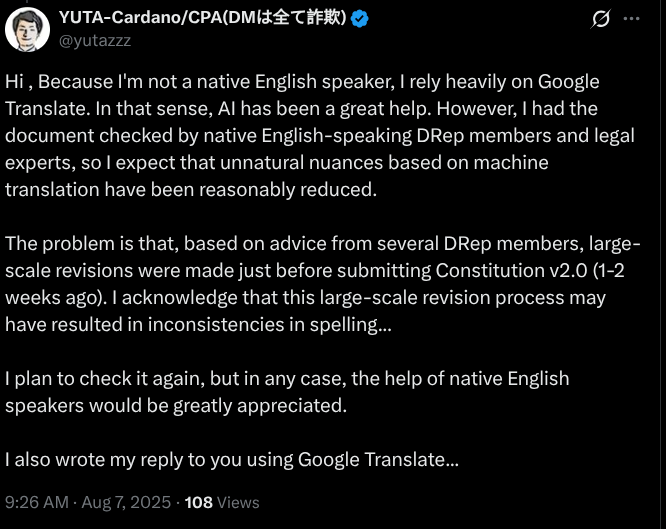
🔦🚨Now I get why this felt so off! It was all AI?!? This is an interesting scenario. Six months ago you posted that you were using Google translate to reply to me and that you "rely heavily" on it (see August screenshot below). Nothing wrong with that. You also mentioned AI. But, now I'm seeing responses like yours from today (second post below). It reads as 100% AI. I'm getting the distinct impression that I'm discussing this with Chat GPT and not really getting authentic responses from a human. I'm not so sure that's a valuable use of time on my side. I can talk to AI anytime on my own. 🚨🚨But, the Important Part: This surfaces bigger philosophical questions about your governance actions and how much they are actually human driven vs. AI. How much of the Constitutional Amendment was you and how much was AI? The massive reorganization of the sections definitely feels like AI in retrospect. Humans don't normally edit legal docs like that. But, AI does. It would also explain why it was so hard to just hit the "track changes" button. There's no wrong or right answer. But, people deserve the disclosure.
Army of Spies tweet media
YUTA-Cardano/CPA(DMは全て詐欺)@yutazzz

Thank you for sharing your view and for the effort you’ve clearly put into articulating it. I appreciate the seriousness with which you are engaging in this discussion. That said, I believe the argument as presented contains several methodological issues that are significant in the context of constitutional and governance design. I will focus strictly on the structure of the reasoning itself. 1. Reduction of institutional analysis to inferred motivations The core issue under discussion is the scope, limits, and institutional role of the Constitutional Committee (CC) within the Cardano Constitution. However, the argument reframes this issue primarily in terms of inferred personal motivations—namely, that certain positions are driven by a desire to weaken checks and balances against individual voting power. Institutional design should be evaluated based on its structural effects and systemic outcomes, not on speculative assumptions about individual intent. Arguments grounded in inferred motivation are inherently unfalsifiable and weaken the analytical rigor of constitutional debate. 2. Aggregation of quotations without contextual distinction The cited statements span different contexts, timeframes, and specific concerns regarding CC authority. Treating them collectively as evidence of a single, unified intention risks conflating distinct arguments into a retrospective narrative. Concerns about excessive discretion or arbitrariness in CC decision-making do not, in themselves, amount to opposition to checks and balances. When quotations are removed from their original context and aggregated, institutional critique is replaced by intent attribution. 3. Construction of a false dichotomy The framing suggests a binary opposition between: •those who seek to limit or clarify CC authority, and •those who support strong checks and balances. This dichotomy is misleading. It is entirely coherent to support robust constitutional review while also advocating for clearer constraints to prevent subjective or arbitrary exercise of power. Excluding this middle, institutionally grounded position unnecessarily narrows the scope of the debate. 4. Trivialization of constitutional design as “preferences” Questions of constitutional authority, separation of powers, and governance legitimacy cannot be reduced to mere differences in preference. These design choices have concrete, long-term implications for power concentration, institutional stability, and accountability. Characterizing the disagreement as a “basic and predictable difference in preferences” risks bypassing substantive evaluation of those consequences. 5. Toward a more rigorous discussion A productive constitutional debate should focus on textual interpretation, institutional structure, and foreseeable systemic effects—rather than on who is presumed to want what. I believe the discussion would benefit from returning to these foundations and engaging directly with the design trade-offs involved.


English
18
8
56
14.1K
MLabs
MLabs@MLabs10·
@yutazzz We support you using any and all tools at your disposal in order to be a transparent representative. In general we find your words are pretty consistent with your actions, frankly - who cares about the precise method you used to get there?
English
1
0
1
161
MLabs
MLabs@MLabs10·
@yutazzz Many Japanese people report that chatGPT provides better translation with cultural context awareness than google translate. First and foremost as a drep your job is to communicate to your delgators what is happening and how you intend to represent them 1/2
English
1
0
1
197
YUTA-Cardano/CPA(DMは全て詐欺)
Thank you for sharing your view and for the effort you’ve clearly put into articulating it. I appreciate the seriousness with which you are engaging in this discussion. That said, I believe the argument as presented contains several methodological issues that are significant in the context of constitutional and governance design. I will focus strictly on the structure of the reasoning itself. 1. Reduction of institutional analysis to inferred motivations The core issue under discussion is the scope, limits, and institutional role of the Constitutional Committee (CC) within the Cardano Constitution. However, the argument reframes this issue primarily in terms of inferred personal motivations—namely, that certain positions are driven by a desire to weaken checks and balances against individual voting power. Institutional design should be evaluated based on its structural effects and systemic outcomes, not on speculative assumptions about individual intent. Arguments grounded in inferred motivation are inherently unfalsifiable and weaken the analytical rigor of constitutional debate. 2. Aggregation of quotations without contextual distinction The cited statements span different contexts, timeframes, and specific concerns regarding CC authority. Treating them collectively as evidence of a single, unified intention risks conflating distinct arguments into a retrospective narrative. Concerns about excessive discretion or arbitrariness in CC decision-making do not, in themselves, amount to opposition to checks and balances. When quotations are removed from their original context and aggregated, institutional critique is replaced by intent attribution. 3. Construction of a false dichotomy The framing suggests a binary opposition between: •those who seek to limit or clarify CC authority, and •those who support strong checks and balances. This dichotomy is misleading. It is entirely coherent to support robust constitutional review while also advocating for clearer constraints to prevent subjective or arbitrary exercise of power. Excluding this middle, institutionally grounded position unnecessarily narrows the scope of the debate. 4. Trivialization of constitutional design as “preferences” Questions of constitutional authority, separation of powers, and governance legitimacy cannot be reduced to mere differences in preference. These design choices have concrete, long-term implications for power concentration, institutional stability, and accountability. Characterizing the disagreement as a “basic and predictable difference in preferences” risks bypassing substantive evaluation of those consequences. 5. Toward a more rigorous discussion A productive constitutional debate should focus on textual interpretation, institutional structure, and foreseeable systemic effects—rather than on who is presumed to want what. I believe the discussion would benefit from returning to these foundations and engaging directly with the design trade-offs involved.
Army of Spies@ArmyofSpies

The discussion around the Constitution boils down to a simple difference in preferences. The largest single individual DRep is likely to desire a weaker Constitutional Committee to weaken the checks and balances against his voting power. This is obvious from past actions and statements: --literally deleted the phrase "checks and balances" from the Constitution; --"[CC] already holds enormous power"; --"CC holds even greater default power"; --"the Cardano Constitution places constraints on the CC’s excessive authority"; --"the Cardano Constitution exists to constrain the CC’s excessive power"; --"Cardano Constitution is is not a weapon for the CC—it is a restraint on the CC"; --"DReps (and SPOs) bear the responsibility of monitoring both the inherently powerful CC and the Constitution that binds it"; --"[i]f the CC were free to invoke the Tenets loosely or expansively, it would open the door to highly subjective, and potentially authoritarian, decision-making"; and --"judgments of the form 'this proposal violates the Tenets, in my personal view' must be exercised with extreme restraint". On the other end of the spectrum, many others will want strong checks and balances against undue concentration in voting power. Basic and predictable difference in preferences.

English
1
0
23
7.4K