Möbius

477 posts

Möbius banner
Möbius

Möbius

@MobiusExchange

Unified Margin for All DeFi Backed by @yzilabs

Katılım Ocak 2025
42 Takip Edilen1.4K Takipçiler
Möbius
Möbius@MobiusExchange·
It seems the tokenized stocks on Robinhood still provide price exposure rather than actual stock ownership. Is there any project that gives users real ownership of the underlying shares? The other key use case is using them as collateral instead of simply adding liquidity. RBH needs protocols built around this.
English
0
0
0
25
𝗵𝘂𝗻𝘁𝗲𝗿
gonna start experimenting with apps on @robinhoodapp's chain ideally they're: > novel > utilize stock tokens > not a copy/paste from other chains pls leave any recs below
English
28
0
87
7.4K
Möbius
Möbius@MobiusExchange·
@sgoldfed So this could create a form of enterprise-grade L2, where companies pay higher fees in exchange for stronger security standards and clearer recovery guarantees, right? And would this be beneficial for Ethereum’s economy?
English
0
0
0
15
Steven Goldfeder
Steven Goldfeder@sgoldfed·
I’ve proposed what I believe is a win-win fix for Ethereum’s rollup revenue a few times: Ethereum needs to provide more for its most successful L2s, and charge them a premium for it. Ethereum should adopt its largest rollups in the sense that a critical bug in Arbitrum, Base, or Robinhood Chain should be treated as an Ethereum vulnerability and trigger an L1 fork just like an L1 bug would. This fixes the ecosystem's biggest pain points in three ways: 1. It's an incredibly valuable feature, and Ethereum could name its price. 2. The main reason L2s keep security councils around today is to handle emergency vulnerabilities. If L1 acts as the security backstop, L2s can safely get rid of them. 3. Several L1 folks have been pushing for based/native rollups, motivated by the belief that L1 should have more control of and value capture from its L2s. But the technical designs are problematic and none of them have any commercial traction. Rather than trying to build momentum from scratch, Ethereum should just monetize the thriving L2s that already exist.
Lorenzo Valente@LorenzoARK

The Robinhood Chain is the cleanest case study of what happened to ETH's economics over time. Since inception, @RobinhoodApp Chain has grossed ~$816K in revenue. @Arbitrum, the middleware provider, takes 10%: ~$80K. Arbitrum then pays Ethereum for settlement: $1,538. The margin profile roughly: Robinhood: 89% Arbitrum: 10% Ethereum: 0.15% If your thesis is "ETH is money," Robinhood building here is ultra bullish. More activity, more ETH collateral, more lindyness. If your thesis is "ETH is a revenue generating asset," this is the ultra-bear case. And here's the uncomfortable truth: Robinhood was never going to build on Solana, Sui or any monolithic L1. They want the stack customization. They want to be landlords, not renters. Ethereum won this deal on merit. It's just not pricing it right. A healthy split to me looks more like: Robinhood: 75% Arbitrum: 10% Ethereum: 15% Ethereum sells the most valuable settlement layer in crypto at marginal cost. Things need to change. @ethlabs_org


English
22
7
93
12.7K
Möbius
Möbius@MobiusExchange·
@milesdeutscher The ecosystem still needs a reason for users to fund agents and trade The key question is whether Robinhood’s ecosystem can create new economic incentives for agents to trade
English
0
0
0
11
Miles Deutscher
Miles Deutscher@milesdeutscher·
Robinhood CEO (Vlad Tenev) is going all in on agentic AI. His plan: give everyday Robinhood users the same AI trading tools institutions have. AI x financial services is about to completely explode. It's clear where the world is headed.
English
81
91
875
109K
Möbius
Möbius@MobiusExchange·
There are two major drawbacks. → Fragmented liquidity Assets and collateral become isolated from larger chains, forcing users to bridge funds while market makers spread liquidity across another ecosystem. → Worse ux More chains mean more bridging, gas tokens, network switching and withdrawal delays, often adding complexity without clear user benefits.
English
0
0
0
100
Suhail Kakar
Suhail Kakar@SuhailKakar·
hot take: every single large crypto app will have its own chain capture your own mev + sequencer revenue instead of leaking it to L1, customize the fee token and gas economics, own your upgrade path the ones that don't are just leaving money on the table
English
51
5
105
17.9K
Möbius
Möbius@MobiusExchange·
but token can also be used to bootstrap new markets It is a form of reinvestment, putting capital directly back into the protocol instead of constantly using it for buybacks It depends on how the token is used, It can generate more revenue for the platform and improve ux or create pain for holders
English
0
0
0
15
Alex
Alex@alex_hunter20·
For everyone asking for a $UNIT token, answer this: Unit is generating $12M in annualized revenue. TradeXYZ is generating $24M in annualized revenue. Why would Shoku willingly give up $36M/year in revenue just to launch a token? Because if they did, they’d have to spend most of that revenue on buybacks to support the token. So they’d end up with vested team tokens, little to no revenue, and a supply they couldn’t dump easily even after vesting… all just to make you happy with an airdrop? lol It’s not like they ever announced a token or promised an airdrop. They don’t owe you anything. On top of that, people could dump $HYPE to rotate into $UNIT if the P/E ends up being more attractive, especially if Hyperliquid eventually turns the growth mode off. Jeff didn’t roll out the red carpet for Shoku just for Shoku to stab him in the back as a thank you lol
Alex tweet mediaAlex tweet media
Havoc.hl 𝕏@Havochl_

tradeXYZ flipping Hyperliquid in 24H volume is exactly why I don't think Shoku's token would be bearish for $HYPE if that token is used to incentivize liquidity and attract more traders, tradeXYZ holders will effectively be funding user acquisition for Hyperliquid. The app takes the dilution while Hyperliquid still provides the execution and settlement layer and captures half of the trading fees, which sounds much closer to leverage than competition. If more builders like Shoku come to Hyperliquid and achieve similar scale, the result is not value leaking away from $HYPE but an expanding network of businesses competing to generate activity for it.

English
40
5
195
31.5K
Möbius
Möbius@MobiusExchange·
@andyyy Interesting. This will definitely be a wake up call for Base New economic incentives are what bring users onchain. The race between top builders is heating up
English
0
0
0
37
Andy
Andy@andyyy·
Robinhood chain launch has been incredibly successful. This is very bullish for Ethereum.
Andy tweet media
English
27
21
338
21.1K
Möbius
Möbius@MobiusExchange·
Distribution is only the starting point. Robinhood's success will depend on whether it can turn tokenized assets into usable credit. Millions of funded accounts do not automatically become onchain capital. Users still need a compelling reason to move onchain: better yield, new assets, 24/7 markets, and, more importantly, the ability to unlock leverage without selling what they already own. The real opportunity begins when tokenized stocks become usable collateral. Robinhood brings tokenized stocks onchain and Lighter takes the next step by allowing those assets to be used as collateral. Instead of simply holding tokenized equities, traders can deposit them directly and open perpetual positions without needing separate USDC or additional margin. But as more Perp DEXs, lending markets, and DeFi protocols begin accepting tokenized stocks as collateral, a new problem appears. Every protocol still manages collateral independently, forcing users to split capital and overfund multiple accounts. This is where a Credit Layer becomes necessary. Instead of locking collateral inside individual protocols, Mobius gives users a single Credit Account where their entire portfolio becomes one source of buying power. If the portfolio is healthy and well hedged, it becomes borrowable collateral. Users can borrow against their portfolio, deploy capital into new opportunities, and trade across multiple venues without moving collateral. Robinhood brings tokenized assets onchain. Lighter turns them into productive collateral. Mobius turns productive collateral into productive credit. That's what gives traders a reason to stay, not because everything is onchain, but because their capital works harder there
Index@TheIndexFi

x.com/i/article/2076…

English
3
1
9
501
Möbius
Möbius@MobiusExchange·
even if the memecoin activity cools down, robinhood should still remain on the watchlist. not because of an airdrop or short-term incentives, but because of new economic opportunities. why? because this is what robinhood needs to turn distribution in theory into real adoption. they need a sustainable narrative, and vlad has talked about it from the beginning. rwafi will be the next opportunity. it has to offer better experiences and greater benefits than simply buying traditional stocks. otherwise, no one will use robinhood chain.
English
0
0
0
109
Möbius
Möbius@MobiusExchange·
@sonyasunkim But for illiquid RWAs, composability does not automatically create liquidity. When pricing is uncertain, KYC limits the buyer base, and redemptions are slow, how should protocols manage oracles and liquidations without diluting the asset’s native yield?
English
0
0
0
36
Sonya Kim
Sonya Kim@sonyasunkim·
Hot take: Tokenized asset issuers shouldn't bake liquidity sleeves into the asset. It just erodes native yield and makes the asset less attractive. If the underwriting is sound and the risk/reward is compelling, liquidity will form around the asset on its own. Let composability do the work.
English
25
7
101
12.9K
Möbius
Möbius@MobiusExchange·
A few strong points here: Robinhood reverses the usual blockchain playbook. Most chains build infrastructure first, then use incentives to attract users. Robinhood starts with millions of funded accounts and opens the infrastructure to builders afterward. It also reduces two major RWA costs at once. Distribution lowers customer acquisition costs, while its brand and regulatory infrastructure reduce the cost of earning trust. More importantly, this is qualified distribution. These users were not attracted by airdrops. They already trust Robinhood to hold and trade real money, making them more valuable for onchain RWA adoption than ordinary crypto traffic.
English
0
0
0
129
Möbius
Möbius@MobiusExchange·
native token is not that important for Robinhood Chain. The core of its story is simply building an ecosystem attractive enough to bring capital onchain. Still, the lesson from TON and Telegram remains, since memecoins and mini apps were once major drivers behind TON’s price growth.
English
0
0
2
50
Emperor Osmo 🐂 🎯
Emperor Osmo 🐂 🎯@Flowslikeosmo·
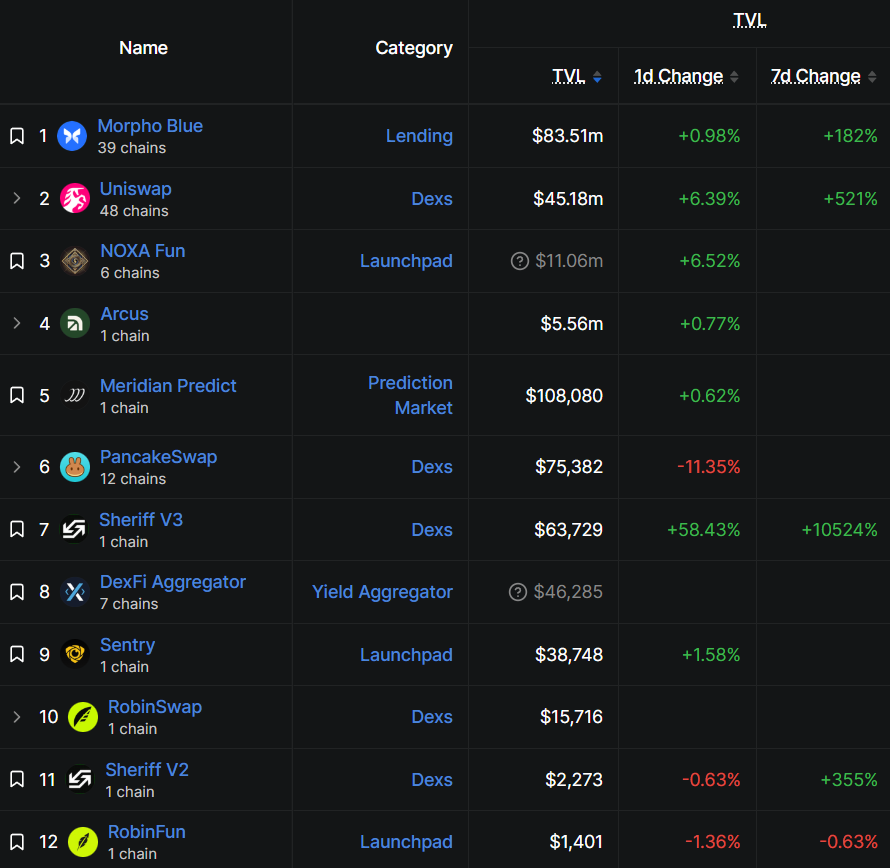
Robinhood Chain is one week old, but the numbers already look interesting. The chain now holds $150.9M in TVL, with @Morpho, @Uniswap, and @Noxa_Fi accounting for 96% of it. Against that liquidity, it is processing $875.5M in daily DEX volume. → For context, Solana does roughly $1.57B per day with $4.86B in TVL. That means Robinhood Chain is producing more than half of Solana’s daily volume with just 3% of the capital. The difference becomes even clearer when you look at capital velocity. Daily DEX volume is equal to 580% of Robinhood Chain’s TVL. → Solana sits at 32% →Base is closer to 19% In other words, every dollar on @RobinhoodApp Chain is turning over far more frequently. Capital is constantly moving through trades, pools, and launches. Fee generation tells a similar story. Robinhood Chain’s 30-day app fees are equal to 16.7% of TVL. → Solana, already one of the strongest fee-generating ecosystems in crypto, sits at 3.8%. → Base is at 1.1%. But the concentration is impossible to ignore. Solana’s three largest protocols, Jupiter, Sanctum, and Kamino, represent roughly 30% of tracked TVL across an ecosystem with hundreds of applications. Robinhood Chain’s top three control 96%. Chain-level revenue is still small. Robinhood Chain generated $644K over the last 30 days, compared with $1.59M for Solana and $2.21M for Base. So the real question is what happens next. Robinhood Chain is already generating Solana-scale dollar volume on a fraction of the liquidity, but most of that activity is concentrated in a handful of protocols and driven by a market that is only one week old. When the launch excitement and memecoin activity cool down, does the volume hold, or was this just hype mistaken for adoption?
Emperor Osmo 🐂 🎯 tweet media
English
18
6
70
8K
Möbius
Möbius@MobiusExchange·
RWAfi is a narrative worth watching. I think once memecoins finish their role of creating hype and attracting capital, a few other money games built around RWAfi will drive DeFi on RBH to explode. After all, for such a large distribution layer, building an economy around memecoins alone would be a waste
English
0
0
1
12
Gyo
Gyo@Gyokeres_eth·
Early Projects Watchlist - Robinhood Edition @arcus_xyz - Spot and Perps Dex @gomintly - Automated agentic DeFi savings @aaro_fun - Memecoin launchpad @oasisRBH - Onchain ownership @exypnos_xyz - Swap dex @hoodmarket_ - Prediction market @theindexfi - Stock dividend protocol @noxa_fi - Multi-DEX token launchpad @robinfunxyz - Fair-launch bonding curves @robinfarms - Onchain farming game All these projects are on @RobinhoodCrypto chain, and as always, DYOR
Gyo tweet media
English
162
111
690
47.8K
Möbius
Möbius@MobiusExchange·
@SebVentures the arbitrage only works if spot liquidity is deep enough. otherwise spreads, slippage, and redemption costs can eat most of the funding market still lacks one place where traders can run both legs efficiently
English
0
0
0
25
Möbius
Möbius@MobiusExchange·
@Route2FI What do you think about a future where you can hold tokenized stocks as the long side of your portfolio, borrow stablecoins against the same balance sheet, and at the same time hedge through shorts on Hyperliquid, Lighter, or Aster?
English
0
0
0
92
Route 2 FI
Route 2 FI@Route2FI·
Can I use onchain stocks (Ondo, xStocks, etc.) as collateral anywhere yet? Let's say I want to hold the S&P 500 as collateral and borrow stablecoins.
English
152
36
457
115.2K
Möbius
Möbius@MobiusExchange·
a reasonable strategy could be for tradexyz to keep growth mode longer for markets that still need to bootstrap liquidity, then move only some mature markets to standard fees. and if fees increase from 0.9 bps to 9 bps, tradexyz and hyperliquid only need to retain around 10% of current volume to generate the same amount of fees. i also have not seen any mention of an end date for growth mode, but i think it needs to be extended so bots and market makers can remain, keeping spreads tight and slippage low.
English
0
0
0
41
Carlos
Carlos@0xcarlosg·
TradeXYZ has now flipped Hyperliquid’s native markets in daily perp volume for a third consecutive day. TradeXYZ markets are still in growth mode, meaning all-in fees discounted ≥90% (0.9bps base taker vs 9bps standard), split 50/50 with Hyperliquid. Has anyone modeled the incremental HL revenue once growth mode ends? Wonder how much of this flow survives a 10x increase in fees.
Carlos tweet media
English
9
2
95
18K
Möbius
Möbius@MobiusExchange·
@Tiza4ThePeople wow, that is a pretty interesting concept. the innovation lies in how sll manages risk, allocates capital, and maintains liquidity rather than searching for a new source of yield onchain is exactly the ideal place for programmable strategies to operate efficiently
English
0
0
0
50
Santisa
Santisa@Tiza4ThePeople·
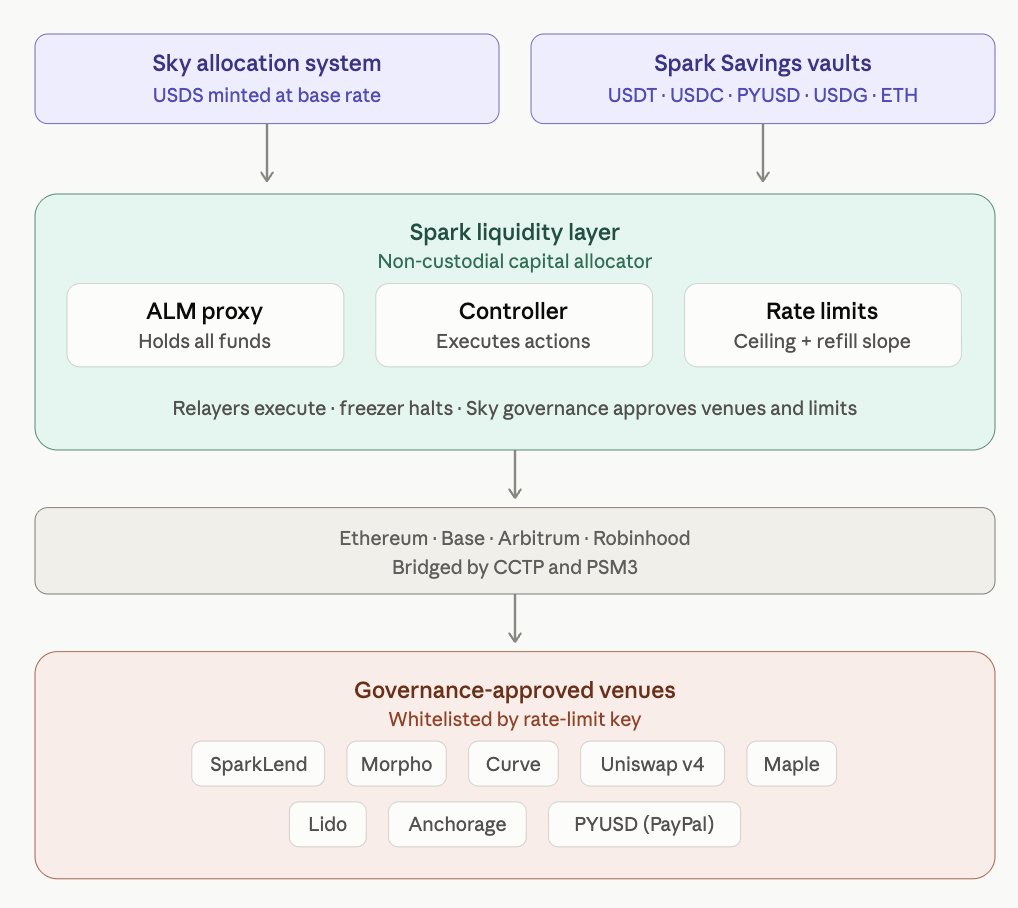
People are sleeping on what a beast the Spark Liquidity Layer (SLL) has grown into, and how sophisticated yet fundamentally safe and simple Spark's operation is now. The SLL is a smart-contract-governed system that routinely moves hundreds of millions between multiple protocols, across multiple chains, with strict rate limits and bounds on operations, while being aware of rates and liquidity levels and dynamically adjusting them to be at target with both. The SLL recently integrated Uniswap to kickstart Spark's FX layer, and is now heavily using it as both LP and user to efficiently move between different stable assets and strengthen the savings product's performance in both returns and liquidity, while reducing counterparty risk by settling these swaps atomically onchain. In just the past week, Spark routed $180M in volume through the USDT/USDS pool alone, which powers Spark Savings USDT and allows for institutional-grade yield by being liquid and low risk, with structurally higher rates than alternatives thanks to the broader USDS backing, which enables scalable yield. I think Spark is showcasing just how blockchain technology allows finance to operate at its highest level, minimising trust without compromising efficiency.
Santisa tweet media
Uniswap@Uniswap

Uniswap processed 58% of all EVM stable ⇄ stable volume in the last 30 days Stablecoins move on 🦄

English
7
4
57
9.4K
Möbius
Möbius@MobiusExchange·
@Offchain @LGUS @RobinhoodApp could this be the future, where impressions, delivery, and settlement are all recorded on the same system and can then be used as collateral, valued, or financed? programmable miracle?
English
0
0
0
22
Offchain
Offchain@Offchain·
Blockchain is going mainstream. Companies like @LGUS are exploring the transformation of their business on programmable rails. While institutions like @RobinhoodApp are already going head first. For a long time it was a matter of if, recently it’s been a matter of when - and that when is now.
FINTECH.TV@FINTECHTVglobal

"A massive boom in institutional adoption" may be on the way in the second half of 2026. @sgoldfed of @Offchain tells @RemyBlaireNews $HOOD is going deep on blockchain, LG is following suit, and $SECZ just hit a major milestone with its publicly available tokenization platform.

English
14
4
63
13K
Möbius
Möbius@MobiusExchange·
@nicoypei @DefiLlama exactly, tvl only has value when there is a real economy taking place underneath it, (lending/borrowing...) otherwise, it can be faked through incentives and short term campaigns crypto needs to change how it evaluates growth for the market to truly mature
English
0
0
1
43
Nico | supernova.vision
It's time for @DefiLlama to stop treating TVL as the most important metrics for every protocol High TVL generates no fees if they aren't being lent out For money markets > Real: active loan size, interest APY, fee take rates > Vanity: TVL, low borrow rate For perp dexes > Real: OI, OI/vol ratio, low flicker rate, depth, quote quality > Vanity: volume, TVL, 0 fee
Kolten@0xKolten

Reminder that @aave has more active loans than the next six lending protocols COMBINED. This is the single most important metric alongside revenue.

English
11
3
27
6.3K
Möbius
Möbius@MobiusExchange·
@haydenzadams most of the volume comes from memecoins, but what i see as more promising is the volume from tokenized stocks. dominating memecoin and crypto asset volume is pretty cool, but becoming the venue where tokenized stocks are traded is even cooler. that market could be much larger
English
0
0
1
115
Hayden Adams 🦄
Hayden Adams 🦄@haydenzadams·
Uniswap is generating $5.2m in daily fees right now Above any protocol other than USDC + USDT and far more than Hype, Pump, etc defillama.com/fees
Hayden Adams 🦄 tweet mediaHayden Adams 🦄 tweet media
English
276
151
1.6K
410.2K
Möbius
Möbius@MobiusExchange·
ai is making software easier to build than ever, which makes distribution the defining skill of this generation. the same applies to finance. aave lets fintechs and banks access existing infrastructure and liquidity instead of rebuilding from scratch, while the winning perps and prediction market platforms will be those that solve fragmented liquidity across venues.
English
0
0
0
15
Stani
Stani@StaniKulechov·
Every company will eventually write their own software to replace third party services that are dated, slow or overpriced. Even for startups part of founding a new company will mean writing dedicated software to run the company.
Luke Pierce@lukepierceops

Starbucks spends $400 million a year on software. Yesterday they announced they're moving off IBM and Microsoft to build their own custom systems in-house. IBM dropped 3% and Salesforce dropped 4% on the news. And honestly this is, unequivocally, the biggest signal I've seen since OpenAI and Anthropic launched their consulting arms back in Q1. The largest companies in the world are done paying for software that half fits how they work. We saw this coming about a year ago. Moved everything we build off Airtable and low-code tools and went fully custom. Already paying off, and it's only going to compound from here. This is the opportunity right now. You get all of a company's data into one system. You build out a single operating system for the entire business. You cut out bad, redundant processes. Then you layer AI on top of it, under the correct processes. That's the core of AI consulting. Helping companies actually operate better. There are a lot of fly-by-night offerings circulating right now when it comes to Ai Services. For example, 'second brains'. Throwing scattered data into a second brain while the processes underneath stay broken does nothing. The companies who will absolutely destroy their competition over the next 5 years are rebuilding how they work from the ground up. Starbucks is showing you what other companies will be doing over the next several years. Your job is to position yourself to facilitate that process for as many companies as you can.

English
38
27
309
48.9K