
Ben Rodgers
428 posts

Ben Rodgers
@MrRodgersAHT
Assistant Headteacher : QOE, ECT Lead, Former Curriculum Leader of PE
Katılım Kasım 2022
419 Takip Edilen275 Takipçiler
This was a great listen
podcasts.apple.com/gb/podcast/bey…
@beyondgoodpod
I loved the aspect of professional preparation, prior to the lesson. 🤓
@adamboxer1 gets a mention! 📖
English
Ben Rodgers retweetledi

Learning objectives succeed or fail because of the verb.
Words like understand know or appreciate sound good but cannot be seen measured or proven.
The fix is simple. Use actions you can watch
Instead of understand say follow.
Instead of be aware say apply.
Observable verbs mean clear goals and easy results.
♻️ Repost to help others in your network with this.
➕ And follow me at Sean McPheat for more.

English
Ben Rodgers retweetledi

Absolutely loved reading this - thank you. My takeaway is how powerful subject development meetings can be when they’re protected spaces for teachers to think deeply, rehearse subject‑specific pedagogy, and prepare intellectually for what’s coming next. I especially loved the idea of videoing great subject meetings as models - such a smart way to make expert thinking visible and build shared practice across teams 🤩
English

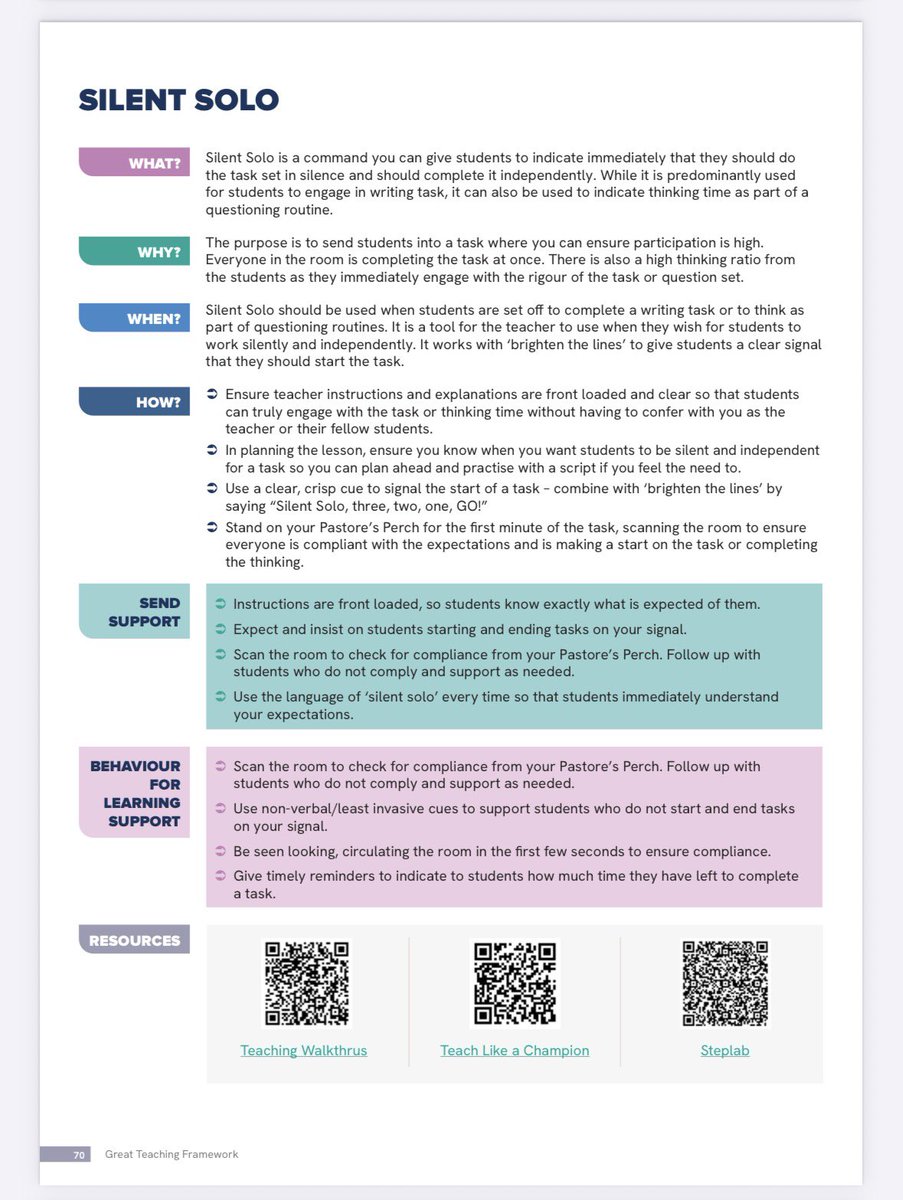
***GREAT TEACHING FRAMEWORK***
Our great teaching framework is nearly complete. Over the last few months, we (@MissCole279) have been working on creating a shared language of what excellent teaching looks like in every classroom.
The framework is built around seven key principles. Each principle is underpinned by:
Clear instructional components ✅
Observable classroom techniques ✅
Coaching questions ✅
This isn’t a checklist. This is a framework to ensure that every student experiences high quality teaching.
#TheLongdendaleLegacy


English
Ben Rodgers retweetledi

@oliviajune82 I remember at a researchED hearing @Ruth_Ashbee talking about 'declarative' knowledge (knowledge 'that') and 'procedural' knowledge (knowledge 'how').
I found that more useful than knowledge vs. skills...
English

My return train has been cancelled due to the heat but at least I am *on my way* to @LitdriveUK
🙏 Looking forward to meeting all the English teachers who are at Aston University today, giving up their time today to think about how the next academic year can be even better.

English
Ben Rodgers retweetledi

*NEW BLOG*
newtothepost.wordpress.com/2026/07/06/inc…
I have summarised the @EducEndowFoundn latest research on Inclusive Teaching for you all! Visuals too!
English
Ben Rodgers retweetledi

🔄 FORMATIVE ACTION LOOPS! In this special edition of ⚗️DistillED, @teacherhead and @ValentinaDevid explore how teachers can move from simply gathering evidence of student learning to making purposeful instructional decisions. Includes FREE one-page guide.
👉Read Tom and Valentina's post here: newsletter.jamieleeclark.com/p/formative-ac…
If you’re keen to learn more about formative action, follow @toetsrevolutie and check out: formative-action.com

English

☀️Book Giveaway - Summer Holiday Edition! ☀️
To celebrate the summer holidays, I’m giving away 3 signed copies of my best-selling book, ‘Literacy Essentials for Every Teacher’.
To enter:
✅ Like this post and comment
Winners drawn at random Saturday 11th July, 5pm BST.

English
Ben Rodgers retweetledi

Exercise books are so temptingly inspectable. You can flick through then and feel you’ve seen learning. But full pages, neat titles, coloured pens and polished paragraphs are, at best, just proxies. The more beautiful a book is often the less evidence of learning it provides. More often, it’s evidence we’re looking in the wrong place. open.substack.com/pub/daviddidau…
English
@MrMartin_PE Tell me more about this?!
What was the intention this session!!?
Ps. Custard creams!
English

Reactive bitesized CPD that is instantly implementable in the classroom!
*What is your favourite biscuit?*
A question with a low floor but a high ceiling…amongst other things; exactly what we need to think about when teaching to the top!
There’s only one answer by the way…


Airedale Academy@AiredaleAcad
This morning’s bitesize CPD sharpened our approach to the 6 fundamentals of great teaching, especially adaptive and responsive teaching. Snappy learning, instant classroom impact.
English
Ben Rodgers retweetledi

An Extended Learning Model - assembling my favourite ideas about learning. teacherhead.com/2026/07/01/an-… via @teacherhead
English
@Yorkshire_Steve @greeborunner Completely agree. But..
How would ofsted et al measure the impact of KS3 provision?
What are the key indicators?
Books? Student voice?
English

Ks3 curriculums should have educational merit and rigour in their own right.
We should check whether schools are teaching it well and pupils are learning what was intended, especially those who don't take it as an option.
English
This recommendation in the White working class report from @PolicyFirst is spot on.
Anyone who has heard me speak has heard variances of me banging on about 'if a secondary school wants to improve ks4 outcomes, then make ks3 awesome, ks4 is a lot easier then!'

English
Ben Rodgers retweetledi

@Catlin_Tucker I remember when I was young and very bad at teaching i used to do stations. They looked great, but nobody learnt anything
Now im old and average at teaching i have discovered the virtues of "students sitting in their seats" and "everyone doing the same thing at the same time"
English
Ben Rodgers retweetledi

Ben Rodgers retweetledi

I’ve been reflecting on @MrGoodwin23 @rEDYshire talk, What Are They Thinking?, and what it means for checking for understanding. robgeogchambers.substack.com/p/making-think… Checking for understanding is not an interruption to teaching. It is part of teaching. Without it, we risk teaching in the dark. #checkingforunderstanding #intellectualpreparation #rEDYorkshire @OutwoodIE @Inner_Drive @researchED1 @teach_well
English
What a summary!
Thank you so much @RobGeog
This is comprehensive, and incredibly insightful.
Thank you to @KateJones_teach for delivering. Gutted not to be there
Rob Chambers@RobGeog
@MrRodgersAHT @KateJones_teach Here are my reflections on the session Ben! Finally had chance to write them up. robgeogchambers.substack.com/p/when-feedbac…
English
Ben Rodgers retweetledi
@RobGeog @KateJones_teach Looking forward to hearing/reading.
Particularly, surrounding feedback!
I’m sure the legend, that is @KateJones_teach will share the slides! 🤞🙏😜
English
@MrRodgersAHT @KateJones_teach @rEDYshire A great day Ben! Will be reflecting over next couple of days on key takeaways :)
English

English