Ryan McCullough retweetledi
Ryan McCullough
8.7K posts

Ryan McCullough retweetledi

The $640K+ Ferrari Luce EV just shows how FAR ahead the Tesla Model S Plaid was compared to the rest of the EV industry.
Model S Plaid ($109,990):
• 0-60 mph in 1.99s
• 1,020 hp
• 368 Miles of Range
• 1/4 mile in 9.23s @ 155mph
• 0-124 mph in 6.2s
• Self-Driving
• Free Lifetime Supercharging
• Free Maintenance for 4 years
• 204 mph Top Speed w/Track Pack
• Seats 5 adults Comfortably
• Comfort Air Suspension
Ferrari Luce EV ($640,000):
• 0-60 mph in 2.4s
• 1,020 hp
• 280 miles of range
• 0-124 mph in 6.8s
• No Self-Driving
• 193 mph top speed
• Seating for 4
The Model S Plaid went out as one of the best performance cars ever. Legacy Auto can’t even catch up.

English
Ryan McCullough retweetledi

A farmer dies in April 2026.
His son inherits the farm. The farm has been in the family since 1847.
The farm consists of: 300 acres of grazing pasture, a farmhouse built in 1892, a barn, a milking parlour, two tractors of varying ages, a Land Rover that runs about 70% of the time, and a herd of 180 Hereford-cross cattle.
On paper, the farm is worth approximately £3.2 million. This is because land near him has been bought recently by a London hedge fund looking for carbon credits, which has dragged the comparable value of every field within forty miles upward to a number nobody local can justify.
In cash, the farm produces a profit of about £28,000 a year in a good year. In a bad year it loses money. The son also works as a fencing contractor three days a week to keep the operation viable.
The inheritance tax bill on a £3.2 million estate, even at the reduced 20% rate, comes to approximately £140,000 after the increased threshold is applied. The son does not have £140,000. The son has never had £140,000. The son has £4,200 in his current account and an overdraft.
The son sells 60 acres to a developer to pay the tax. The developer puts solar panels on the 60 acres. The remaining herd cannot be sustained on the reduced land. The herd is sold. The barn becomes a holiday let.
A different family eats Brazilian beef this Christmas without knowing why the price went up.
The Treasury collects £140,000.
The land never produces British food again.

English
Ryan McCullough retweetledi

Elon Musk just put the entire university system on trial.
Not the curriculum. Not the professors. The premise.
Musk: “You don’t need college to learn stuff. Everything is available basically for free. You can learn anything you want for free.”
For a thousand years, universities held one monopoly. Access. You paid the toll or you stayed ignorant.
The internet erased that in a decade.
Every lecture. Every framework. Every textbook. Free. From any screen on Earth.
The six-figure tuition is no longer buying knowledge. It is buying a signal.
Musk: “There is a value that colleges have, which is seeing whether somebody can work hard at something, including a bunch of annoying homework assignments, and still do their homework assignments.”
That is the product. Not intelligence. Not creativity. Not vision. Compliance.
You are paying $200,000 to prove you can tolerate bureaucracy on a schedule.
Musk: “Colleges are basically for fun and to prove you can do your chores. But they’re not for learning.”
The entire system is a sorting machine for corporate HR. It does not measure what you can build. It measures whether you can sit still, follow directions, and deliver on command.
Four years of obedience dressed as education.
Musk: “If you’re trying to do something exceptional, you must have evidence of exceptional ability. I don’t consider going to college evidence of exceptional ability.”
The system optimizes for average. It rewards the compliant. It certifies the patient. It quietly filters out everyone who refuses to wait for permission.
The ones who reshaped the modern world never finished the test.
Musk: “Gates is a pretty smart guy, he dropped out. Jobs is pretty smart, he dropped out. Larry Ellison, smart guy, he dropped out.”
They did not drop out because it was too hard. They dropped out because the speed limit was too low.
The most dangerous thing a university does is convince a generational talent that finishing the syllabus is the achievement.
It is not. It is the floor.
A degree is a receipt for compliance. The future has never belonged to people who finish their homework. It belongs to the on
English
Ryan McCullough retweetledi

@Tesla I just wish there had been a run off of RHD versions…6 years of demand left untapped 😥
English
Ryan McCullough retweetledi

Ryan McCullough retweetledi

Elon Musk just described how the entire government operates in a single sentence.
Musk: “Paying people to do nothing doesn’t make sense.”
Then he told a Milton Friedman story that should terrify every bureaucrat on the payroll.
Friedman watched workers digging ditches with shovels.
He suggested they use excavators instead.
Someone pushed back.
“But then we’re going to lose a lot of jobs.”
Musk: “Friedman says, well, in that case, why don’t you have them use teaspoons?”
One sentence.
That’s all it took to gut the entire logic of modern government.
The teaspoon is not a punchline.
It is the actual policy.
Every agency that would cease to exist if it actually solved the problem it was created for.
Every department that measures success by headcount instead of output.
Every approval that routes through nine desks before someone can say yes.
Teaspoons.
The system doesn’t want excavators.
Excavators finish the job.
And a finished job is the one thing the system can’t afford.
So it hands you a teaspoon. Calls it a career. Gives you a pension for never asking why the ditch took forty years.
But this isn’t about laziness.
It’s about control.
A person digging with a teaspoon doesn’t have time to build something better.
Doesn’t have the energy to question the plan.
Doesn’t have a thought left to ask if the ditch even needed digging.
Busy people don’t ask dangerous questions.
That’s the point.
The economy doesn’t run on productivity.
It runs on the appearance of productivity.
Millions of people sit at desks right now doing work a single script could replace by morning.
They know it.
Their managers know it.
The people who sign their budgets know it.
But the teaspoon stays in their hand.
Because the moment you hand someone an excavator, they finish by noon.
And a person with a free afternoon starts thinking. Starts building. Starts wondering why they needed permission to dig in the first place.
That’s the thing the system can’t survive.
Not unemployment.
Free time.
Musk didn’t tell a joke on Rogan.
He described the longest con in modern governance.
Keep them digging.
Keep them busy.
Keep the teaspoon in their hand so they never look up long enough to see the ditch was pointless from the start.
Friedman told that story sixty years ago.
He meant it as a warning.
The system heard every word.
It just made sure everyone kept calling it a joke so no one would recognize it as a confession.
English
Ryan McCullough retweetledi

Spain just lost a tax fight with Shakira so badly that the court is making the tax agency refund her €60 million AND pay her entire legal bill. That second part is the unusual one. Spanish courts almost never punish their own tax agency.
The case came down to one number Spain could never prove: how many days Shakira actually lived in the country in 2011. To be taxed in Spain on money you earn anywhere in the world, you have to be there more than 183 days a year. That's the law. The tax agency tried for years to prove Shakira crossed that line. Even with every record they could find, they could only reach 163 days. Her own records put the number at 143.
She spent most of 2011 on tour. 120 concerts in 37 countries. She didn't own a home in Spain, and her business wasn't headquartered there either. The agency's whole case rested on the fact that she was dating a Barcelona soccer player at the time.
The original tax bill Spain handed her was €55 million. About half was the tax claim itself. The other half was a fine for not paying it. So Spain was demanding €27 million in tax, plus €27 million in punishment for not paying the €27 million they couldn't prove she owed.
Today's ruling wiped all of that out. The court ordered a €60 million refund with interest. Then it ordered the tax agency to cover her entire legal bill from its own budget. It's the kind of penalty Spanish courts rarely impose. They only use it when they think the agency had no business bringing the case in the first place.
Spain has done this to other wealthy foreigners before. Lionel Messi was convicted in 2016 of dodging €4.1 million in taxes. Cristiano Ronaldo settled in 2019 for €18.8 million. Shakira herself has paid Spain twice already in other cases: €7.3 million in 2023 to avoid a separate trial, and another €6.6 million in 2024 for a different one. The pattern with rich foreigners has been the same every time: pursue, assess, fine.
Shakira pointed something out in her own statement. She had the resources to fight Spain for 8 years. Most people in her position don't. They settle in year one because they can't afford a decade of legal bills against the government.
Spain can technically still appeal to the Supreme Court in the next 30 days. Tax lawyers say they almost certainly won't. The ruling is too solid.
EL MUNDO@elmundoes
#ÚltimaHora🔴 Shakira queda absuelta de fraude fiscal y Hacienda tendrá que devolverle 60 millones de euros más intereses #Echobox=1779092419" target="_blank" rel="nofollow noopener">elmundo.es/economia/diner…
English
Ryan McCullough retweetledi

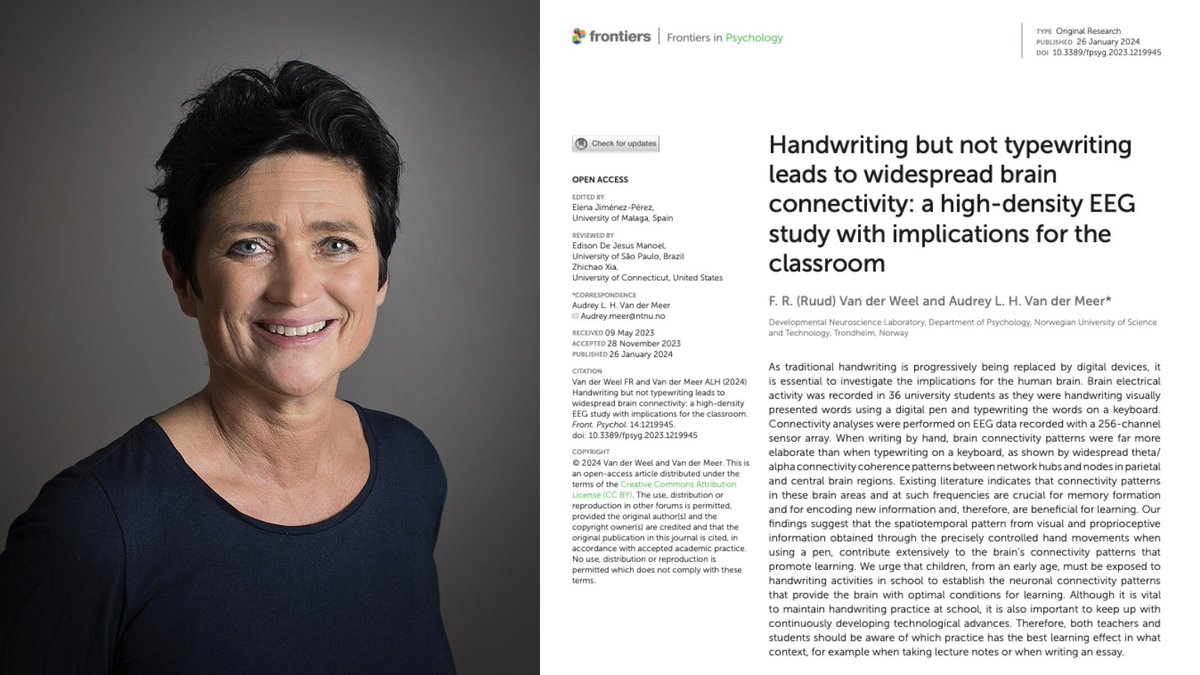
A Norwegian neuroscientist spent 20 years proving that the act of writing by hand changes the human brain in ways typing physically cannot, and almost nobody outside her field has read the paper.
Her name is Audrey van der Meer.
She runs a brain research lab in Trondheim, and the paper that closed the argument was published in 2024 in a journal called Frontiers in Psychology. The finding is brutal enough that it should have changed every classroom on Earth.
The experiment was simple. She recruited 36 university students and put each one in a cap with 256 sensors pressed against their scalp to record brain activity. Words flashed on a screen one at a time.
Sometimes the students wrote the word by hand on a touchscreen using a digital pen, and sometimes they typed the same word on a keyboard. Every neural response was recorded for the full five seconds the word stayed on screen.
Then her team looked at the part of the data most researchers had ignored for years, which is how different parts of the brain were communicating with each other during the task.
When the students wrote by hand, the brain lit up everywhere at once.
The regions responsible for memory, sensory integration, and the encoding of new information were all firing together in a coordinated pattern that spread across the entire cortex. The whole network was awake and connected.
When the same students typed the same word, that pattern collapsed almost completely.
Most of the brain went quiet, and the connections between regions that had been alive seconds earlier were nowhere to be found on the EEG.
Same word, same brain, same person, and two completely different neurological events.
The reason turned out to be something nobody had really paid attention to before her work. Writing by hand is not one motion but a sequence of thousands of tiny micro-movements coordinated with your eyes in real time, where each letter is a different shape that requires the brain to solve a slightly different spatial problem.
Your fingers, wrist, vision, and the parts of your brain that track position in space are all working together to produce one letter, then the next, then the next.
Typing throws all of that away. Every key on a keyboard requires the exact same finger motion regardless of which letter you are pressing, which means the brain has almost nothing to integrate and almost no problem to solve.
Van der Meer said it plainly in her interviews.
Pressing the same key with the same finger over and over does not stimulate the brain in any meaningful way, and she pointed out something that should scare every parent who handed their kid an iPad.
Children who learn to read and write on tablets often cannot tell letters like b and d apart, because they have never physically felt with their bodies what it takes to actually produce those letters on a page.
A decade before her, two researchers at Princeton ran the same fight using a completely different method and ended up at the same answer. Pam Mueller and Daniel Oppenheimer tested 327 students across three experiments, where half took notes on laptops with the internet disabled and half took notes by hand, before testing everyone on what they actually understood from the lectures they had watched.
The handwriting group won by a wide margin on every question that required real understanding rather than surface recall.
The reason was hiding in the transcripts of what the two groups had actually written down.
The laptop students typed almost word for word, capturing more total content but processing almost none of it as they went, while the handwriting students physically could not write fast enough to transcribe a lecture in real time, which forced them to listen carefully, decide what actually mattered, and put it in their own words on the page.
That single act of choosing what to keep was the learning itself, and the keyboard had quietly skipped the choosing and skipped the learning along with it.
Two studies. Two countries. Same answer.
Handwriting makes the brain work. Typing lets it coast.
Every note you have ever typed instead of written went into your brain through a thinner pipe. Every meeting, every book highlight, every idea you captured on your phone instead of on paper was processed at half depth.
You did not forget those things because your memory is bad. You forgot them because typing never woke the part of the brain that would have made them stick.
The fix is the thing your grandmother already knew.
Pick up a pen. Write the thing down. The slower road is the faster one.

English
Ryan McCullough retweetledi

@saylor Strategy now own 4.02% of all the Bitcoin that will ever be created...
...or around 5% if you take into account all the lost Bitcoin.

English
Ryan McCullough retweetledi

@TheAliceSmith The problem is that after they “eat the rich”, they will starve
English
Ryan McCullough retweetledi