Yagyesh

5.2K posts

Yagyesh

Yagyesh

@NeoTheElder

Software Engineer, NC State Alumni, I tweet about tech and politics - views my own..! I love books, travel, cricket and squash not necessarily in that order

San Francisco, CA Katılım Kasım 2012
893 Takip Edilen145 Takipçiler
Yagyesh retweetledi
Paul Iusztin
Paul Iusztin@pauliusztin_·
One of the smartest ideas in @Neo4j’s agent memory system: Reasoning traces are stored as graph structures. So you can query: Which tools were used What decisions were made Which reasoning paths succeeded What failed previously The agent can literally traverse its own thinking history.
English
4
5
53
2.7K
Yagyesh retweetledi
ClaudeDevs
ClaudeDevs@ClaudeDevs·
We’ve shipped a security-guidance plugin for Claude Code that helps identify and fix vulnerabilities as you’re writing code. Available for all Claude Code users. Install from the plugin marketplace (/plugins).
English
358
1.6K
17K
1.8M
Yagyesh retweetledi
Capafy
Capafy@Capafyai·
Introducing Capafy: the Skill-based Agent Marketplace. Now your Skill runs as a product and earns while you sleep. On Capafy, you can upload your Skills, they run online while staying closed-source, and you get paid every time someone uses them. You can also use Skills uploaded by industry top talent to get expert-level work done directly. You'll find Skills built from industry expertise in every field. Let's say: ·A creator with 100M+ views uploaded their viral video Skill; ·A recruiter who's screened 10,000+ resumes uploaded their hiring Skill; ·A top sales rep who's closed thousands of deals uploaded their cold email Skill. Skills uploaded by industry top talent across countless fields can be used directly to get excellent work done. - Launch your Skills: upload the Skills you've built in Claude Code, Codex, or OpenClaw, and get paid every time someone uses them. - Use expert Skills: get expert-level work done, not the average AI output. Use them in one click, or connect your own Agent via agent-to-agent and let it tap into the expert Skills on Capafy.
English
266
217
580
324.8K
Yagyesh retweetledi
Tech with Mak
Tech with Mak@techNmak·
The full AI engineering curriculum is now free. It's called AI Engineering from Scratch. 20 phases, 428 lessons, roughly 320 hours end to end. Free. MIT license. Runs on your own laptop. The design principle that makes it different from everything else => every algorithm gets built from raw math before a single framework loads. Backprop by hand. Tokenizer by hand. Attention by hand. Agent loop by hand. Then you implement the same thing in PyTorch or sklearn. By the time the production library appears, you already know what it's doing underneath. Every lesson ends with something you keep: → Prompt templates for any AI assistant → Skill files for Claude, Cursor, Codex, OpenClaw, Hermes  → Agent definitions you wrote the loop for yourself  → MCP servers built from scratch in Phase 13 428 lessons means 428 artifacts by the end. Tools you built and actually understand. The full 20 phases: → Phase 0 - Setup & Tooling (12 lessons)  → Phase 1 - Math Foundations (22 lessons)  → Phase 2 - ML Fundamentals (18 lessons)  → Phase 3 - Deep Learning Core (13 lessons)  → Phase 4 - Computer Vision (28 lessons)  → Phase 5 - NLP (29 lessons)  → Phase 6 - Speech & Audio (17 lessons)  → Phase 7 - Transformers Deep Dive (14 lessons)  → Phase 8 - Generative AI (14 lessons)  → Phase 9 - Reinforcement Learning (12 lessons)  → Phase 10 - LLMs from Scratch (22 lessons)  → Phase 11 - LLM Engineering (15 lessons)  → Phase 12 - Multimodal AI (25 lessons)  → Phase 13 - Tools & Protocols (23 lessons)  → Phase 14 - Agent Engineering (42 lessons)  → Phase 15 - Autonomous Systems (22 lessons)  → Phase 16 - Multi-Agent & Swarms (25 lessons)  → Phase 17 - Infrastructure & Production (28 lessons)  → Phase 18 - Ethics, Safety & Alignment (30 lessons)  → Phase 19 - Capstone Projects (17 projects, 20-40 hours each) Python, TypeScript, Rust, Julia throughout. GitHub Repo: github.com/rohitg00/ai-en…
Tech with Mak tweet media
English
14
207
969
38.1K
Yagyesh retweetledi
ZARA
ZARA@HeyZaraKhan·
Become Google AI Expert (for free). The people learning this now will have a massive advantage in the next 3 years. Here are all the best resources in one place: (save this) 1. Gemini Academy: grow.google/ai 2. Gemini API Documentation: ai.google.dev 3. Prompt Engineering Guide: promptingguide.ai 4. Gemini Cookbook: github.com/google-gemini/… 5. Google AI Studio: aistudio.google.com 6. Gemini for Developers YouTube: @GoogleDevelopers" target="_blank" rel="nofollow noopener">youtube.com/@GoogleDevelop… Vertex 7. AI Documentation: cloud.google.com/vertex-ai/docs 8. Gemini SDK Examples: github.com/googleapis/pyt… 9. MCP Documentation: modelcontextprotocol.io 10. Free AI Courses by Google: cloudskillsboost.google/journeys/118 I hope you found this helpful. For more you can follow me @HeyZaraKhan
ZARA tweet media
English
3
77
270
21.5K
Yagyesh retweetledi
Matt Pocock
Matt Pocock@mattpocockuk·
Things people get wrong with my grill-* skills: - Being too passive - Not grilling in parallel - Not prototyping - Going into the dumb zone - Grilling too hard - Grilling too large a topic - Using too dumb a model - Clearing the context too soon Here's the breakdown:
English
39
50
1.1K
63.9K
Yagyesh retweetledi
Khairallah AL-Awady
Khairallah AL-Awady@eng_khairallah1·
Boris Cherny, the creator of Claude Code at Anthropic, just explained why single-agent workflows are already dead in this talk he breaks down exactly how the future is teams of agents, not better prompts: - the 14% you lose to CLAUDE.md before typing a word - one agent researching. one building. one reviewing. one orchestrating - the architecture that separates hobbyists from real builders - the 3 properties every agent team needs to actually survive if you've been using Claude for more than a month and never left the chat window, you've been using one agent when you could be running a team of them instead of another show tonight, watch this make sure to bookmark it before it gets lost in your feed the guide is in the article below
Khairallah AL-Awady@eng_khairallah1

x.com/i/article/2057…

English
94
238
2.3K
676.7K
Yagyesh retweetledi
ZARA
ZARA@HeyZaraKhan·
Become a Claude Certified Architect Here are all the required resource in one place: (save it) Training courses: anthropic.skilljar.com (13 free courses) Cookbook: github.com/anthropics/ant… Exam Guide: share.google/0eqIbebzRMUt8K… Practice questions: claudecertifications.com (free) MCP documentation: modelcontextprotocol.io (free) API documentation: docs.anthropic.com (free) Partner Network: anthropic.com/partners (free to join) Link to join: anthropic.skilljar.com/claude-certifi… Personal Playbook someone created after the exam: drive.google.com/file/d/1luC0rn…
ZARA tweet media
English
34
489
2.5K
180.4K
Yagyesh retweetledi
Matt Pocock
Matt Pocock@mattpocockuk·
Skills should be: - Concise - Responsible for one thing, not multi-step - Composable - Progressively disclosed - Harness-agnostic What else? Or - what did I get wrong?
English
188
83
1.7K
130.1K
Yagyesh retweetledi
Daniel San
Daniel San@dani_avila7·
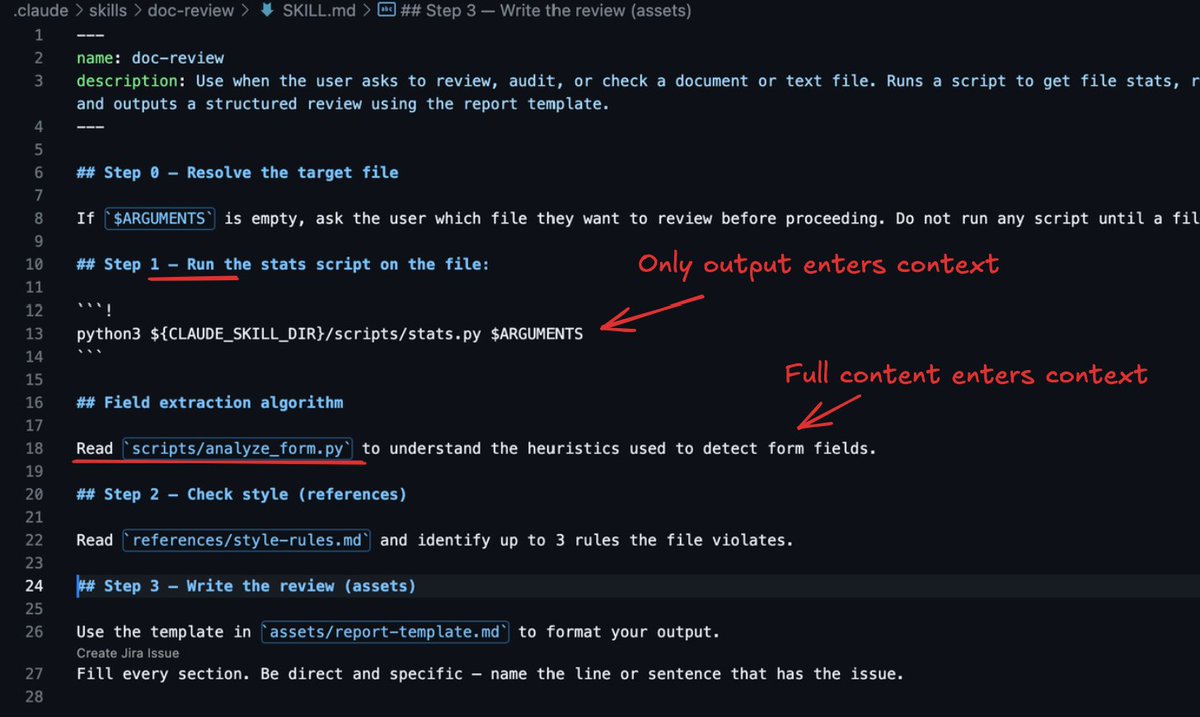
IMPORTANT! In Skills, Run vs Read makes a huge difference in how your script consumes tokens How you call a script inside your Skill matters, the verb decides whether Claude executes the code or reads it as context In this case: - Step 1 uses "Run" with an executable code block, the script runs in bash, the file never enters the context window, only the stdout from stats.py does - The "Field extraction algorithm" section uses "Read" pointing at analyze_form.py, Claude opens the file and loads the full source into context, same as any reference markdown Same script, same location, completely different cost If you want deterministic code execution without paying tokens for large script files, you need to be deliberate with this. "Run" for execution, "Read" or "See" only when the code itself is the documentation Most utility scripts in a Skill should be Run, not Read!
Daniel San tweet media
Daniel San@dani_avila7

Progressive disclosure in Skills is useful for loading large instruction sets into Claude without burning context But the real power isn’t in the markdown, It’s in the scripts Running a script mid-flow inside a skill gives you two properties you can’t get from instructions alone: - Deterministic execution, the same input produces the same output every time -The script never enters the context window, only its stdout does A 2000-line validator costs zero tokens until it runs, and even then you only pay for what it prints If your skills are markdown-only, you’re leaving the most powerful part of the system on the table

English
11
15
81
10.2K
Yagyesh retweetledi
Aakash Gupta
Aakash Gupta@aakashgupta·
She literally broke down how to run evals in Claude Code (built the whole thing live): 01:34 - What people get wrong with evals 04:35 - Why product taste is the alpha now 09:28 - Building a PM agent from one prompt 19:00 - Instrumentation without writing code 22:00 - Watching traces stream in live 28:00 - Getting Claude to write your first eval 33:58 - When vibe evals work and when they don't 48:50 - The self-improving loop (this part is wild) 01:03:00 - Same-day shipping is real 01:06:00 - The context graph unlock
English
3
13
121
136.3K
Yagyesh retweetledi
Huaxiu Yao
Huaxiu Yao@HuaxiuYaoML·
Every memory system for LLM agents evolves what it stores. None evolves how it retrieves. 🧬 EvolveMem is out, now shipping inside the SimpleMem v0.3.0 update. Powered by AutoResearch: the system researches its own retrieval, treating the full retrieval config as a structured action space and running a closed loop: evaluate ➜ diagnose ➜ propose ➜ validate ➜ repeat. 🔬 From a minimal baseline, 7 autonomous rounds produce a retrieval policy that beats the strongest published baseline by +25.7% on LoCoMo and +18.9% on MemBench. 🧬 It discovers entirely new retrieval dimensions not present in the original design, all integrated into the unified SimpleMem package. 📄 Paper: arxiv.org/abs/2605.13941 💻 Code: github.com/aiming-lab/Sim… Led by @itsJiaqiLiu, @XinyeYee with contributions from @richardxp888, @ZhengBerkeley, @cihangxie
Huaxiu Yao tweet media
English
12
80
422
27.9K
Yagyesh retweetledi
Vivo
Vivo@vivoplt·
best 15 accounts to follow in AI: @karpathy = LLMs king @steipete = built openclaw @gregisenberg = startup ideas king @rileybrown = vibecode king @jackfriks = solo apps king @levelsio = startups king @marclou = startups king @EXM7777 = AI ops + systems king @eptwts = AI money twitter king @godofprompt = prompt king @vasuman = AI agents king @AmirMushich= AI ads king @0xROAS = AI UGCs king @egeberkina = AI images king @MengTo= AI landing pages king follow them all and learn.
English
254
826
6.1K
533.4K
Yagyesh retweetledi
Zed
Zed@zeddotdev·
Anthropic's Claude billing changes hit June 15. We wrote up what it means for Zed users and what your options are: zed.dev/blog/anthropic…
English
21
28
660
55.2K
Yagyesh retweetledi
Paul Iusztin
Paul Iusztin@pauliusztin_·
Deep into learning how harnesses such as Claude Code, OpenCode and Pi are designed. I want to know the nitty-gritty details. For that, you need to read the code. There is no better way to do that than using an LLM Wiki on top of all the repos combined. Like that, you get the architecture of each, BUT the most beautiful part is that you also get: - aggregated concepts - how entities relate to each other - logs of your questions And the best one is the comparison of core design choices. It gets even more powerful when you combine it with your personal notes, research, articles and videos. Everything with references so LLMs can easily parse them without one-shotting your subscription. It's such an amazing way to learn and research. P.S. In the next few weeks, I will write a few articles on this at decodingai.com
Paul Iusztin tweet media
English
0
6
27
1.3K
Yagyesh retweetledi
Khairallah AL-Awady
Khairallah AL-Awady@eng_khairallah1·
Boris Cherny, the creator of Claude Code at Anthropic, just explained why most people aren't getting real results from Claude in this podcast he breaks down exactly how most people never actually set up Claude: - the 14% you lose to CLAUDE.md before typing a word - the features that change how Claude thinks before you type a word - the settings 95% of users have never opened - the workflows hiding behind one toggle if you've been using Claude for more than a month and never left the chat window, you have at least 30 untouched features. probably 38 instead of another show tonight, watch this make sure to bookmark it before it gets lost in your feed my breakdown of all 40 features is below
Khairallah AL-Awady@eng_khairallah1

x.com/i/article/2057…

English
81
459
3.6K
1.2M
Yagyesh retweetledi
Daniel San
Daniel San@dani_avila7·
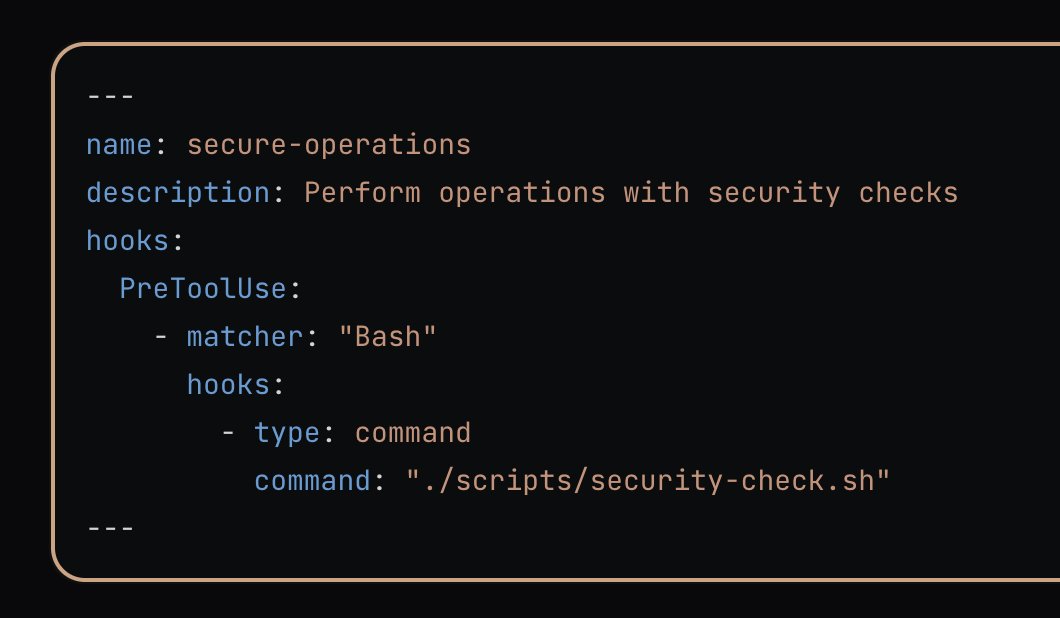
Been thinking about writing a similar article focused on Skills, Subagents and how to handle the context window with Hooks defined in their frontmatter What do you think, would this be useful?
Daniel San tweet media
Daniel San@dani_avila7

x.com/i/article/2048…

English
6
21
291
53.7K
Yagyesh retweetledi
Paul Iusztin
Paul Iusztin@pauliusztin_·
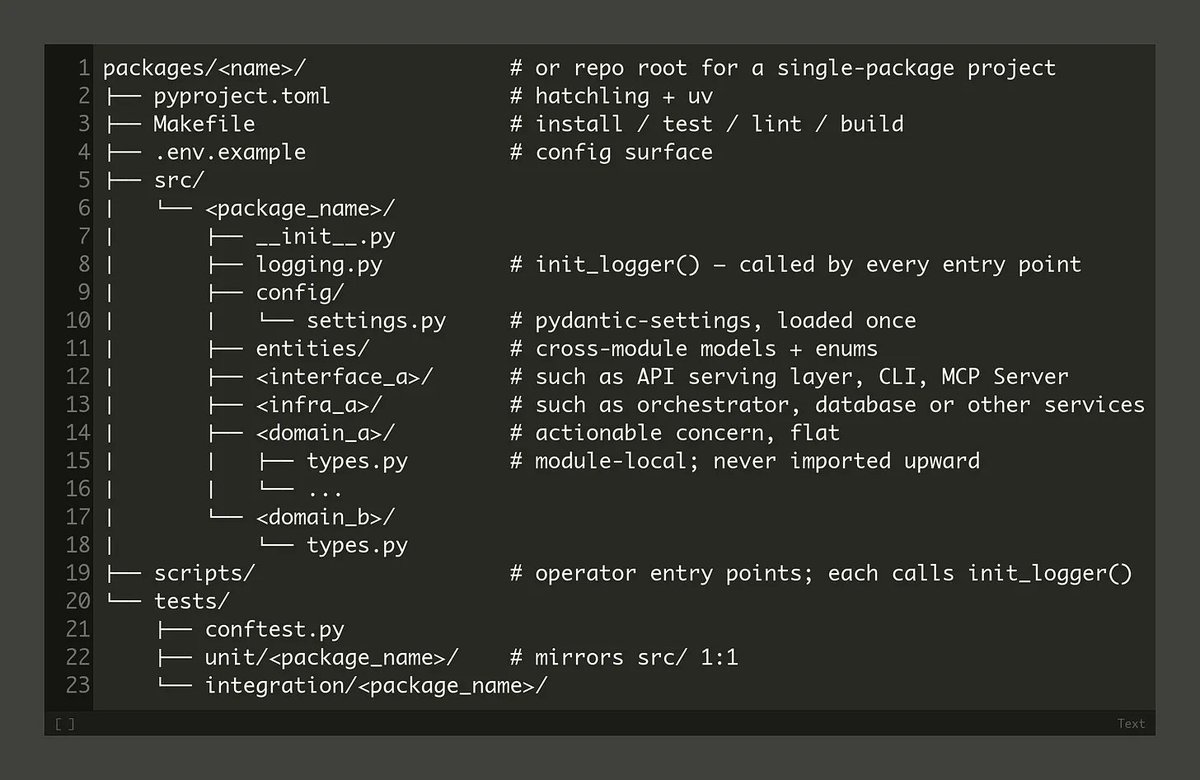
I used to rely heavily on code templates. Here's why I've stopped... AI engineering moves too fast for static scaffolding. Your template is already outdated by the time you use it. So maintaining the templates becomes its own engineering project. Times have changed. Instead of static templates... We’ll dynamically scaffold projects with agents. And the value will be from the engineering system behind it. Things like: Skills CLAUDE.md files ADR workflows DDD glossaries Engineering playbooks Architecture decision processes Tech stack CI/CD conventions TDD workflows Human approval gates And more importantly... The processes those agents follow. For example: A PM agent writes ADRs before major architectural changes A software engineer agent uses red-green TDD before implementation An on-call agent loops on CI/CD failures until the pipeline passes The orchestrator pulls the latest framework docs via Context7 at scaffold time Skills define how code should be structured around business domains instead of abstract folders CLAUDE.md files encode your engineering standards directly into the workflow The days of the frozen folder structures are gone. We now have agents to dynamically compose the project at runtime. It does so by: Reading the project requirements Selecting the right architecture patterns Pulling the latest framework docs Generating the required components Evolving the system over time Good software now emerges from good engineering loops. Do you agree?
Paul Iusztin tweet media
English
1
2
9
498