
Nigel Goldenfeld. @NigelGoldenfeld.bsky.social
853 posts

Nigel Goldenfeld. @NigelGoldenfeld.bsky.social
@NigelGoldenfeld
Interested in everything. I tweet here primarily about science when I have time and something non-trivial to say.


Day 29/30 of great biology papers. "Phylogenetic structure of the prokaryotic domain: The primary kingdoms," by Carl Woese & George Fox (1977). Perhaps the most important paper in evolutionary biology. It established a "third domain" of life. *** This paper is just 2.5 pages in length. It contains a single table as its figure. Its publication went largely unnoticed by biologists, but The New York Times printed a story about a "third type of life" on its front page. Prior to this study, all life was divided into two categories: Cells that have a nuclear membrane (eukaryotes), and cells that don't (prokaryotes). Francis Crick first proposed "comparing sequences to infer relationships" as early as 1958. But this paper heralded the dawn of molecular phylogenetics. Woese and Fox claimed, provocatively, that "all cellular life falls into one of three large relatedness groups: eukaryotes...eubacteria, and archaebacteria." (See pnas.org/doi/epdf/10.10…) They made this claim by sequencing a single, highly-conserved gene across many organisms: Ribosomal RNA. This is the catalytic part of ribosomes, the protein-making machines inside of cells. By studying how rRNAs had mutated over eons and eons, Woese and Fox inferred the evolutionary connections between cells. Many well-regarded microbiologists at the time believed that the relationships between microbes could not be determined without a fossil record. This sounds hilarious in hindsight. But it was a real, mainstream belief. Roger Stanier, who helped modernize microbiology and was a respected professor at UC Berkeley and the Pasteur Institute, wrote in his textbook, The Microbial World, in 1970: "[r]eflection and experience have shown, however, that the goal of a phylogenetic classification can seldom be realized. The course that evolution has actually followed can be ascertained only from direct historical evidence contained in the fossil record. This record is at best fragmentary and becomes almost completely illegible in Precambrian rocks more than 400 million years old." Overturning dogma and telling professors that they're wrong is fun! A classic. One more day to go! Paper: pnas.org/doi/full/10.10…


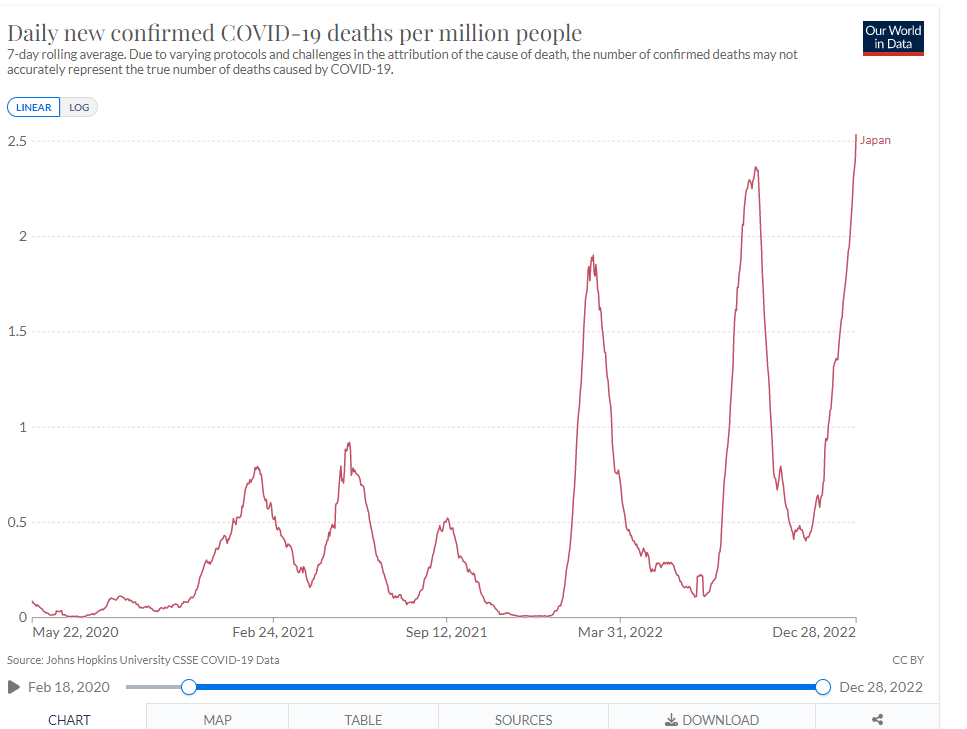
I have no idea about the details of ORF9B mutation but this tweet did prompt me to go look at Japan's Covid data and - for a country with its very high vax rates and a recent big wave - it's not looking great. Anyone have any insights into the current Covid situation in Japan?