
Sabitlenmiş Tweet
🅰️🆂🥧👁r¡🆖
30.2K posts
🅰️🆂🥧👁r¡🆖
@NonLocalityGuy
🙏talk2GOD 〰️ 🅲onsciousness🎟 Nonlocality 🕳️ Neur🧠 C0️⃣DE Pixel🎱 Dream 💤 PsΨ🔮 Cell🦠 Percepti🖼n DeepRL🅰️ Finance🏦 🦉Phil 📣Ar❌iv
Recoꪜ🆖Mng🆖Dir🛀🏻🇺🇸🇸🇪 Katılım Şubat 2011
1.8K Takip Edilen1.7K Takipçiler

@omarsar0 Elvis my man🫶strongest conceptual overlay, ‘Failures often originate @ the model-environment boundary, not inside latent reasoning capability itself.’ While my cap mkts system is actually more advanced in sovereign gov semantics. 📝 provides validation + lifecycle formalization
English

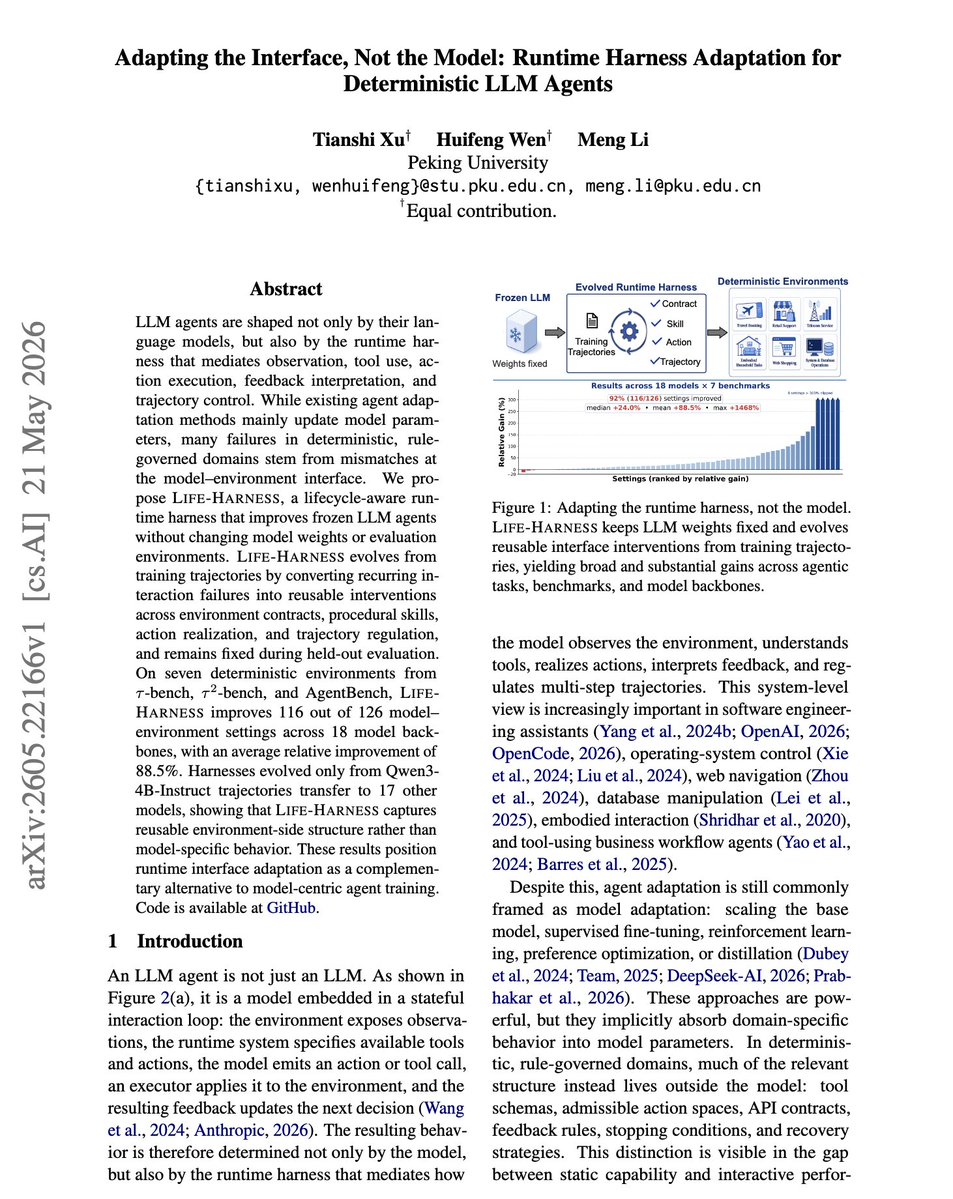
// Adapt the Interface, Not the Model //
I am fascinated by the results across my cheap-model-plus-good-harness builds.
This new paper also shows good signs of the code-as-agent-harness thesis.
The idea is really simple. Do not touch the model. Instead, modify the runtime interface that wraps the frozen LLM. Then convert recurring interaction failures into reusable interventions on the harness side.
The paper reports an average relative improvement 88.5% across 7 deterministic environments, 126 model-environment settings, and 18 backbones.
A harness learned from one model trajectory generalizes to 17 other backbones. That tells you the harness is capturing environment structure, not model-specific patterns.
If you ship agents in production, your harness work is more portable than you might assume.
Paper: arxiv.org/abs/2605.22166
Learn to build effective AI agents in our academy: academy.dair.ai
English
@WOLF_Bitcoin_ Matters👇🏼
x.com/nonlocalityguy…
🅰️🆂🥧👁r¡🆖@NonLocalityGuy
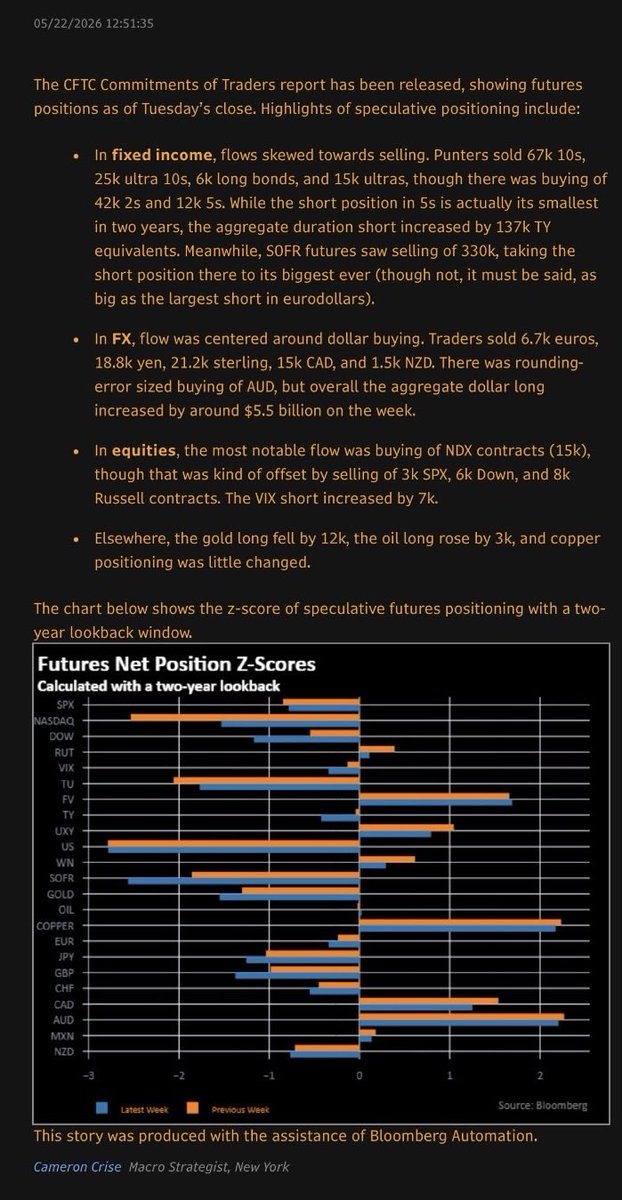
📣🏗️ CFC Positioning Update: Record SOFR Short 🎙️ outright duration hatred, this isn’t “peeps bearish bonds”, it’s positioning becoming one-sided in a system still carrying massive leverage. Macro view 🆚 evolving into a Macro consensus = matters
English

@kanair @_fernando_rosas @Shuqin_Ma Brilliant work. Kudos👊🏻 Consciousness should not be assigned by external labels, superficial behavior, or arbitrary computational maps. Instead, the relevant object is a system’s canonical functional structure.
🫶 the line “a state is a space of possible futures.”
English

I’m happy to share our new preprint on “canonical functionalism.” (with @Shuqin_Ma)
The core idea is that functional structure can be uniquely identified by the system’s counterfactual state-transition structure, without arbitrary semantic labels.
arxiv.org/abs/2605.21506
English
@PessoaBrain Agree, if cortical activity contains meaningful 🏗️ > ~667ms res, then a coarse-grained model could incorrectly conclude.
Reminds me of controversy around global signal regression/filtering in fMRI
Sabotaging selves by removing large-scale coherence we’re trying to understand⁉️
English
*Are neurons simple??*
This is a cool paper, elegant. But unless I'm getting something wrong it doesn't really test what it intends to because the binning implies that there's not temporal information below 667 ms (for cortex). But that's where a lot of the action is!
Christopher W. Lynn@ChrisWLynn
Our understanding of neural computation (in the brain and artificial networks) is founded on an assumption: That neurons fire in response to a linear sum of inputs. But can real neurons be so simple? In a new paper, I systematically test this assumption nature.com/articles/s4156…
English

🅰️🆂🥧👁r¡🆖 retweetledi


🅰️🆂🥧👁r¡🆖 retweetledi
Scientists have discovered a surprising “third state” that exists beyond the binary of life and death.
When an organism dies, most of us assume every cell dies with it. Yet some cells stubbornly refuse that fate. Given the right environment, they wake up, reinvent themselves, and begin entirely new lives- behaving in ways their original body never allowed.
In one groundbreaking experiment, researchers took skin cells from dead frog embryos, scattered them in a dish, and watched in astonishment as the cells regrouped into multicellular clusters called xenobots. These tiny living robots could move, heal themselves, and even reproduce not genetically, but by gathering loose cells into piles that turned into brand-new xenobots.
The phenomenon isn’t unique to frogs. Human lung cells collected after death have recently self-assembled into “anthrobots” microscopic, self-propelled structures that swim through fluid and, remarkably, can promote healing in nearby damaged nerve cells.
What these experiments reveal is that many cells retain a hidden plasticity, a kind of dormant creativity. Even after the organism as a whole has died, individual cells can still change their identity, team up with others, and build entirely novel forms of life.
The medical implications are staggering. In the coming years, doctors may be able to grow patient-specific biobots from a person’s own cells even postmortem cells to clear arterial plaque, deliver drugs precisely to tumors, repair spinal injuries, or regenerate tissue, then peacefully dissolve without triggering immune rejection.
Death, it seems, is not an absolute endpoint for every part of us. At the cellular level, some pieces may still have remarkable second acts left to perform.
(Source: “Biobots arise from the cells of dead organisms − pushing the boundaries of life, death and medicine,” The Conversation, 2024)
English


🅰️🆂🥧👁r¡🆖 retweetledi
📣🎙️had an argument last nite with someone I consider a friend. It was about labels. Buckets of identity. Groupthink. Even generational identity.
The Logos—reason, truth, divine order—can only be received by a soul no longer clinging to borrowed identity or collective illusion.
Groupthink seduces us with the comfort of belonging but at the cost of coherence with first principles. Detachment is not isolation, it is the condition for communion with that which is eternally true.
“𝗖𝗼𝗺𝗲 𝗼𝘂𝘁 𝗳𝗿𝗼𝗺 𝗮𝗺𝗼𝗻𝗴 𝘁𝗵𝗲𝗺 𝗮𝗻𝗱 𝗯𝗲 𝘀𝗲𝗽𝗮𝗿𝗮𝘁𝗲,” 𝘀𝗮𝘆𝘀 𝘁𝗵𝗲 𝗟𝗼𝗿𝗱. (𝟮 𝗖𝗼𝗿. 𝟲:𝟭𝟳)
Only then can one hear clearly, see structurally, and act rightly.
#TALK2GOD🙏
English
🅰️🆂🥧👁r¡🆖 retweetledi

🚨 For the first time in history, scientists have managed to capture the moment when an oxygen atom and a hydrogen atom combine to form water on a nano scale.
English
🅰️🆂🥧👁r¡🆖 retweetledi

FITCH RATINGS' U.S. PRIVATE CREDIT DEFAULT RATE HITS A HIGH OF 6.0% IN APRIL 2026
English
Consciousness research often starts from the hard problem and declares consciousness has no function. But even if phenomenal consciousness does not seem to add new physical causality, the fact that organisms evolved consciousness may still matter. They are actually separate issues. We should ask what consciousness is for. Many say consciousness and intelligence are independent, but I suspect they might be deeply connected.
English
🅰️🆂🥧👁r¡🆖 retweetledi

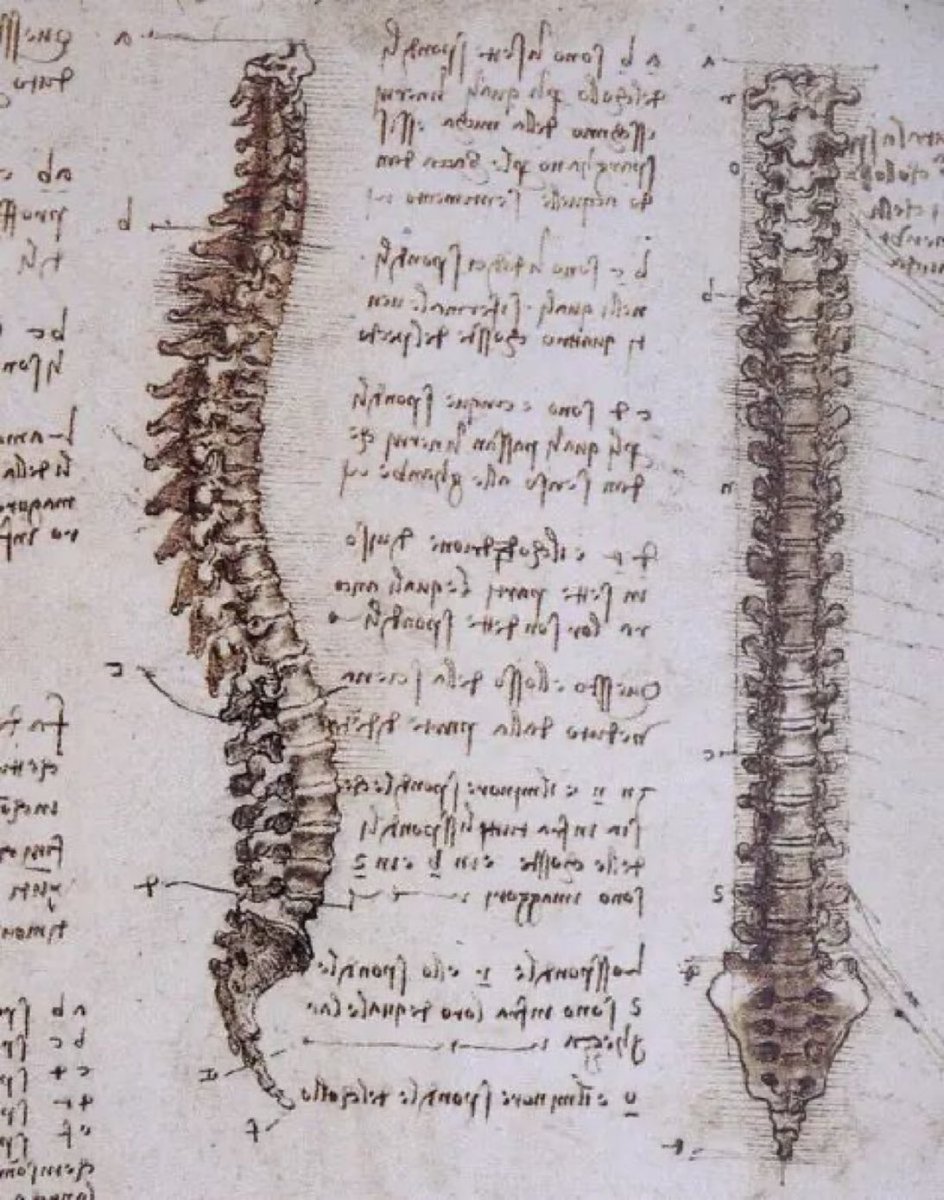
Leonardo da Vinci's (1452–1519) drawing of the human spine.
English