"post-AGI, no one is going to work and the economy is going to collapse"
"i am switching to polyphasic sleep because GPT-5.5 in codex is so good that i can't afford to be sleeping for such long stretches and miss out on working"
feels like a good time to seriously rethink how operating systems and user interfaces are designed
(also the internet; there should be a protocol that is equally usable by people and agents)
Peter Thiel's advice to early-stage startups:
"One basic frame is that if you're starting a company, you always start small.
So how do you get to monopoly when you're small?
Answer, you start with a very small market. And the conventional business thing is always you want to go after really big markets.
There are no big markets without lots of competition.
You never want to go after big markets. You want to go after small markets.
Facebook started with 10,000 people at Harvard. It was such a small market, it could not have been funded.
It would not have been funded by investors if you'd actually pitched it.
So it sort of bootstrapped the whole thing. It went from 0% to 60% market share in 10 days. That was actually a very auspicious start.
Now, PayPal, we went after 30,000 power sellers on eBay.
Again, sort of a subset of a subset of a subset of the payment space, but it has these very distinct, unique characteristics that made it a well-defined market.
We got to about 30%, 35% market share in three months. Again, a very, very promising start.
There was a tremendous amount that went wrong with all the clean tech companies in the last decade.
And I think failure is always a little bit overrated because people can't learn much from failure.
When you fail, you normally failed for multiple reasons. You failed for reasons A, B, C, D, E, and F. And maybe you think you failed because of A.
Next time around, you'll fail for the other five reasons.
So that's why I think we often make the mistake of... of overrating failure in various contexts.
Cleantech failed for many different reasons. But one that I think is very important, and people haven't thought about enough, is that the markets were just way too big.
Every PowerPoint presentation you saw in the period 2005 to 2008 started with, we are in the energy market. And this is a market that's in the hundreds of billions or trillions of dollars.
And then it's a fraction of a fraction of a fraction of that market.
And then you end up with a dynamic where you have to beat the other nine thin film solar panel companies.
Then you have to beat the other 90 solar panel companies.
Then you have to beat the wind companies.
And then fracking comes out of right field. And China comes out of left field.
And you're sort of like this minnow in this vast ocean.
And there's just competition everywhere, most of it not even visible from the point at which you get started."
NVDIA CEO Jensen Huang: Your startup doesn't need a business plan
“I didn’t know how to write a business plan… Making a financial forecast that nobody knows is going to be right or wrong turns out to not be that important.”
Jensen continues:
“I think that the art of writing a business plan ought to be much, much shorter. It should force you to concisely answer: What is the problem you’re trying to solve? What is the unmet need you believe will emerge? And what is it that you’re going to do that is sufficiently hard that when everybody else finds out it’s a good idea, they’re not going to swarm it and make you obsolete? It has to be sufficiently hard to do.”
Marc Andreessen echoes similar points in a separate interview:
“The process of planning is very valuable for forcing you to think hard about what you’re doing, but the actual plan that results from it is probably useless. In particular, now that we’re VCs, we’re evaluating pitches and when people come in, we want to hear their plan and we want to hear it in some detail because we want to see that they can think about the entire thing end-to-end. And if their initial plan doesn’t make sense, then obviously there’s an issue because they’re not quite capable of fully thinking this through. But when you get somebody who comes in and they present you the perfect plan and everything is fully integrated and makes sense, all you know from that is that they can come up with a good plan—which is good! But the odds that will be the plan they succeed on is still very small.”
Video source: @AcquiredFM (2023)
Sam Altman gave a 1-hour masterclass on turning ideas into billion-dollar companies.
This is the exact playbook everyone at YC companies uses.
No excuses anymore.
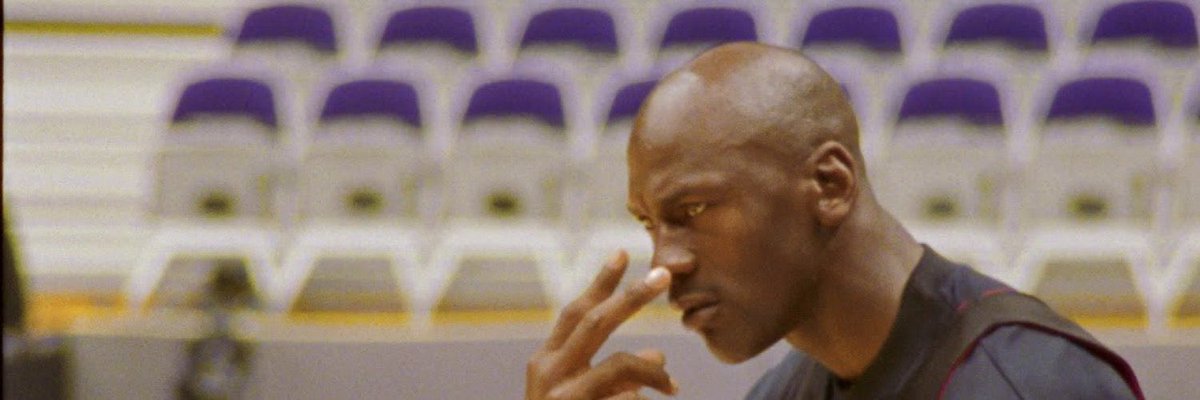
26 ways Michael Jordan was described in his 700 page biography:
1. His competence was exceeded only by his confidence.
2. Jordan believed mostly in himself. In Mike he trusted. All others were open to question.
3. Michael puts every ounce of talent to use. Jordan goes all out. He outthinks you.
4. Animation and hyper-competitiveness were simply Jordan's normal state.
5. He had the motivation to be the best at it.
6. He tested himself.
7. He discovered the secret quite early in his competitive life: the more pressure he heaped on himself, the greater his ability to rise to the occasion.
8. He came to practice every day like it was Game 7 of the NBA Finals. That's what set the tone for our team.
9. It took the fewest of words to set him off. He would seize on apparently meaningless cracks or gestures and plunge them deep in his heart, until they glowed radioactively, the nuclear fuel rods of his great fire.
10. Young Michael had begun taking note of the pro game on TV. He was finding rare and special instructors through television.
11. At each step along his path others would express amazement at how hard he competed.
12. At every level he was driven as if he were pursuing something that others couldn't see.
13. He had a clear notion of what he wanted and he wasn't reluctant about expressing it publicly.
14. The coach would recall that Jordan kept sneaking back into succeeding groups for more work that evening.
15. Jordan could sense immediately that he had something the others didn't.
16. They all began to grasp that Jordan's belief in himself reflected a level of intensity no one had contemplated before.
17. He was so committed he wouldn't allow himself to become sidetracked. He knew he wanted to be the best. He was very sure of himself, sure of what he wanted to do, and nothing was going to stop him
18. He was upset with teammates who lacked the necessary competitive drive.
19. He wanted to work on his shooting. And after practice he'd make you help him. He'd keep working on his shooting. He didn't care how long he was out there. Michael loved to play the game.
20. Jordan determined that he wanted to be recognized for having the “complete game."
21. Jordan presented a singleness of purpose that was hard to dent.
22. That's what made him a badass.
He wasn't just a talent.
It was the understanding of it all, the work ethic, the game itself, the strategy involved.
He got it all. He understood all of it.
23. You got to understand what fuels that guy, what makes him great. He took the pain of that loss and held on to it. It's a part of what made him.
24. To his coaches his capacity to be coached was his single most impressive attribute. I had never seen a player listen so closely to what the coaches said and then go and do it.
25. It was quite possible that no one ever did anything better than Michael Jordan played basketball late in his career.
26. No one had seen him coming.
This is probably one of the greatest lessons for life.
"If you’re having fun, then you’re dangerous, right? Then you’re hard to compete with. You don’t want to go up against the person who’s having a good time doing it because if it feels like a hassle or a chore, that’s the person who gives up when it gets difficult. But the person who’s having a great time at the start is much more likely to stick with it when it gets hard."
(James Clear on The Knowledge Project)
This robot assistant from the NVIDIA CES Keynote on Monday is going viral.
@NaderLikeLadder explains all the hottest emerging AI trends in one demo: AI applications in 2026 will be multi-model, multi-modal, hybrid cloud/local, use open source models as well as proprietary models, control robots and embedded devices in the physical world, and have voice interfaces. (And the demo had a cute robot *and* a cute dog. Gold.)
The demo was built with @pipecat_ai. NVIDIA posted a really nice technical walk-through and complete code. The Reachy Mini robot from @huggingface is open source hardware. (You can order it now, I have one!). You can run the assistant locally on your own hardware, in the cloud, or both.
Cruise founder Kyle Vogt’s framework for choosing a startup idea
After cofounding Twitch and selling the company to Amazon for $1 billion in 2014, Kyle was trying to figure out what to do next:
“Twitch was and is today pretty successful but the result was entertainment mostly… That was a good thing. It felt good to entertain people, but… I realized I wanted something that scratched more of an existential itch and so something that truly matters.”
Twitch took eight years to become successful, so one of Kyle’s core requirements for his next idea was that he had to be willing to commit at least 10 years to it. As he explains, “When you think about things from that perspective, you certainly raise the bar for what you choose to work on.”
Ultimately Kyle came up with three requirements for his next company:
1. Interesting technology. “It had to be something where the technology itself determines the success of the product. Like hard, really juicy technology problems, because that’s what motivates me.”
2. Impactful. “It had to have a direct and positive impact on society in some way. So an example would be healthcare or self-driving cars because they save lives… There’s a clear connection to somehow improving other people’s lives.”
3. Large scale. “It had to be a big business because for the positive impact to matter, it’s got to be a large scale.”
After thinking on it more and experimenting with various side projects, he ultimately decided self driving cars was what he wanted to work on:
“I just took the plunge right then and there and said, this is something I know I can commit 10 years to. It’s probably the greatest applied AI problem of our generation. And if it works, it’s going to be both a huge business and probably the most positive impact I can possibly have on the world.”
General Motors acquired Cruise for more than $1 billion two years later, but Kyle continued to work on self-driving as CEO of Cruise through November 2023. So his 10-year forecast actually proved quite accurate.
Sam Altman gives similar advice in his blog post “Startup Advice”: “In general, don’t start a startup you’re not willing to work on for ten years.”
Video source: @lexfridman (2019)
Jensen Huang just BROKE the most important rule in the industry.
And it explains why Nvidia controls 95% of the AI chip market.
Last night at CES, he unveiled Vera Rubin - the new AI supercomputer that's shipping right now.
Full production started weeks ago.
But here's the part that made every semiconductor engineer in the room go crazy:
Reuben GPU is 5x faster than Blackwell.
But only has 1.6x the transistors.
That should be physically impossible.
Moore's Law says you get maybe 25% more performance per transistor generation.
Jensen just delivered 300%.
How?
He BROKE the most sacred rule in chip design.
The rule every company follows: "Never redesign more than 1-2 chips per generation."
Nvidia redesigned all six chips simultaneously.
Vera CPU. Reuben GPU. Connect X9 networking. Bluefield 4 DPU. MVLink switches. Spectrum X Ethernet.
Every. Single. Component.
From scratch.
He calls it "extreme co-design."
The industry calls it insane.
One rack now moves 240 terabytes per second.
That's TWICE the entire global internet bandwidth.
In a single rack.
And it runs on 45°C water - no chillers needed.
Which saves 6% of global data center power.
But the real story isn't the hardware...
It's what they're doing with it.
Nvidia just open-sourced Alpha Mayo.
The world's first reasoning autonomous vehicle AI.
Mercedes-Benz CLA launches with it in Q1. Europe Q2. Asia by year-end.
Not a concept car. Not a limited release.
Full production vehicles.
And the AI will even explain its reasoning out loud.
"I'm slowing down because the truck ahead is braking and there's a cyclist merging."
It thinks. Then tells you what it's thinking. Then executes.
Jensen drove it through San Francisco for an hour yesterday.
No hands. No interventions.
Through heavy Sunday traffic.
The whole thing is open source now.
Every line of training code. Every data source. The entire stack.
But why would Nvidia give this away?
Because they learned something from the last year:
Open models activated the entire world.
DeepSeek R1 proved open source can hit the frontier.
Downloads exploded. Every country, every startup, every researcher can now build AI.
And they all need Nvidia hardware to train it.
That's the strategy.
Give away the recipes. Sell the kitchen.
The partnerships tell you where this is going:
Siemens is integrating Nvidia into every industrial design tool.
Cadence and Synopsys are rebuilding chip design around Nvidia.
Palantir, ServiceNow, Snowflake - their entire platforms now run on Nvidia's agentic AI stack.
This isn't just selling chips anymore.
Nvidia is rebuilding the entire computing stack.
From design to manufacturing to deployment.
Every layer of the trillion-dollar AI infrastructure buildout runs through them.
And now they're 18 months ahead of everyone else.
Again.
The competition is still trying to match Blackwell.
Nvidia's already shipping the thing that makes Blackwell look slow.
What do you think - is anyone catching them?
The only company capable of this might be Google.
If you’ve never written code before, this is for you. I’ve just launched a course that shows you, in less than 30 minutes, how to describe an idea for an app and build it with AI.
In this course, you'll build a working web application - a funny interactive birthday message generator that runs in your browser and can be shared with friends. You'll customize it by telling AI how you want it changed, and tweak it until it works the way you want. By the end, you'll have a repeatable process you can apply to build a wide variety of applications.
If you want to try vibe coding, this will be the best place to start! Further, you'll be able to use these techniques with whatever tool you're most comfortable with (like ChatGPT, Gemini, Claude, or others) -- we're vendor neutral.
Skills you'll gain:
- How to build web apps with AI - zero coding skills needed
- How to fix and improve your creations by chatting with AI
- A simple process you can use to build other things you can dream up
Building with AI is one of the most fun things in the world. Please join me and take your first step! I think you will be surprised at what you can build. And if you're an experienced engineer, please share this with someone in your life who's been curious about building with AI.
Come build with me! deeplearning.ai/courses/build-…