OmegaHami
57 posts

OmegaHami
@OmegaHami
Quantum, Space, Technology and Muscle Cars.. and cute animals


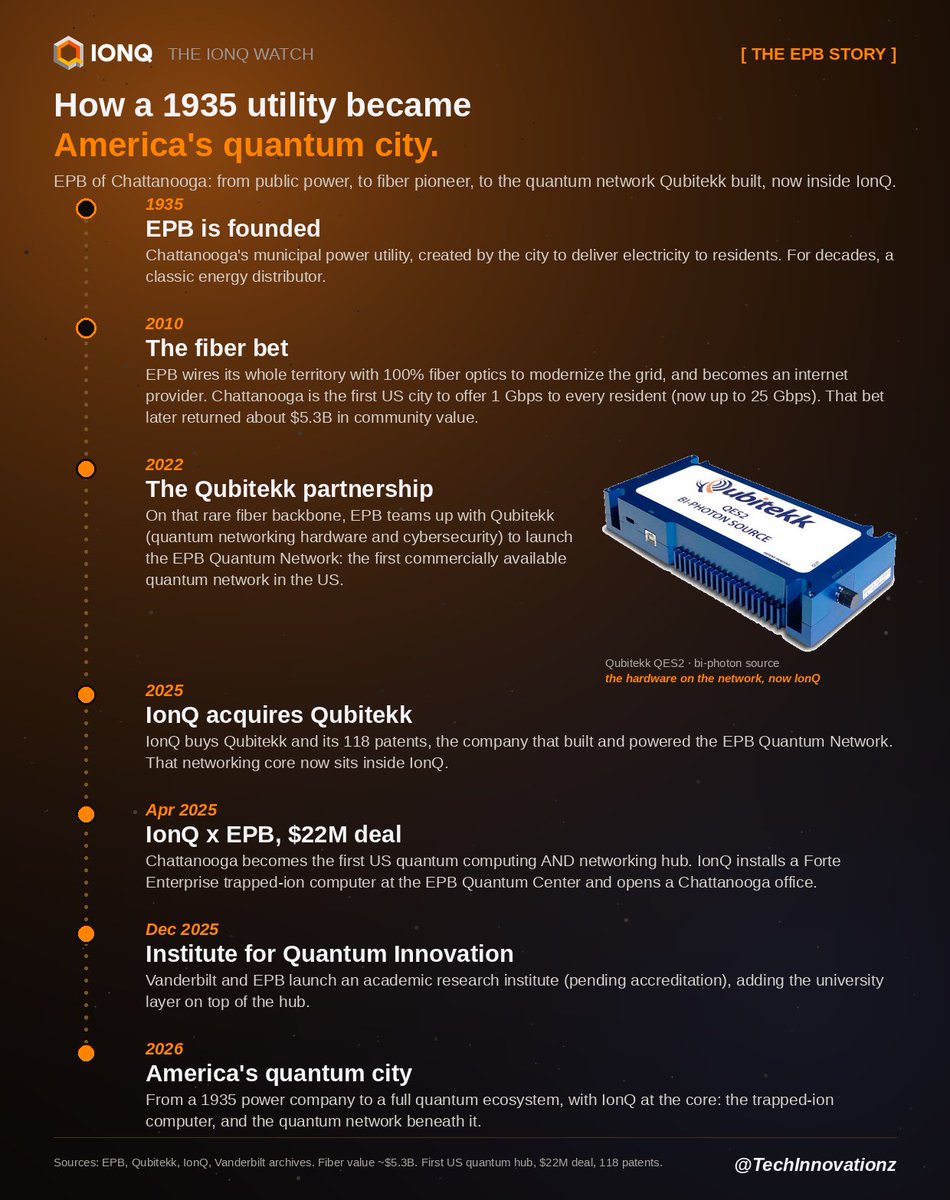
$IonQ 🚨 BREAKING: EPB & Vanderbilt University launch the Institute for Quantum Innovation in Chattanooga, Tennessee This is MASSIVE for $IONQ 🧵👇 The EPB Quantum Center will host America’s first commercially available trapped-ion quantum computer powered by IonQ technology (launching early 2026). What this institute will do: → Accelerate breakthroughs in energy, cybersecurity, AI & advanced manufacturing → Train the next-gen quantum workforce with hands-on access to real quantum infrastructure → Drive startup creation & economic development across Tennessee Why it matters for $IONQ investors: McKinsey projects quantum tech could unlock $2 TRILLION in value by 2035. EPB’s quantum initiatives alone are expected to generate up to $1B in local economic value between 2026-2035. Tennessee is now positioning itself as THE national hub for quantum commercialization with full bipartisan federal support from Sen. Blackburn, Sen. Hagerty & Rep. Fleischmann. This isn’t R&D hype anymore. This is real infrastructure. Real applications. Real revenue pipeline. IonQ is moving from lab to market and Chattanooga just became ground zero for American quantum leadership. 🇺🇸⚛️ Link: epb.com/newsroom/press… #IonQ #QuantumComputing #IONQ #Chattanooga #Vanderbilt #EPB #QuantumEconomy

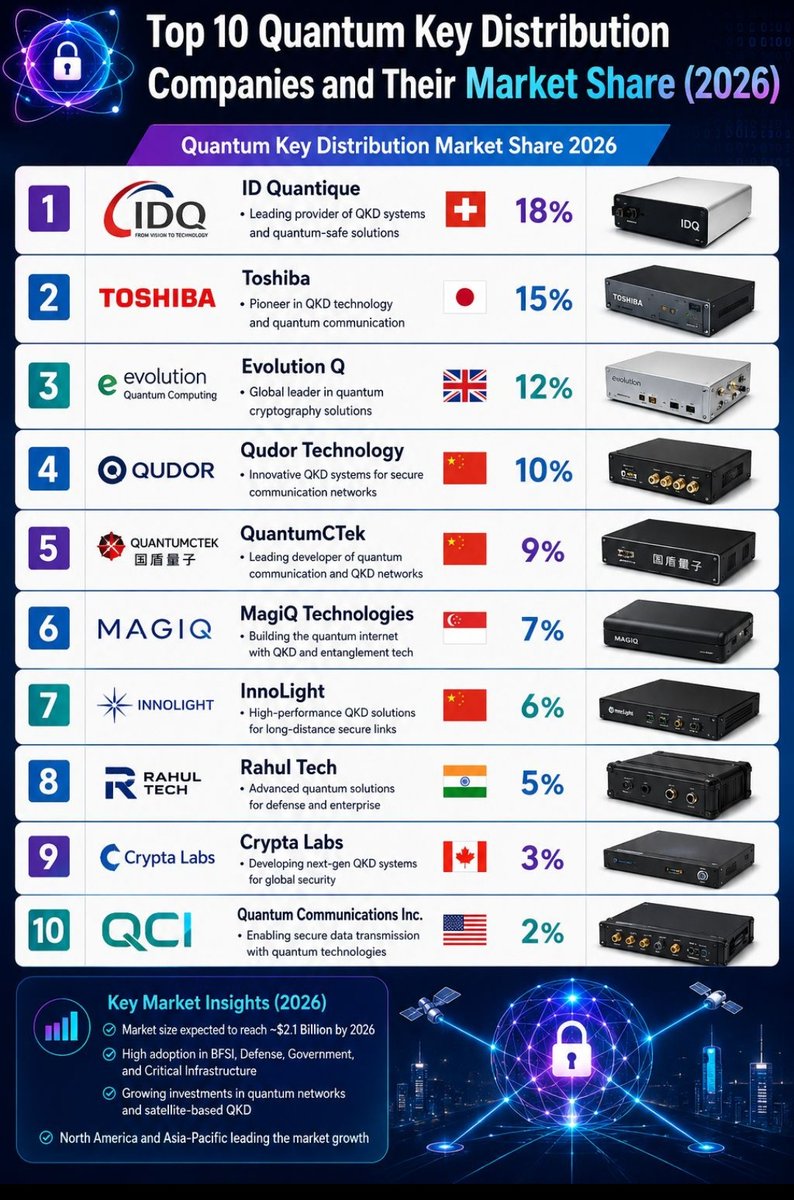
$IONQ New GIS report says IonQ has overtaken Toshiba in terms of QKD market share.


$IONQ Four of the five Clavis XG models need dedicated fiber for the quantum signal. The fifth one doesn't. Clavis XG Multiplex, launched June 17 by ID Quantique (an IonQ company), is the newest of five. The portfolio logic is the story. QKD in one line: encryption keys travel as quantum states of light, any interception disturbs the channel, and both endpoints detect it instantly. Physics, not math assumptions. The line-up: → Short Haul, Backbone, Long Haul: point-to-point on dedicated fiber, 60 to 150 km → Hub & Spoke: star deployments, up to 90 km → Multiplex: quantum keys riding the same shared metro fiber as live data (WDM), up to 60 km Dedicated dark fiber is the hidden line item of every QKD deployment. In metro networks it is scarce and expensive. Multiplex removes it. What actually sells these boxes is the integration. They interface with the encryptors operators already run: Cisco, Nokia, Ciena, Juniper, Thales, ADVA, Fortinet, Palo Alto. OSI Layers 1 to 3 plus MPLS. ETSI and ITU standards work. Enterprise-grade form factor, maintenance and management, with Clarion KX handling every key from an existing NOC or SOC. No rip-and-replace. That is the pitch. Buyers: critical infrastructure, governments, telcos, banks. Anyone holding data with a 5-10+ year shelf life, already exposed to "harvest now, decrypt later," the top quantum concern for 61% of firms in Thales' latest Data Threat Report. "Making the existing infrastructure more enterprise grade, secure, and QKD cheaper to operate." - @jordan_shapiro , @IonQ_Inc President, Quantum Platform IonQ's own Florida LambdaRail corridor is the case in point: ~100 quantum-safe miles now launching on a 1,540-mile network. Cost gates every deployment like it. This portfolio attacks the gate. Security is the part of IonQ's platform that generates revenue today, not in the 2030s. 🔗idquantique.com/quantum-safe-s… #IonQ #Quantum #QKD

$IONQ The “5% we shelved.” NVIDIA’s Dr Krysta Svore on what quantum reopens, at the Economist’s “Commercialising Quantum” panel: “We stopped studying certain molecules and molecular structures because they were too complex or too hard.” Now, with a new computing architecture, “that 5% now becomes a huge field if you’re able to use it well.” Her concrete example: catalysis and chirality. “You want to drive towards the more therapeutic drug as opposed to the harmful one,” and quantum lets you “study that more accurately.” Quantum’s first prizes are the “too hard” problems classical methods abandoned, strongly-correlated chemistry, catalysts, drugs. $IONQ #IonQ #Quantum #NVIDIA


One of the use cases that quantum computers can address is national security. $INFQ CEO Matthew Kinsella: “We can bucket them into two: Quantum sensing and quantum computing. Quantum sensing is a massive infrastructure that needs to be synchronized to do things at orders of magnitude higher precision than classical systems. This applies not only for protecting homeland, but also in the field of battle for soldiers.” $INFQ has several contracts with the Department of Defense worth a few million dollars. Meanwhile, $IONQ has a $54,5 million contract with the US Air Force and highlights its enterprise-grade systems fit into standard portable 19-inch racks that can be deployed in submarines, ships, and aircraft. Imagine the potential of quantum computers if the Department of Defense is already a customer.