

@TugboatPhil Except at sundown. They attack each other all day, but come sundown, you'll find 4 on the same feeder.
English
Peter Shrinks
2.7K posts


Here's Gavin Newsom at the groundbreaking ceremony for the "butterfly bridge," lying to the public about how much the project would cost and making fun of Caltrans for constantly disappointing voters. He knows his own government is incompetent—and he think it's funny.





What is the biggest lesson you learned from your father growing up? Share 👇🏽



A law written for energy independence is now the mechanism for food dependence. The Renewable Fuel Standard mandates that 15 billion gallons of corn ethanol be blended into American transportation fuel annually. That volume consumes approximately 43 percent of the US corn crop. The mandate was established by the Energy Policy Act of 2005 and expanded by the Energy Independence and Security Act of 2007. It was designed for a world where corn was abundant and America wanted to reduce reliance on foreign oil. That world no longer exists. Corn acres are falling to 94 million from 98.8 million because urea at $610 makes the nitrogen economics impossible. The RFS takes its 15 billion gallons from a shrinking harvest. The percentage of remaining corn available for feed, food, and export compresses with every acre that switches to soybeans. The mandate does not flex. The biology does. Waiving the RFS requires the EPA Administrator to make a formal determination that implementation would cause severe economic or environmental harm. The process involves a public comment period, regulatory review, and potential legal challenges from the ethanol industry. The EPA proposed 2026 and 2027 RFS volume requirements in June 2025 and has been targeting Q1 2026 for the final rule. The rulemaking machinery was designed for normal agricultural cycles. It was not designed for a war that closed the world’s most important fertiliser transit route during planting season. Even if the EPA Administrator initiated a waiver today, the timeline from announcement to implementation stretches weeks to months. The corn planting window closes in three to four weeks. The legal process cannot outrun the biological calendar. By the time a waiver could take effect, the acreage decisions it was meant to influence would already be irreversible. The RFS is the transmission belt that converts a fertiliser crisis into a food crisis. Without the mandate, a shrinking corn crop would still produce less total output, but the available supply could be allocated flexibly between feed, food, and fuel based on market signals. With the mandate, 43 percent of whatever corn exists is legally spoken for before a single hen eats a kernel or a single tortilla is pressed. The flexibility that markets provide is overridden by the rigidity that law imposes. The cattle herd is at 86.2 million head, a 75-year low. Poultry operations rebuilt from the 2025 avian flu but face rising feed costs. Dairy herds are contracting. Every animal that eats corn competes with a fuel pump that has legal priority. The protein cascade, from corn to feed to meat to eggs to dairy to the grocery shelf, begins at the point where the RFS takes its cut. Corn Belt legislators who championed the RFS to support their farming constituents now face a perverse outcome: the law they wrote to help farmers is the law that prevents the market from adjusting to a crisis their farmers are living through. The ethanol industry will resist any waiver. The livestock industry will demand one. The consumer will pay the difference. And the EPA rulemaking process was designed for annual adjustments, not emergency response during a 21-day-old war. Fifteen billion gallons. Written into statute. Consuming 43 percent of a crop that just lost 4.8 million acres to a fertiliser price that originates in a strait the law never contemplated. open.substack.com/pub/shanakaans…



Reading articles this morning about the failed US/Iran nuclear negotiations and disappointments among some in DC and UK about their end. But they lament not continuing with an Iranian effort to end up, after a long negotiation (enabling a build up of its threatening missile and proxy forces), with another, likely weaker JCPOA. They dismiss Trump’s goals of verified denuclearization, including a permanent end to enrichment, as “maximalist.” Yet, Iran is not enriching and its centrifuge program is essentially destroyed. Rather than building on making that permanent, they want to facilitate rebuilding Iran’s centrifuge program, while likely willing in the end to accept a nuclear deal that would not have sufficient verification to be an “effective bulwark against weaponization.” It is not surprising that the Trump administration did not want to continue down that path. From @ArmsControlNow: “The Iranian proposal, as presented on Feb. 26, did not meet the maximalist terms that the White House demanded, including no enrichment, dismantlement of Iran's nuclear facilities, and removal of enriched uranium gas from Iran. Nor did it appear to be sufficiently restrictive from a nonproliferation perspective to be an effective bulwark against weaponization.”

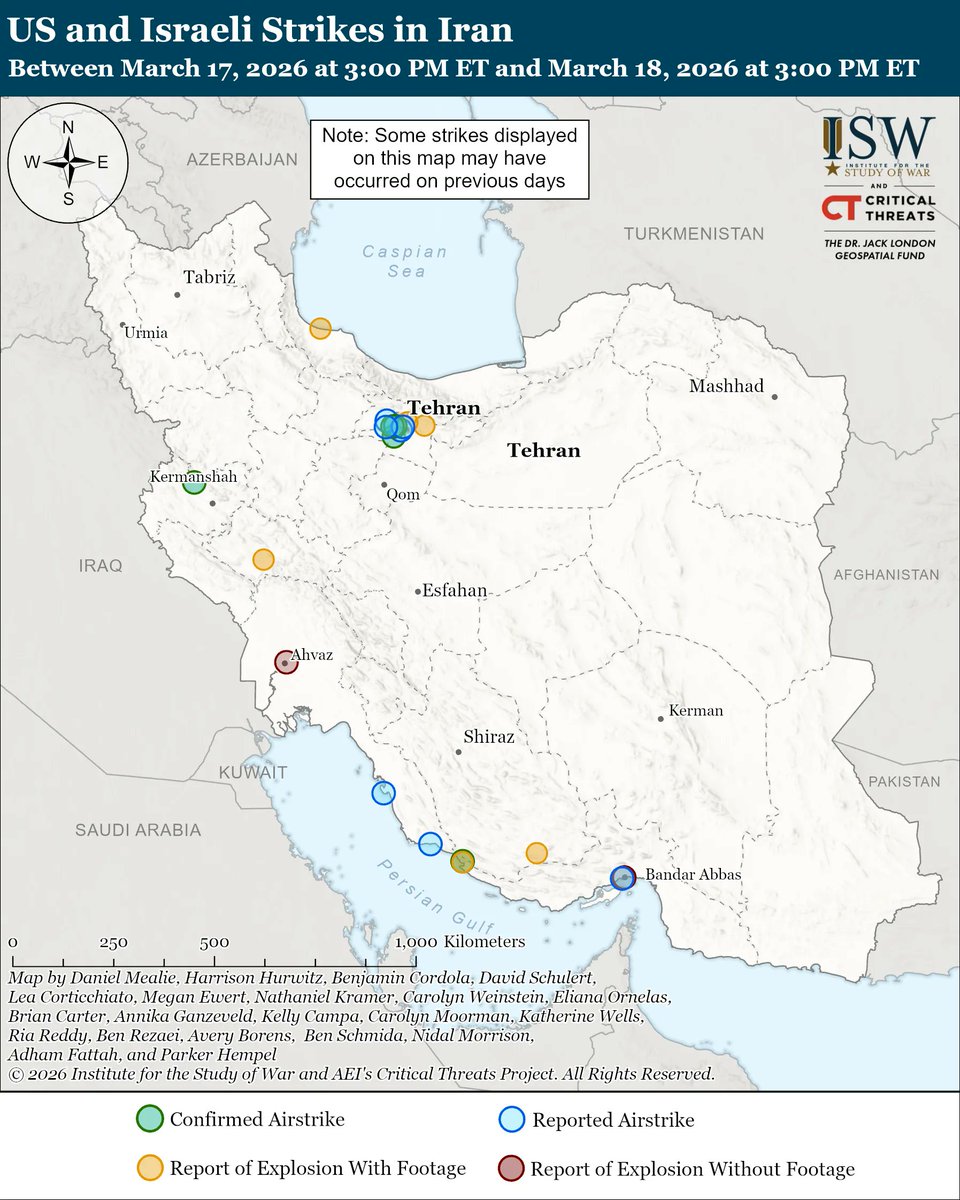
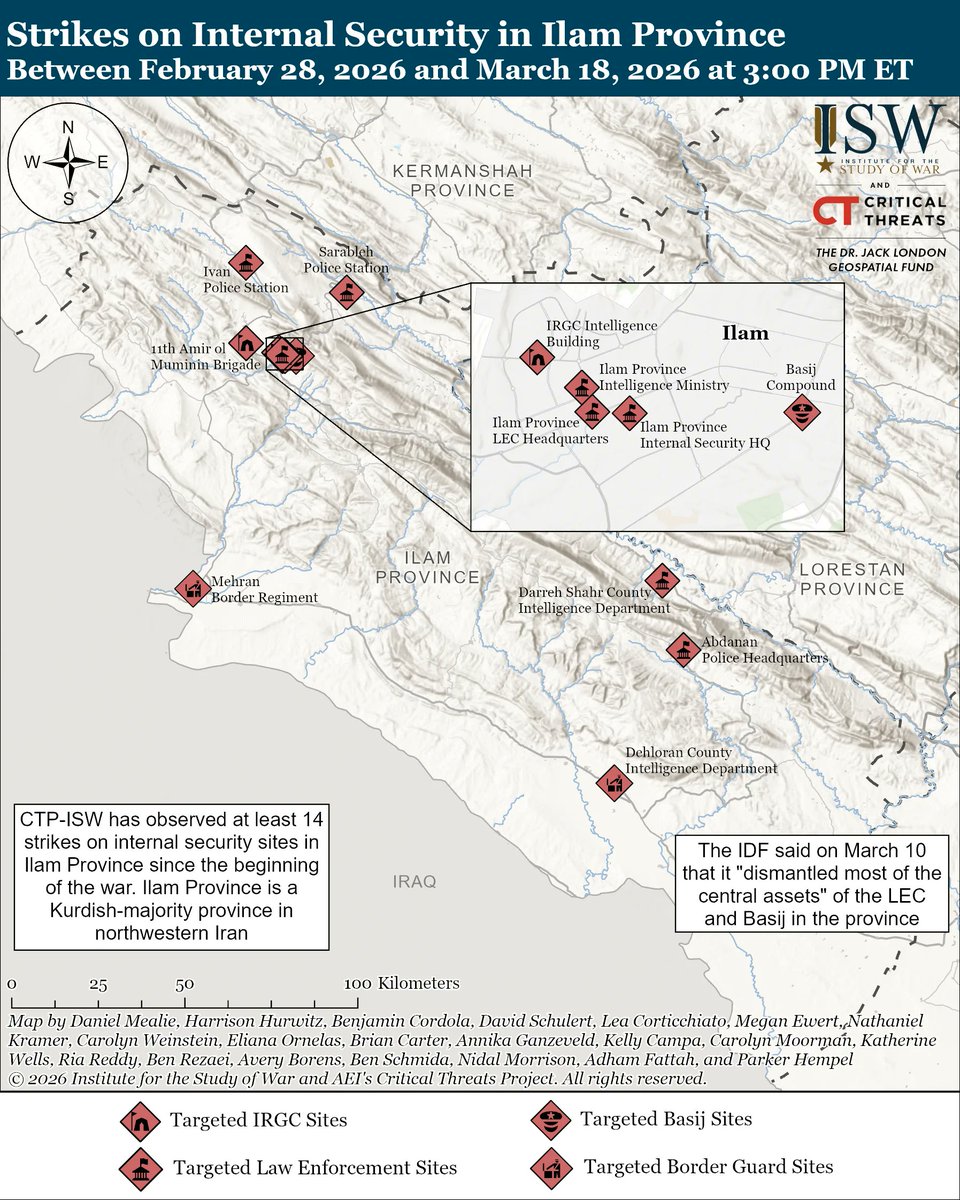
NEW: The Israel Defense Forces (IDF) struck critical Iranian energy infrastructure on March 18, including facilities linked to the South Pars natural gas field and the Asaluyeh processing hub in Bushehr Province. These facilities are central to Iran’s domestic natural gas supply and broader energy system, which supports a significant portion of Iran’s economic activity and regime revenue. Iran exports a small share of its natural gas, primarily to Iraq and Turkey, meaning disruptions will also affect regional energy consumption. The IDF killed Iranian Intelligence Minister Esmail Khatib in an airstrike on March 18. Khatib was responsible for coordinating the regime’s repression of the Iranian population in his role within the Ministry of Intelligence and Security, including overseeing the regime‘s crackdowns on the Winter 2025-2026 protests and the 2022 Mahsa Amini protests. The combined force’s decapitation campaign and targeting of security services is reportedly causing paranoia among Iranian regime officials and members of Iranian security services. Israeli strikes targeting internal security services are reportedly hurting “rank-and-file morale” and are driving security forces to sleep in vehicles, mosques, or sports facilities in order to avoid targeting. Hezbollah claimed 57 attacks targeting Israeli forces and positions in northern Israel and southern Lebanon since CTP-ISW’s last data cut off. The IDF has continued to conduct airstrikes targeting Hezbollah in southern Lebanon, including strikes targeting Hezbollah’s social and financial service network in Lebanon.


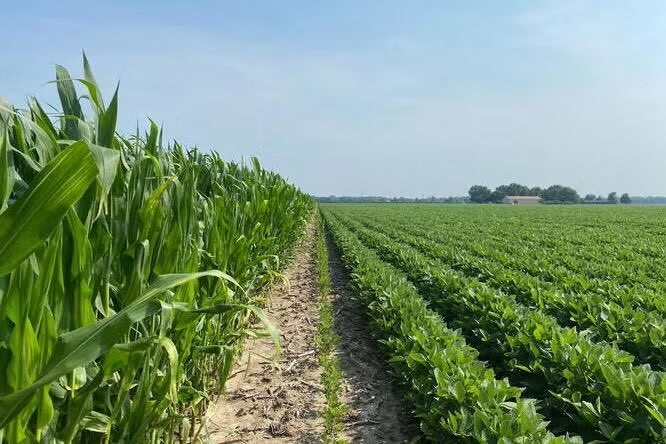
Right now, in barns and equipment sheds across the American Midwest, farmers are making the most consequential decision of this war. Not generals. Not senators. Farmers. At $683 per ton urea, corn economics have collapsed. Nitrogen is the single largest input cost for corn production. At pre-war prices a farmer could justify 180 pounds per acre and expect a margin. At $683 the math breaks. Soybeans fix their own nitrogen from the atmosphere through root bacteria. They do not need the molecule trapped behind the Strait of Hormuz. The seed decision is being made this week across roughly 90 million acres of American cropland. Once the planter rolls into the field, the choice is irreversible. Corn seed in the ground stays corn. Soy seed stays soy. The acreage allocation locks in. USDA Prospective Plantings reports March 31. That report will tell the world how American agriculture responded to the Hormuz blockade. But the decisions it captures are being made now, in conversations between farmers and agronomists and seed dealers who are looking at nitrogen prices and making the rational economic choice: plant the crop that does not need the input you cannot afford. Every acre that shifts from corn to soybeans tightens the corn balance sheet for the rest of the year. Corn feeds livestock. Corn feeds ethanol. The Renewable Fuel Standard mandates 15 billion gallons of corn ethanol annually, consuming roughly 43 percent of the US corn crop regardless of price. That demand is inelastic. If acres shift and production falls while the mandate holds, corn prices spike. Feed costs spike. The protein cascade reverses. The US cattle herd sits at 86.2 million head, a 75-year low. Poultry and pork margins that were benefiting from cheap feed compress when corn crosses $5 per bushel. This is how a naval blockade 7,000 miles from Iowa reaches the American grocery shelf. Not through oil. Not through shipping. Through nitrogen. The farmer cannot afford the molecule. The molecule cannot transit the strait. The farmer plants soy instead. The corn supply tightens. The ethanol mandate consumes its fixed share. The remaining corn reprices. The feed reprices. The meat reprices. The grocery bill reprices. The decision is not political. It is arithmetic performed on a kitchen table by a person who needs to plant in three weeks and cannot wait for a ceasefire, an escort convoy, or an insurance normalisation that the Red Sea precedent says takes years. The deepest penetrator in the American arsenal cannot reach a sealed Iranian doctrinal packet. But the fertiliser price it failed to resolve is reaching every planting decision on 90 million acres of the most productive farmland on Earth. The war’s most irreversible consequence is not happening in a bunker. It is happening in a barn. And by the time USDA publishes the data on March 31, the seeds will already be in the ground. Full analysis in the link. open.substack.com/pub/shanakaans…


