P. Stein

7.8K posts

P. Stein

P. Stein

@PStein59990336

Anonymous, lawyer

Katılım Mart 2019
706 Takip Edilen133 Takipçiler
P. Stein
P. Stein@PStein59990336·
@messeduppcs This is SMBC, please give credit to the original artist.
English
0
0
9
1.2K
P. Stein
P. Stein@PStein59990336·
@LevyAntoine Après, ces salariés ont peut-être une autre vision : ils ont pris un risque, cela n’a pas marché. Mais il ne faut pas les plaindre, ce sont des adultes. Idem pour les investisseurs.
Français
1
0
5
3.7K
Antoine Levy
Antoine Levy@LevyAntoine·
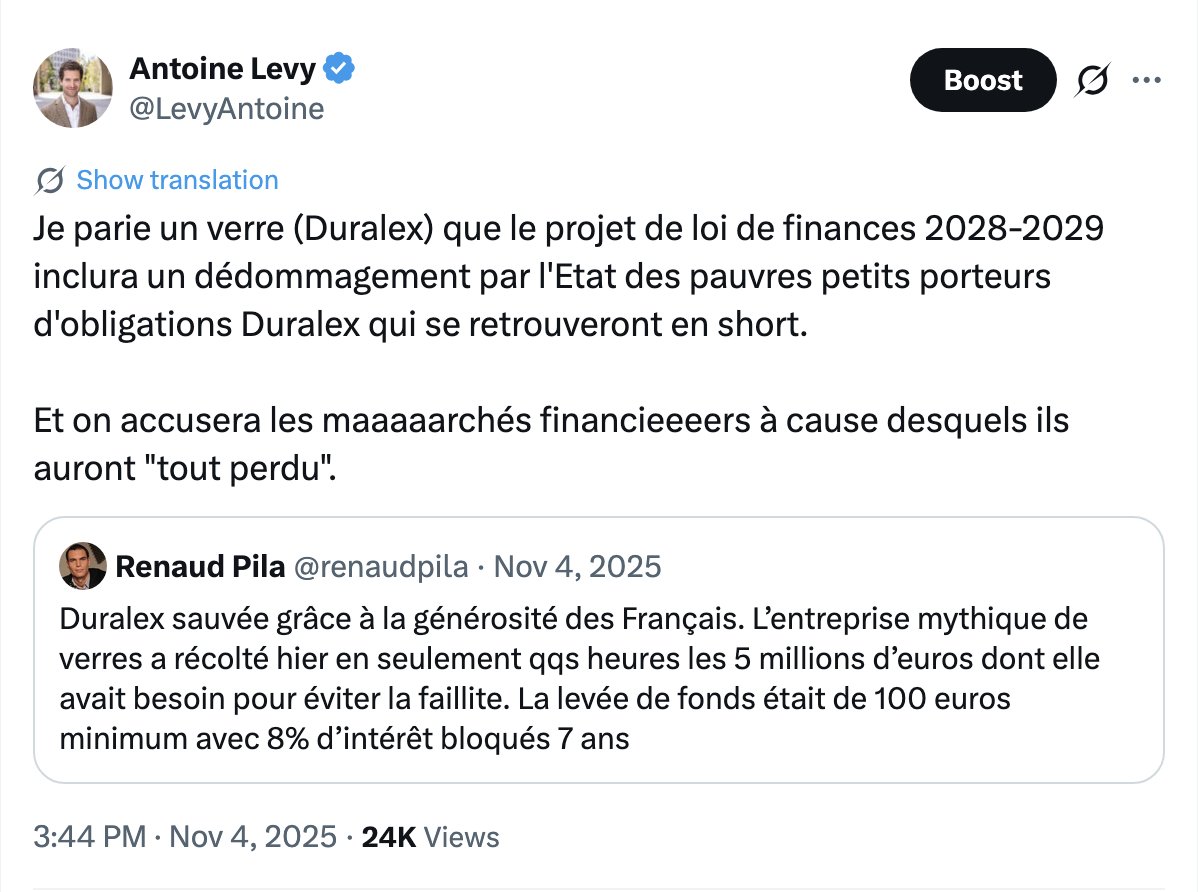
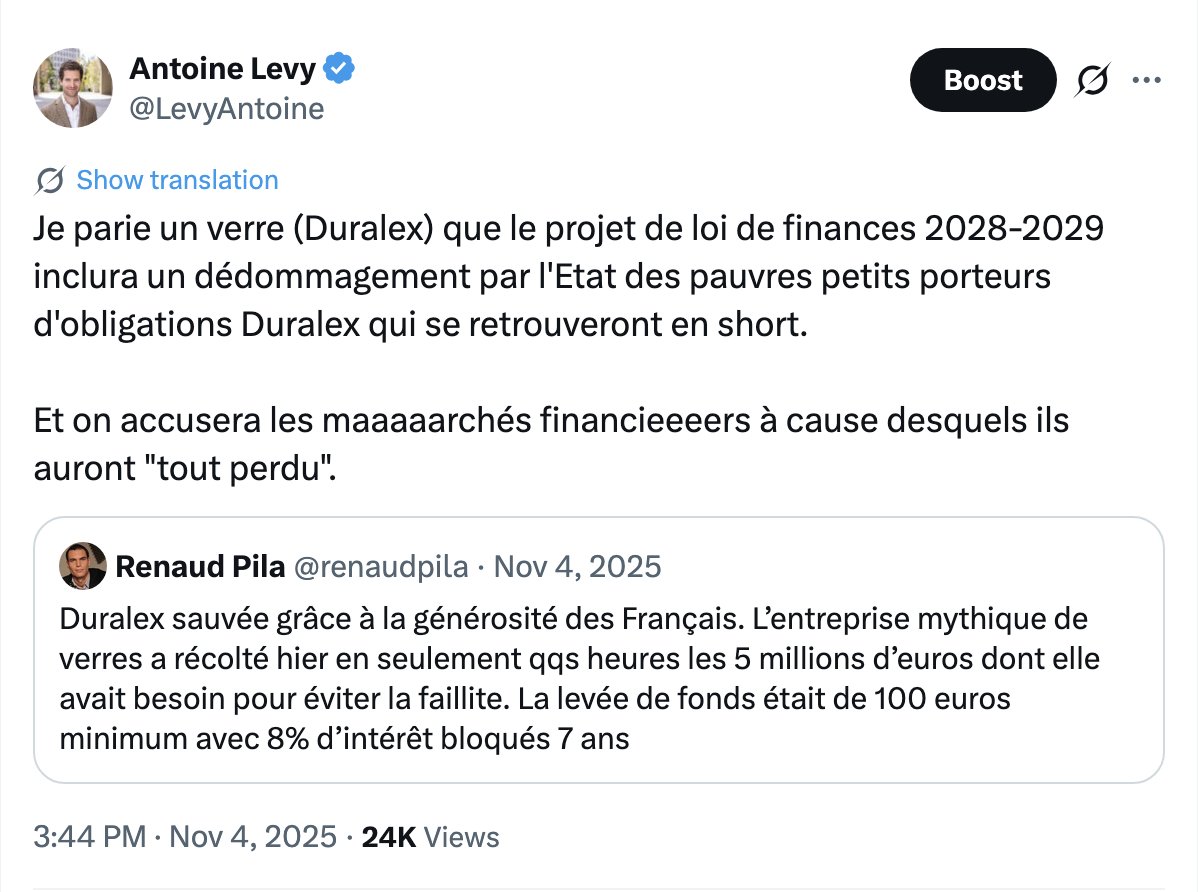
Je vais revenir sur cette histoire de Duralex, dont je plains sincèrement les salariés, parce que c'est un véritable scandale. En 2025, Duralex a levé une souscription d'environ 5 millions d'euros sur une plate-forme, LITA. Ces 5 millions devaient rapporter du 7%/an, avant d'être remboursables au bout de 7 ans. En pratique, après ce dépôt de bilan, les ~22 000 souscripteurs ne recevront probablement quasiment rien - comme absolument 100% des personnes capables de lire un bilan l'avaient prédit.
Antoine Levy tweet media
Brut FR@brutofficiel

Les salariés avaient sauvé l'usine en 2024, avant de lancer l'an dernier une souscription auprès des Français. (Photo : REUTERS)


Français
84
417
1.9K
330.8K
P. Stein
P. Stein@PStein59990336·
@Alea_ I don’t understand why the EU refuses to communicate clearly on this topic, notably why it takes long to become a member of the EU.
English
0
0
0
4
jck✨
jck✨@Alea_·
🛑 Ukraine Rejects German Compromise On EU Entry 🛑 Ukrainian President ZELENSKIY rejected a proposal to grant Ukraine a "partial member" status in the European Union, saying that, given the Ukrainian armed forces are defending the entire EU against Russian attacks, Ukraine should be granted full member-state status. In a letter to senior EU officials, ZELENSKIY said Kyiv's objective of becoming a full EU member remains unchanged and warned against so-called "half measures." "We have never regarded member-state status as joining some kind of 'half-union,'" he wrote. The statement appears to be Kyiv's clearest rebuke to date of German Chancellor MERZ's proposal. Last month MERZ proposed allowing Ukraine limited integration into EU institutions without full voting rights, a measure intended to balance the EU's enlargement ambition and commitment to Ukraine with some member states' concerns that accession is proceeding too quickly.
English
1
1
0
230
P. Stein
P. Stein@PStein59990336·
@LevyAntoine This is important. Currently, there is significant political capital being spent to convince people to invest - directly or via funds or pension products - in unlisted companies. There is a reason for this. However, we should not forget a lot of people can lose their money.
English
0
0
0
90
P. Stein
P. Stein@PStein59990336·
@MrLovenstein Frankly, even in that case, the bunny got it good.
English
0
1
57
10.2K
P. Stein
P. Stein@PStein59990336·
@vtchakarova Their actions don’t seem at all as coherent as you portray them to be though. Iran is a huge mess. China visit portrayed Trump as weak. Ukraine currently getting momentum in the war and unlikely to accept a ceasefire.
English
1
0
1
127
P. Stein
P. Stein@PStein59990336·
@Valen10Francois How do you take into account the fact that Bardella performs poorly in interviews? This has been MLP’s weak spot too.
English
1
0
1
497
François Valentin
François Valentin@Valen10Francois·
My basecase for quite a while now has been a Jordan Bardella presidency Not just because he regularly beats centrists as below But also because I'm not even sure centrists will reach the runoff. The space is crowded, the Macron presidency will be hard to dissociate from. The Melenchon train will pick up speed as it always does in presidential elections and soft left voters will be tempted to vote tactically. Melenchon has no shot at winning the runoff against virtually anyone. A lot can happen in a year "for sure", but it will take a major shakeup to stop Bardella.
France Elects 🇫🇷@FRElects

Poll for the second round of the presidential election : J. Bardella (RN) : 52% ✅ É. Philippe (HOR) : 48%

English
25
15
244
37.7K
P. Stein
P. Stein@PStein59990336·
@sc_cath C’est pas vraiment le sujet. S’il y avait un décalage de 10%, ça coute cher, mais c’est la vie dans l’absolu. Le sujet est que les 33% suffiront plus et qu’en réalité, c’est plus de 33%. La moitié du budget école, police, armée… tout pour les retraites. Et ça ne suffira pas.
Français
0
0
1
659
Sylvain Catherine
Sylvain Catherine@sc_cath·
Non, ce sont des maths. Même avec un rendement très « bon père de famille », un taux d'épargne global de ~20 % permet de lisser la consommation sur le cycle de vie. Ici, on parle de 33 % des salaires bruts pour la seule répartition, hors épargne privée, hors investissement immobilier… Ce sont des niveaux de cotisation très supérieurs à ce qui suffirait aux actifs pour financer leur propre retraite.
Sylvain Catherine tweet media
didier-schauber@DSchauber

@sc_cath "ce pourcentage est beaucoup trop élevé" toute votre théorie est basée sur cette affirmation gratuite.

Français
10
55
414
30.6K
P. Stein
P. Stein@PStein59990336·
@jeremiahscholl @JesusFerna7026 For a couple with around 2.5K each, that’s 60K taxable income. 2.5K tax if 2 kids, 500 tax if 3 kids. Every year, and it scales with revenue.
English
0
0
0
44
P. Stein
P. Stein@PStein59990336·
@jeremiahscholl @JesusFerna7026 The 3rd child is an entire tax part. Meaning, a family of 3 gets 4 parts, not 3. This reduces taxes by quite a lot in a country with progressive taxes.
English
1
0
0
52
Jesús Fernández-Villaverde
Jesús Fernández-Villaverde@JesusFerna7026·
Let me lay out the unpleasant arithmetic of the replacement rate, and why a modern society finds it so hard to reach. A population of 100 women in an advanced economy needs 210 children to replace itself. Why? Absent sex-selective practices, roughly 105 boys are born for every 100 girls. Evolution overshoots male births because boys are more prone to early death from accidents and disease. Therefore, of 210 children, about 108 are boys and 102 are girls. Not all girls reach the midpoint of their fertile age: accidents, suicide, homicide, and illness take some. In an advanced economy, about 98% of them survive, leaving 100 women to replace the original 100. Now consider the distribution of children per woman. Imagine 15 women have no children. Five do so by choice, for various reasons (professional, affective, religious). Ten face unfixable fertility problems, theirs or their partner’s. The 10% figure is conservative: the medical literature points to around 13%, and that does not even count male fertility problems. Of the remaining 85, 10 have one child, 60 have two, 10 have three, and 5 have four. I am stopping at four to keep the post concise; very few women in younger cohorts have five or more children, but I could adapt the example to account for them. Hence, the 100 women in this population have 180 children, for a completed fertility rate of 1.8. Interestingly, this is roughly the rate we saw in many advanced economies until the early 1990s, and in the U.S. until around 2008. But we are still 30 children short of replacement! Voluntary childlessness is only 5%. Three-quarters of women have two or more children. Look around: most of your friends will have two, plenty will have three or four. And yet, we are well below replacement. You would not look at this population and call it selfish (is having two kids hedonistic?) or accuse it of losing family values (only 5% of women are choosing voluntarily not to have children). The point is simpler. To reach 210 births, you need a substantial share of women to have three or more children. Two as the “normal” pattern will not get you there. And modern society makes three or more a costly proposition for most families. Of course, current fertility rates in most advanced economies are well below 1.8. But my point is that, under present social arrangements, we should not expect 2.1, even if (to humor last weekend’s debate) we banned smartphones and TikTok. We need many, many more families with three or four children. More pointedly, there is no self-regulating mechanism that pushes a society back to 2.1. The market-clearing analogy many economists use is flawed; scarcity feedback does not work the same way. (Another post on this another day.) And, as I often read, the claim that “nature” somehow regulates current overpopulation is just childish mumbo jumbo. So yes, the arithmetic of replacement rate is unpleasant.
Jesús Fernández-Villaverde tweet media
English
140
372
1.8K
1.5M
P. Stein
P. Stein@PStein59990336·
@pietercleppe @ecb Quite a lot of the worst-hit countries are outside Euro (Romania, N Macedonia, Georgia) or recently joined (Bulgaria). Switzerland’s case is very specific for a ton of reasons. Denmark is pegged to euro.
English
0
0
5
196
P. Stein
P. Stein@PStein59990336·
@JesusFerna7026 @bluegod If the transmission of social norms is an accelerator, how come there is no direct link between progressive countries and fertility? And what about countries like France, which are relatively progressive, but has gone from 1.85 to 1.65 in 10 years.
English
0
0
0
157
Jesús Fernández-Villaverde
Jesús Fernández-Villaverde@JesusFerna7026·
Smartphones are not the explanation for the recent decline in fertility. Instead, they are an accelerator of deeper forces already at work. Let’s start with the facts. Fertility is falling almost everywhere: in rich, middle-income, and poor countries; in secular and religious countries; and in countries with high and low levels of gender equality. The decline accelerated around 2014. So, no country-specific explanation will work unless you are willing to believe that 200 distinct country-specific explanations arrived at roughly the same time. Smartphones look like the obvious candidate: the first iPhone was released in 2007, and global adoption has been astonishingly fast. Economists understand the first major decline in fertility in advanced economies, from 6 or 7 children per woman throughout most of human history to about 1.8, that occurred between the early 1800s and roughly 1970, well before smartphones. The main drivers were a sharp fall in child mortality (effective fertility was rarely above 3 and often close to 2) and the shift from a low-skill, rural agrarian economy to a high-skill, urban industrial one. We have quantitative models that fit these facts well. Country-specific factors mattered too, of course. Proximity to low-fertility neighbors accelerated Hungary’s decline, while fragmented landowning structures accelerated France’s. But these were second-order mechanisms. This is also why most economists long considered Paul Ehrlich’s doom scenarios implausible. We forecast that fertility in middle- and low-income economies would follow the same path as in the rich, probably faster, because reductions in child mortality reached India or Africa at lower income levels (medical technology is nearly universal, and most gains come from handwashing and cheap antibiotics, not Mayo Clinic-level care). Much of what we see in Africa or parts of Latin America today is still that old story. But in the 1980s, a new pattern appeared. Japan and Italy fell below 1.8, the level we had thought was the new floor. By 1990, Japan was at 1.54 and Italy at 1.36. This second fertility decline began in Japan and Italy earlier than elsewhere, driven by country-specific factors, but the underlying dynamics were widespread: secularization, an education arms race, expensive housing, the dissolution of old social networks, and the shift to a service economy in which women’s bargaining power within the household is higher. The U.S. lagged because secularization came later, suburban housing remained relatively cheap, and African American fertility was still high. U.S. demographic patterns are exceptional and skew how academics (most of whom are in the U.S.) and the New York Times see the world. My best guess is that, without smartphones, Italy’s 2025 fertility rate would be about 1.24 rather than 1.14. I doubt anyone will document an effect larger than 0.1-0.2. Italy was at 1.19 in 1995, not far from today’s 1.14. The TFR is cyclical due to tempo effects, so I do not read too much into the rise between 1995 and 2007 or the decline from 1.27 in 2019 to 1.14 today. The direct effect of smartphones is not zero, but it is not, by itself, that large. Where social media, in general, and smartphones, in particular, matter is in the diffusion of social norms. What would have taken 25 years now happens in 10. Social media are not the cause of fertility decline; modernity is. But they are a very fast accelerator. That is why social media are a major part of the story behind Guatemala (yes, Guatemala) going from 3.8 children per woman in 2005 to 1.9 in 2025. Without them, Guatemala would also have reached 1.9, just 20 years later. Modernity, in its current form, is incompatible with replacement-level fertility. By modernity, I do not mean capitalism: fertility fell earlier and faster in socialist economies than in market economies. Socialist Hungary fell below replacement in 1960, and socialist Czechoslovakia in 1966 (both experienced small, short-lived baby booms in the mid-1970s). By modernity, I mean a society organized around rational, large-scale systems and formalized knowledge. Countries will not converge to the same fertility rate. East Asia is likely stuck near 1, possibly below, given its unbalanced gender norms and toxic education systems. Latin America faces the same gender problem plus weak growth prospects, so I expect something around 1.2. Northern Europe has more egalitarian family structures and might hold near 1.5. The very religious societies are probably the only ones that will sustain 1.8. All of this could change with AI or changes in population composition. We will see. But on the current evidence, deep sub-replacement fertility is the “new new normal.” Unless we reorganize our societies, better learn to handle it as best we can.
Jesús Fernández-Villaverde tweet media
English
222
919
3.7K
891.6K
P. Stein
P. Stein@PStein59990336·
@lugaricano « You can’t be fooled if you’re already an idiot. »
English
0
0
1
186
Acyn
Acyn@Acyn·
Trump on Taiwan: When you look at the odds, China is very, very powerful, big country. That's a very small island. Think of it, it's 59 miles away. We're 9500 miles away. That's a little bit of a difficult problem. Taiwan was developed because we had presidents that didn't know what the hell they were doing. They stole our chip industry.
English
1.2K
1K
3.5K
2.6M
P. Stein
P. Stein@PStein59990336·
@LevyAntoine Ok, but how can they even increase given overall revenue?
English
0
0
0
685
Antoine Levy
Antoine Levy@LevyAntoine·
This is a really important fact, common to many major cities, which I discussed with L’Express for the cases of Paris and NYC recently. Most people in these places do not pay market rents, and while potentially providing valuable insurance, that’s a contributor to the housing shortage.
Antoine Levy tweet media
Daniel Golliher 🗽@danielgolliher

English
5
20
129
26.4K
Jeremy Cliffe
Jeremy Cliffe@JeremyCliffe·
Quite aside from the Starmer drama, it is remarkable how utterly absent the realities of today's EU are from current UK debates about reset/rejoin etc. Both neo-remainers and neo-leavers are peddling a "back to 2016" button that doesn't exist.
English
12
31
168
25.6K
P. Stein
P. Stein@PStein59990336·
@izakaminska @amonck Europe has a full interest in pooling ressources especially without the US. National militaries in each MS would consume huge budgets.
English
0
0
0
33
Izabella Kaminska
Izabella Kaminska@izakaminska·
My point is more that 'cohesive Europe' was only ever possible because American supervision (and subsidies) enabled it. What's pretty incredible, really, is the degree to which American "supervision" was not more popularly understood by the people of Europe. This speaks to the skill with which America masked its influence and control over Europe. Whether Europe can remain cohesive without American supervision is the question at hand.
English
3
0
15
1.8K
P. Stein
P. Stein@PStein59990336·
@izakaminska Is it an ideological divide, or is it just the US wanting to do whatever it wants?
English
0
0
0
449
Izabella Kaminska
Izabella Kaminska@izakaminska·
I think we need to be blunt about what's happening. The EU is trying to Brexit the Pax Americana system, because of a fundamental ideological breakdown over who gets to call the shots over how rents are collected from the people and how they are later distributed. And some other stuff, such as freedom of speech. x.com/izakaminska/st…
English
9
20
100
12.3K