Patty

50 posts

Patty

Patty

@Patty_H93

Katılım Nisan 2026
83 Takip Edilen3 Takipçiler
Patty
Patty@Patty_H93·
@bryan_johnson @BittBurger The increase in data/demand will far outpace supply of medical expertise and availability.
English
0
0
0
107
Bryan Johnson
Bryan Johnson@bryan_johnson·
@BittBurger I understand their perspective. More data is intimidating and creates a lot of new responsibility and liability risk. Doctors will have help though with AI tools so they'll be in a stronger position overall. It's just the unknowns in this transition that they're reacting to.
English
7
2
107
5K
Bryan Johnson
Bryan Johnson@bryan_johnson·
The Midjourney scanner is revolutionary. There’s a bullish case that exceeds the most optimistic takes. I was at the unveiling and used the scanner myself. I personally want to experiment with a weekly whole body Midjourney scan to add to my 1.5 billion data points and let my AI and doctors start connecting the dots. Most of the early commentary has focused on the wrong questions: “is it as good as MRI?” and “what about false positives?” These are legitimate concerns, but they miss the bigger shift. The more important question is: what does fast, low cost, safe whole body imaging unlock? Let’s start with measurement. A speedometer tells you how fast you are going. A fuel/battery gauge tells you when to stop. A thermostat tells you what to wear. The stock price tells you how much money you’ve made or lost. We measure what we care about. Except, oddly, for our bodies, which are among the least measured things in our lives. Most people have more data on their favorite sports team, bank account, and social media performance than their body. The future will think we were crazy for this. The first law of medicine is to do no harm. Our current system has harm baked into it. + an undiagnosed condition progressing silently is harm + a doctor who can’t easily get a patient screened preventively is harm + having no baseline to compare against when something shows up is harm Our preventive net is narrow and inconsistent. Late stage diagnoses that could have been caught earlier remain common. Midjourney’s technology won’t eliminate that overnight, but it points toward a future where routine wholebody baselines become normal rather than exceptional. Midjourney can help flip harm-by-default into a new expectation for our health infrastructure: almost no one will ever again be blindsided by a late-stage, life-threatening diagnosis that could have been caught earlier reasonably and cost-effectively. Some examples of what earlier structural visibility enables: + breast cancer caught while localized has a ~99% five year survival rate. Once it has spread distantly, that drops to around 32%. + an abdominal aortic aneurysm kills more than 8 in 10 people when it ruptures. A single ultrasound finds the aorta in 99 percent of people, and screening cuts aneurysm deaths by a third to a half. Midjourney’s technology will not do it all on its own. Its full angle, water immersion approach works around bone rather than seeing through it, and routes bowel gas to image the full abdominal cross section. Yet two real limits remain: air filled lungs stay a blind spot even here, and the brain is out of reach behind the skull, beyond the torso and legs this scanner covers. That is fine, and they may improve these areas over time. Midjourney doesn’t need to do it all in order for it to be one of the biggest things to hit medicine in a long time. Let’s look at where specifically Midjourney may be useful to each of us. We’ll start with where we get data today: 1) Blood draws tell us what is happening chemically. 2) Wearables tell us how the body is functioning. 3) Imaging tells us what is happening structurally. The third layer, soft tissue, is the one we have never been able to access easily. MRI is great, but it is expensive, intimidating, and slow. Midjourney's technology excels with soft tissue. Here are three places it could be game changing. There are many more. 1. Metabolic health - fatty liver is one of the earliest structural signs of metabolic dysfunction. It’s strongly linked to insulin resistance, type 2 diabetes, and cardiovascular risk. Being able to track visceral fat, muscle fat infiltration, and liver fat over time could give a much clearer picture than blood markers alone. Over 88% of Americans are metabolically unhealthy. 2. Endocrine tissue - the same metabolic patterns often cluster with thyroid issues, PCOS, and hypogonadism. Ultrasound can directly image the thyroid and ovarian structures. Fat tissue itself is an endocrine organ, so tracking it structurally adds another useful data layer. 3. Soft tissue + multiomics - new proteomic aging clocks can already predict risk for many chronic diseases from blood proteins. These molecular models could become significantly more powerful when combined with actual structural imaging data. The two are complementary, not competitive. The real advantage: baseline + longitudinal tracking The biggest unlock isn’t a single scan. It’s having a baseline followed by regular follow-ups. A one off scan in a moment of concern turns every finding into a potential crisis. Without context, you have no idea whether something is new, stable, or changing. With baseline + repeated measurement, the question changes from “what is this?” to “is this changing?” Most incidental findings stay stable. The dangerous ones tend to grow or evolve. Trajectory is often more informative than any single image or timepoint.This is why false positives become more manageable with frequent, low-friction imaging. Midjourney has a difficult road ahead. Building robust, clinically validated medical hardware and software is extremely hard. Regulatory, technical, and adoption challenges shouldn’t be understated. Also, David is doing this for the right reasons and he’s well positioned financially to push through the difficulty. On the horizon We are moving quickly into a future where we will have continuous biological measurement. It will be all around us, a lot of it invisible and autonomous. Measurement will be in our gyms, beds, homes, clothing, offices, cars, glasses, and wearables. It will also be inside of us, in tissue and circulating in our blood vessels. This moves us from managing crises to preventing them. But this future will not just show up. We need bold builders like David and his team, willing to do the hard work.
Midjourney@midjourney

A technical dive inside our new "Midjourney Scanner"

English
142
390
4.9K
569.4K
Patty
Patty@Patty_H93·
@omninomsky @DudeWhoInvests I still think this proves that the capability is improving. Well documented, routine , verifiable back office work is at risk. Maybe not within large organizations , since governance , risk , red tape exists. But other players/competitors that can build a system from ground up
English
0
0
0
17
Patty
Patty@Patty_H93·
@omninomsky @DudeWhoInvests So, this isn’t an argument about power of LLMs but how to steer them and the incapabilities of humans at large
English
1
0
0
17
Patty
Patty@Patty_H93·
@omninomsky @DudeWhoInvests Fair. My point is more so , the tool keeps checking all the boxes and doing things previously thought of as difficult , even impossible. I want to be proven wrong and to see plateaus badly lol
English
1
0
0
15
MJY
MJY@omninomsky·
Again, no offense to these people. But these are toys. Cool toys. Impressive toys. But they're not even approaching the kinds of problems I'm talking about. People don't rely on these systems at scale. They don't have to consider regulations and policies. It doesn't have to be audited. If it breaks, we don't have to worry about an actual outage that someone has to fix. I can go on.
English
1
0
0
18
Patty
Patty@Patty_H93·
@omninomsky @DudeWhoInvests This is how I felt and feel about lesser models. But all the output from fable - small prompts creating game prototypes , cyber capabilities , benchmark scores..all point to efficiency gains and better agentic output ..it’s unfathomable but hard to refute. Look here:
Taelin@VictorTaelin

this is my personal singularity moment this post may sound like a paid ad. I only wish. I'm concerned, more so than happy. the world is changing, and, among the scenarios where AI goes terribly wrong, inequality is the most realistic, yet, the one Anthropic seems to be the least concerned about. I'm glad OpenAI is taking the opposite stance: *personal AGI for everyone*. I think this is a commendable position in the times we live. but who am I in the queue of the bread? anyway, Fable is here, so I'll just report my first-hour experience first of all, all my pet prompts are solved. → λ-calculus puzzles → bug questions → one-shot apps all are trivial to it. I don't have anything harder other than my ongoing work so, in the last several days, I've been toying with HVM5, a new interaction net evaluator with a faster loop. after writing the first version, I left 32 GPT-5 agents working for ~20 hours each. this resulted in up to 2x speedups, but the file size increased by 2-fold and quality decreased significantly. I then simplified the whole thing into an even simpler core, and left Opus 4.8 and GPT 5.5 optimizing it for 8 hours. Opus got a legit 6% - 34% speedup in most benches. GPT got better results, but, sadly, an unusable file. I then asked Fable to optimize it. 2 hours later, it landed a 1770% speedup in one case, 100%+ in other 4, and 22% in average. yes, in 2 hours it outperformed me, opus 4.8 and a swarm of gpt 5.5 agents, by one order of magnitude. that could not possibly be legit. "it must be hardcoding the benchmarks" (GPT trauma). so I read its explanation and what it did was, indeed, the most high impact optimization one could try first. seems like HVM5 was wasting a lot of time garbage-collecting unused branches of pattern-match nodes. I had optimized that for static mats, but not for dynamic mats. skill issue. Fable figured how to do it for these, resulting in a massive speedup in some benches but wait, is that *correct*? I'm not sure yet, it is credible, but this is the kind of thing that is very easy to get wrong on interaction nets. the problem is, when I was ready to start auditing Fable's solution so I could tell whether it was buggy or legit, it interrupted me to tell me it had found a massive bug on the code *I* had written. ... wait, what? so... for garbage collection purposes, I stored a bit on lambda term pointers that meant "the variable bound by this lambda has been freed, so, its lambda must free whatever argument it is applied to". that's fine. yet, on duplicator nodes, I also used the same bit to mean "one of the duplicated variables was freed, so, treat this dup as a passthrough no-op". so, if a lambda entered a duplicator, it would mistake the lambda's collection bit for its own, resulting in corrupted interaction! that's a mouthful, why I'm writing this? just so you can appreciate the sheer absurdity of what just happened. I didn't ask it to find bugs. I asked it for an optimization. and even if I did ask it to find bugs, this bug is so astonishingly subtle and specific, identifying it takes mastering the domain to an extent that it beyond even me. I'd easily need hours or days to fix it, *if* I ever came across it. chances are it would just go unnoticed. and Fable found it and fixed it like it was nothing, while it was busy adding a 17x speedup to a file that neither I, nor Opus 4.8, nor a fleet of GPT 5.5 managed to barely make 2x faster. oh and there is also another tab where it is also ripping through Bend's codebase and finishing everything I had to do I don't know what to say anymore this isn't about Anthropic or OpenAI, this is about our collective future as a species. the world is changing, and we need to be aware of it, and discuss how to handle this change. receipt below . . .

English
1
0
0
40
MJY
MJY@omninomsky·
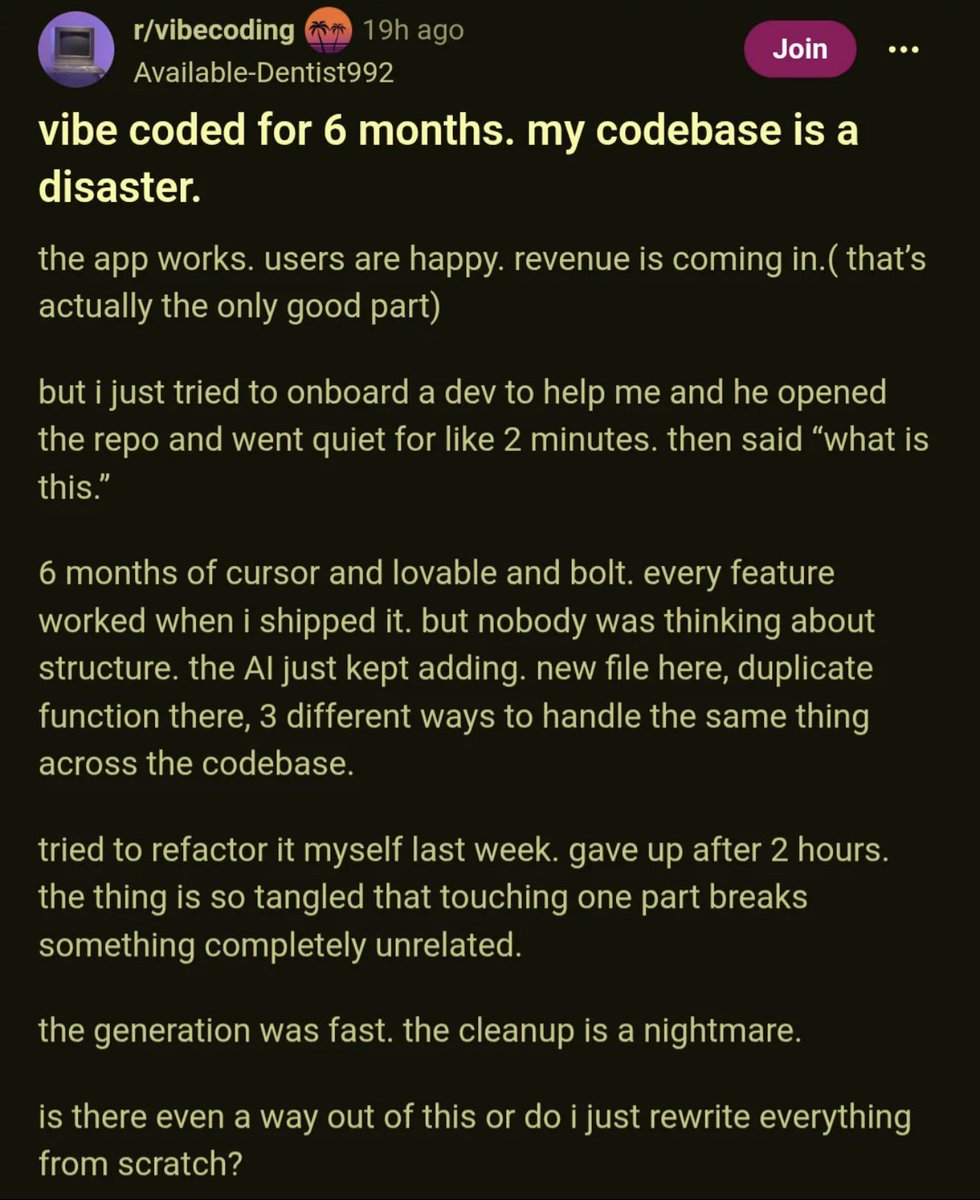
I get the concern but the other thing I believe we're going to see over this correctional year is the reality of what AI is actually capable of. People who work with it regularly already intuitively know these limitations. There are papers by companies and research orgx that also discuss these issues. Ultimately, AI is a force multiplier but not necessarily in the right direction. This is true in any field. In the hands of seasoned veterans, AI can be used to move quickly in the right direction. After that, things can degrade quickly. Consider the attached image for example. AI well do what you ask but it may only be slightly better than a monkeys paw. It's not guaranteed cursed, but lack of domain knowledge can quickly lead to unmanageable resources. Companies that too aggressively drain their expertise will face this. Some already have. Many are realizing that the hype from Anthropic/OpenAI/Nvidia/Oracle etc is just that. Fear based marketing to instill FOMO in the public and scare them into aggressive adoption or be left behind. But LLMs face fundamental problems that incremental advancements won't fix. First; human language is naturally ambiguous. Words have multiple meanings. The same sentence can mean different things. This means hallucinations aren't going away. This means domain experts have to monitor. This leads to the second problem. LLMs are stochastic in nature. Even when trying to run LLMs deterministically, a slight difference in input means massive difference in output. In software, that means an entirely new code base that has to be reviewed for correctness. And we see the downstream effect; developers spending the time they'd where they'd be coding reviewing AI code instead. Net 0 on ROI (before factoring in token expense). This leads to the final issue and perhaps the biggest hurdle. AI models have finite attention. They're incredible on a small set of focused tasks per prompt. But if you combine prompts into a bigger prompt (add more tasks, increase scope) the AI has to split its attention across everything. As this increases, the AI predictably compensates in ways that don't work. So for simple demos, and small amounts of work, it does great. With experts who know how to break down the tasks correctly and knows what a correct solution looks like it's great. But for everyone else? Not so much. Resolving these problems will require major research breakthroughs. I don't think we'll see them within the decade.
MJY tweet media
English
2
0
0
56
Patty
Patty@Patty_H93·
@omninomsky @DudeWhoInvests Incentives will be for investment in on prem compute and reduction in force..unemployment will rise
English
0
0
0
10
Patty
Patty@Patty_H93·
@omninomsky @DudeWhoInvests But if the open models become SOTA in 5/6 months..and continue to accelerate..wouldn’t that be worse for labor market/economy/investment? Cost of token capital being high is good for already expensive human capital. If the models become more capable and cheaper , that seems bad..
English
2
0
0
19
MJY
MJY@omninomsky·
@Patty_H93 @DudeWhoInvests Right, I think LLMs are definitely here to stay. I think AI/AI adjacent companies betting the farm on hyperscalers will come time bite back hard.
English
1
0
0
21
Patty
Patty@Patty_H93·
@omninomsky @DudeWhoInvests I think LLM usage will continue to rise and the next move will be to cheap open weight models. What that means for asset prices , I’m not sure.
English
1
0
1
21
MJY
MJY@omninomsky·
@DudeWhoInvests It absolutely is in one. But the dot-com kind, not the tulip kind.
English
1
0
0
34
Patty retweetledi
Al Carns
Al Carns@AlistairCarns·
This week the most advanced AI model on the planet got switched off by a foreign government. British researchers were studying it. British companies were testing it. British hospitals were piloting it. Not any more. This isn't an AI story. It's the story of every industry we used to lead. Britain has some of the best AI talent in the world. DeepMind was built here. Our AI Safety Institute writes the rules other countries follow. We have the researchers, the universities, the standards. What we don't have is the power stations to run the data centres, the planning system to build them, or the industrial base to make the chips. So the work happens here and the value lands somewhere else. We invent. Others build. Others decide. Then we read about it on Saturday morning. Same story as the kit our soldiers don't have. Same story as the factories we used to. I spent nine months in government making this argument inside the room. I'll make it louder from outside.
Anthropic@AnthropicAI

The US government, citing national security authorities, has issued an export control directive to suspend all access to Fable 5 and Mythos 5 by any foreign national, whether inside or outside the United States, including foreign national Anthropic employees. The net effect of this order is that we must abruptly disable Fable 5 and Mythos 5 for all our customers to ensure compliance. Access to all other Claude models is not affected. We apologize for this disruption to our customers. We believe this is a misunderstanding and are working to restore access as soon as possible. Read our full statement: anthropic.com/news/fable-myt…

English
667
1.3K
8K
1.1M
Marius Hobbhahn
Marius Hobbhahn@MariusHobbhahn·
Reminder that the last 12 months are plausibly the least crazy months of AI for the rest of your life! It's only getting crazier from here ...
English
2
29
360
10.7K
Brian O'Connor
Brian O'Connor@brioooc·
@MatthewBerman Uhm How about a genuine worry about the potential to wreak havoc on infrastructure that Amazon benefits from remaining stable?
English
2
0
3
885
levi ioffe
levi ioffe@realLeviIoffe·
@billyhumblebrag “imagine the worst possible thing for me to get” Anthropic has a team of slaves in the Philippines typing out every query by hand?
English
4
0
170
5K
billy
billy@billyhumblebrag·
Its so over. Zitron about to drop the bomb. Load up on puts. This is the big one.
billy tweet media
English
28
5
195
133.1K
Patty
Patty@Patty_H93·
@kimmonismus This honestly makes me bearish on eventual ASI
English
0
0
0
139
Chubby♨️
Chubby♨️@kimmonismus·
Google DeepMind published a 60-page paper mapping the road from AGI to superintelligence, written by Hutter, Legg, and Genewein. No hype, just a sober analysis The paper uses three levels. AGI = roughly average human performance across most cognitive tasks. ASI = a system that beats large, well-coordinated groups of human experts across virtually everything (their bar: tens of thousands of experts working ten years on one problem). Universal AI / AIXI = the theoretical ceiling, uncomputable, only approachable from below. Then they explore the question of how this could be achieved: Scaling compute, models, and data, the continuation of the trend that drove the breakthrough so far. It is the only path with historical data available for extrapolation. The core question: Does quantity transform into quality? Even if individual models plateau, the sheer act of running millions of faster AGI instances could trigger the leap. (A quick aside: that is a fascinating philosophical idea. It always reminds me of Hegel’s dialectic, the notion that quantity transforms into quality. We ought to start drawing on philosophical theories to make sense of the future.) Algorithmic paradigm shifts: a genuine break from the transformer pretraining paradigm. New architectures, new learning methods. However, hard to predict by definition. Recursive self-improvement: AI accelerates AI research, which produces better AI, which accelerates research further. Multi-agent coordination: superintelligence emerges from large collectives of AGI agents working together, like automated corporations or AI economies. Collective intelligence potentially far exceeding any individual model. The authors naturally point to what I repeatedly describe as the biggest bottleneck: energy. I recently linked to a few graphs showing, on the one hand, the extent to which energy is already becoming a problem and, on the other, how China dominates the expansion of both nuclear and solar energy in the global race. But the authors also address a profound shift in the world of work in a post-AGI era. I would say this is a reality we must face. So, it is not just about scaling, but also about whether the underlying conditions - such as energy and hardware - can be effectively established. Six things that could slow or stop all of this: The data wall. Quality training data runs out, possibly before the end of this decade. Resource demand grows too fast. Energy, chips, rare earths, investment. The physical infrastructure can't scale arbitrarily. The neural paradigm hits a ceiling. Pretrained transformers plus fine-tuning may not be enough to reach AGI, let alone go beyond it. Research gets harder. Keeping Moore's law going already needs 18x more researchers than in the 1970s. Ideas are genuinely harder to find as fields mature. The abstraction barrier. Models trained on human concepts may never invent new ones from scratch. Saturating GPQA or SWE-bench shows mastery of what humans already worked out, not the ability to go beyond it. Train only on pre-Newtonian physics and you won't reason your way to relativity. Deliberate slowdown. Regulation, accidents, public backlash. Real, but likely countered by the competitive pressure between companies and nations. I think it’s great that Google is addressing questions such as which paths they believe lead to AGI, what the road to ASI might look like, what challenges will arise, and much more. Overall, however, it sounds to me like all of this could actually succeed, making it, in that sense, a call to discuss and reflect on the consequences.
Chubby♨️ tweet media
English
62
183
1.3K
80.1K
Dawn Song
Dawn Song@dawnsongtweets·
Everyone says the latest AI agents will be "job-ready" soon, especially after the release of Fable 5 this week. But is that really the case? Over the past many months, my group and collaborators have been building Agents' Last Exam (ALE), a benchmark designed to test exactly that claim on real digital labor-market work. My group and collaborators previously have created many of the benchmarks the field runs on, including MMLU, MATH, CyberGym, and ExploitGym. Today, I'm excited to share Agents' Last Exam (ALE): a rolling benchmark that measures whether AI agents can actually perform economically valuable work across a broad range of real-world domains. With ALE, we evaluated Fable 5, GPT-5.5, Composer 2.5, and other frontier agent systems across more than 1,500 expert-sourced tasks spanning 55 occupations. The result is both impressive and sobering. Today's agents can solve a meaningful fraction of professional tasks. But when we look at the hardest tasks, the ones requiring sustained reasoning, deep domain expertise, and reliable execution over long horizons, they are still far from human-level performance. On ALE's hardest tier, every frontier agent we tested, including Fable 5, achieved a 0% success rate. The age of useful agents is here. The age of truly job-ready agents is not. We hope Agents' Last Exam (ALE) will serve as a new guidepost and north star for developing agents capable of reliably performing economically valuable work across a broad range of domains. 🧵
Dawn Song tweet media
English
62
206
965
276.9K
Patty
Patty@Patty_H93·
@casoxbt In the fabled 5 release deck there were signs of neuralese and anthropic is probably far ahead of OAI now..
English
0
0
0
16
caso
caso@casoxbt·
ai 2027 check-in (do you remember this?) ✅ on track: - AI now writes AI (80%+ of anthropic's code) - METR task horizons doubling ~4mo - cyber going nuclear (mythos: 10k+ critical bugs) ❌ off track: - no neuralese - no single dominant lab - no geopolitical takeoff ai-2027.com
English
1
0
0
217
prinz
prinz@deredleritt3r·
@AndrewCurran_ Still not a fully formed opinion (I need to read through the documents released today carefully), but I have the exact opposite impression.
English
2
1
30
2.5K
Andrew Curran
Andrew Curran@AndrewCurran_·
The internal boost from Mythos-assisted development since February is just too big. Anthropic is pulling away from the pack for the first time, and at the same time they are also speeding up. The race legitimately feels like it is changing for the first time in years.
English
24
41
762
100.9K
Patty
Patty@Patty_H93·
@gigglefartninja @beffjezos The absolutely insane idea that coding will be solved and a swarm of agents will run most workflows..it’s seemingly looking like a plausible reality..can’t fathom it
English
1
0
0
16
local man
local man@gigglefartninja·
@beffjezos my Claude Code sessions went from "solid autocomplete" to "wait did it just autonomously refactor my entire codebase and explain why my approach was wrong" real quick. Fable is a different animal. been posting daily builds on my profile if anyone wants receipts
English
1
0
0
432