Adam Paulisick

4.6K posts

Adam Paulisick banner
Adam Paulisick

Adam Paulisick

@paulisick

CEO/Founder @SkillyAI.com (Service as a Software) ex @BCG @Nielsen via 3x acquisitions - Prof @SCSatCMU - maad Scientist @maadlabs - life w/ @ashleycecil

Katılım Haziran 2010
349 Takip Edilen2.5K Takipçiler
Matt Zieger
Matt Zieger@mattzieger·
How many URLs do you personally own?
English
1
0
0
87
Adam Paulisick retweetledi

Aaron Levie
Aaron Levie@levie·
Jevons paradox is happening in real time. Companies, especially outside of tech, are realizing that they can now afford to take on software projects that they wouldn’t have been able to tackle before because now AI lets them do so. We’re going to start to use software for all new things in the economy because it’s incrementally cheaper to produce. Marketing teams at big companies will have engineers helping to automate workflows. Engineers in life sciences and healthcare will automate research. Small businesses will hire engineers for the first to build better digital experiences. And as long as AI agents still require a human who understands what to prompt, how to review when an agent goes off the rails, how it guide back, how to maintain the system that was built, how to fix the ongoing bugs, and more, we will still have humans managing these agents. This is why all the advice you get of not going into engineering is wrong. The world is going to increasingly be made up of software, and the people that understand it best will be in a strong economic position. This will happen in other roles as well where output goes up and demand increases.
Lenny Rachitsky@lennysan

Engineering job openings are at the highest levels we’ve seen in over 3 years There are over 67,000 (!!!) eng openings at tech companies globally right now, with 26,000 just in the U.S. We don’t know if there would have been more open roles if not for AI or if AI is actually leading to more open roles, but since the start of this year, the increase in open eng roles is accelerating even more.

English
226
654
4.7K
1M
Lenny Rachitsky
Lenny Rachitsky@lennysan·
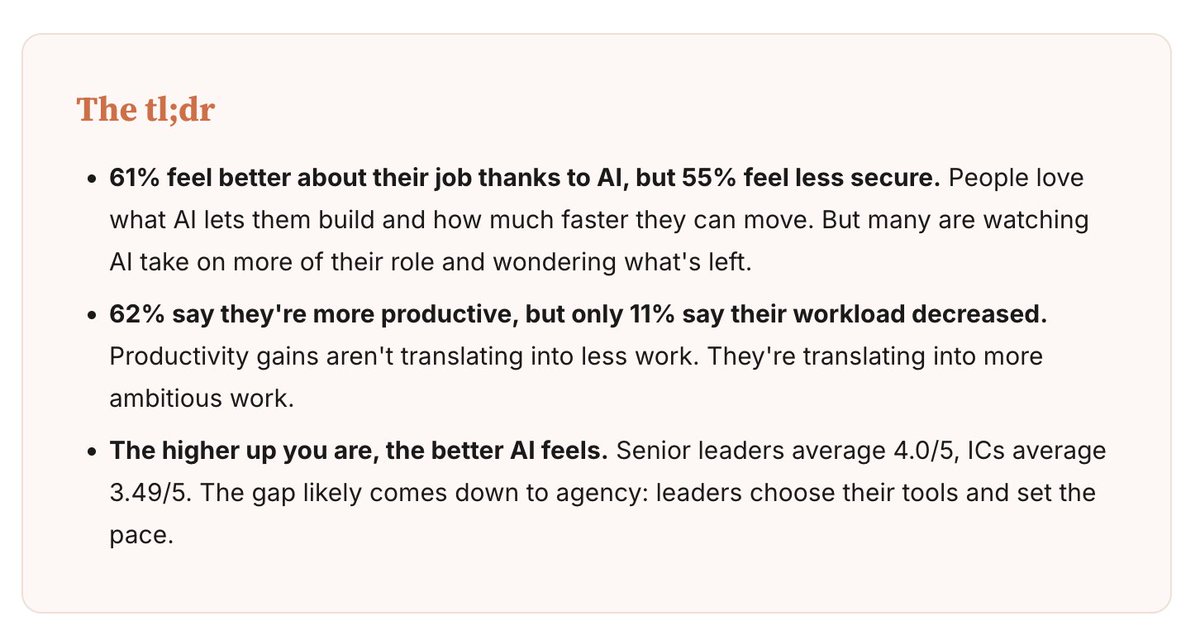
The results from our latest reader poll: How has AI changed how you feel about your job? The short version: most people better about their work with AI, and yet also less secure in their role. People are also feeling more productive, but almost no one feels their workload has actually gone down. Respondents shared a fascinating mix of feelings: a sense of childlike wonder, coupled with deep frustration about the impossible pace of change and suffering from AI slop everywhere. (Shoutout @noamseg for running this poll, and to everyone who participated)
Lenny Rachitsky tweet media
English
38
6
68
11.4K
Adam Paulisick retweetledi
Yuri Sagalov
Yuri Sagalov@yuris·
Waymo should let people buy the cars. They should then allow users to decide if they want the car dedicated to them or optionally enter it into Waymo service during certain times and hours (eg while they’re at work).
English
31
8
162
22.6K
Adam Paulisick
Adam Paulisick@paulisick·
@thinkshiv I hear you @thinkshiv but if cos are built to de-risk/amplify long term value (in theory) and the volume of distribution/macro everything pretty much gives them a 1-2 year buffer because other folks share the mindset is it all just marketing for inflated acquisitions?
English
0
0
0
10
Shiven Ramji
Shiven Ramji@thinkshiv·
If you are enterprise leader and are dependent on reports like this you’re ngmi ☠️
Alex Lieberman@businessbarista

It's crazy how slow big enterprises are moving. On March 12, Deloitte published it's State of AI report, a 41-page analysis of AI's diffusion in the enterprise. The content was solid, there was just one issue... The 3,235 director-to-csuite-level respondents were surveyed in...wait for it...August to September 2025. This entire report is based on data that is 6-7 months stale, which in the world of AI, is pre-historic. Just think about how much the technology has changed and improved since then: 1) Coding agents went from fine to exceptional. Anthropic launched Claude Sonnet 4.5 in late September 2025 with major gains in coding, agents, and computer use, then followed with Opus 4.6 and Sonnet 4.6 in early 2026. 2) AI started producing native work products, not just text. OpenAI positioned GPT-5.2 and GPT-5.4 around professional work like spreadsheets, presentations, code, long-context reasoning, and tool use. 3) Security agents emerged as a serious new category. OpenAI launched Codex Security (formerly Aardvark) as an autonomous security research preview, and Anthropic launched Claude Code Security. 4) OpenClaw was released in November 2025. It became one of the fastest-growing projects in GitHub history & could have massive implications in the enterprise as governance & data security is figured out. All of this to say, you now have hundreds of thousands of leaders basing their view of their own organization's AI strategy & progress on a picture that is literally half a year old. It's both incorrect & potentially problematic if it leaves execs saying "we're exactly where we need to be on AI relative to our peers." If you're a leader: - Stay current: AI is moving so quickly, it actually matters that you stay on top of the news cycle because consequential model releases & product updates are happening weekly. - Go deep: Most executives don't understand the technology. Don't build your foundation of knowledge on a house of cards. Watch a @karpathy youtube video & get to the heart of what makes LLMs & their current architecture so powerful. - Stay close to the work: the only way to "own AI transformation" is to deeply understand what needs to be transformed. mastery over your customer-facing products, your internal workflows, and the proficiency of your people is table stakes for driving change. If you're Deloitte/big consultancy: you need to meet this moment with authority and accuracy. And accuracy, in a space that's reinventing itself in days not months, means ensuring great insights are tied to fresh data.

English
1
0
1
150
Adam Paulisick retweetledi
hari raghavan
hari raghavan@haridigresses·
The Delve scandal is the perfect excuse for me to write my long-simmering rant about SOC-2 and InfoSec. 1. 90% of SOC-2 is security theater. We couldn't pass audit until we had completed an annual performance review (absurd requirement for a team of 4). It is mind-boggling to me that we collectively decided to adopt an accounting framework (and accounting firms) to validate infosec. 2. SOC-2 startups are (at least in part) culpable for this mess, thanks to Jevon's Paradox. It's now "easier" to get it, so getting the certification is table stakes for an enterprise contract. "But Hari, startups can now sell to enterprise more easily" — nope. 3. I would argue that the approach for selling to enterprise was *better* prior to 2017: — Enterprises were more open to doing pilots without SOC-2, because it was harder to do and not table stakes. This is, obviously, a more efficient way to transact and explore ad hoc relationships. — You'd simply have to do actually useful things like pentesting, security questionnaires, etc. to show you were serious about security... which you have to do today anyway, because SOC-2 is a terrible proxy for real security. And enterprises have gotten easier to sell into, because they realized they need to be more tech forward. Correlation, not causation. SOC-2-as-table-stakes killed a more pragmatic, trust-based sales motion. All in all, the introduction of SOC-2 as an industry standard introduced *more* friction into the process, racked up *higher* costs for their customers, for ultimately the *same or worse* security outcomes. We would all be better off if we threw the standard in the trash, because then we might actually come up with something sensible. 4. Perhaps the Delve takedown was penned by a competitor, but — if the facts hold up — that doesn't make it any less valid. This is a wildly competitive space, and I've seen some truly nasty stuff happen, from an observer's seat. But people are using that to discredit the piece, even though the facts so far are pretty damning (regardless of the biases of the speaker). 5. All of the SOC-2 companies are roughly equivalent (no matter what they tell you), and you should optimize for a good service at a reasonable price and grit your teeth and get it done when you think you have enough PMF where enterprises might want it. 6. Don't even get me started on GDPR and CCPA. Cookie banners take quality-adjusted years off peoples' lives, just like cigarettes and the DMV. And just like SOC-2 is security theater, they are privacy theater. 7. Most importantly: getting dinged because you didn't pass security reviews has nothing to do with security. It means your buyer / champion didn't care enough to push it through. If you're sorely lacking, it might be an actual issue. You should (obviously) do the important stuff (vulnerability scans, pentests, 2FA, be careful with phishing), but after that... Spend your time building something that buyers want to rip out of your hands. Your security problems will start disappearing.
English
40
44
468
58.4K
Adam Paulisick retweetledi
Michelle Rial
Michelle Rial@TheRialMichelle·
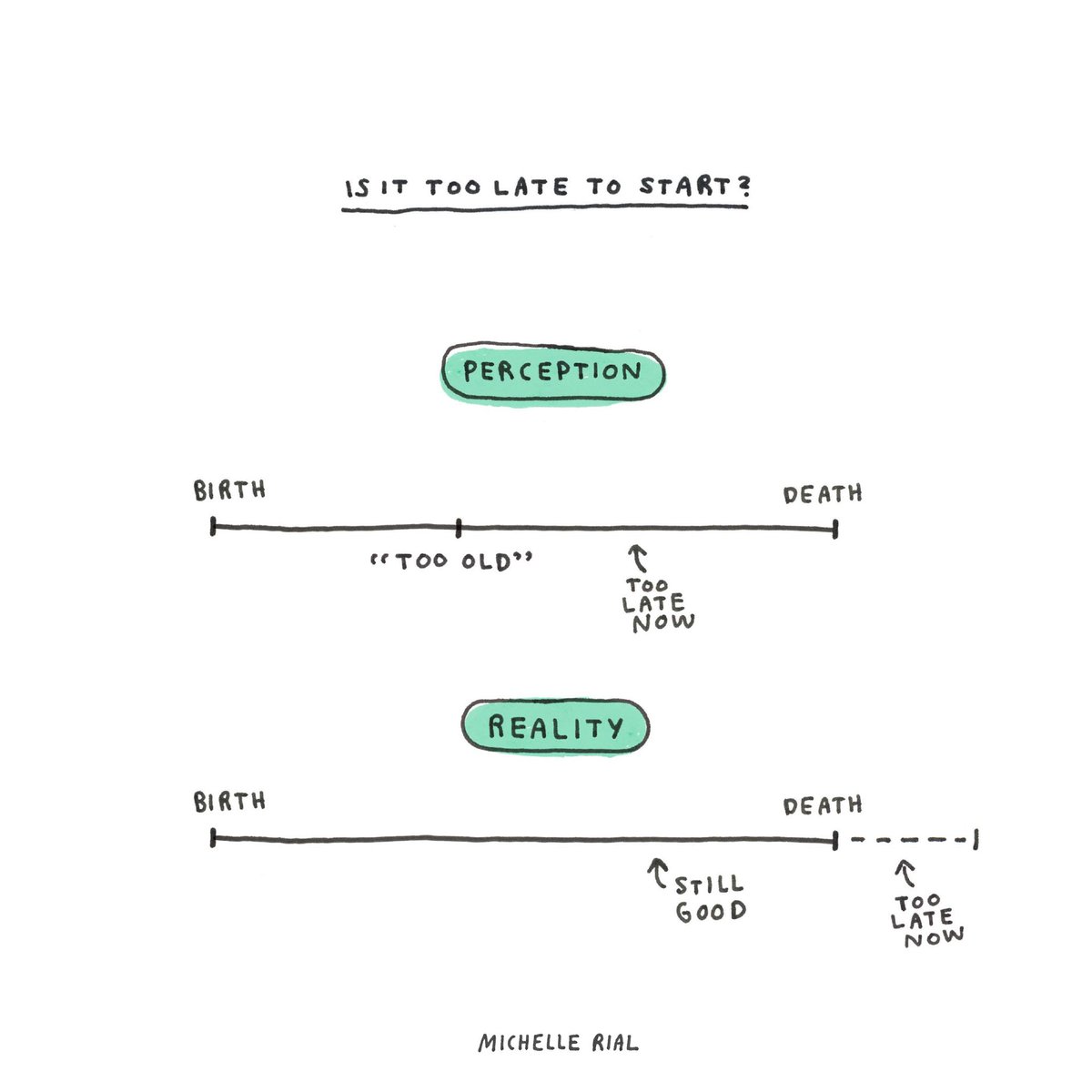
I hope you start doing the thing 🤍
Michelle Rial tweet media
English
70
14.3K
56.2K
0
Adam Paulisick retweetledi
1Password
1Password@1Password·
MoltBot shows what agentic AI can really do when software has memory, autonomy, and deep system access. It also exposes a gap most security models weren’t built for. When agents store tokens, configs, and long-term memory as plain text on disk, a compromise doesn’t just expose credentials, it leaks context too. Security for agents can’t be a one-time approval. It’s about continuously mediating it. @jmeller breaks it down ⤵️ bit.ly/4boMvVX
English
7
13
145
30.6K
Adam Paulisick retweetledi
Eliot Durbin
Eliot Durbin@etdurbin·
🔥LFG! Well done and big congrats to @vxanand @kareemamin and team @clay on consistently doing things in your own way… which is setting a new standard for other high growth companies.
Varun Anand@vxanand

Today @Clay is announcing our second employee tender in just 9 months at a $5B valuation. Employee tender offers are rare at private tech companies, and repeat tenders at this frequency are rarer still. Under the traditional model, employees take on years of risk with no path to liquidity until an IPO or acquisition. We’re not building Clay that way. We believe that companies hitting their milestones should offer equity as part of people’s journey, not just at the end. And we want all our employees to benefit meaningfully from the value they create. There are two reasons companies don't do tenders: 1) you don't have the demand for your stock; 2) you think your team will get demotivated if they sell their shares. Re: the first -- I can't help you much there (but maybe DM me and I can do a video consulting on your biz problems). On the second -- in our experience, the opposite happens! When people feel trusted, supported, and happy, they stay longer and build with more conviction - just check out our Glassdoor reviews (p.s. we’re hiring!). Our teams are more loyal, energized, and motivated to make a big outcome happen because they know we care about doing right by them. The tender will allow employees to sell up to $55M of Clay shares at a $5B valuation, and is led by DST Global, with participation from @conviction, @AvraCap, @OpCo_VC and @Frontlinevc, alongside a stellar roster of angels and customers, including Stripe's @chughesjohnson, Figma CMO @SheilaVashee, Superhuman CEO @shishirmehrotra, and product leader @lennysan. Thank you to our team, community, and customers for making this milestone possible. We're hyped for the journey ahead! → Check out The New York Times feature by @m_delamerced: nytimes.com/2026/01/28/bus…

English
0
1
7
597
Adam Paulisick retweetledi
Lenny Rachitsky
Lenny Rachitsky@lennysan·
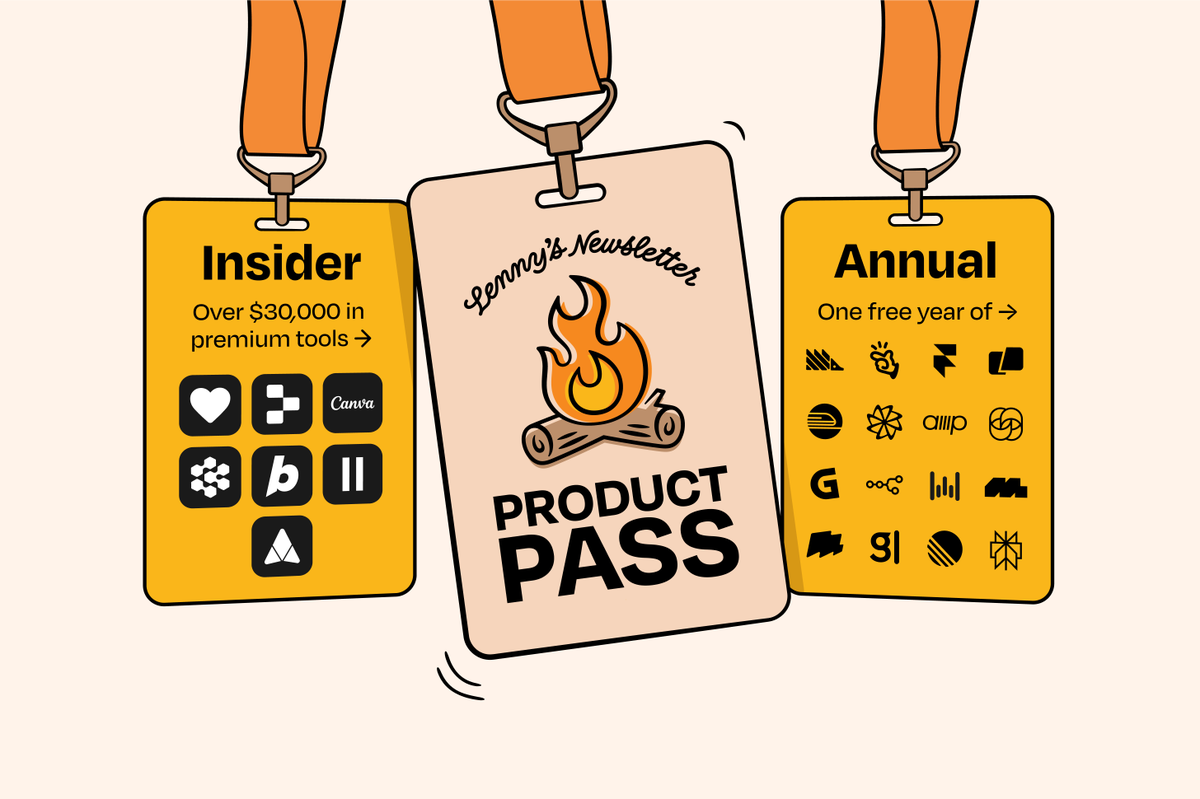
🚨 Lenny's Newsletter paid subscribers now get a free year of 7 incredible products: 1. @ManusAI 2. @FactoryAI 3. @AmpCode 4. @Railway 5. @elevenlabs 6. @Canva 7. @Framer This is on top of 15+ products subscribers already get, including @Lovable @Replit @n8n_io @GammaApp @Linear @WisprFlow. It sounds too good to be true, but it's not. → Already a paid subscriber? Grab your free products here: lennysproductpass.com → Not yet a subscriber? Subscribe at lennysnewsletter.com/subscribe and then grab your free products at the link above. My goal with this Product Pass is to get you to stop scrolling and to start building. To actually experience the most important, cutting-edge, beautifully crafted products for yourself. Grab your codes and learn more: lennysnewsletter.com/p/product-pass… 23 premium tools, over $25,000 in value. The most epic bundle in history just keeps getting better. If you'd like to see another product join this bundle, let us know in the comments.
Lenny Rachitsky tweet media
English
59
41
414
252.4K
Adam Paulisick retweetledi
James Zou
James Zou@james_y_zou·
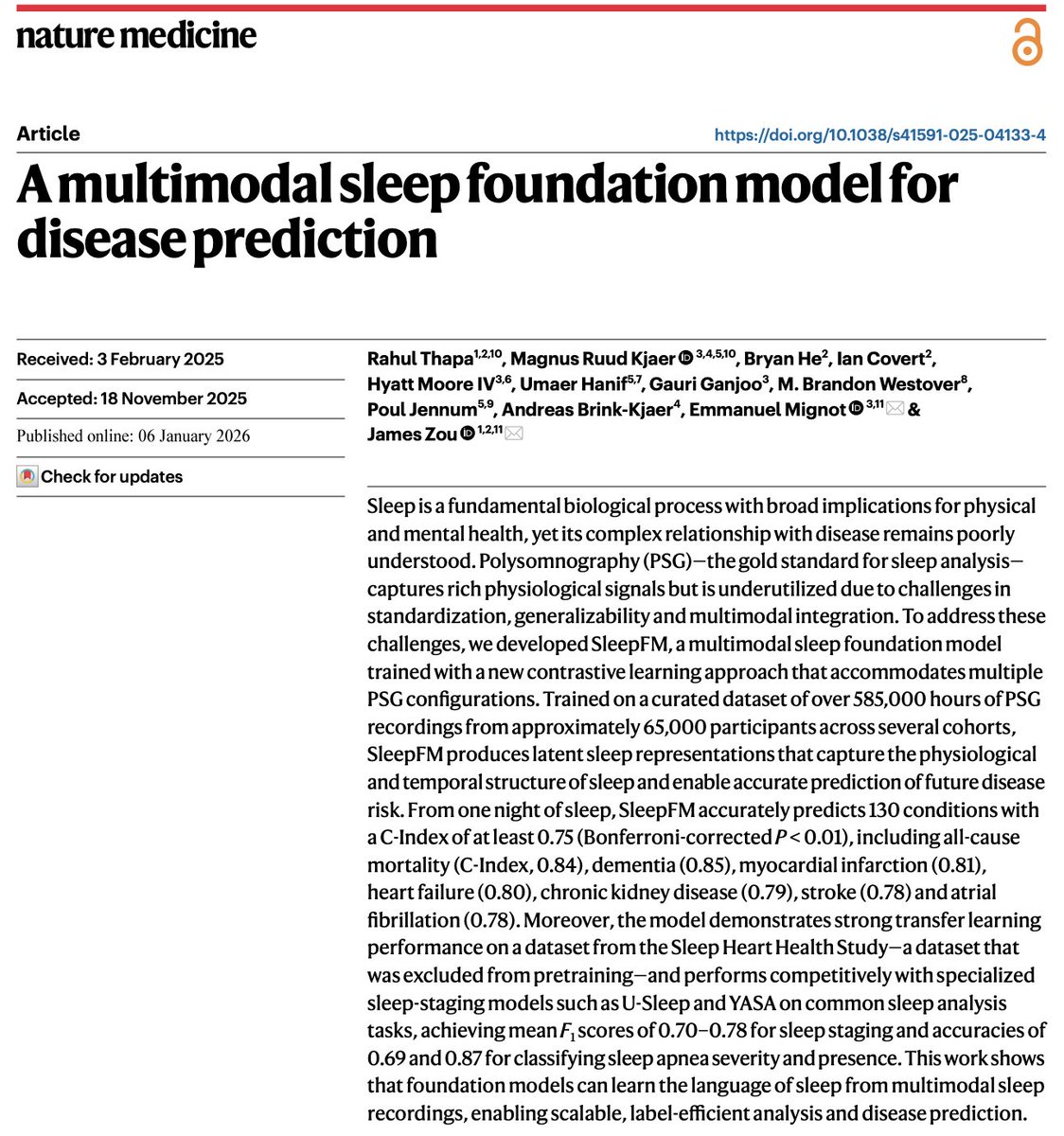
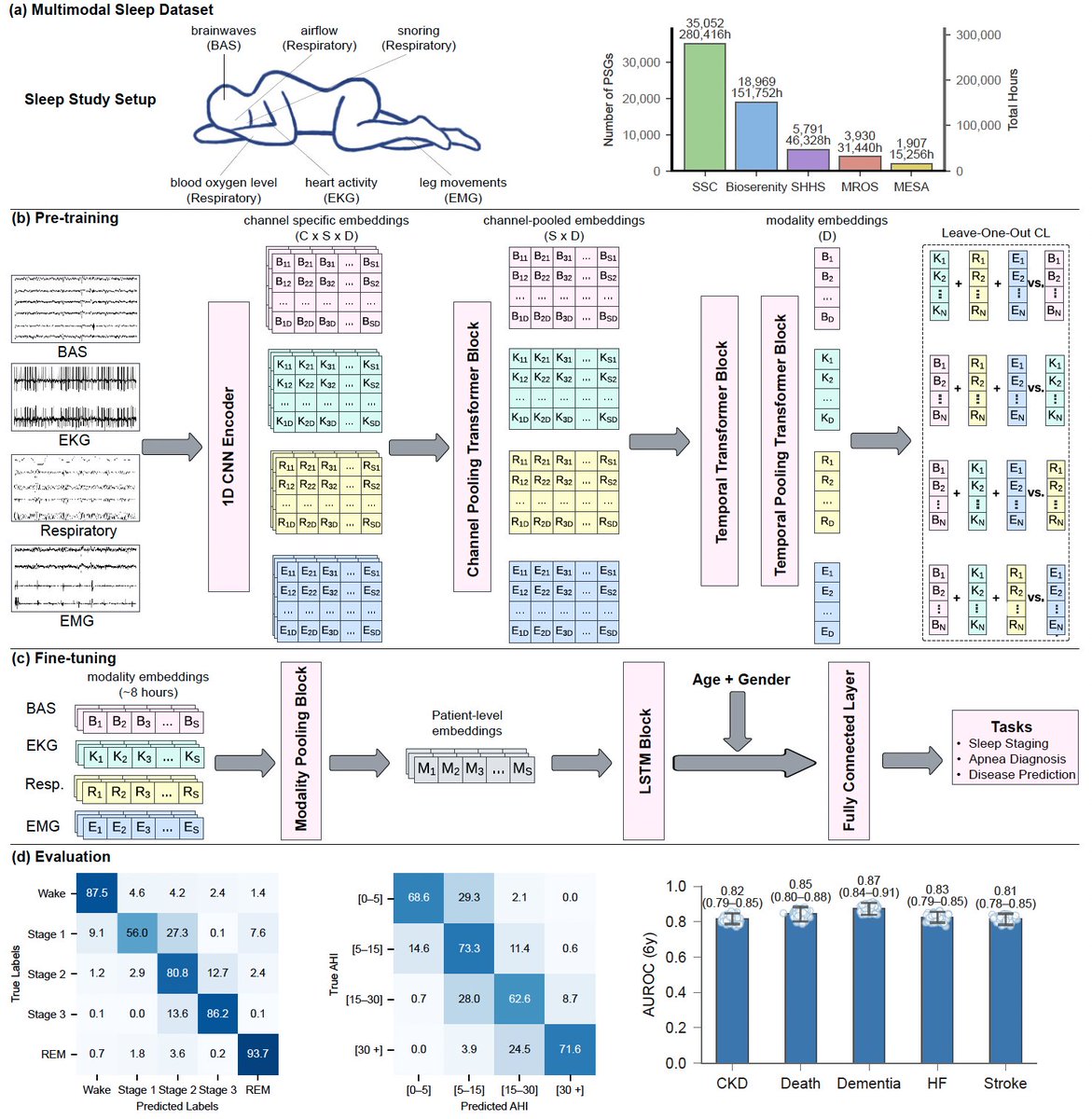
Today in @NatureMedicine we report that AI can predict 130 diseases from 1 night of sleep🛌 We trained a foundation model (#SleepFM) on 585K hours of sleep recordings from 65K people—brain, heart, muscle & breathing signals combined. AI learns the language of sleep🧵
James Zou tweet mediaJames Zou tweet media
English
275
2.1K
11K
911.8K
Adam Paulisick
Adam Paulisick@paulisick·
@GRoditiD I doodle future concepts/games/apps/inventions. Not often original but random stuff like a portable mini golf course, subscription diner attached to a chicken coop, multiple churches that come together at a central bakery in the same building, etc. It’s a lot more fun wi AI help
English
0
0
0
61
the ghost of groditi’s future 👹
kinda wanna get a hobby in 2026. what is a good hobby for dads with no spare money and who only have free time in blocks that are 40 minutes or shorter and happen at completely unpredictable dates and times? it can’t be smoking cigarettes, thats way too expensive in CA these days
English
3.6K
197
19.4K
2.2M
Adam Paulisick retweetledi
Thorsten Ball
Thorsten Ball@thorstenball·
Whoever at WorkOS implemented this: Thank you, thank you, I bless you, I bless your house, your family, the streets on which you walk, thank you thank you
Thorsten Ball tweet media
English
117
169
5.6K
284K
Adam Paulisick retweetledi
claire vo 🖤
claire vo 🖤@clairevo·
Everyone wants enterprise b2b ACV, no one wants 6-12 month sales cycles, 200 point security questionnaires, redlines, net 60, white glove onboarding, services partner ecosystem, last minute procurement negotiation step, 14 page MSAs, champions that leave the company. 90-180 day activations, features built to save churn, Europe->Asia timezone sales calls, cringe outbound campaigns, SCIM, data deletion and portability process, msft ecosystem integrations (teams!), or EU data residency.
claire vo 🖤@clairevo

speaking to my b2b heart: @gdb says “boring enterprise problems” are still massively underserved by AI startups rn

English
142
148
1.9K
287.3K