Plz Call Me Doc🥼*not an actual Doc
11.6K posts

Plz Call Me Doc🥼*not an actual Doc
@PleaseCallMeDoc
Mapping the architecture of American life — systems, incentives, and the dynamics that shape the reality we live in. Clarity built from structure, not noise.


From @SASCGOP Chairman @SenatorWicker & @HASCRepublicans Chairman @RepMikeRogersAL — "We welcome NATO Secretary General Mark Rutte’s visit to Washington. We look forward to hearing how allies are implementing their historic commitment, driven by President Trump, to spend 5% of GDP on defense and what more they will do to respond to Iran’s threats. We are also interested in hearing about any positive developments in the UK-led effort to ensure freedom of navigation in the Strait of Hormuz. Free passage and commerce are vital to our shared security and prosperity..."

The "U.S. doesn't need NATO" narrative is a classic case of misdiagnosing the bill. We don't stay in the alliance out of sentiment or charity: we stay for the massive strategic discount. Leaving wouldn't shrink our budget; it would make global power "full retail" expensive. The fantasy that walking away saves money collapses under simple arithmetic. Our defense spending tracks our global interests, not our treaty obligations. Right now, NATO is the surcharge-free infrastructure for American power. Alliances are cost-sharing arrangements for problems that get brutally expensive the moment you manage them solo. Forward basing, overflight rights, and intelligence pooling aren't "gifts" to Europe. They are the mechanisms that let the U.S. project power without buying redundant carrier groups or duplicating logistics networks we already have access to. The "we’re footing the bill" narrative evaporates once you look at the actual structure. NATO isn’t a communal bank account. It’s a set of sovereign militaries. The NATO common fund represents less than 0.1% of U.S. military spending (approximately one-sixth of the ~€3.8 billion total). The value isn’t in pooled dollars; it’s in pooled deterrence. If we walk away, we don't just "save" money. We lose the "wholesale" price of global stability and replace it with the staggering cost of unilateralism. In a world where rivals are banding together, pretending that going it alone is cheaper isn't realism. It’s nostalgia dressed up as strategy.


#Hungary Opp leader Magyar sees VP JDVance's remarks as positive: "The USG said it will work w whoever is elected, since Hungary is part of NATO..eg, they are letting go of Orban, prepping for his defeat." t.me/liveukraine_me…


Trump threatens to quit NATO. We spend $300 billion a year defending Europe — including their war in Ukraine. But when we need them they don’t lift a finger. What it would take to leave.

If NATO breaks, every American pays for it. Not in theory — in your wallet, your job, your security, your kids’ future. A NATO rupture isn’t “Europe’s problem.” It’s an American recession, an American vulnerability, an American decline. Carafano is right to sound the alarm. Here’s the part nobody says out loud: A fractured NATO doesn’t create sovereignty. It creates vacuums. And vacuums don’t stay empty. Cheering a rupture isn’t cheering sovereignty — it’s cheering a vacuum. And in geopolitics, vacuums get filled by actors who don’t share our interests or our standards. For decades, the U.S. has benefited from something no rival can replicate: a stable, wealthy, aligned Europe that anchors the world’s largest economic relationship. The transatlantic alliance isn’t charity. It’s the capability floor for American power. Transatlantic trade isn’t a side‑story. It’s the backbone of American prosperity: - It’s larger than U.S.–China trade in value‑added terms. - It supports more high‑wage American jobs per dollar. - It’s built on deep investment, shared standards, and integrated supply chains. - A 10% drop in transatlantic trade shaves ~0.5% off U.S. GDP. That isn’t a rounding error — it’s a systemic shock. Break NATO, and you don’t just lose a military alliance. You destabilize the economic engine that underwrites American strength. Security is the literal infrastructure of trade. When Europe becomes unstable, capital moves, supply chains fracture, markets tighten, adversaries expand influence, and the U.S. loses leverage everywhere at once. Ukraine isn’t just defending its territory. By defending Europe’s stability, Ukraine is defending the transatlantic trade America depends on. That’s what “America First” actually looks like when you strip away the slogans and look at the geometry. If you want a strong America, you want a strong NATO. If you want American prosperity, you want a stable Europe. If you want American leverage, you want the alliance intact. You cannot have a strong America surrounded by a broken world. Everything else is noise.

Orbán has vetoed more EU decisions than any leader in the bloc's history. On April 12, Hungarians vote in what may end his 16-year grip on power — AP News. 1/


Is Operation Epic Fury a strategic move? In a recent conversation with @heatherwilly and @tomkarako, Kari Bingen argues that with Iran at its weakest point in recent history, there was no better time to launch a preventive attack.


Anthropic and the Department of War are... at war. But who can we trust to govern superintelligent AI? The government, or the market? Two people who strongly disagree on this are @deanwball (ex senior advisor to Trump) and @DKokotajlo (ex OpenAI). So I asked them to debate it! But this goes way beyond a simple debate. They also had to red-team their own arguments and steelman each other. It's a new format called an ANTI-debate (more info below). Lmk what you think! 00:00 - Intro 03:42 - Daniel’s Story 04:34 - Dean’s Story 06:52 - Opening Statements 19:54 - Rebuttals 25:45 - Free Debate 36:32 - Steelmanning 45:40 - Red-teaming 51:38 - Synthesis 1:17:30 - Closing Statements

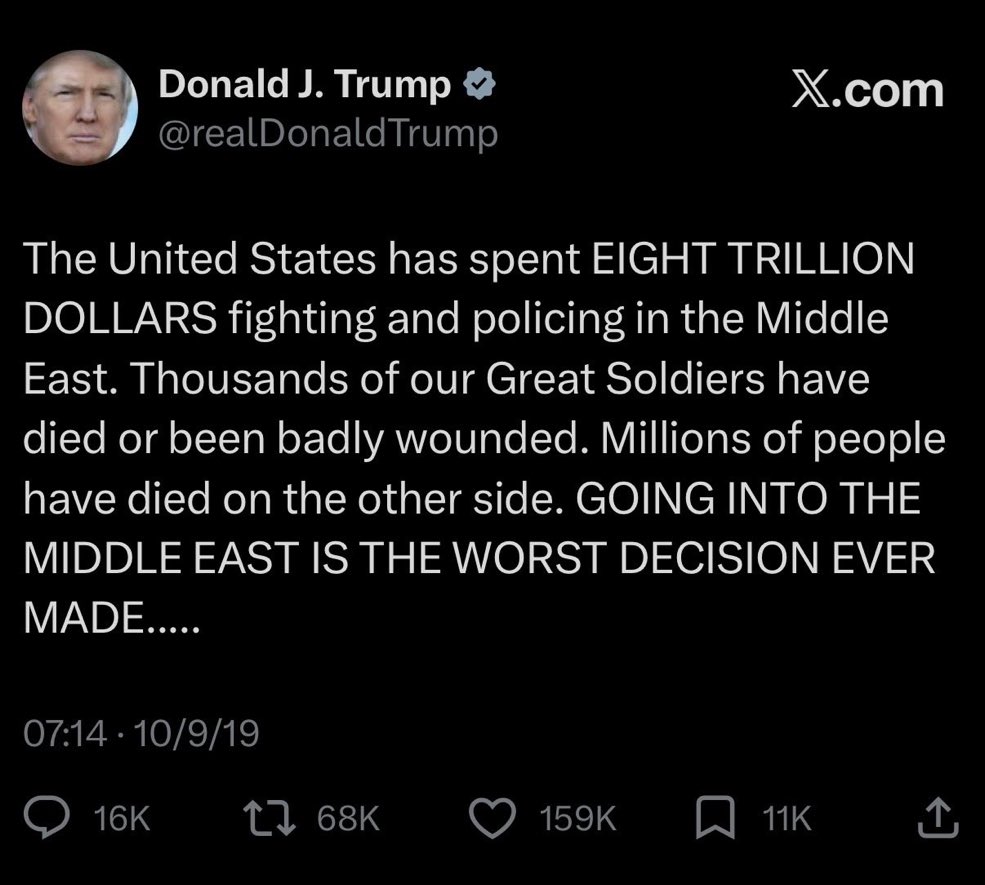
Nobody was going to stand idle after 9/11, and everyone knew it. The idea that the post‑9/11 wars were “badly conceived and executed” ignores the actual sequence. Forward defense kept threats pressured near their source and held the system together. It’s the retreat from that posture —across parties and administration— that unleashed the instability we’re living with now.


NOW - Trump's message to Americans who do not support the Iran War: "They're foolish."


“Without [Orban’s] role legitimizing Kremlin talking points and sanitizing them,” Russian narratives may never have broken through in the United States, the former official said. “There are a lot of people on the right in the U.S. who would never associate with Russians but think that Hungarians are perfectly fine.”