Poly VPN

256 posts

Poly VPN banner
Poly VPN

Poly VPN

@Poly_VPN

Low-latency London tunnel for Polymarket traders. WireGuard protocol. Sub-30ms taker / sub-10ms maker. Built for bots and serious traders. https://t.co/tBORVtAb1F

London Katılım Mart 2026
71 Takip Edilen50 Takipçiler
Sabitlenmiş Tweet
Poly VPN
Poly VPN@Poly_VPN·
Getting started with PolyVPN: Spin up a Vultr VPS in London — same datacenter as our server 1. Subscribe at poly-vpn.xyz and get your WireGuard key by email 2. Drop the config on your server and run wg-quick up polyvpn 3. Your bot is now <1ms from our node, with fastest possible path to polymarket That's it. No code changes, no complexity — just faster fills. 🇬🇧
English
2
0
6
631
Poly VPN
Poly VPN@Poly_VPN·
@Emotion_web3 Accurate, especially being first to react, is super important. If you can't react in time, it doesn't matter if you're right. Get faster with poly-vpn.xyz
English
0
0
0
4
EMOTION CRYPTO
EMOTION CRYPTO@Emotion_web3·
Most traders still think the edge is in having an opinion. It is not. The real edge is in: >how early you see it > how well you price it > how calmly you size it > and whether you can act before the crowd turns your thesis into an expensive entry That is the difference between a person who reads markets and a person who just reacts to them. A lot of people still approach Polymarket like a place to guess outcomes. But the best traders do not think in guesses. They think in mispricing. Not: “Will this happen?” But: “At these odds, is this worth buying?” That one shift changes everything. Because in prediction markets, you do not make the real money by being emotionally right. You make it by being priced right before everyone else. That is why wallet tracking matters. That is why timing matters. That is why structure matters more than confidence. The crowd keeps buying what feels obvious. Sharp traders keep buying what is still uncomfortable, underpriced, and early. And that is usually where the real edge lives.
StacyOnChain@stacyonchain

x.com/i/article/2047…

English
5
0
11
167
Poly VPN
Poly VPN@Poly_VPN·
@Lummox_eth Step by step guide right here with real explanations: x.com/i/status/20451…
Poly VPN@Poly_VPN

Latency Arbitrage on Polymarket Weather Markets — A Two-Layer Edge Nobody Is Talking About Most people thinking about Polymarket latency arb focus on one thing: getting their order to the CLOB faster. Fair enough. But in weather markets there's actually a second latency layer upstream of execution that almost nobody is exploiting. Let me explain. How Weather Markets Resolve Polymarket weather markets resolve against a public weather API — a centralized data feed that aggregates readings and publishes an official figure. This is your resolution source. This is what determines whether your YES or NO pays out. The thing is, that public API isn't magic. It's pulling from physical weather stations and sensor networks, aggregating them, and publishing a number. That process takes time. There is a measurable lag between what the atmosphere is actually doing and what the public API says it's doing. This is your first latency opportunity. The Calibration Model Idea Local weather station feeds — the raw, unaggregated kind — update faster than the public API. They're noisier, less reliable, and not what Polymarket resolves against. But here's the thing: if you can build a model that maps local station readings to what the public API is about to print, you effectively get a few hundred milliseconds of lookahead on the resolution feed. This is exactly the same insight as trading Binance price directly instead of waiting for Chainlink. Chainlink is just a lagged aggregation of faster feeds. Anyone who figured that out early made a killing. The weather version of this insight is sitting there waiting. The model doesn't have to be perfect. It just has to be right often enough, and early enough, that you can move before the public API catches up and the rest of the market reprices. Now Add The Execution Layer Here's where it gets interesting. Both of these edges — the data feed and the CLOB — are geographically concentrated in London. The public weather API's infrastructure is in London. The local station feeds you'd use to build your calibration model are in London. And Polymarket's CLOB is in London. If you're running your bot from a VPS in Ireland or Amsterdam, you're eating latency at both ends of the trade. Your data arrives late. Then your order arrives late. Two separate penalties, stacking quietly against you on every single trade. The trader in London gets the local feed faster, runs the calibration model faster, and gets the order to the CLOB faster. That's not one edge — it's the same edge compounding twice. poly-vpn.xyz puts your infrastructure in London. Same city as the data, same city as the order book. Is This Worth Building? The calibration model is non-trivial — you'd need to backtest how well local station data predicts the public API print, figure out the lead time, and size your trades accordingly. It's a research project before it's a trading strategy. But the underlying logic is sound. And in a market where most participants are focused purely on execution speed, the trader who also has an upstream data edge is playing a different game entirely. The Chainlink insight was table stakes within a month of people figuring it out. The weather version of that insight is still early.

English
0
0
1
15
Poly VPN
Poly VPN@Poly_VPN·
@Jeremybtc Don't know about u, but my mom is proud of my volume
English
0
0
0
2
Jeremy
Jeremy@Jeremybtc·
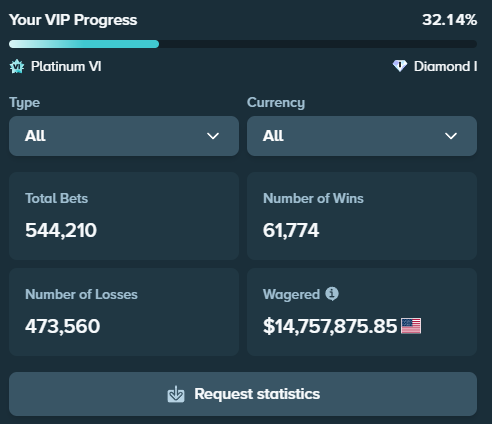
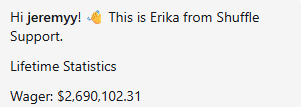
I wonder what my mom would think if she found out I have nearly $20M in wager volume on casinos
Jeremy tweet mediaJeremy tweet media
English
47
5
113
9.4K
Poly VPN
Poly VPN@Poly_VPN·
@mahera777 @PolymarketTrade Get on the action yourself by writing your own bot. Here's how to get started: x.com/i/status/20451…
Poly VPN@Poly_VPN

Latency Arbitrage on Polymarket Weather Markets — A Two-Layer Edge Nobody Is Talking About Most people thinking about Polymarket latency arb focus on one thing: getting their order to the CLOB faster. Fair enough. But in weather markets there's actually a second latency layer upstream of execution that almost nobody is exploiting. Let me explain. How Weather Markets Resolve Polymarket weather markets resolve against a public weather API — a centralized data feed that aggregates readings and publishes an official figure. This is your resolution source. This is what determines whether your YES or NO pays out. The thing is, that public API isn't magic. It's pulling from physical weather stations and sensor networks, aggregating them, and publishing a number. That process takes time. There is a measurable lag between what the atmosphere is actually doing and what the public API says it's doing. This is your first latency opportunity. The Calibration Model Idea Local weather station feeds — the raw, unaggregated kind — update faster than the public API. They're noisier, less reliable, and not what Polymarket resolves against. But here's the thing: if you can build a model that maps local station readings to what the public API is about to print, you effectively get a few hundred milliseconds of lookahead on the resolution feed. This is exactly the same insight as trading Binance price directly instead of waiting for Chainlink. Chainlink is just a lagged aggregation of faster feeds. Anyone who figured that out early made a killing. The weather version of this insight is sitting there waiting. The model doesn't have to be perfect. It just has to be right often enough, and early enough, that you can move before the public API catches up and the rest of the market reprices. Now Add The Execution Layer Here's where it gets interesting. Both of these edges — the data feed and the CLOB — are geographically concentrated in London. The public weather API's infrastructure is in London. The local station feeds you'd use to build your calibration model are in London. And Polymarket's CLOB is in London. If you're running your bot from a VPS in Ireland or Amsterdam, you're eating latency at both ends of the trade. Your data arrives late. Then your order arrives late. Two separate penalties, stacking quietly against you on every single trade. The trader in London gets the local feed faster, runs the calibration model faster, and gets the order to the CLOB faster. That's not one edge — it's the same edge compounding twice. poly-vpn.xyz puts your infrastructure in London. Same city as the data, same city as the order book. Is This Worth Building? The calibration model is non-trivial — you'd need to backtest how well local station data predicts the public API print, figure out the lead time, and size your trades accordingly. It's a research project before it's a trading strategy. But the underlying logic is sound. And in a market where most participants are focused purely on execution speed, the trader who also has an upstream data edge is playing a different game entirely. The Chainlink insight was table stakes within a month of people figuring it out. The weather version of that insight is still early.

English
0
0
0
4
mahera
mahera@mahera777·
$33 -> $1,500 on Toronto weather prediction mostly buys stocks at 0.1c-10c for small amounts $2-$35 he has over 2,000 weather predictions on Polymarket
mahera tweet media
English
18
1
59
1.3K
Poly VPN
Poly VPN@Poly_VPN·
@RoundtableSpace This is inaccurate, Bonereaper made his money from exploiting a queue priority bug If you want to have queue priority like this guy, try out our product poly-vpn.xyz
English
0
0
0
11
0xMarioNawfal
0xMarioNawfal@RoundtableSpace·
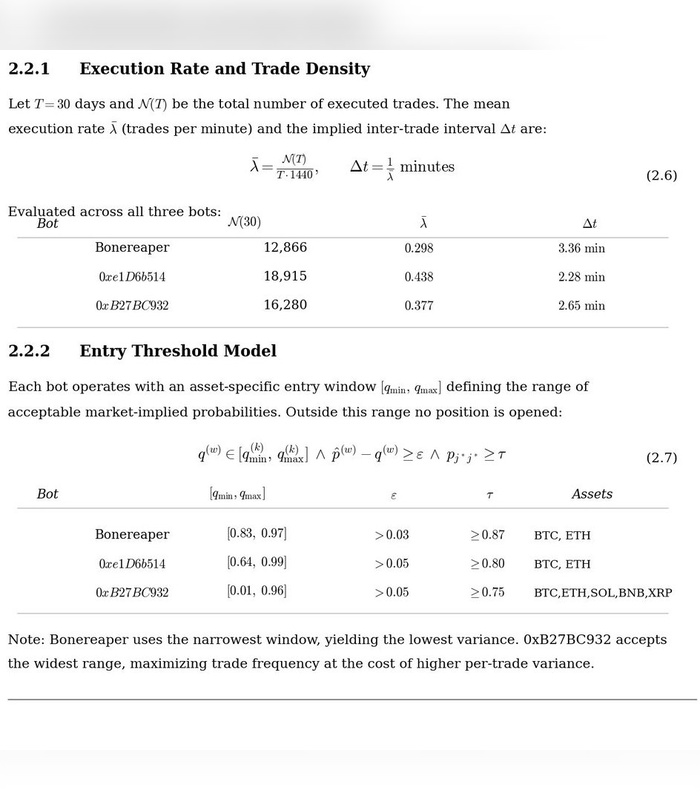
A DEAD RUSSIAN MATHEMATICIAN JUST HELPED PRINT $468,228 ON POLYMARKET IN 30 DAYS. Markov never saw a prediction market, but his math ended up building exactly the kind of bot that can dominate them.
0xMarioNawfal tweet media
English
5
6
100
56.3K
eventwaves
eventwaves@EventWavesIO·
What kind of prediction market trader are you?
eventwaves tweet media
English
4
0
10
516
shmidt
shmidt@shmidtqq·
-> 2024: Polymarket lag = 12 seconds -> 2025: lag = 6 seconds -> 2026: lag = 2.7 seconds -> my bot reaction: 4.1 seconds -> I was early in 2024 -> I was on time in 2025 -> I am exit liquidity in 2026 -> the gap was closing on me, not for me
cvxv666@antpalkin

x.com/i/article/2046…

English
20
1
46
1.7K
Poly VPN
Poly VPN@Poly_VPN·
@de1lymoon Get on the action yourself, here is a guide on how to start: x.com/Poly_VPN/statu…
Poly VPN@Poly_VPN

Latency Arbitrage on Polymarket Weather Markets — A Two-Layer Edge Nobody Is Talking About Most people thinking about Polymarket latency arb focus on one thing: getting their order to the CLOB faster. Fair enough. But in weather markets there's actually a second latency layer upstream of execution that almost nobody is exploiting. Let me explain. How Weather Markets Resolve Polymarket weather markets resolve against a public weather API — a centralized data feed that aggregates readings and publishes an official figure. This is your resolution source. This is what determines whether your YES or NO pays out. The thing is, that public API isn't magic. It's pulling from physical weather stations and sensor networks, aggregating them, and publishing a number. That process takes time. There is a measurable lag between what the atmosphere is actually doing and what the public API says it's doing. This is your first latency opportunity. The Calibration Model Idea Local weather station feeds — the raw, unaggregated kind — update faster than the public API. They're noisier, less reliable, and not what Polymarket resolves against. But here's the thing: if you can build a model that maps local station readings to what the public API is about to print, you effectively get a few hundred milliseconds of lookahead on the resolution feed. This is exactly the same insight as trading Binance price directly instead of waiting for Chainlink. Chainlink is just a lagged aggregation of faster feeds. Anyone who figured that out early made a killing. The weather version of this insight is sitting there waiting. The model doesn't have to be perfect. It just has to be right often enough, and early enough, that you can move before the public API catches up and the rest of the market reprices. Now Add The Execution Layer Here's where it gets interesting. Both of these edges — the data feed and the CLOB — are geographically concentrated in London. The public weather API's infrastructure is in London. The local station feeds you'd use to build your calibration model are in London. And Polymarket's CLOB is in London. If you're running your bot from a VPS in Ireland or Amsterdam, you're eating latency at both ends of the trade. Your data arrives late. Then your order arrives late. Two separate penalties, stacking quietly against you on every single trade. The trader in London gets the local feed faster, runs the calibration model faster, and gets the order to the CLOB faster. That's not one edge — it's the same edge compounding twice. poly-vpn.xyz puts your infrastructure in London. Same city as the data, same city as the order book. Is This Worth Building? The calibration model is non-trivial — you'd need to backtest how well local station data predicts the public API print, figure out the lead time, and size your trades accordingly. It's a research project before it's a trading strategy. But the underlying logic is sound. And in a market where most participants are focused purely on execution speed, the trader who also has an upstream data edge is playing a different game entirely. The Chainlink insight was table stakes within a month of people figuring it out. The weather version of that insight is still early.

English
0
0
0
47
Alex
Alex@de1lymoon·
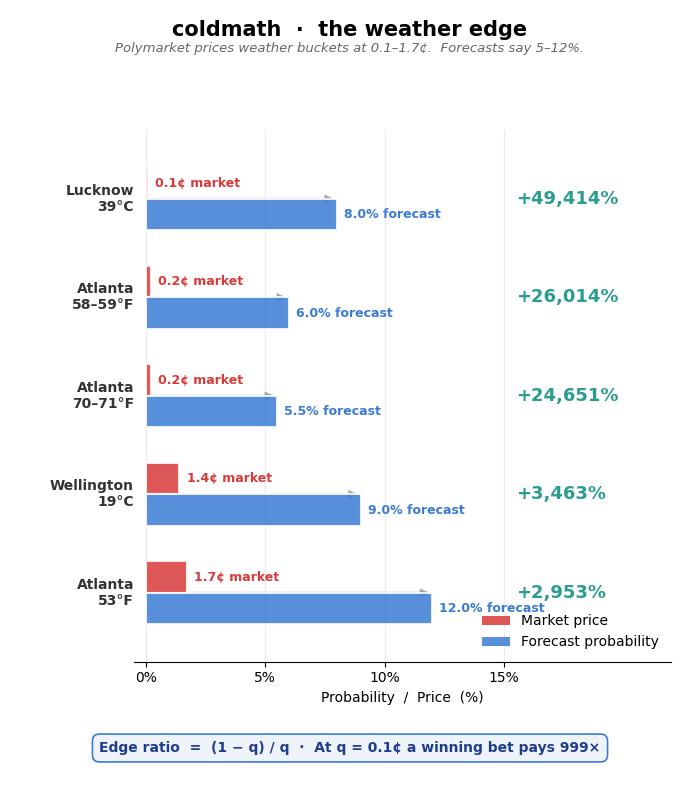
Weather sniper on polymarket turned $186 → $6,630 by placing a single bet on the temperature in Wellington He buys YES on temperature buckets in the {0.1¢ – 1.7¢} range before the market reads the actual KMA / NWS forecast Forecast says Lucknow 39°C → 8% likely. Market prices it at $0.001. He buys Result: $0.001 → $1.00 when it hits = +49,414% return His best trades: $13.84 → $6,851 (Lucknow 39°C at 0.1¢, +49,414%) $23.54 → $6,146 (Atlanta 58-59°F at 0.2¢, +26,014%) $24.41 → $6,041 (Atlanta 70-71°F at 0.2¢, +24,651%) $186 → $6,630 (Wellington 19°C at 1.4¢, +3,463%) $202 → $6,172 (Atlanta 53°F at 1.7¢, +2,953%) Edge ratio = (1 − q) / q At q = 0.001 → 999× per winning trade Real probability just has to clear 0.5% to print
Alex tweet media
Alex@de1lymoon

x.com/i/article/2044…

English
9
2
50
4.8K
Poly VPN
Poly VPN@Poly_VPN·
@kar4arodon Most people farm hard on polymarket to ensure getting a big airdrop, not sure that what you are suggesting is the correct move
English
0
0
0
18
karcharodon
karcharodon@kar4arodon·
3 easy ways to increase your $POLY airdrop ? first - pick market with "Earn 4%" logo - open long-term position second - open any market - click on add rewards third - open any trader - send tip did I miss something?
karcharodon tweet media
English
16
3
45
2.1K
Filipe Flores
Filipe Flores@ofilipeflores·
Um cara colocou US$ 2 mil no Polymarket apostando na temperatura de Paris. Depois foi lá e esquentou o sensor de previsão do tempo com um secador de cabelo. Resultado: bateu a meta de temperatura, sacou US$ 36.900 e sumiu no meio da multidão. O mercado previu tudo. Menos o secador.
Português
174
564
11K
2.2M
Poly VPN
Poly VPN@Poly_VPN·
@AlterEgo_eth Here is how the pros actually do it: x.com/Poly_VPN/statu…
Poly VPN@Poly_VPN

Latency Arbitrage on Polymarket Weather Markets — A Two-Layer Edge Nobody Is Talking About Most people thinking about Polymarket latency arb focus on one thing: getting their order to the CLOB faster. Fair enough. But in weather markets there's actually a second latency layer upstream of execution that almost nobody is exploiting. Let me explain. How Weather Markets Resolve Polymarket weather markets resolve against a public weather API — a centralized data feed that aggregates readings and publishes an official figure. This is your resolution source. This is what determines whether your YES or NO pays out. The thing is, that public API isn't magic. It's pulling from physical weather stations and sensor networks, aggregating them, and publishing a number. That process takes time. There is a measurable lag between what the atmosphere is actually doing and what the public API says it's doing. This is your first latency opportunity. The Calibration Model Idea Local weather station feeds — the raw, unaggregated kind — update faster than the public API. They're noisier, less reliable, and not what Polymarket resolves against. But here's the thing: if you can build a model that maps local station readings to what the public API is about to print, you effectively get a few hundred milliseconds of lookahead on the resolution feed. This is exactly the same insight as trading Binance price directly instead of waiting for Chainlink. Chainlink is just a lagged aggregation of faster feeds. Anyone who figured that out early made a killing. The weather version of this insight is sitting there waiting. The model doesn't have to be perfect. It just has to be right often enough, and early enough, that you can move before the public API catches up and the rest of the market reprices. Now Add The Execution Layer Here's where it gets interesting. Both of these edges — the data feed and the CLOB — are geographically concentrated in London. The public weather API's infrastructure is in London. The local station feeds you'd use to build your calibration model are in London. And Polymarket's CLOB is in London. If you're running your bot from a VPS in Ireland or Amsterdam, you're eating latency at both ends of the trade. Your data arrives late. Then your order arrives late. Two separate penalties, stacking quietly against you on every single trade. The trader in London gets the local feed faster, runs the calibration model faster, and gets the order to the CLOB faster. That's not one edge — it's the same edge compounding twice. poly-vpn.xyz puts your infrastructure in London. Same city as the data, same city as the order book. Is This Worth Building? The calibration model is non-trivial — you'd need to backtest how well local station data predicts the public API print, figure out the lead time, and size your trades accordingly. It's a research project before it's a trading strategy. But the underlying logic is sound. And in a market where most participants are focused purely on execution speed, the trader who also has an upstream data edge is playing a different game entirely. The Chainlink insight was table stakes within a month of people figuring it out. The weather version of that insight is still early.

English
0
0
0
161
Alter Ego
Alter Ego@AlterEgo_eth·
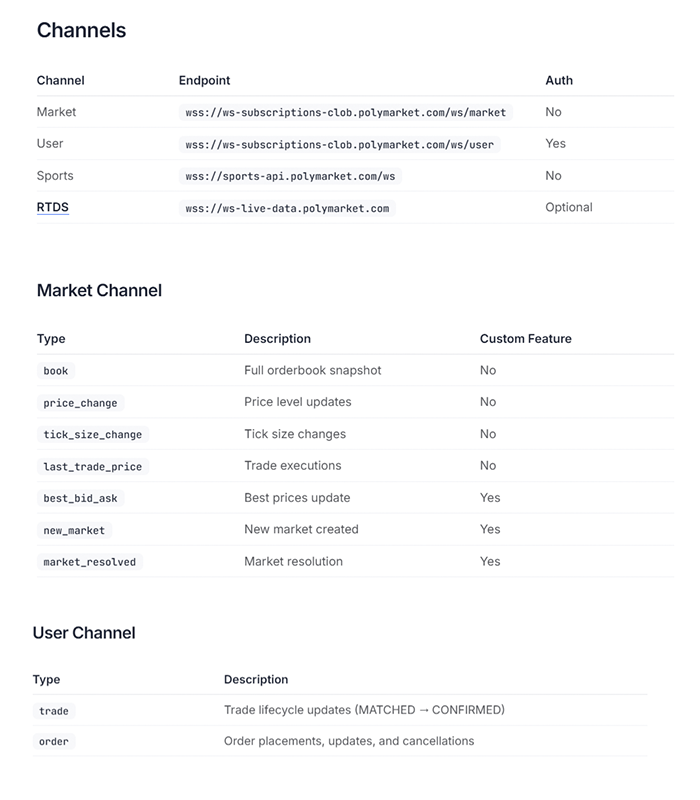
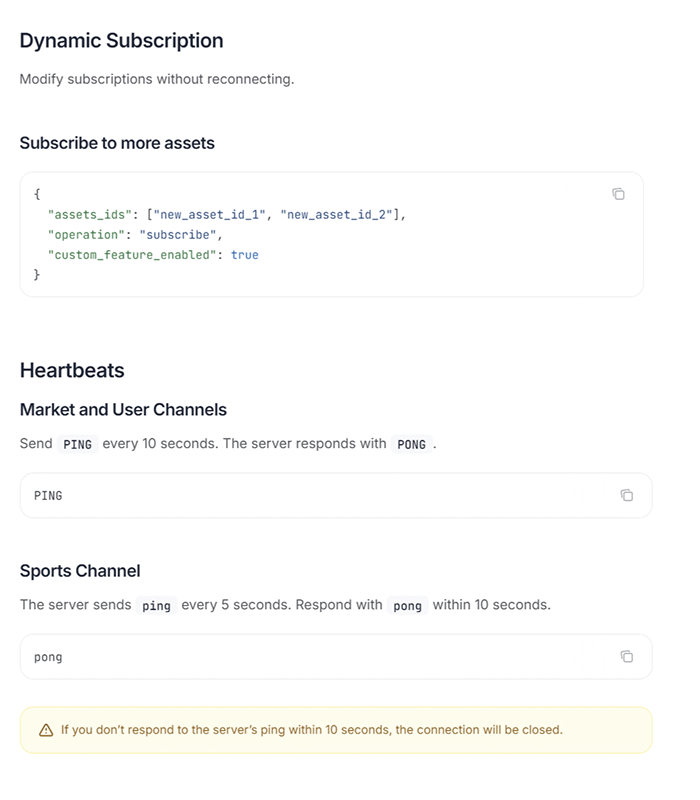
Most Polymarket weather bots share the same problem They poll the REST API every 5–60 minutes, but the market moves before that Weather models update on a schedule - GFS every 6 hours, ECMWF twice a day, HRRR every hour Every time a new model run drops - the forecast can shift by several degrees Polymarket reacts to that with a delay - usually anywhere from a few minutes to an hour That delay is your entry window.The bot that sees the forecast change first enters the position before the price has adjusted Most bots miss this window because they rely on REST polling They request the price every few minutes, get a snapshot, compare it to the forecast But by the next request, the market may have already moved Polymarket provides a WebSocket API that solves this Instead of periodically asking "what's the current price" - you subscribe to a stream and receive updates in real time Endpoint: wss://ws-subscriptions-clob.polymarket.com/ws/market No auth required - just the token ID of the market you want to track You get live orderbook diffs: new orders, cancellations, fills - everything as it happens The logic looks like this: → a model publishes a new run → your bot detects it → compares the updated forecast to the current price in the WebSocket stream → if there's edge → enters the position All of this happens before REST-based bots make their next request The difference between REST polling and WebSocket isn't just a technical detail It's the difference between being first in and arriving after the edge is already gone
Alter Ego tweet mediaAlter Ego tweet media
Alter Ego@AlterEgo_eth

How to reverse-engineer any Polymarket trader's strategy using the API Polymarket is fully transparent on-chain.Every position, every market, every PnL number - all publicly accessible via API Here's exactly how it works Step 1. How many markets has the trader played? Hit the Polymarket Data API at the /traded endpoint with their wallet address as the user parameter Returns one number - the exact same counter shown on their public profile. 50 markets vs 3,000 markets tells you a lot before you look at anything else Step 2. Closed positions The /closed-positions endpoint on the same Data API gives you every resolved market the trader participated in. The key field is realizedPnl - how much they actually made or lost on each position. Paginate with limit=50 and offset - keep pulling pages until you get an empty response Step 3. Open positions The /positions endpoint has a detail most people miss. Positions split into two types: active (market still running) and redeemable (market resolved, tokens not yet claimed) Redeemable positions never appear in closed-positions - they live here until the trader claims their winnings For redeemable positions, PnL = realizedPnl + cashPnl. Both fields matter Once you have all three endpoints, you can build a real picture. Total PnL = sum of realizedPnl from closed + sum of realizedPnl + cashPnl from redeemable. Then take the eventSlug from each position and hit the Polymarket Gamma API at the /events endpoint with that slug. You get category tags for every market. Now you can see: what percentage of their trades are weather markets? Politics? Crypto? Where is their win rate highest? Where do they consistently lose? This is how you reverse-engineer anyone on the leaderboard. Pull their positions. Tag by category. Sort by PnL In 10 minutes you know whether you're looking at a weather specialist with a systematic edge, a political quant, or someone who got lucky on one big trade Once you have the raw data - feed it straight into AI Ask it to find patterns in entry timing, position sizing, category focus, win streaks and losing runs What looks like intuition from the outside often turns out to be a very specific, repeatable system. AI will spot it faster than any manual analysis

English
7
5
68
4.2K
Poly VPN
Poly VPN@Poly_VPN·
@dobioprer @Polymarket Sick man, check this out if you wanna level up your game: x.com/Poly_VPN/statu…
Poly VPN@Poly_VPN

$5 Million Is on the Table. Here's How to Get Your Share. Polymarket just announced $5 million in liquidity rewards for April 2026 — distributed across sports and esports markets including major European football leagues, CS:GO, DOTA 2, and League of Legends. Rewards are paid daily in USDC directly to maker addresses. Reward farming on Polymarket isn't dead. It just moved to sports. If you want to capture a meaningful slice of that $5M, you need to understand how the rewards formula actually works — and why infrastructure matters more than most people think. This is a practical guide to getting started as an automated liquidity provider on Polymarket. What Is Liquidity Providing on Polymarket? Polymarket runs on a Central Limit Order Book (CLOB). Every market has a YES and NO side, priced between $0.01 and $0.99, representing the implied probability of an outcome. For markets to function — for takers to buy and sell at fair prices — someone has to post resting orders on both sides of the book. That's you, the liquidity provider. In return for taking on inventory risk and keeping markets tradeable, Polymarket pays liquidity rewards on top of any spread you collect. With $5M allocated just for April, the combination of spread income and rewards makes automated LP genuinely interesting again. How the Rewards Formula Works Before you write a single line of bot code, understand this: Polymarket's rewards formula is not passive. It's designed to force liquidity into the most useful part of the book. Quadratic spread penalty. Rewards don't scale linearly with how much size you post. They collapse quickly the further your quotes sit from the Adjusted Midpoint. Posting tight quotes near the midpoint earns disproportionately more than posting wide. The formula rewards quotes where price discovery actually happens. Adjusted Midpoint. This isn't simply (best bid + best ask) / 2. Polymarket filters out "dust" orders below a minimum incentive size before computing the midpoint. This prevents a classic attack: posting tiny orders at extreme prices to artificially pin the midpoint, then farming rewards around the fake center. Time = risk exposure. Rewards accumulate the longer your orders sit in the book. But longer time in the book also means higher probability of getting filled. You're effectively selling gamma — the longer you stay, the more tail risk you're absorbing. There's no free lunch. Single-sided penalty. You can post on just one side of the book in the neutral zone (roughly 0.10–0.90 probability), but you'll earn roughly a third of what two-sided quoting earns. At the extremes (near 0 or 1), both sides are required or your rewards drop to zero. What You Need to Build A Price Feed Your bot needs a "fair value" — a theoretical probability for each market condition. Without this, you're quoting blind and informed takers will pick you off systematically. For sports markets, this means connecting to a real-time odds feed or building your own implied probability model from line movements. The key insight: whatever data source Polymarket uses for resolution is your reference point, not your pricing input. You want to be ahead of that feed, not reacting to it. For crypto UP/DOWN markets the same principle applies — Polymarket resolves against Chainlink, which is a lagged aggregation of faster feeds. Price off Binance directly. Treat Chainlink as the resolution reference only. A WebSocket Connection Polymarket's API provides real-time order book data over WebSocket. You need to subscribe to: book — Level 2 order book snapshots and updates price_change — order placements and cancellations last_trade_price — fill events best_bid_ask — top of book order / trade events on your authenticated user channel — your own fills, placements, cancellations By combining book snapshots with event streams, you can reconstruct the full order book state in memory at all times. Order Management Logic Your bot needs to handle: Quote placement — post limit orders on both sides at your desired spread around fair value Cancel/replace cycle — when your fair value updates, cancel stale quotes and repost at the new price. This needs to be fast. Stale quotes are free options for informed takers. Inventory management — as you get filled on one side, your position accumulates. You need rules for when to hedge, pull quotes, or widen spreads to manage directional exposure. Edge cases — ghost fills, WebSocket disconnections, and high-latency periods where your quotes go stale before you can cancel them Note: if you're still running v1 SDK code, update immediately. CLOB v2 goes live April 22 — all existing order books will be wiped at cutover and the new order struct requires re-signing. Bot operators on legacy code will be offline from day one. Risk Parameters Before going live, set hard limits: Maximum position size per market Maximum total exposure across all markets Minimum spread (below which you won't quote, regardless of rewards) Circuit breakers for unusual market conditions A Practical Starting Strategy for the $5M Pool The $5M rewards are split across Pre-match and Live (in-play) phases. Live markets are faster and more competitive — prices move with game events in real time. Pre-match is slower and a better starting point if you're building your first bot. The basic playbook for pre-match sports LP: Connect to a real-time sports odds feed and derive implied probabilities Post two-sided quotes tight enough to earn meaningful rewards, wide enough to survive normal line movement Cancel and repost as your fair value updates when new information arrives (injuries, lineup changes, line movement on other platforms) Collect rewards daily in USDC while collecting spread on fills The edge comes from having a better pricing model than competing LPs and being faster to reprice when information changes. Where Latency Decides Who Wins For slow pre-match markets hours before a game, latency is mostly irrelevant. You're adjusting quotes over minutes, not milliseconds. The moment you move into live in-play markets — or any market with active taker flow — latency becomes your most important infrastructure variable. Polymarket's CLOB matches orders on price-time priority. Same price, first arrival wins. When a goal is scored and every market maker is racing to cancel stale quotes and repost at the new price, the traders who complete that cycle first set the new market. Everyone else gets picked off on their stale quote, or arrives too late to post at the new best price. The CLOB is in London. Every cancel, every new order, every reprice makes a round trip to London. If your VPS is in Ireland or Amsterdam, you're adding unnecessary latency to every single one of those round trips. In a race measured in milliseconds, that compounds across hundreds of reprices per day into real money. With $5M in rewards concentrated in April, competition among LPs is going to be fierce. The makers who capture the largest share won't just have better pricing models — they'll have faster infrastructure. poly-vpn.xyz puts your infrastructure in London, same city as the CLOB. Better queue position on posts, faster cancels on stale quotes, less adverse selection from takers who are already there. The Honest Picture Reward farming on Polymarket went through a boom-and-bust cycle. Early LPs with 10,000 USDC were reportedly making 200–300 USDC per day at peak. That era ended as more sophisticated players entered and rewards-per-dollar compressed. The $5M sports announcement changes the calculus again — but not back to the easy days. The rewards are real, but so is the competition. The makers who capture a meaningful share will be the ones with solid pricing models, fast cancel/replace infrastructure, and servers in the right city. Liquidity rewards are best understood as a bonus on top of real trading edge, not a standalone money printer. But with $5M on the table in a single month, the bonus is worth taking seriously. Further Reading Polymarket liquidity rewards docs: docs.polymarket.com/market-makers/… CLOB v2 migration guide: docs.polymarket.com/changelog

English
0
0
0
4
Tiptop
Tiptop@dobioprer·
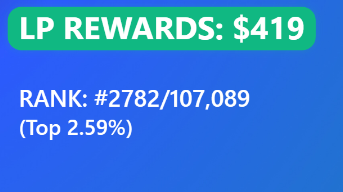
How many LP rewards have you earned on @Polymarket? I was able to farm $419. And it was very difficult to do.
Tiptop tweet media
English
12
3
43
882
Poly VPN
Poly VPN@Poly_VPN·
@0xSweep This is one of the most dangoures exploits possible in the world of trading, here is a deep dive on it's inner workings: x.com/Poly_VPN/statu…
Poly VPN@Poly_VPN

One of the most interesting exploits in Polymarket's history wasn't a hack. It didn't require sophisticated code. It was just a mechanic that let certain traders have their cake and eat it too. Here's how it worked. The Free Option Problem Polymarket's order matching used a nonce system — a sequence number attached to each order that determined validity. The quirk was that a trader could submit a fill for an existing order, and then had a small window before the transaction was finalized on-chain to decide whether to actually go through with it. In practice, savvy traders figured out they could use this as a free option on short-term crypto markets. The playbook looked like this: Bitcoin is trading at $95,000. A 5-minute UP/DOWN market is open with a market maker quoting both sides. A trader locks in a fill on the UP position at the current price. Then they wait. Not long — a few seconds. Just long enough to watch the Binance feed. If Bitcoin moves up in those few seconds, they let the transaction go through. They bought the UP position right before the move — instant edge. If Bitcoin moves down, they cancel. No loss. No exposure. The market maker on the other side had their liquidity locked the entire time and had no idea whether the trade was happening or not. Rinse and repeat, hundreds of times a day. The market maker is effectively writing free options without being compensated for it. Every time the price moves favorably for the taker, the trade fills. Every time it doesn't, it vanishes. The taker has asymmetric information and zero downside. Why This Was Hard To Stop The reason this worked for as long as it did is that it sat in a grey zone between a protocol bug and expected behaviour. The nonce system was doing what it was designed to do. The exploit was in the gap between order submission and on-chain finality — a gap that exists because Polymarket's CLOB is a hybrid system, with off-chain order matching and on-chain settlement. The traders doing this at scale were running bots. Fast ones. The faster your infrastructure, the more of these windows you could open per minute, and the more selectively you could fill based on real-time price feeds. This is also where location started to matter. A bot in London, close to both the CLOB and major price feeds, could evaluate the Binance move and make the cancel/fill decision faster than a bot running from Amsterdam or Ireland. Even in an exploit, latency was an edge. How CLOB V2 Fixes It The rebuilt matching engine in CLOB v2, going live April 22, closes this. The new order struct removes the conditions that made selective post-fill cancellation viable. Once a match occurs in the new system, it's committed. The free option window is gone. For market makers this is unambiguously good news. The structural tax they were paying to nonce exploiters disappears. Spreads should tighten as a result — makers can quote more aggressively when they're not implicitly writing free options on every fill. For the traders who were running this strategy, the edge is dead. What replaces it is a cleaner, faster, more competitive market where the advantages are structural rather than exploitative. What The New Game Looks Like With protocol quirks patched out, the remaining edges on Polymarket v2 are legitimate ones — better pricing models, faster data feeds, and lower latency infrastructure. The CLOB doesn't slow down for anyone. A faster matching engine means arb windows are shorter, queue priority is decided more quickly, and the gap between your order arriving and someone else's matters more than it ever did in v1. Polymarket's CLOB is in London. It was in v1 and it'll be in v2. The nonce exploit let you manufacture an edge from anywhere. Latency arbitrage doesn't. You either have the infrastructure or you don't. poly-vpn.xyz puts you in London — same city as the matching engine, on the right side of every queue.

English
0
0
0
262
Sweep
Sweep@0xSweep·
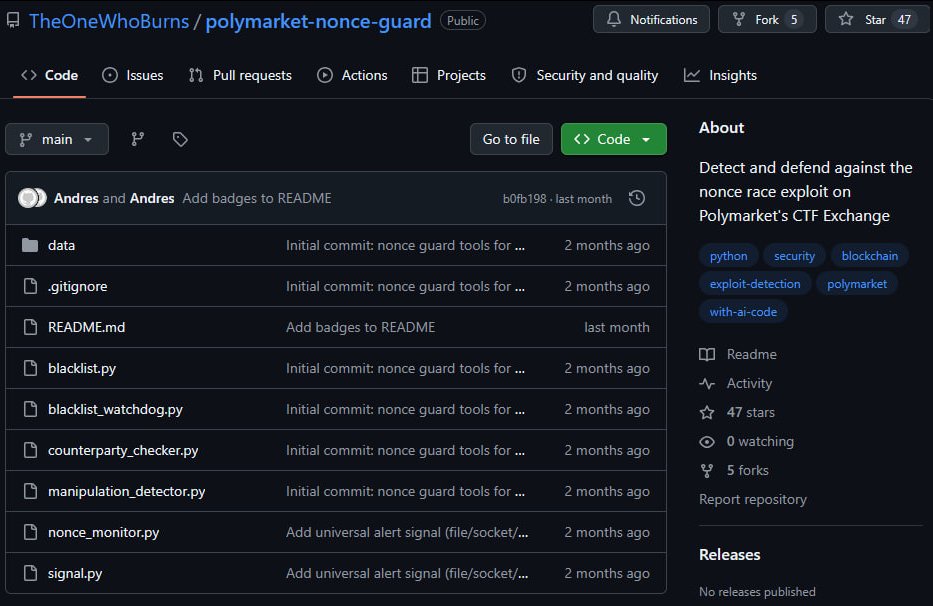
Someone found a way to wipe out Polymarket market makers with 10 cents per attack Polymarket matches trades on an off chain order book, then settles them on chain seconds later The gap between those two systems is the exploit A trader places a trade against a market maker bot and the API confirms the fill instantly, but before anything hits the blockchain he cancels the trade on chain The bot already hedged a position that never existed and now the attacker takes the free money 10 cents in gas per attack, 50 seconds per cycle, one wallet pulled $16,427 in a single day It's called Ghost Fills and Polymarket still hasn't fixed it, so a dev built an open source tool called Nonce Guard to defend against it himself
Sweep tweet mediaSweep tweet media
English
37
9
141
15.1K
Poly VPN
Poly VPN@Poly_VPN·
@herman_m8 @Polymarket @PolymarketTrade Awesome bro, check out this article to speed up your winnings: x.com/Poly_VPN/statu…
Poly VPN@Poly_VPN

$5 Million Is on the Table. Here's How to Get Your Share. Polymarket just announced $5 million in liquidity rewards for April 2026 — distributed across sports and esports markets including major European football leagues, CS:GO, DOTA 2, and League of Legends. Rewards are paid daily in USDC directly to maker addresses. Reward farming on Polymarket isn't dead. It just moved to sports. If you want to capture a meaningful slice of that $5M, you need to understand how the rewards formula actually works — and why infrastructure matters more than most people think. This is a practical guide to getting started as an automated liquidity provider on Polymarket. What Is Liquidity Providing on Polymarket? Polymarket runs on a Central Limit Order Book (CLOB). Every market has a YES and NO side, priced between $0.01 and $0.99, representing the implied probability of an outcome. For markets to function — for takers to buy and sell at fair prices — someone has to post resting orders on both sides of the book. That's you, the liquidity provider. In return for taking on inventory risk and keeping markets tradeable, Polymarket pays liquidity rewards on top of any spread you collect. With $5M allocated just for April, the combination of spread income and rewards makes automated LP genuinely interesting again. How the Rewards Formula Works Before you write a single line of bot code, understand this: Polymarket's rewards formula is not passive. It's designed to force liquidity into the most useful part of the book. Quadratic spread penalty. Rewards don't scale linearly with how much size you post. They collapse quickly the further your quotes sit from the Adjusted Midpoint. Posting tight quotes near the midpoint earns disproportionately more than posting wide. The formula rewards quotes where price discovery actually happens. Adjusted Midpoint. This isn't simply (best bid + best ask) / 2. Polymarket filters out "dust" orders below a minimum incentive size before computing the midpoint. This prevents a classic attack: posting tiny orders at extreme prices to artificially pin the midpoint, then farming rewards around the fake center. Time = risk exposure. Rewards accumulate the longer your orders sit in the book. But longer time in the book also means higher probability of getting filled. You're effectively selling gamma — the longer you stay, the more tail risk you're absorbing. There's no free lunch. Single-sided penalty. You can post on just one side of the book in the neutral zone (roughly 0.10–0.90 probability), but you'll earn roughly a third of what two-sided quoting earns. At the extremes (near 0 or 1), both sides are required or your rewards drop to zero. What You Need to Build A Price Feed Your bot needs a "fair value" — a theoretical probability for each market condition. Without this, you're quoting blind and informed takers will pick you off systematically. For sports markets, this means connecting to a real-time odds feed or building your own implied probability model from line movements. The key insight: whatever data source Polymarket uses for resolution is your reference point, not your pricing input. You want to be ahead of that feed, not reacting to it. For crypto UP/DOWN markets the same principle applies — Polymarket resolves against Chainlink, which is a lagged aggregation of faster feeds. Price off Binance directly. Treat Chainlink as the resolution reference only. A WebSocket Connection Polymarket's API provides real-time order book data over WebSocket. You need to subscribe to: book — Level 2 order book snapshots and updates price_change — order placements and cancellations last_trade_price — fill events best_bid_ask — top of book order / trade events on your authenticated user channel — your own fills, placements, cancellations By combining book snapshots with event streams, you can reconstruct the full order book state in memory at all times. Order Management Logic Your bot needs to handle: Quote placement — post limit orders on both sides at your desired spread around fair value Cancel/replace cycle — when your fair value updates, cancel stale quotes and repost at the new price. This needs to be fast. Stale quotes are free options for informed takers. Inventory management — as you get filled on one side, your position accumulates. You need rules for when to hedge, pull quotes, or widen spreads to manage directional exposure. Edge cases — ghost fills, WebSocket disconnections, and high-latency periods where your quotes go stale before you can cancel them Note: if you're still running v1 SDK code, update immediately. CLOB v2 goes live April 22 — all existing order books will be wiped at cutover and the new order struct requires re-signing. Bot operators on legacy code will be offline from day one. Risk Parameters Before going live, set hard limits: Maximum position size per market Maximum total exposure across all markets Minimum spread (below which you won't quote, regardless of rewards) Circuit breakers for unusual market conditions A Practical Starting Strategy for the $5M Pool The $5M rewards are split across Pre-match and Live (in-play) phases. Live markets are faster and more competitive — prices move with game events in real time. Pre-match is slower and a better starting point if you're building your first bot. The basic playbook for pre-match sports LP: Connect to a real-time sports odds feed and derive implied probabilities Post two-sided quotes tight enough to earn meaningful rewards, wide enough to survive normal line movement Cancel and repost as your fair value updates when new information arrives (injuries, lineup changes, line movement on other platforms) Collect rewards daily in USDC while collecting spread on fills The edge comes from having a better pricing model than competing LPs and being faster to reprice when information changes. Where Latency Decides Who Wins For slow pre-match markets hours before a game, latency is mostly irrelevant. You're adjusting quotes over minutes, not milliseconds. The moment you move into live in-play markets — or any market with active taker flow — latency becomes your most important infrastructure variable. Polymarket's CLOB matches orders on price-time priority. Same price, first arrival wins. When a goal is scored and every market maker is racing to cancel stale quotes and repost at the new price, the traders who complete that cycle first set the new market. Everyone else gets picked off on their stale quote, or arrives too late to post at the new best price. The CLOB is in London. Every cancel, every new order, every reprice makes a round trip to London. If your VPS is in Ireland or Amsterdam, you're adding unnecessary latency to every single one of those round trips. In a race measured in milliseconds, that compounds across hundreds of reprices per day into real money. With $5M in rewards concentrated in April, competition among LPs is going to be fierce. The makers who capture the largest share won't just have better pricing models — they'll have faster infrastructure. poly-vpn.xyz puts your infrastructure in London, same city as the CLOB. Better queue position on posts, faster cancels on stale quotes, less adverse selection from takers who are already there. The Honest Picture Reward farming on Polymarket went through a boom-and-bust cycle. Early LPs with 10,000 USDC were reportedly making 200–300 USDC per day at peak. That era ended as more sophisticated players entered and rewards-per-dollar compressed. The $5M sports announcement changes the calculus again — but not back to the easy days. The rewards are real, but so is the competition. The makers who capture a meaningful share will be the ones with solid pricing models, fast cancel/replace infrastructure, and servers in the right city. Liquidity rewards are best understood as a bonus on top of real trading edge, not a standalone money printer. But with $5M on the table in a single month, the bonus is worth taking seriously. Further Reading Polymarket liquidity rewards docs: docs.polymarket.com/market-makers/… CLOB v2 migration guide: docs.polymarket.com/changelog

English
0
0
0
20
Trackmind
Trackmind@0xTrackmind·
My friend lost $3,200 on Polymarket last month He's a software engineer at Google. Not an idiot. I showed him my screen without saying a word. He read the numbers three times. "This is fake" 27 days. $200 in. $14,300 out. 74% win rate. Sharpe 2.47. "Show me the wallet" I showed him the wallet. He stopped breathing for a second. "What the hell are you running" Four repos. All free. Claude does the rest. github.com/warproxxx/poly… 86 million on-chain trades. Every wallet. Every entry. Every exit. All public. One prompt: find every wallet with 100+ trades and win rate above 70%. Rank by profit. 14,000 wallets. 4 minutes. 47 targets returned. Top 20 made more than the bottom 13,000 combined. "That's not a stat. That's a cheat code" github.com/Polymarket/pol… 500 markets. Claude kills 93% of them before a dollar moves. 487 become 35. Bot trades 10 a day. Ignores everything else. github.com/Polymarket/age… Three agents. No shared memory. Two agree - full size. One alone - half. Disagree - no trade. That one rule killed 40% of losing trades overnight. github.com/dylanpersonguy… 47 target wallets never hold to settlement. 91% exit early. 73% of max profit. Then redeploy. My bot does the same. Cuts at 85% of expected move or 3x volume spike. Copytrade here: @trackmind" target="_blank" rel="nofollow noopener">kreo.app/@trackmind "Total cost" $25 a month. He works at Google. $400,000 a year. Benefits. RSUs. The whole thing. He quit three weeks later. Sent me one message on his last day. "Bot's doing $800 a day. I'm not going back" The repos are free. The window is open. What are you waiting for?
Trackmind@0xTrackmind

x.com/i/article/2046…

English
21
46
383
89.2K