Filip Procházka

28.2K posts

Filip Procházka banner
Filip Procházka

Filip Procházka

@ProchazkaFilip

Backend ⚡ Java/Kotlin, PostgreSQL, Cloud. 🛠️ Recovering overengineer.

Brno 🇨🇿 Katılım Mayıs 2009
576 Takip Edilen2K Takipçiler
Filip Procházka
Filip Procházka@ProchazkaFilip·
Mostly agree with one caveat - the LLM is very good at following patterns. If you're refactoring legacy codebase with it, its gonna be super painful because its context is full of the legacy crap it has to read. If you have nice codebase, producing good code becomes simpler
Mario Zechner@badlogicgames

i can't speak for david. what i see is this: if you let agents build or extend a codebase with only minor or no supervision, you get unmaintainable garbage, because the agent makes terrible decisions that compound, both big and small. those decisions make it hard for both you and the agent to keep modifying the code base, until eventually it's unrecoverable. why does the agent make bad decisions? i can't tell for sure, but my gut tells me that training data can currently not capture the holistic thinking needed to design and evolve complex systems. that's one part of the problem. related to that, and oversimplified: agents output the "mean quality" of the code they saw during training. most of that code is very bad. specifically tests, which humans are terrible at writing at. another part of the problem is that specification via prompt is not precise enough, so the agent has to fill in the blanks, giving it enough rope to hang itself. the more detailed your spec gets, so the agent gets constrained and less likely to produce crap, the closer you are to handwriting the code yourself, as that's the most detailed version of the spec that can exist. so then you gain nothing. back to prompt spec it is, which means the agent fills in blanks, which means we get suboptimal or truely bad results. using agents can still be a net productivity boost (see other posts in my thread), but it is not easy to come up with consistent workflows that produce both production quality maintainable code while retaining the speed advantages agents give you.

English
1
0
3
527
Filip Procházka retweetledi
◢
@joemccann·
This is actually insane. Dude hard-coded a WebAssembly (WASM) interpreter into the weights of a transformer, losslessly. In essence, a computer is running inside a LLM that can actually run computations, not infer or guess a calculation like most do today.
Christos Tzamos@ChristosTzamos

1/4 LLMs solve research grade math problems but struggle with basic calculations. We bridge this gap by turning them to computers. We built a computer INSIDE a transformer that can run programs for millions of steps in seconds solving even the hardest Sudokus with 100% accuracy


English
81
335
4.2K
506.2K
Filip Procházka retweetledi
Randy Olson
Randy Olson@randal_olson·
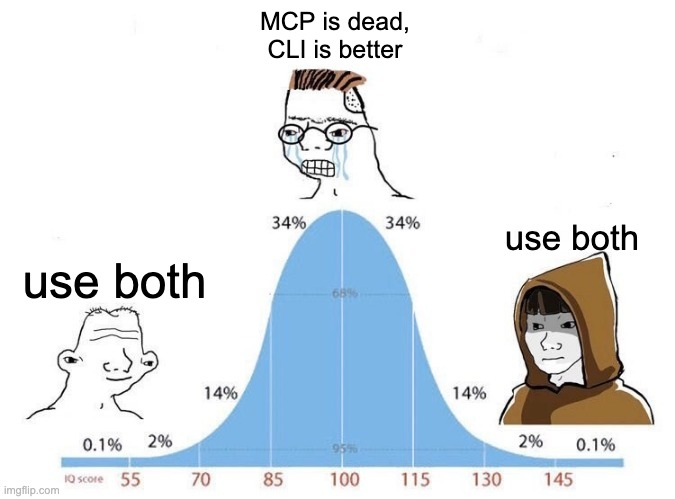
Summary of the MCP vs. CLI debate on X this week.
Randy Olson tweet media
English
39
70
778
44.2K
Filip Procházka retweetledi
Raul Junco
Raul Junco@RaulJuncoV·
People keep saying software development is dying. Let’s be clear. Nothing has changed where it actually matters. I don’t care if you: • Write every line yourself • Copy code from Stack Overflow • Generate it with Claude Code You still own the result. If the system breaks in production, nobody asks: “Was this written by AI?” They ask: “Why did this happen?” And the engineer who shipped it needs an answer. The tools changed, yes. The responsibility didn’t. So the same fundamentals still apply: • Get the requirements right • Understand the domain • Get your edge cases and failure modes • Put tests in place AI can help you write code faster. But it can’t take responsibility when that code causes problems. That part is still yours.
Raul Junco tweet media
English
12
17
100
9.4K
Filip Procházka retweetledi
Lukasz Olejnik, Ph.D, LL.M 𝛁
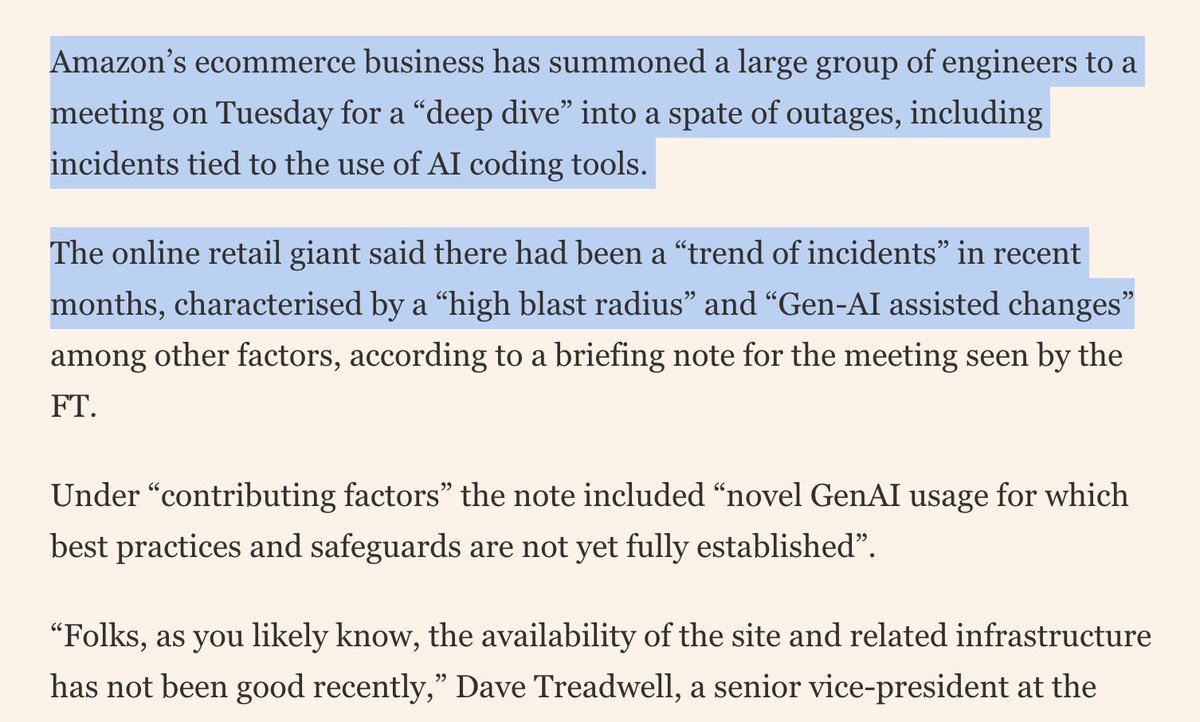
Amazon is holding a mandatory meeting about AI breaking its systems. The official framing is "part of normal business." The briefing note describes a trend of incidents with "high blast radius" caused by "Gen-AI assisted changes" for which "best practices and safeguards are not yet fully established." Translation to human language: we gave AI to engineers and things keep breaking? The response for now? Junior and mid-level engineers can no longer push AI-assisted code without a senior signing off. AWS spent 13 hours recovering after its own AI coding tool, asked to make some changes, decided instead to delete and recreate the environment (the software equivalent of fixing a leaky tap by knocking down the wall). Amazon called that an "extremely limited event" (the affected tool served customers in mainland China).
Lukasz Olejnik, Ph.D, LL.M 𝛁 tweet media
English
972
3.3K
19K
29.8M
Filip Procházka
Filip Procházka@ProchazkaFilip·
@xf3l1x @borekb Ono to AFAIK vevnitř furt používá playwright, akorát si to nastartuje process kterej drží tu session s prohlížečem a cli si povídá s procesem místo rovnou s prohlížečem. Ale teda byť to lepší je, furt mi přijde že všechny browser integrace jsou zatím úplně tupý...
Čeština
1
0
0
88
Milan Felix Šulc
Milan Felix Šulc@xf3l1x·
@borekb Agent-browser mi funguje daleko lepe. Mam pocit, ze umi nejak dobre ovladat browser bez nejakeho agenta, pripojovat s k dalsim externim sluzbam, coz ki prijde ze plawright neumi. Kdybys zjistil detaily, tak budu rad, tez by me to zajimalo.
Čeština
1
0
1
603
Borek Bernard
Borek Bernard@borekb·
Dokázal byste někdo říct, jak se liší agent-browser a playwright-cli v praxi? Na papíře to jsou velmi podobné věci, tak jestli tam jsou nějaké důležité nuance.. (agent-browser je fantastická věc ❤️, firmou se nám to šíří jako lavina 🙂)
Čeština
4
1
13
4.7K
Filip Procházka retweetledi
frankie
frankie@FrankieIsLost·
it's really this simple
frankie tweet media
English
29
210
2.7K
84.8K
Filip Procházka retweetledi
James Ward
James Ward@JamesWard·
Programming language doesn’t matter until you need to: - have actual parallelism - scale horizontally - scale vertically - compile 1m LoC - incrementally compile 1m LOC - refactor without breaking anything - review a large diff - validate a change - detect and remove dead code - maintain backwards compatibility - get a large team working efficiently - onboard new hires - validate the security of a system - invent custom abstractions to reduce duplication - work around abstractions someone else invented - troubleshoot production issues at 2am - be operationally efficient - deploy on Friday - deploy 100 times a day - handle time & timezones correctly - handle currency correctly - eliminate null pointer exceptions - depend on libraries that are maintained & secure ​​- produce something of more value than a tweet
English
22
83
719
70.4K
Filip Procházka retweetledi
Kamil Zmeškal ⚛
Kamil Zmeškal ⚛@KamilZm·
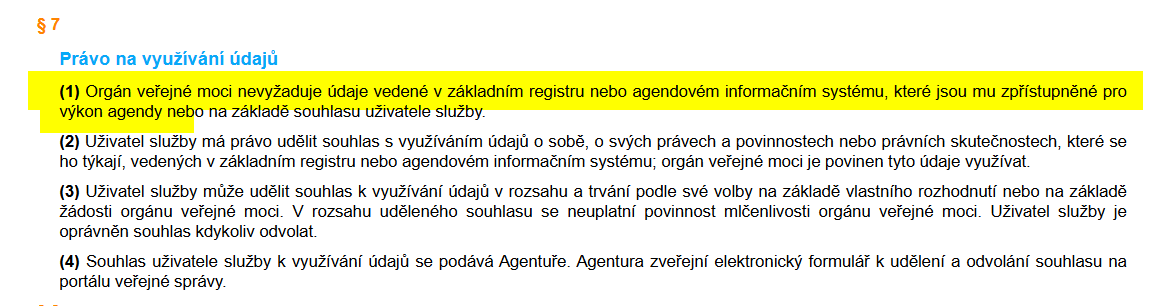
Tohle je potřeba pořád připomínat, protože se stále objevují podobné případy, kdy úředníci buď neví nebo jsou líní. Pokud po Vás bude nějaký úřad vyžadovat předložení výpisu z katastru (LV) apod., tak se braňte. Jednak to mají dostupné zadarmo už mnoho, mnoho let a také existuje § 7 zákona o právu na digitální služby.
Kamil Zmeškal ⚛ tweet media
Vojtech Kolar@VojtechKolar1

@michalblaha @milan_mihalcin Plati to i pro vypis z katastru? Zadal jsem o pokaceni stromu a musel koupit vypis z KN, abych dokazal ze je to moje zahrada 🤦🏻‍♂️🤣

Čeština
7
26
219
24.4K
Filip Procházka retweetledi
Bo Wang
Bo Wang@BoWang87·
Prof. Donald Knuth opened his new paper with "Shock! Shock!" Claude Opus 4.6 had just solved an open problem he'd been working on for weeks — a graph decomposition conjecture from The Art of Computer Programming. He named the paper "Claude's Cycles." 31 explorations. ~1 hour. Knuth read the output, wrote the formal proof, and closed with: "It seems I'll have to revise my opinions about generative AI one of these days." The man who wrote the bible of computer science just said that. In a paper named after an AI. Paper: cs.stanford.edu/~knuth/papers/…
Bo Wang tweet media
English
155
1.9K
9.1K
1.2M
Filip Procházka retweetledi
Dan Vega
Dan Vega@therealdanvega·
Code is cheap, Software is not 🤔 Anyone can write code. Building software that's maintainable, observable, secure, and actually solves a problem? That's the hard part. This is why fundamentals matter more than ever.
English
58
151
1.1K
32.8K
Filip Procházka retweetledi
Piotr Sarna
Piotr Sarna@sarna_dev·
most important lesson from years of distributed systems: keep everything on a single machine for as long as humanly possible
English
52
231
4.8K
136.9K
Filip Procházka retweetledi
Evren Önem
Evren Önem@eonem·
Just tell Claude to keep the reliability high bro. What do you mean software engineering isn’t just ✨producing some code✨ but tradeoffs, edge cases, infra, monitoring, scale, security, and 3am outages?
Gergely Orosz@GergelyOrosz

On one end, the Anthropic team is a massive user of AI to write code (80%+ of all code deployed is written by Claude Code). They ship amazingly fast. On the other hand, seeing these beyond terrible reliability numbers suggests there might be a downside to all this speed:

English
5
15
293
29.4K
Filip Procházka retweetledi
Amy Tam
Amy Tam@amytam01·
Run agents they said. You'll reclaim your time they said. I was up until 4AM monitoring my agents and thinking of new cool things to build. I no longer want to sleep.
English
125
91
1.4K
60.4K
Filip Procházka retweetledi
claire vo 🖤
claire vo 🖤@clairevo·
New SLA: your sales team has to respond faster than I can code it up
English
6
8
83
8.1K
Filip Procházka
Filip Procházka@ProchazkaFilip·
While I agree with the "lets start fresh" sentiment, dropping your own historical context is foolish. Being able to lookup past decisions is extremely useful for understanding missbehaving code.
Chintan Turakhia@chintanturakhia

Our migration to @linear was simple. Delete and start fresh. If it’s in the backlog, likely wasn’t going to see light of day anyways. If it’s a priority, team should already be working on it. Your hundreds of tickets sitting around is a crutch. You should be sprinting instead.

English
0
0
2
386
Filip Procházka retweetledi
josh
josh@eudaemonea·
@SecWar "Anthropic’s stance is fundamentally incompatible with American principles" the stance:
josh tweet media
English
119
584
8.8K
381.1K
Filip Procházka retweetledi
Aaron Levie
Aaron Levie@levie·
This is counterintuitive for some, which is why there’s a paradox named after it. But if you lower the cost of something that was previously supply constrained, demand for that thing goes up. Software engineering is just one of the easiest examples to contemplate. The process goes like this: every small business, every IT team, every large enterprise sees that engineering can now drive vastly more output. They then start to consider all the new things they can build or automate. They even test building prototypes themselves. They only get so far with that approach because they realize there are still 50 other tasks that go into building software and maintaining it. So they start to hire more engineers to do that work. All of this for work they never would have considered automating or having software for if AI didn’t exist. So yes, automating tasks, in plenty of fields, will lead to demand for experts, not less.
Puru Saxena@saxena_puru

The software industry is apparently dying but job postings for software engineers are rapidly rising!

English
194
403
3.4K
589.8K