ProofRails
225 posts

ProofRails
@ProofRails
The open translation layer from onchain events to audit-grade ISO records.

Thanks for the spotlight @FlareDevHub! Worth noting that we supports anchoring across all FDC attestation types, not just payments. Any data that can be verified through Flare's Data Connector can be turned into a provable, shareable record. We're building the infrastructure to make every verified event on Flare portable and trustworthy, whether it's a payment, a balance check, or any external data feed. If FDC can verify it, We and @ProofRails can anchor it.

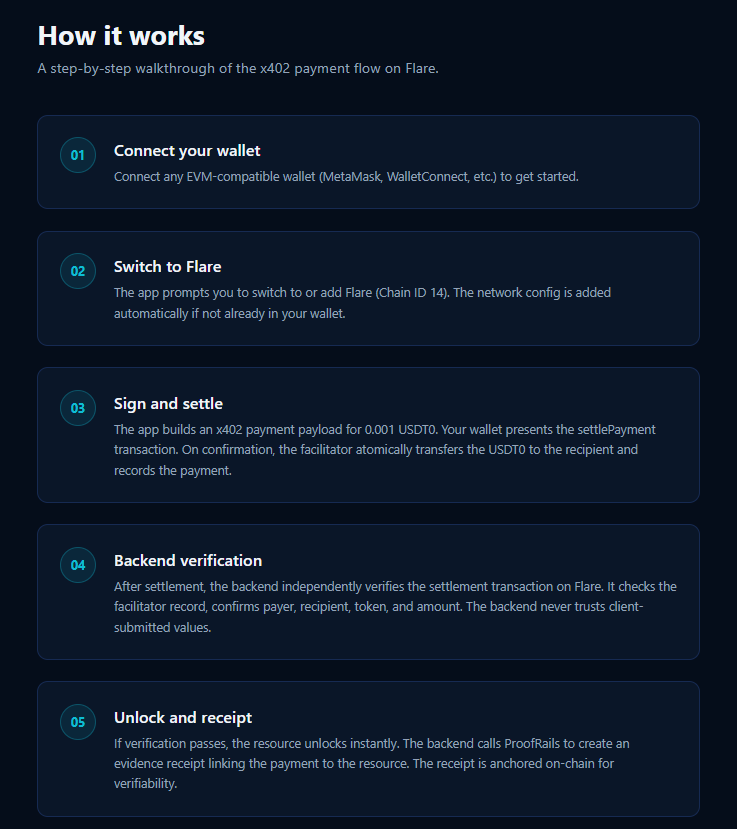
Imagine you are trying to build a product where a user pays in $XRP on XRPL, but the thing you want to unlock lives somewhere else: a SaaS backend, an API, an agent, a smart contract, or a workflow that institutions already run on standard financial rails. That is where things usually break. The payment happened, but outside XRPL it is still just chain-specific data, hard to verify, hard to standardize, and hard to use across systems without custom logic or a closed network. What @ProofRails and @Burstnodes are showing is a different future: take a real payment from XRPL, verify it through Flare’s data infrastructure, translate it into an ISO-native financial event, and anchor its proof on @FlareNetworks so it becomes a trusted signal that apps, agents, and other systems can actually build on. That is big in general because it turns payment from an endpoint into infrastructure. The onchain transaction becomes a portable, machine-readable event that can trigger access, settlement, reporting, automation, and new financial products across stacks. And this is especially significant for XRPFi. XRP has always been strong as a payment rail. The missing layer was an open way to make those payments usable in programmable environments. If XRPL payments can be verified and used as valid proof elsewhere with standards and references from Flare, then XRP not only moves value, but can drive new types of workflows and logic in DeFi, applications, agents, and institutional operations. The institutional angle is where this gets even bigger. The same architecture can expand beyond simple user payments into treasury operations, cross-system reconciliation, payment-triggered servicing, compliance evidence, and multi-chain financial workflows where external payment activity needs to become a trusted input for automated systems.

Follow @useprovn to see what we're building with @ProofRails and how you can register transactions across Flare, Bitcoin, Ethereum and more with on-chain proof anchoring.

Imagine you are trying to build a product where a user pays in $XRP on XRPL, but the thing you want to unlock lives somewhere else: a SaaS backend, an API, an agent, a smart contract, or a workflow that institutions already run on standard financial rails. That is where things usually break. The payment happened, but outside XRPL it is still just chain-specific data, hard to verify, hard to standardize, and hard to use across systems without custom logic or a closed network. What @ProofRails and @Burstnodes are showing is a different future: take a real payment from XRPL, verify it through Flare’s data infrastructure, translate it into an ISO-native financial event, and anchor its proof on @FlareNetworks so it becomes a trusted signal that apps, agents, and other systems can actually build on. That is big in general because it turns payment from an endpoint into infrastructure. The onchain transaction becomes a portable, machine-readable event that can trigger access, settlement, reporting, automation, and new financial products across stacks. And this is especially significant for XRPFi. XRP has always been strong as a payment rail. The missing layer was an open way to make those payments usable in programmable environments. If XRPL payments can be verified and used as valid proof elsewhere with standards and references from Flare, then XRP not only moves value, but can drive new types of workflows and logic in DeFi, applications, agents, and institutional operations. The institutional angle is where this gets even bigger. The same architecture can expand beyond simple user payments into treasury operations, cross-system reconciliation, payment-triggered servicing, compliance evidence, and multi-chain financial workflows where external payment activity needs to become a trusted input for automated systems.


Introducing ProofRails V2: the control and evidence engine that turns blockchain payments into verifiable financial records institutions and individuals can audit, reconcile, and trust.


Introducing ProofRails V2: the control and evidence engine that turns blockchain payments into verifiable financial records institutions and individuals can audit, reconcile, and trust.


Introducing ProofRails V2: the control and evidence engine that turns blockchain payments into verifiable financial records institutions and individuals can audit, reconcile, and trust.


ProofRails is a tool that converts blockchain (onchain) transactions into structured, ISO 20022-compliant records for audits and financial reporting. It creates verifiable evidence bundles, signs them, and anchors hashes on Flare for timestamping and integrity checks. This bridges crypto with traditional banking systems.