RaviDevisetty

175 posts

RaviDevisetty

RaviDevisetty

@RaviDevisetty

Not investment advice. For educational purposes only.

Katılım Mart 2022
569 Takip Edilen21 Takipçiler
RaviDevisetty
RaviDevisetty@RaviDevisetty·
@DimitryNakhla What will happen if new entrants with technology edge come into those areas and undercut pricing with deep pockets?
English
0
0
1
546
Dimitry Nakhla | Babylon Capital®
Charlie Munger famously said: “Invert, always invert.” So let’s apply that to dLocal $DLO. A business with ~$440M in cash, $0 long-term debt, trading at ~14x earnings, operating across ~45 markets in some of the fastest-growing and most underpenetrated payment corridors in the world — LATAM, APAC, and Africa. $DLO has 3 distinct paths to grow: 1️⃣ 𝐂𝐮𝐫𝐫𝐞𝐧𝐭 𝐦𝐞𝐫𝐜𝐡𝐚𝐧𝐭𝐬. 𝐂𝐮𝐫𝐫𝐞𝐧𝐭 𝐦𝐚𝐫𝐤𝐞𝐭𝐬. More volume flowing through an already embedded relationship. No new sales cycle required. 2️⃣ 𝐂𝐮𝐫𝐫𝐞𝐧𝐭 𝐦𝐞𝐫𝐜𝐡𝐚𝐧𝐭𝐬. 𝐍𝐞𝐰 𝐦𝐚𝐫𝐤𝐞𝐭𝐬. dLocal operates across ~40 markets. Most merchants are only using a fraction of them. The cross-sell opportunity is already sitting inside the existing customer base. 3️⃣ 𝐍𝐞𝐰 𝐦𝐞𝐫𝐜𝐡𝐚𝐧𝐭𝐬. 𝐀𝐧𝐲 𝐦𝐚𝐫𝐤𝐞𝐭. Winning business from merchants not yet on the platform — in markets where the digitization tailwind is still in its early stages. 𝐍𝐨𝐰 𝐢𝐧𝐯𝐞𝐫𝐭. What are the odds $DLO fails on all three simultaneously? That existing merchants use them less, don’t expand into new markets, and no new merchants come on board — all at once? That’s a difficult case to make. And this doesn’t even account for the future suite of services $DLO may be able to layer on top as payment volume scales through their platform. More volume means more data, more trust, and more monetization opportunities over time.
Dimitry Nakhla | Babylon Capital®@DimitryNakhla

1/13 $DLO has become one of the more interesting companies in global payments. Since its 2021 IPO, the stock is down -82%, while Revenue & EPS have grown at 35% and 19% CAGR (2022-LTM). Today it trades at 15x earnings and a 6.4% FCF yield. Is this an opportunity or trap?

English
5
2
72
33K
RaviDevisetty
RaviDevisetty@RaviDevisetty·
@joecarlsonshow AI will only make the content a lot more cheaper in the long term and will be a huge tailwind
English
1
0
0
148
Joseph Carlson
Joseph Carlson@joecarlsonshow·
When you compare Netflix standard price with how much they spend on content, their price per content has not gone up, it's gone down.
Joseph Carlson tweet media
English
32
10
337
49.4K
RaviDevisetty
RaviDevisetty@RaviDevisetty·
@QualityInvest5 I read that they are also trying securization with a small sample using vantage score which is the moat of fico. Have to see the sample results and whether it will stick.
English
0
0
1
83
Aria Radnia 🇮🇷
Aria Radnia 🇮🇷@ariaradnia·
When $FICO charges $10 per credit score and Vantage used to cost $4 (a significant discount) and it gained no meaningful traction Why would this dynamic change AT ALL if Vantage is discounted even more?
English
12
0
76
9.5K
RaviDevisetty
RaviDevisetty@RaviDevisetty·
@SayNoToTrading The question is how much operating income they are getting through underwriting(loan approval) vs selling and buying of loans & B2B business. The moat is on the second one and the also major profits. Every major bank these days have a propriety model for underwriting
English
0
0
3
249
Say No To Trading
Say No To Trading@SayNoToTrading·
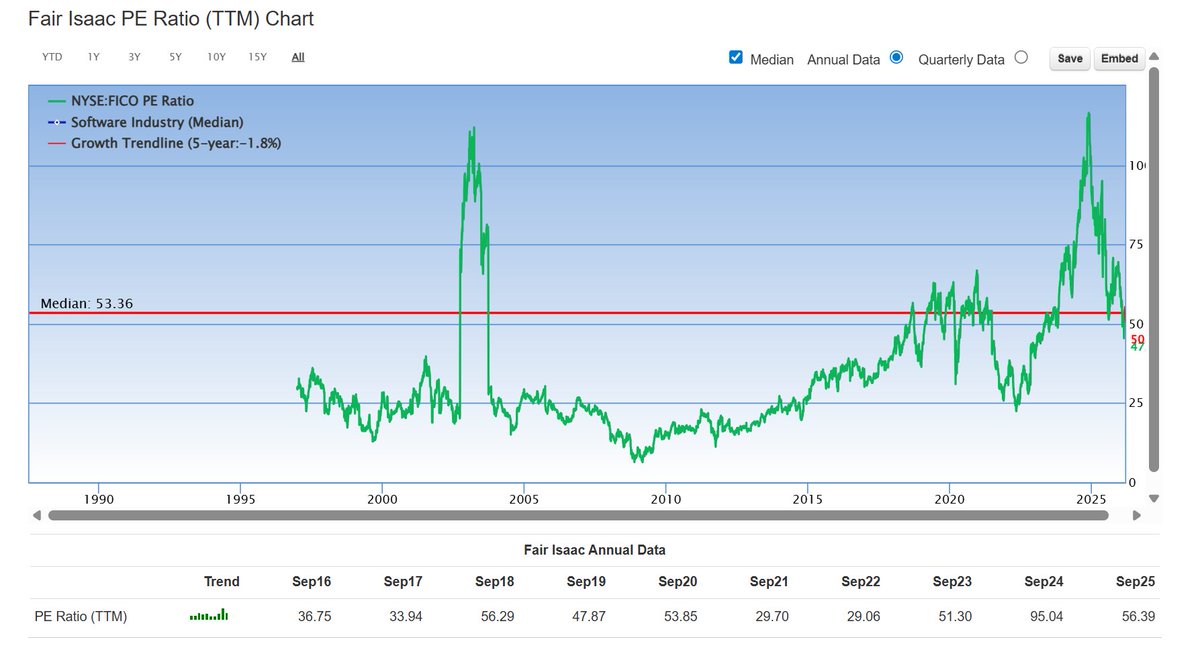
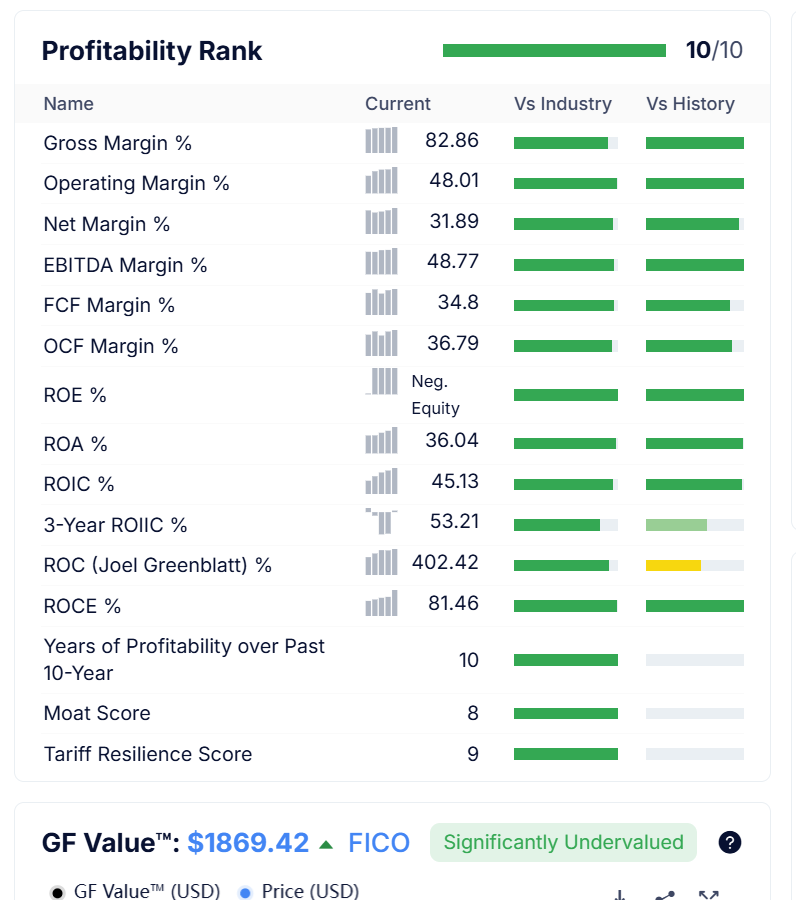
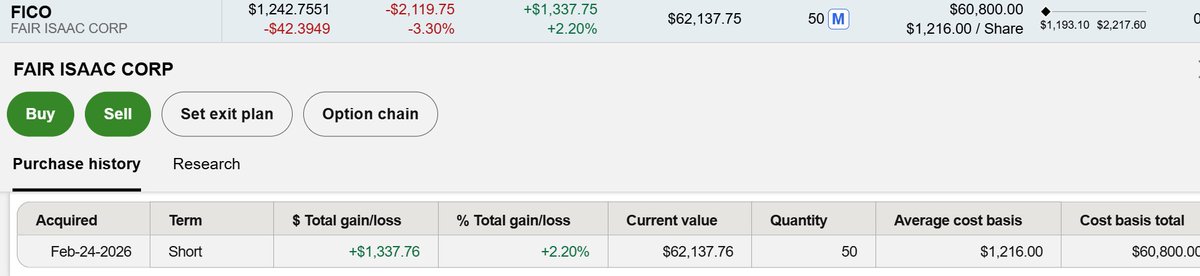
I see a lot of people brushing off this latest $FICO drama as nothing: - Experian $EXPGY $EXPGF $EXPN revealed it will provide VantageScore 4.0 for $0.99 per mortgage score. - Equifax $EFX and TransUnion $TRU participated in the pricing initiative to expedite VantageScore adoption by lenders. - This strategy follows the FHFA’s 2025 resolution to authorize VantageScore for mortgage underwriting. It's true this is not exactly news, as we knew something like this was coming, but the synchronized announcements from $EFX and $EXPGY were a surprise. You can own $FICO stock and make all the jokes you want about "can't Claude Code credit scores" and VantageScore is garbage, but that is kind of putting your head in the sand. True on the former but not the latter. VantageScore was very much a joke about 15 years ago but not anymore. Nothing lasts forever and we are seeing a transition from monopoly (FICO) to duopoly (FICO and VantageScore). The difference is, FICO must pay for data from the credit bureaus to generate their scores, so they are at a disadvantage in that regard. $EFX $EXPGY $TRU already own the data. As I've said before, the arrangement between them is similar to what banks did to create Zelle, which as you know, very much hurt $PYPL Venmo and $XYZ Cash App. They couldn't compete with the banks' built-in advantages. I am OK owning a small position in $FICO but not one I want to go heavy on, even though I think they will do fine. The biggest risk is further multiple compression in my opinion as the narrative around them changes. Attachments from @gurufocus. Forward PE just shy of 30. I remember the sentiment surrounding FICO in 2010s and my concern is reverting to multiples closer to there, rather than any noteworthy business deterioration. Also, the argument that FICO scores are so cheap relative to mortgage or loan size, their price doesn't matter, is flat-out wrong. When I had a credit biz coming out of GFC, I saw first hand the major banks move away from FICO scores and utilize proprietary scoring models for credit card approvals. Now, they can legally do so for mortgages. Before, they couldn't.
Say No To Trading tweet mediaSay No To Trading tweet mediaSay No To Trading tweet mediaSay No To Trading tweet media
English
14
11
127
21.5K
RaviDevisetty
RaviDevisetty@RaviDevisetty·
@vladtenev Deposits are the holy grail of banking. All banks and brokerages are going to have a tough time
English
1
0
2
58
Vlad Tenev
Vlad Tenev@vladtenev·
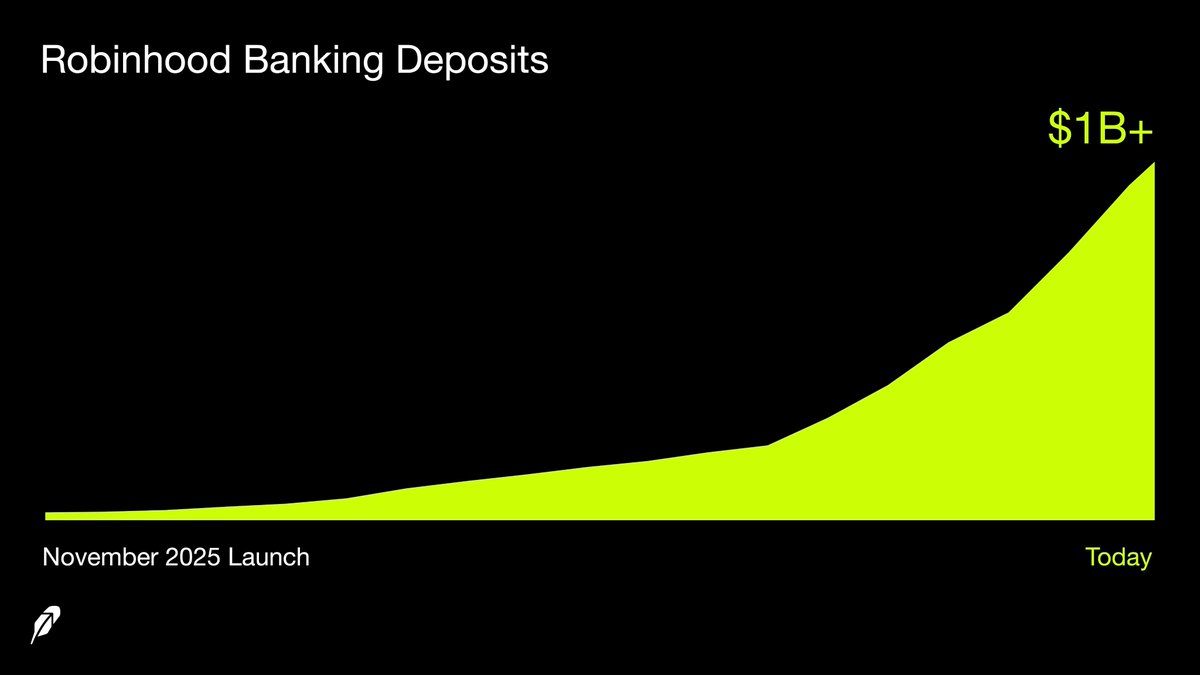
Robinhood Banking just crossed $1B in deposits from 65K funded customers. Huge milestone — and the team is just getting started🔥 Robinhood is a financial technology company, not a bank. Banking services are provided by Coastal Community Bank, Member FDIC.
Vlad Tenev tweet media
English
165
129
1.7K
439.4K
Aria Radnia 🇮🇷
Aria Radnia 🇮🇷@ariaradnia·
What P/E do you think this company deserves? Quantitatively, it has: - Revenue 10–12% - EPS growth 16–18% - With 40% FCF margins - Rock-solid balance sheet - ROCE of 45% (for those of you who care) And qualitatively, it has: - A massive AI tailwind - Strong network effects - ABSURDLY high switching costs - High-retention subscription model - Global reach as the de-facto INDUSTRY LEADER with around 60% market share So again I ask you, what P/E (or P/FCF) do you think this company deserves to trade at?
English
41
0
60
22.3K
RaviDevisetty
RaviDevisetty@RaviDevisetty·
@QualityInvest5 definitely cheap but the growth rates we have seen in last few years driven by higher pricing and utilization. Pricing driven by higher real estate and hotel rates, higher margins for booking. Questio ln is whether those growth rates can sustain and what happens if economy slows
English
0
0
0
459
RaviDevisetty
RaviDevisetty@RaviDevisetty·
@JohnHuber72 15 years back if they paid little bit more for quality and growth like big tech, they could have made more money and I know it is in hindsight sight?why did n’t they do it? Most importantly can you pay more for quality and growth and still make more money?
English
0
0
0
36
RaviDevisetty retweetledi
David Marcus
David Marcus@davidmarcus·
A few thoughts about PayPal, nearly 12 years after I left. I woke up this morning to dozens of messages from former PayPal colleagues. It pushed me to finally speak up. I never spoke publicly about the company after I left. Part of that was loyalty to John Donahoe, who gave me an unlikely opportunity, handing the reins of PayPal to a startup guy who, on paper, had no business running a then 15,000-person organization. But part of it was something else: I had left. I chose not to stay and fight for the changes I believed in. Speaking from the sidelines felt like armchair commentary. Easy opinions without the burden of execution. So I stayed quiet. But twelve years of silence is long enough. And today's news makes it clear the pattern I've watched unfold isn't self-correcting. I left PayPal in 2014 because I was deeply frustrated. We had executed a silent turnaround of a company that had lost its soul. We brought back engineering talent, shipped good products quickly, and acquired Braintree and Venmo. The company was on a tear. So much so that Carl Icahn felt compelled to accumulate a position in eBay and push for a PayPal spinoff. At the time, eBay decided to fight Icahn. It was a difficult period for me, caught between what I felt was right for PayPal and my loyalty to the eBay team. This is when Mark Zuckerberg approached me to join Facebook. The combination of his conviction that messaging would become foundational, the appeal of going back to building products at scale, and my growing exhaustion with the internal politics at PayPal and eBay eventually convinced me to leave and join one of the best teams in the world, one I had admired for a long time. In the summer of 2014, I met John in a café in Portola Valley and told him I had decided to leave. During that conversation, he told me that Icahn had effectively won the fight, that PayPal was going to become an independent company, and he tried to convince me to stay on as CEO, but I had already said yes to Mark, and my word is my bond. There was no turning back. After my departure, the board scrambled to find a replacement, and it took a few months for them to land on Dan Schulman. The leadership style shifted from product-led to financially-led. Over time, product conviction gave way to financial optimization. Much of the momentum we had created still persisted and carried the company forward, mainly driven by Bill Ready, who came over in the Braintree acquisition and rose to COO. Under his leadership, Venmo grew exponentially, and total payment volume (TPV) accelerated quickly. But the shift under Schulman became more pronounced after Bill's departure at the end of 2019. With him went the product conviction that had defined the post-spinoff momentum. Then, for a period, COVID-fueled online shopping hid a lot of the company's new weaknesses. During that period, the company made a fundamental miscalculation: it optimized for payment volume instead of margin and differentiation. It leaned into unbranded checkout, where PayPal had the least leverage, instead of branded checkout, where the margin, data, and customer relationship actually lived. Visa masterfully structured a deal that effectively ended PayPal's ability to steer customers toward bank-funded transactions, which had been a core driver of PayPal's economics. Not long after, PayPal lost a significant portion of eBay's volume. Over time, it saw its share of checkout among its most profitable customers steadily erode as Apple Pay and others continued to execute well. The same pattern repeated itself across lending, buy-now-pay-later (BNPL), and new rails. On lending, PayPal missed the opportunity to turn it into a platform weapon. Products like Working Capital were conservative, short-duration, and optimized for loss minimization. Lending never became programmable, never became identity-driven, and never became a reason for merchants or consumers to choose PayPal over something else. The missed opportunity in BNPL was even more striking. Klarna, Affirm, and Afterpay didn't just offer installment payments, they built consumer finance brands, persistent credit identities, and new shopping behaviors. PayPal saw the BNPL turn, entered the market, and had every advantage: distribution, trust, and merchant relationships. But BNPL was treated as a defensive checkout feature rather than an offensive category. There was no attempt to turn it into a core consumer relationship, no super-app behavior, and no meaningful differentiation for merchants. Others built platforms, PayPal added a feature. The failure to lean into building and owning new rails followed the same logic. After the spinoff, PayPal had a once-in-a-generation opportunity to build a global, at scale payment network. Instead, the company focused on building on top of existing networks and third-party rails. More recently, that mindset carried over to PYUSD. Technically, the product was sound. Strategically, it launched without a compelling transactional reason to exist. PYUSD had distribution, but no organic demand. It was not embedded deeply enough into flows to become a true settlement layer, a cross-border merchant rail, or a programmable money primitive. It sat adjacent to the product instead of inside the core of it. Acquisitions during this period followed a similar pattern. Honey was not a strategic acquisition for PayPal. It added activity, but not leverage. It lived outside the transaction, monetized affiliate economics rather than payment economics, and never meaningfully strengthened PayPal's control of the customer or the checkout moment. Xoom solved a real problem in remittances, but it never compounded PayPal's advantage. It scaled volume without changing the underlying rails, identity graph, or settlement model, and as importantly, it didn’t cater to a high-value, high-margin customer archetype. None of these were bad companies. They were just a wrong fit for PayPal and became unnecessary distractions. The board eventually recognized the problem. In 2023, they brought in Alex Chriss, an Intuit veteran with a strong product background, explicitly to restore product conviction. It was the right instinct. But Alex came from software, not payments. He understood SMB product development. He didn't have the muscle memory for transaction economics, network effects, or settlement infrastructure. In hindsight, he also made an error: clearing out much of the leadership team that understood payments deeply. Executives with years of institutional knowledge departed within his first year. This morning, Alex was removed as CEO. Branded checkout grew 1% last quarter. The board tapped another operator, Enrique Lores, the former HP CEO who's been on the PayPal board for five years. I don’t know Enrique. And he might be a great leader, but on paper at least, he’s a hardware executive. For a payments company. The common thread through all of this is incentive design. Once PayPal became independent, short/medium-term predictability beat long-term vision and ambition. Stock performance mattered more than platform risk and network opportunity. Financial optimization replaced product conviction. I'm not claiming I would have made every call differently. Running a public company at scale involves tradeoffs I didn't have to make after I left. But the pattern, choosing predictability over platform risk, again and again, was a choice, not an inevitability. Over time, the company that had every advantage and could’ve become the most consequential and relevant payments company of our time, lost its mojo, its product edge, and its ability to compete in a market that’s being rewired and reinvented in front of our eyes. That's the part that's hardest to watch for a company I care so deeply about.
English
612
941
8.8K
2.4M
RaviDevisetty retweetledi
Joseph Carlson
Joseph Carlson@joecarlsonshow·
Buying software companies should come with a disclaimer that it’s not good for your mental health.
English
63
36
1.3K
81.1K
RaviDevisetty
RaviDevisetty@RaviDevisetty·
@themattharbaugh I have lot of respect for Terry Smith but I also believe his under performance in short term is due to paying higher multiples for lower growth trajectory and ultimately he will do fine due to high ROIC businesses
English
0
0
1
78
Matthew Harbaugh
Matthew Harbaugh@themattharbaugh·
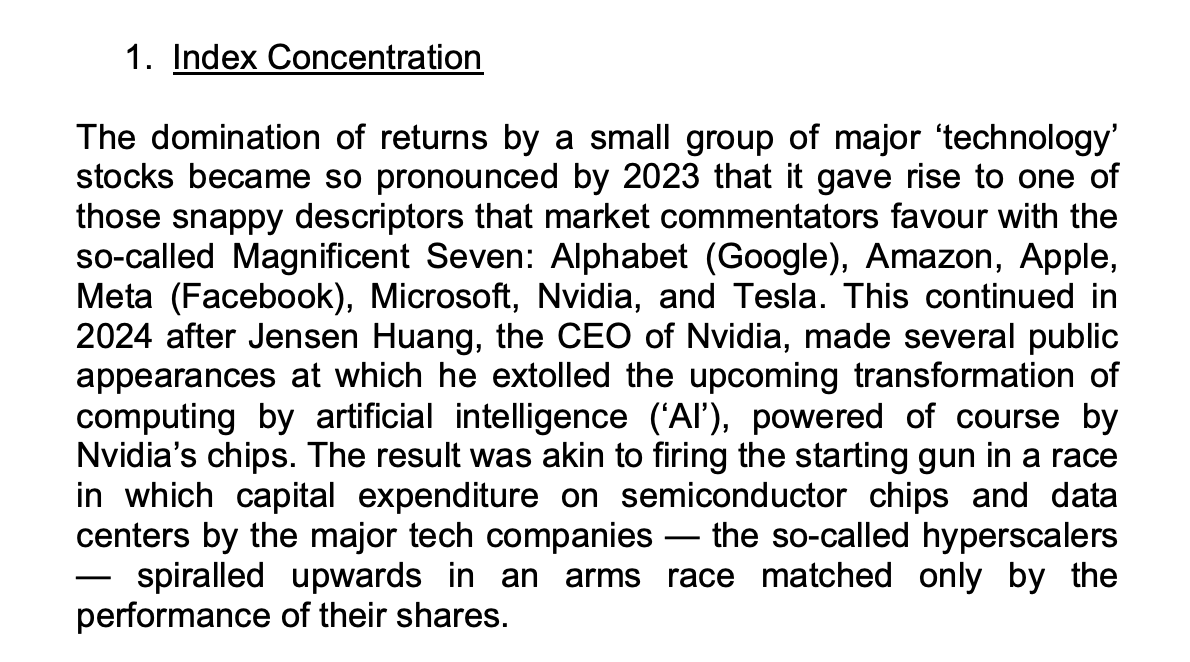
Terry Smith's 3 reasons why he underperformed the market 1. Index concentration 2. Growth of index funds 3. Dollar weakness Do you agree?
Matthew Harbaugh tweet mediaMatthew Harbaugh tweet mediaMatthew Harbaugh tweet media
English
14
7
54
28K
RaviDevisetty
RaviDevisetty@RaviDevisetty·
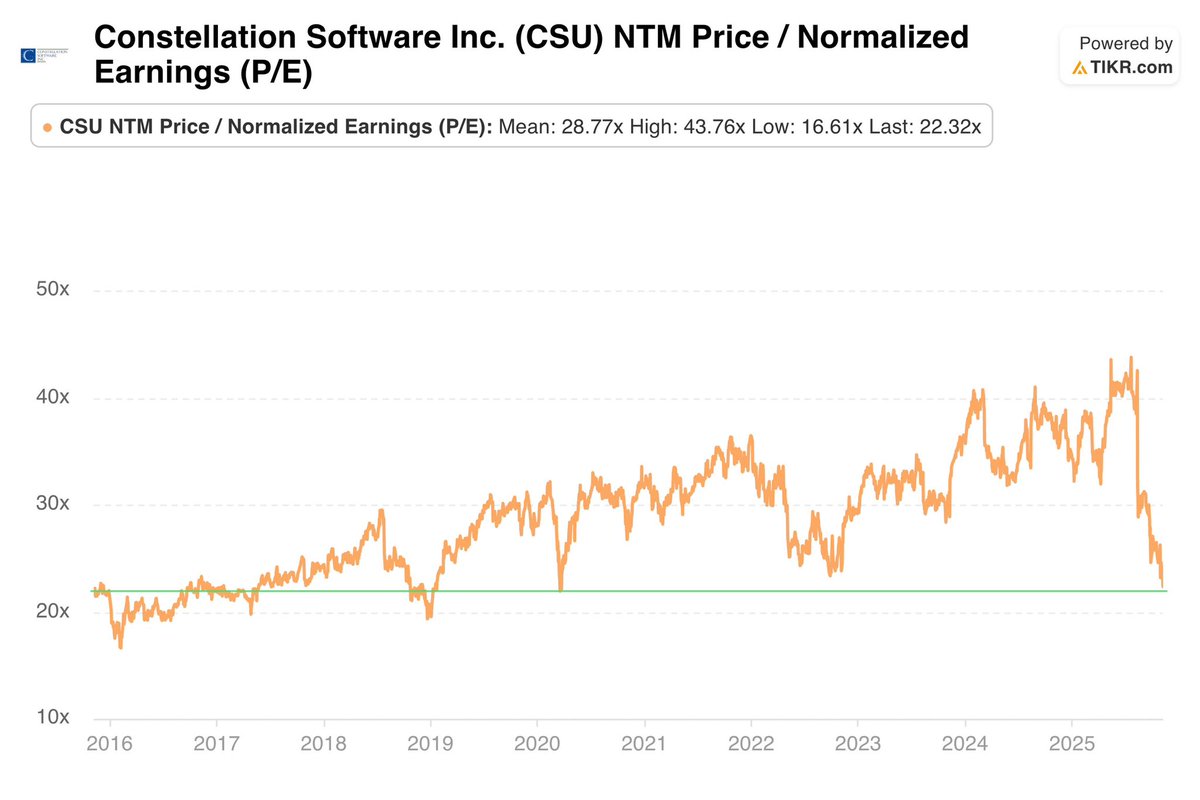
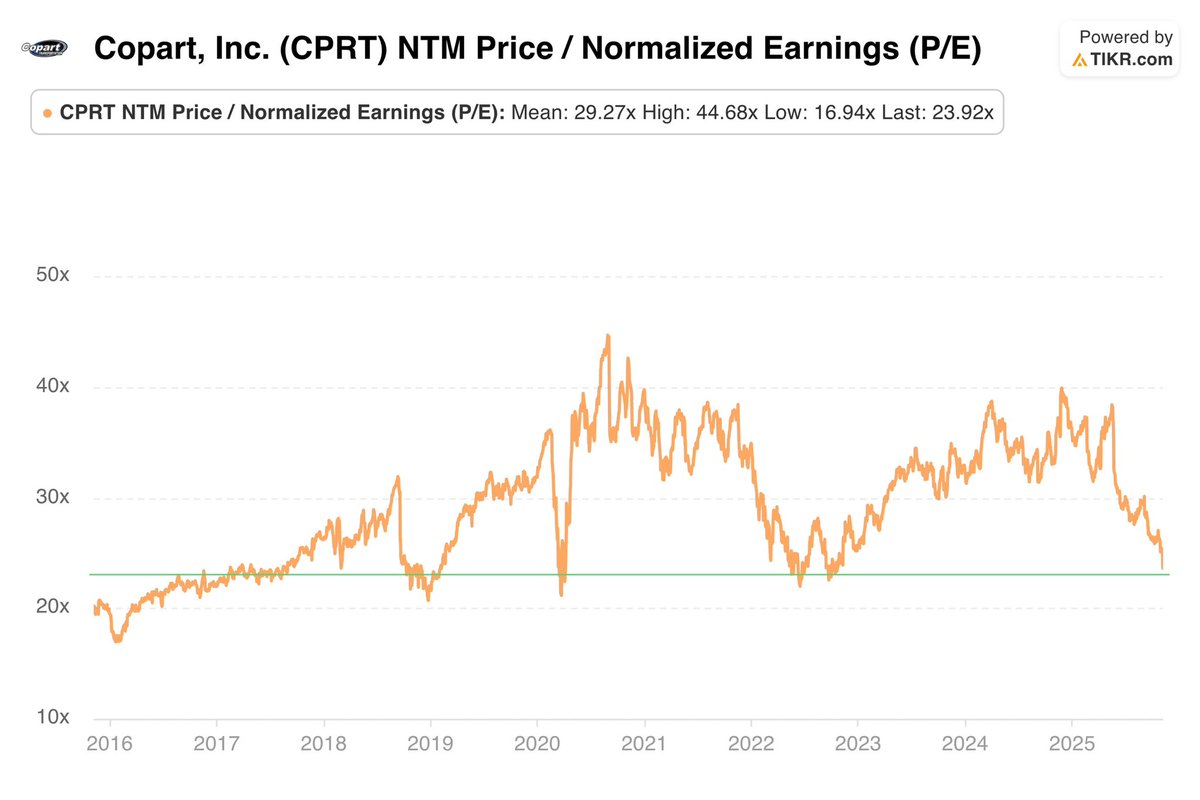
@DimitryNakhla Significant revenue growth rates for $cprt, $pgr, $bro in last few years is driven by higher asset prices in the last few years post covid. Those growth rates and valuations are not sustainable and they are coming down to earth and look more reasonable
English
1
0
3
661
RaviDevisetty
RaviDevisetty@RaviDevisetty·
@BarrySchwartzBW @qualityequities Yes. Cheap based on current forecast. Only question is all these business are competing for ad dollars, new entrants like openAI & other AI businesses, improved ad targeting by Netflix, Disney/tiktok in an economy that could potentially slow down and can cut dollars first
English
0
0
0
82
Barry Schwartz
Barry Schwartz@BarrySchwartzBW·
Meta at 20x 2027 with dd revenue growth expected.
English
10
4
118
11.7K
RaviDevisetty retweetledi
The Long Investor
The Long Investor@TheLongInvest·
5 YEAR Perf: $NVDA +1270% $GOOG +217% $TSLA +210% $META +159% $MSFT +142% $AAPL +128% $AMZN +40% One has been considerably lagging and arguably one of the strongest fundamentals
English
75
79
1.7K
175.6K
RaviDevisetty retweetledi
*Walter Bloomberg
*Walter Bloomberg@DeItaone·
NEW EXPORT CONTROLS UNDER CONSIDERATION BY THE U.S. COULD CURB EXPORTS ON WIDE RANGE OF GOODS TO CHINA, SOURCES SAY
English
11
34
252
111.5K
RaviDevisetty retweetledi
Triple Net Investor
Triple Net Investor@TripleNetInvest·
This clip is one of the only online clips of Jeff Sutton, New York City's undisputed king of retail real estate Sutton comes from humble beginnings Wanting to get into NYC real estate but lacking the funding to compete with bigger real estate players, Sutton took a different strategy He would first find a potential tenant, determine where they wanted a store, and then seek to buy out the lease from the existing tenant at the location For instance, he would famously take Payless executives out for a tour and have them point to where they wanted their stores to be Then he'd reach out to the existing tenant of the location and try to buy them out If that didn't work, he'd try and buy out the landlord, and sometimes, he made the tenant he was representing his own subtenant He would use this strategy for other national/gloabl retailers and soon owned/controlled some of the most prime real estate in the city with some of the most coveted tenants Today, he's worth an estimated $2.3 billion If you're interested in retail real estate, this is a rare, must watch clip of one of the biggest players in the space - someone you should definitely learn more about
English
25
160
1.1K
327.5K
RaviDevisetty
RaviDevisetty@RaviDevisetty·
@joecarlsonshow Even though service now acquisitions are better than CRM, sales force is dealing with $40B revenue base vs service now $10b revenue base
English
0
0
0
203
Joseph Carlson
Joseph Carlson@joecarlsonshow·
Did Salesforce actually buy something without overpaying for it?
English
65
4
229
37.5K
RaviDevisetty retweetledi
The Transcript
The Transcript@TheTranscript_·
$NVDA CEO's advice to students: "resilience matters in success...I don't know how to teach it to you except for, 'I hope suffering happens to you'..greatness comes from character & character...is formed out of people who suffered..I wish upon you ample doses of pain & suffering"
English
97
1.3K
4.9K
873.1K