
Sabitlenmiş Tweet
Reef
82.6K posts



We raised $5.4M to make paid ads run themselves.
Introducing Playad, the world's first AI marketing team.
First up: paid ads, run by AI.
English
Reef retweetledi

The making of The Rogue.
This project changed me creatively in a lot of ways. Spending years trying to figure out how to tell this story, and finally seeing it come alive the way I always dreamed it, still feels surreal.
What I love about this BTS is that it shows how personal the process really was. All the experimenting, the little discoveries, the obsession with performances, camera movement, atmosphere, and emotion.
This definitely feels like the beginning of a new chapter for filmmakers around the world searching for ways to finally bring their own stories to life.
Extremely proud to be part of this moment and this revolution alongside the entire @runwayml team.
Really happy to finally share this part too.
English
Reef retweetledi

The guy behind Google's Antigravity thought a one-person billion-dollar company was impossible.
Then he changed his mind.
His argument: if you're an ideas guy, and the next guy has the same AI, what's your alpha?
Then he looked at games.
The best games aren't the ones with the best graphics.
Nintendo proves it.
- It's the mechanics.
- The story.
A few things done perfectly.
So the alpha was never the studio of 100 people.
It's the idea.
AI just removed everything between you and shipping it.
One person. Billion dollars.
Increasingly possible.
English
Reef retweetledi

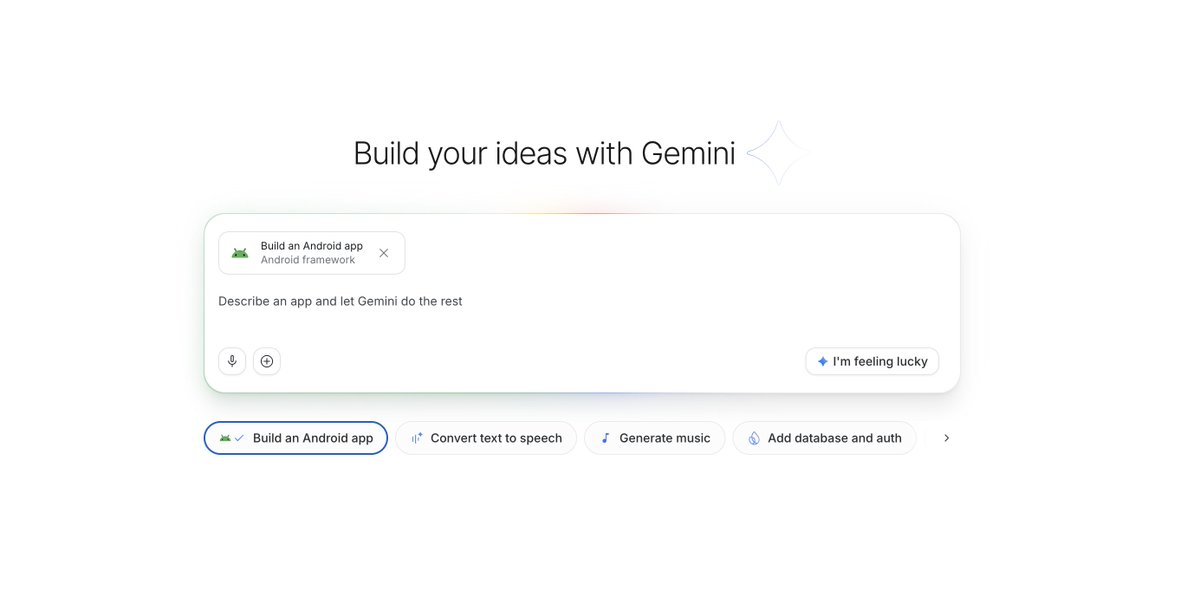
We just launched the ability to build native Android apps directly in Google AI Studio for free!
Since launch last week, people have created more than 250,000 Android apps. Likely >99% of these folks never built an Android app before, everyone can now build, no coding required!
English
Reef retweetledi

F*ck AI from a filmmaker who built entire worlds using CGI, motion capture, digital compositing, virtual cameras, and enough render farms to heat a small country is peak cinema irony.,
He said it like AI personally stole his Oscar.
Cinema people really love technology… right until the next generation gets access to it too.
When rich studios use machines:
innovation.
future of storytelling.
cinematic evolution.
When independent creators use AI:
destroying art.
soulless.
dangerous.
Now AI scares people who built careers being impossible to compete with.
English
Reef retweetledi

“A crash is coming.”
Andrew Ross Sorkin says a massive crash is inevitable. He’s one of the most credible financial journalists in the world.
English
Reef retweetledi

The economy is splitting in two.
Yesterday I toured a new gym in town charging $500/month. They offer blood work, recovery, and concierge-style fitness, but most people are really paying for exclusivity.
They haven’t even opened yet and they’re already 25% sold out.
Later that same day, I talked to a family friend who has owned restaurant chains for 25 years.
He told me they are seeing the highest rate of declined credit cards at the register they’ve ever seen.
Higher than 2008.
English
Reef retweetledi

Meanwhile in business brokerage: ‘Please enter this industry and become our competition. Seriously. There’s $40 trillion in boomer-owned businesses transferring and like 12 of us trying to handle it.
Degen CPA@DrewVento
Nobody making $50,000 plus a month is selling you a course on how to get in their industry and become their competition.
English
Reef retweetledi

Reef retweetledi

So it starts:
Generative AI video is no longer just a demo.
Kling is now being used in real TV and film production.
House of David is the first Hollywood production to openly discuss using AI video generation at an industrial level.
The show has reportedly reached over 44M viewers worldwide, ranked among the top 10 new series debuts in the U.S., and hit #1 on Prime Video in the U.S.
English
Reef retweetledi

🚨 THE ENTIRE AI BOOM MIGHT BE BUILT ON FAKE REVENUE.
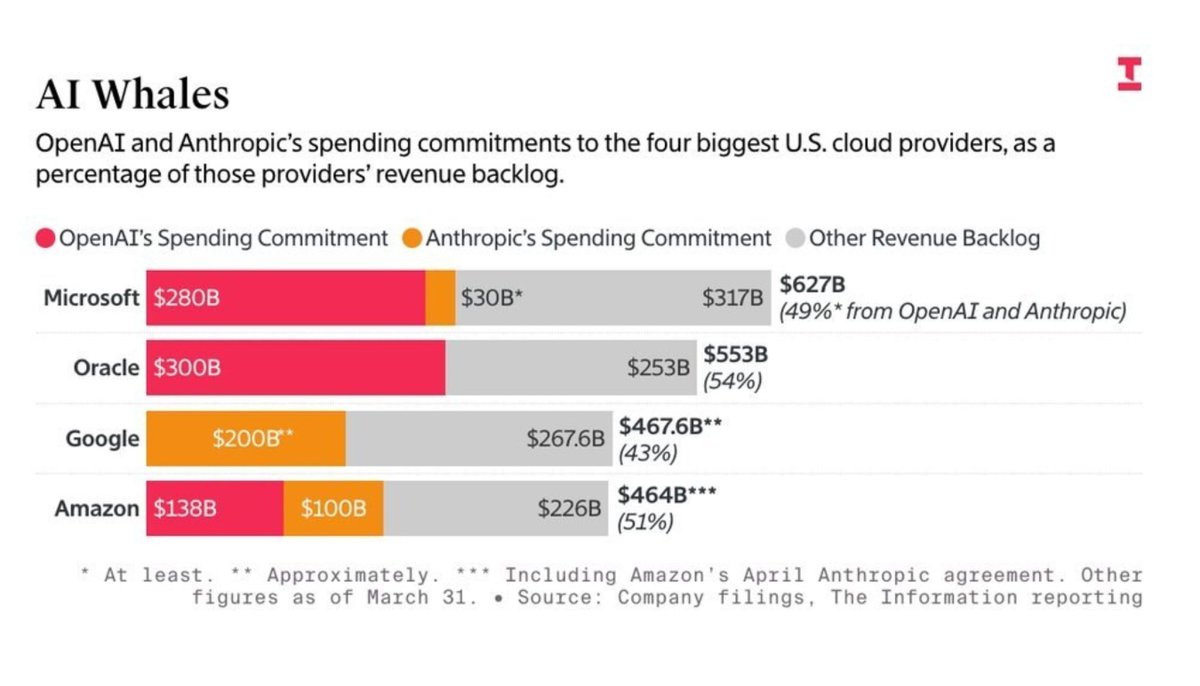
Latest corporate filings show that OpenAI and Anthropic alone make up over half of the entire $2 trillion future cloud backlog held by Microsoft, Oracle, Google, and Amazon.
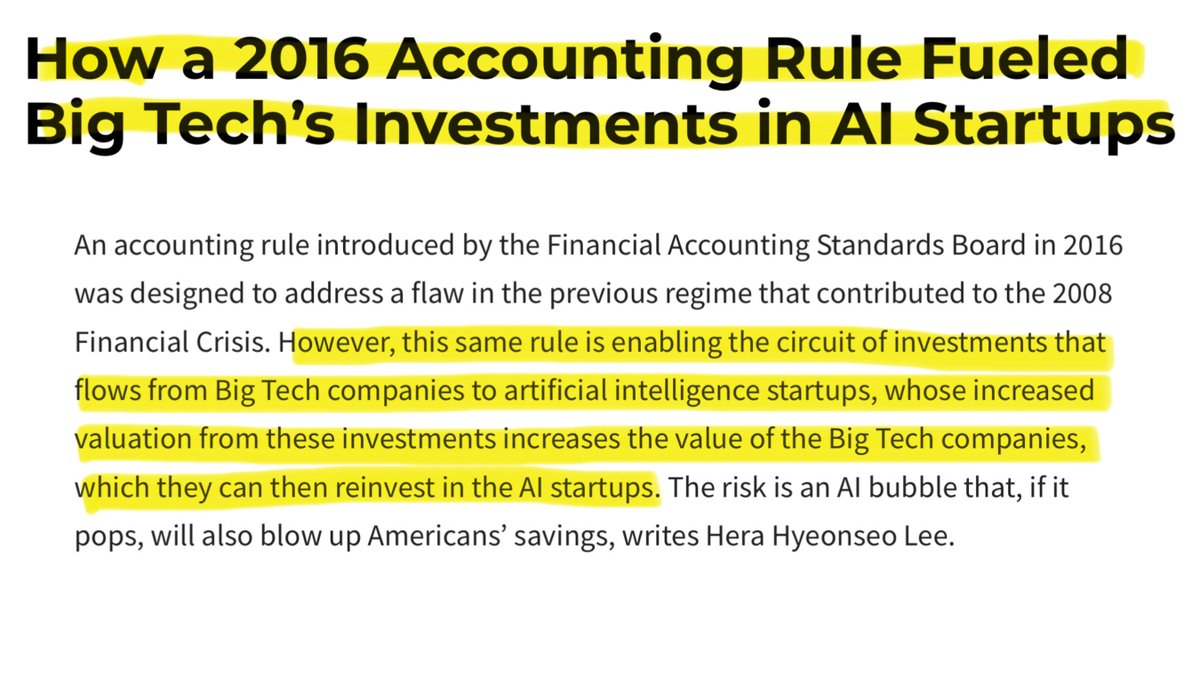
This massive pipeline is actually being created through a circular accounting trick called a round trip revenue loop.
But how it works ?
A tech giant gives billions of dollars to an AI startup as an "investment". But hidden in the contract is a strict rule forcing the startup to hand that exact same money straight back to the tech giant to rent their computer servers.
Look at the documented case of Microsoft and OpenAI.
When Microsoft invested $13 billion into OpenAI, it didn't just give them cash; it gave them "cloud credits" to use Microsoft servers. OpenAI used those exact credits to train its AI models, and Microsoft then turned around and recorded that server usage as brand new "cloud revenue" from a customer.
The tech giant is literally paying itself with its own money and calling it a sale.
This is why OpenAI’s annual cloud bill has ballooned to over $60 billion, double its actual revenue of $25 billion, kept alive solely by this recycled funding loop.
Anthropic runs the exact same play, spending $2.66 billion on Amazon Web Services in just nine months, which was basically 100% of all the money it earned at the time.
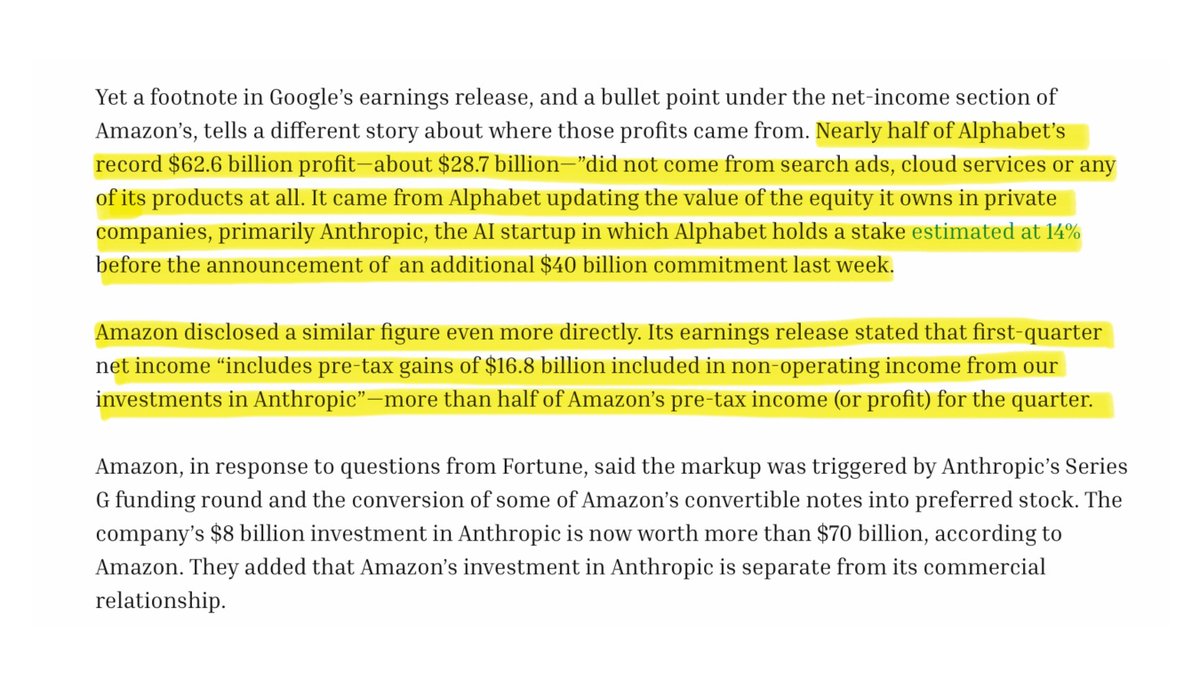
This manufactured demand triggers a second accounting trick where tech giants book massive paper profits. Every time a startup gets a higher value from a new funding round, the tech giant updates the value of its investment on its books and counts that unearned paper gain as direct profit.
In Q1 2026, Alphabet reported a record $62.6 billion profit, but $28.7 billion nearly half, was just a paper markup on its Anthropic investment. In the same quarter, Amazon reported $30.3 billion in profit, but $16.8 billion of it was just an Anthropic paper gain.
While Amazon reported record profits, its actual free cash flow collapsed 95% to just $1.2 billion because it had to spend $44.2 billion in real cash to build physical data centers.
This has created a massive danger where these giant companies rely heavily on just one or two unstable startups. Microsoft has 49% of its $627 billion future backlog tied to OpenAI, while Oracle has an incredible 54% of its entire $553 billion pipeline relying on OpenAI alone.
This perfectly mirrors the 2001 dot-com crash when Global Crossing and Qwest Communications swapped identical fiber-optic network capacity with each other just to book fake sales.
Qwest had to erase $1.4 billion in fake income, and Global Crossing went completely bankrupt.
The only difference is that the dot-com swaps were illegal, but today's AI loop is fully legal under current accounting rules.
This legal loop inflates tech company stock prices, forcing automatic retirement accounts and index funds to buy even more of these tech stocks. It is a self feeding loop where investments, sales, and stock prices all go up on paper without the AI technology ever making real cash profits.

English
Reef retweetledi

Reef retweetledi

We made a cartoon episode without leaving Claude.
Claude writes the story, Nano Banana Pro draws the character sheets and storyboard, Seedance 2.0 animates the final cut. Higgsfield MCP routes it all.
What story would you make first?
English
Reef retweetledi

Jane Street's head of technology just explained the full spectrum of how fast their trading decisions are made.
the fastest systems turn around a packet in under 100 nanoseconds. at that speed, if you attached an oscilloscope to the wire going in and the wire going out, you'd see the response start to leave before the incoming packet has finished arriving.
at that speed, you can't use a CPU. you can't use any programming language. you're on an FPGA direct wired to the network. and the decisions you're making are incredibly simple. because you literally can't compute anything complex in that time.
but here's the part most people miss: that's just one end of the spectrum.
Jane Street runs an ensemble of systems operating at every timescale simultaneously. some decisions happen in nanoseconds. some in microseconds. some in milliseconds. some take hours or a full day.
"the right way to build an optimal trading strategy is an ensemble approach. for some decisions you're making very simple decisions very quickly. for others, you're operating at the scale of microseconds, milliseconds. and in some cases, if you can get that decision turned around in an hour, that's totally fine."
the faster you need to respond, the simpler the decision has to be. the slower you can afford to go, the smarter the model can be.
this is why "Jane Street is just a speed game" is wrong. speed is one dimension. intelligence is the other.
English
Reef retweetledi

Reef retweetledi

You can't tax rich people on unrealized gains from stocks because "it's not real money until it's sold."
So explain to me why my property taxes keep going up based on the unrealized value of my house?
I didn't sell it.
I didn't cash out.
I didn't make a profit.
But somehow I'm paying taxes on paper gains every single year.
Interesting how "unrealized gains" only become a problem when wealthy folks are involved.
English
Reef retweetledi

Reef retweetledi

JUST IN: Starbucks retires AI inventory tool across North America after it reportedly miscounted & mislabeled store items.
English