Reuben Steff

2.1K posts

Reuben Steff banner
Reuben Steff

Reuben Steff

@ReubenSteff

IR/Strategic Studies. Mendel University (Czech Republic). Interests: Great Power Competition | Emerging Tech | Indo-Pacific & European Geopolitics

Brno, Czech Republic Katılım Nisan 2015
2.3K Takip Edilen944 Takipçiler
Sabitlenmiş Tweet
Reuben Steff
Reuben Steff@ReubenSteff·
My new book - New Zealand's Geopolitics and the US-China Competition - is OUT! link.springer.com/book/10.1007/9…. Possible book launches around #NewZealand to come. #nzpol TOC: Ch. 1: New Zealand's Geopolitical Awakening in the Second Cold War Ch. 2: Theoretical Framework: Geopolitical Realism and Great Power Competition Ch. 3: New Zealand’s Material Hand: Physical Geography, Economics, Soft Power, the Foreign Policy System, Defence Force, Memberships and Alliances Ch. 4: The Geopolitics Tradition and New Zealand: From Imperial Defence to Interdependent Strategic Competition Ch. 5: The US-China Great Power Competition in the Indo-Pacific: Colliding Strategies and Ambitions Ch. 6: Great Power Competition in Oceania and New Zealand’s shift from Hedging to Balancing Ch. 7: The Case for Tight Five Eyes Alignment Ch. 8: The Case for Armed Neutrality and Comprehensive National Resilience Ch. 9: Shaping the Balance: New Zealand's Strategic Significance, Defense Revival and Future Research @1NRSmith @AnnaPowles @waikato @CleoPaskal @HM_Int3lligence @Jimrolfe @bernardchickey @JudithCollinsMP @NZUSCouncil @MFATNZ @NZIIA_live @asianewzealand @WarrenAiden @HamishMcD @ben_r @angusblair @wartalke @LowyInstitute @ASPI_org @Simona_Soare @DrJoeBurton @CANZPS @davidcapie @NZ_Trav @GeoffMillerNZ @SamSachdevaNZ @NewsroomNZ @Selwyn_Manning @36th_Parallel @PeterCGrace @NewZealandMFA @chrisluxonmp @andrewlittle_nz @JacobShap @radionz @heraldnz @NewshubNZ @TVNZ @the_postnz @RocketLab @PressNewsroom @NZNationalParty @nzlabour @ACT @nzfirst @TheNBR @waikatotimes @sgourley @JohnBlaxland1 #NewZealand #IndoPacific #security #defense #geopolitics #Pacific #geostrategy #AUKUS #ANZUS #strategy #foreignpolicy #auspol #InternationalRelations
English
9
9
42
3.5K
Reuben Steff retweetledi
Arnaud Bertrand
Arnaud Bertrand@RnaudBertrand·
This is an extraordinary document written by the research arm of China's spy agency (the powerful MSS, basically the CIA and the FBI all wrapped in one) that absolutely zero media has picked up on. As far as I can see, I'm the first person to write about it even though it was published (in Chinese) on May 13th on chinadiplomacy.org.cn, a website of China's Ministry of Foreign Affairs. The document contains perhaps the most authoritative description of where China thinks its relationship with the U.S. stands, and where it’s headed. The title of the report is “The Great Global Transformation and the Path to U.S.–China Coexistence” and I provide a full translation of it in my article, the link of which is at the bottom of this post. To summarize briefly the most important - and, perhaps, surprising - aspect of the document: China's spy agency - the one institution whose entire job is to worry about the U.S. threat - has largely stopped worrying. That's really what transpires from the document. They use a strategic framework borrowed from Mao's "protracted war" theory and, according to this framework, America's offensive phase is finished and China weathered the storm intact. The question is no longer "how do we survive America?" but "how do we manage America?" - and they're proposing a six-step relationship recovery program. I'll let you read the full document as well as my analysis of it here: open.substack.com/pub/arnaudbert…
Arnaud Bertrand tweet media
English
188
1.5K
5.6K
548.1K
Reuben Steff
Reuben Steff@ReubenSteff·
@JacobShap No one is 'at the wheel' re. technology's impact on Western societies. Our leaders do not play any kind of leadership/educational role. Why? Because they are old, don't understand and/or don't care as (class element) they have the wealth to buffer their kids from the worst of it.
English
0
0
0
107
jacob l. shapiro
jacob l. shapiro@JacobShap·
As a parent of young ones I think the kind of screen time matters. Solo tablet time for 3 yr old? Only if the baby is sick or something and I need to buy some time to focus only on her. Family movie during Saturday quiet time? No problem. There’s also a class element of this, the more time you have (ie the less you have to work) the less you need screen time to get a break etc
Jawwwn@jawwwn_

Peter Thiel on screen time for kids: “If you ask executives of social media companies how much screen time they let their kids have— there’s probably an interesting critique one could make.” @andrewrsorkin: “What do you do?” Thiel: “An hour and a half a week.” *audience gasps*

English
6
0
22
9.7K
Reuben Steff
Reuben Steff@ReubenSteff·
@JacobShap @Geo_papic I second that American Factory (doco) is well worth a watch. And that audio clip you paid of AOC is the first and only time it's made me think she might be presidential material. She needs to not overthink things when she is speaking at national/international forums.
English
1
0
1
35
Reuben Steff retweetledi
NickMowbray
NickMowbray@NMowbray23·
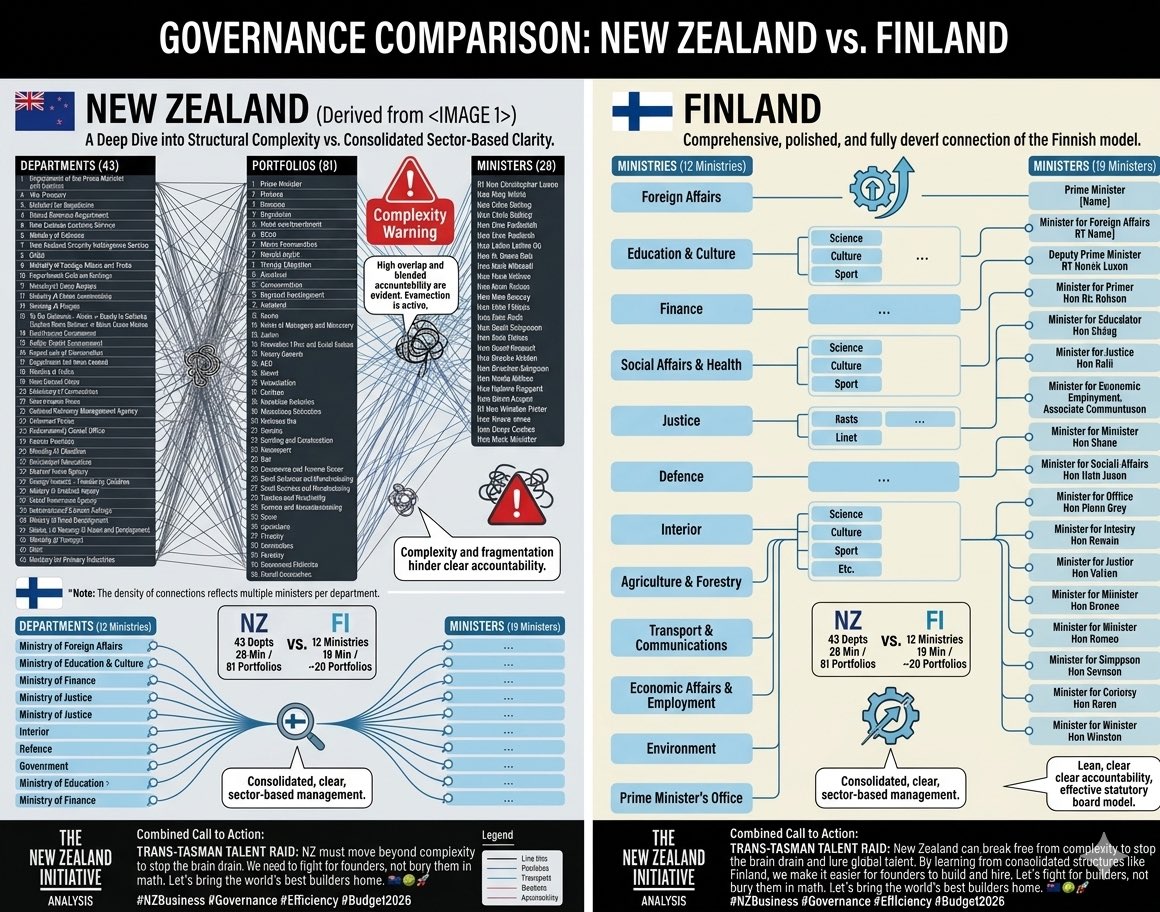
WILD. Comparing the NZ government structure to Finland’s. A picture says 1000 words !! Both countries have similar populations (5.5M). The structures behind are very different. Finland: • 12 core ministries • Clear vertical accountability • Defined ownership • Built for speed, clarity, and execution New Zealand: • 40+ departments • 80+ ministerial portfolios • Layers of overlapping responsibility • Super-ministries reporting across multiple ministers The result? Accountability blur. No improvement. Massive waste. In any high-performing organisation, if everyone is responsible, no one is. NZ has exceptional people. But we need systems designed to deliver outcomes, not a birds-nest structure that creates no improvement or efficiency. Fixing this will be a HUGE unlock on NZ long term. All parties should come together in a bi partisan way to sort this out.@actparty @NZNationalParty @nzfirst @nzlabour
NickMowbray tweet media
English
172
331
1.5K
165.2K
jacob l. shapiro
jacob l. shapiro@JacobShap·
more like a glossy whitepaper for a 21st century East India Company.
Daniel Jeffries@Dan_Jeffries1

The most revealing thing about this AI leadership paper is that it reads less like a vision for innovation and more like a glossy whitepaper for a 21st century East India Company. Every generation of incumbents discovers a new moral vocabulary for why they alone should control transformative technology. In the 90s it was cryptography. We were told strong encryption was too dangerous to spread because terrorists, rogue states, chaos, dual-use, etc. So the US crippled exports, weakened products, slowed adoption, and kneecapped parts of its own software industry. Right up until reality steamrolled the policy and we woke up to its stupidity and then eCommerce, secure communications, software signing, and the modern internet exploded and gave us tremendous benefits. Now the exact same priesthood has returned with AI. - “Dual-use.” - “Strategic advantage.” - “Model distillation.” - “National security.” - “Responsible access.” A few different nouns but mostly the same ones. Same instinct: Centralize control, gatekeep compute, fuse state and corporate power, and call it safety. The funniest part is that this strategy is almost perfectly designed to accelerate the thing they claim to fear. You do not stop a rival superpower (who happens to be the absolute best at scaling energy and manufacturing and who has a choke-hold on rare Earths refinement) from building domestic capability by permanently attempting to strangle them. You create the economic and political incentive for total self-sufficiency. We have already done that as Jensen warned. We went from 100% market to nearly 0%. Huawei is now manufacturing millions of chips. DeepSeek v4 trained on them. They have more energy than the rest of the world combined. Meanwhile, we have activists and anti-economic fools like AOC and Bernie pushing for data center moratoriums and we can't build a single bullet train in 20 years and folks fighting to not expand the energy grid here and new nuclear plants getting tied up in environmental regulation for a decade. The sanctions did the exact opposite of what the hawks wanted. They jumpstarted a moribund, dinosaur of a Chinese chips industry. We basically said to the people who happen control the most powerful manufacturing engine on the planet "we intend to squeeze you." They rightly saw it as an existential threat. The sanctions become the industrial policy. Huawei. SMIC. Domestic lithography. Packaging. Memory. Entire Chinese supply chains that did not exist at serious scale a decade ago now exist precisely because Washington convinced Beijing they had no choice. Brilliant work. So the endgame here is what exactly? 1) Push China into a Manhattan Project for chips and AI. 2) Increase the strategic value of Taiwan even further. 3) Once China reaches self sufficiency that can invade Taiwan and choke off our own super advanced chips where are made there exclusively (and no we don't have even close to enough TSMC factories in Arizona or anywhere else in the world). That's every NVIDIA chip. Every Google tensor chip. Every Apple chip. Every chip in you iPhone and Android phone. Every Amazon chip. The chips in your car and truck and hair dryer and washing machine. 4) Escalate a cold tech war into a permanent civilizational bloc conflict that is likely to turn into a shooting war at one point. 5) Fragment the global software ecosystem. 6) Create American AI aristocracies protected by regulation and compute licensing. And somehow call this “open innovation.” Meanwhile the actual history of software keeps screaming the opposite lesson: Knowledge diffuses, open ecosystems win, developers route around gatekeepers, and attempts to permanently contain computation usually fail. What really jumps off the page is the assumption that a tiny cluster of frontier labs should become quasi-sovereign actors, deciding who gets intelligence, who gets compute, who gets models, and which countries are permitted to participate in the future. Not elected governments. Not open markets. Not open-source communities. A handful of corporations sitting beside the national security state, insisting that concentration of power is necessary to protect democracy. You almost have to admire the audacity.

English
1
0
7
2.2K
Reuben Steff retweetledi
Alicia GarciaHerrero 艾西亞
Alicia GarciaHerrero 艾西亞@Aligarciaherrer·
Sharing my commentary on #Trump-#Xi summit: "The commercial framework announced in Beijing is real and should not be dismissed. But the actual substance of the Beijing summit was grimmer, and more consequential, than the business pages have conveyed. At its core, this was a negotiation about the weaponization of the AI stack — and a mutual communication of red lines that reveals just how precarious the great power relationship remains. The United States arrived in Beijing with one non-negotiable message: China must stop arming Iran. China's red line is Taiwan. What the summit achieved is a tactical pause in an ongoing strategic contest. Both sides needed air. However, the red lines exchanged in Beijing were not concessions. They were warnings. " aliciagarciaherrero.substack.com/p/the-beijing-…
English
2
9
19
2.1K
Reuben Steff
Reuben Steff@ReubenSteff·
Maybe the most important question of the Trump-Xi summit: Did Trump agree to allow access to state-of-the-art semiconductors? I saw one news story claiming he had but nothing to substantiate it.
English
0
0
0
59
Reuben Steff retweetledi
Rohan Paul
Rohan Paul@rohanpaul_ai·
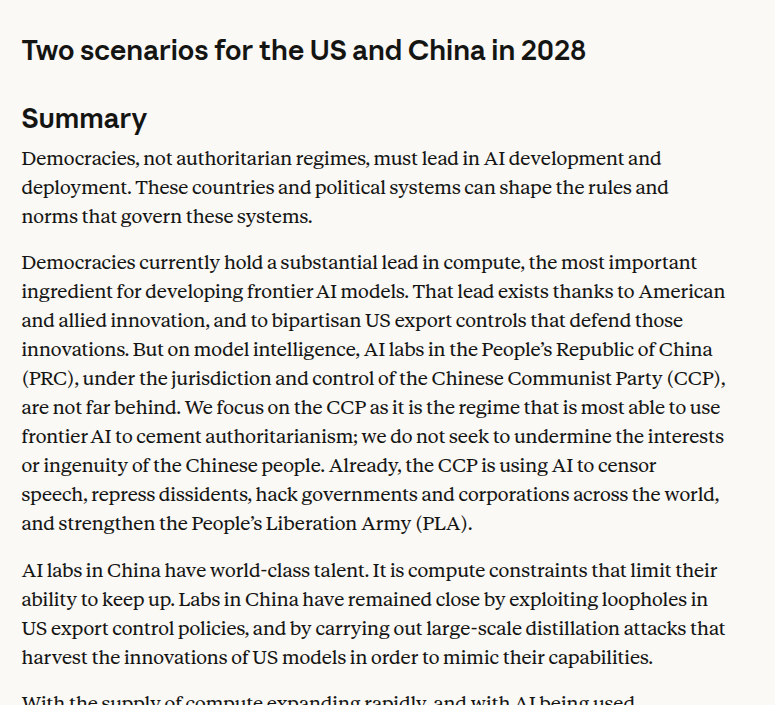
Anthropic drops a paper on the US-China AI race They believe the US and its allies may be able to lock in a 12-24 month frontier AI lead by 2028 if they close China’s access to advanced compute and copied model outputs. The report says China is not far behind because Chinese labs are allegedly using loopholes, smuggled chips, offshore data centers, and distillation attacks to stay close to US frontier labs. Anthropic frames compute as the central bottleneck of AI power, saying advanced chips are not just one input but the gatekeeper for training, deployment, revenue, experimentation, and future model improvement. The report says Huawei may produce only 4% of NVIDIA’s aggregate compute in 2026 and 2% in 2027, which is one of the paper’s sharpest claims about China’s semiconductor gap. Anthropic argues that distillation is systematic industrial espionage, because Chinese labs can use American model outputs to copy capabilities without paying the full training cost. The report claims a Chinese AI lead could enable automated repression, stronger cyber operations, faster military AI deployment, and broader authoritarian influence through cheap global AI infrastructure. Future frontier models may become a “country of geniuses in a data center,” meaning a single model cluster could act like a huge expert workforce for cyber, science, engineering, and military research.
Rohan Paul tweet media
Anthropic@AnthropicAI

We've published a paper that explains our views on AI competition between the US and China. The US and democratic allies hold the lead in frontier AI today. Read more on what it’ll take to keep that lead: anthropic.com/research/2028-…

English
80
109
489
123.3K
Reuben Steff
Reuben Steff@ReubenSteff·
@vtchakarova I essentially made this case in Ch. 4 ('The Systemic Challenges of Multipolarity: The Trials and Tribulations of a Kissingerian Grand Strategy') in my 2021 book on Trump's foreign policy routledge.com/US-Foreign-Pol…
English
0
0
0
127
Velina Tchakarova
Velina Tchakarova@vtchakarova·
Politico is very late to the party. Trump administration views rapprochement with Russia as part of its strategy against China, Politico reports. Trump considers Beijing the main long-term threat to US and economic incentives for Moscow could reduce its dependence on Beijing.
English
11
9
85
8.2K
Reuben Steff retweetledi
Marko Papic
Marko Papic@Geo_papic·
Trump is the only human being in the United States of America who can "land the plane" on US-China rivalry. What's the counter take to that? I don't think there is one. Basically, this is the "only Nixon could go to China" adage, but updated for the 21st century.
English
20
5
86
14.3K
Reuben Steff retweetledi
Ronnie Stoeferle
Ronnie Stoeferle@RonStoeferle·
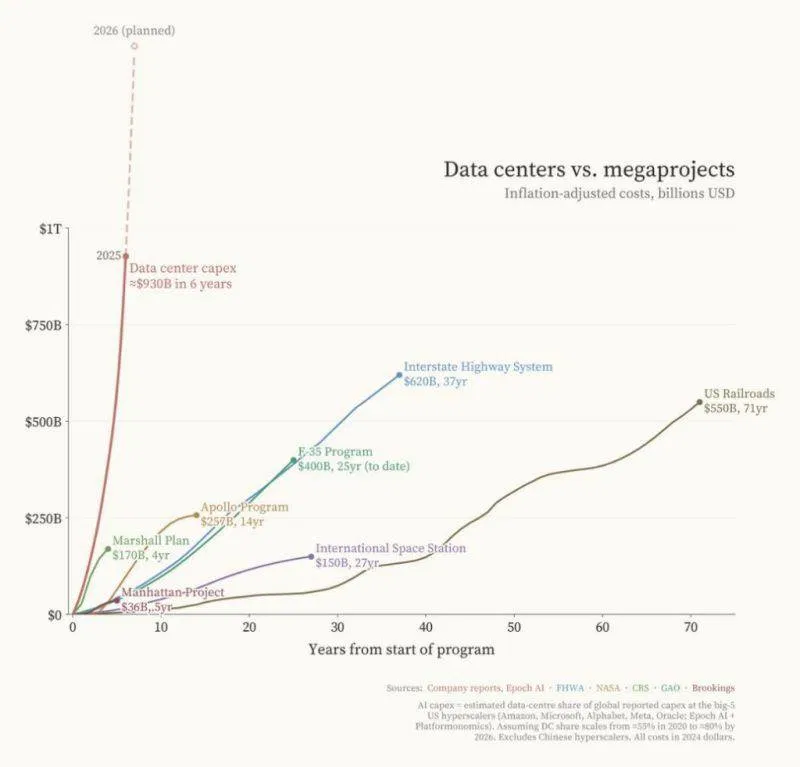
The US is pouring more capital into AI data centers in 6 years (~$930B) than the inflation-adjusted cost of the Marshall Plan, Apollo, Manhattan Project, and the Interstate Highway System — combined. Meanwhile: AI ≈ 45% of the S&P. Energy ≈ 4%. Everyone is overweight the thing that needs power. Underweight the power. H/T @ekwufinance
Ronnie Stoeferle tweet media
English
125
545
2K
198.7K
Reuben Steff retweetledi
🇺🇸 Ronald Carter
🇺🇸 Ronald Carter@USronaldcarter·
🚨 THE NEXT 72 HOURS. DAY BY DAY. BOOKMARK THIS. 📅 TODAY — May 13 → Air Force One lands in Beijing with 12+ named CEOs aboard — Tesla, Nvidia, Apple, BlackRock, Boeing, Goldman Sachs, Citigroup, GE, Qualcomm, Micron, Blackstone, Cargill → Jensen Huang boarded during the Alaska refueling stop — last-minute addition → Trump confirms "many other" undisclosed CEOs also on the plane → The largest corporate delegation ever to accompany a sitting U.S. president touches down in China 📅 MAY 14 — Day 1 of Summit → Trump and Xi sit down for formal talks → The ask: Xi opens China's market to U.S. business — directly, officially, on camera → 12+ of the most powerful CEOs in the world are in the room or the building → Combined market cap of companies represented: over $10,000,000,000,000 📅 MAY 15 — Day 2 / Outcomes → Deal announcements expected — or silence that speaks louder → Every CEO on that plane needs something specific from Beijing: chip licenses, manufacturing access, supply chain agreements, financial market entry → If Xi says yes to even half of it, the trade war framework changes overnight → If Xi says no, 12 CEOs flew to China for nothing — and markets will price that immediately 72 hours. Every step has precedent. Every prediction has math. Nothing like this has ever happened in the history of U.S.-China relations. The outcome of this trip will move markets more than any Fed meeting this year. Bookmark this. Come back May 15. if you're not following me you're finding out about this 48 hours late from someone who read my post..
🇺🇸 Ronald Carter tweet media
English
462
5.1K
19.6K
1.1M
Reuben Steff
Reuben Steff@ReubenSteff·
Alex Karp (Palantir CEO and author of The Technological Republic) meeting with the Ukrainians to cement a US-Ukraine AI/drone alliance. A factor that'll drive Putin towards accommodation? reuters.com/world/europe/z…
English
0
0
1
78
Reuben Steff retweetledi
Ian Willoughby
Ian Willoughby@Ian_Willoughby·
Interesting: Czech support for NATO has never been higher — 82% are in favour, suggests a new poll cited by Seznam Zprávy. Almost half of respondents (44%) are for increased defence spending.
Ian Willoughby tweet media
English
6
23
380
10.8K
Reuben Steff retweetledi
Ancient History Hub
Ancient History Hub@AncientHistorry·
205 years ago today, Napoleon Bonaparte died on a tiny British prison island in the middle of the South Atlantic. He was 51. He had ruled most of Europe. And he changed the world so thoroughly that you are still living inside the systems he built. Start with the obvious one. The Napoleonic Code. He commissioned it in 1800, sat in on the drafting sessions personally, argued with the lawyers, and pushed it through in four years. Equality before the law. Property rights. Religious freedom. The end of feudal privilege. It is still the basis of civil law in France, Belgium, the Netherlands, Italy, Spain, Portugal, most of Latin America, Quebec, Louisiana, and chunks of the Middle East and Africa. About a third of the planet writes contracts using rules a Corsican artillery officer wrote between battles. He sold Louisiana to Thomas Jefferson in 1803 for 15 million dollars. Roughly four cents an acre. It doubled the size of the United States overnight. Without that deal there is no St. Louis, no New Orleans as an American city, no Lewis and Clark, no Manifest Destiny. The American century starts with Napoleon needing cash for a war. He invaded Egypt in 1798 with an army and, weirdly, 167 scientists, mathematicians, and artists. They found the Rosetta Stone. That single slab is the reason we can read hieroglyphs at all. Egyptology as a field exists because Napoleon brought scholars to a war. He built the Bank of France, which still runs French monetary policy. He created the lycée system that still educates French teenagers. He shoved the metric system across Europe at sword-point until it stuck. He emancipated the Jews of every territory he conquered, tearing down ghetto walls in Rome, Venice, Frankfurt. He abolished serfdom in Poland. He standardized road networks, civil registries, and tax codes that European governments still operate from. And then there's the soldiering. He fought around 60 major battles and won most of them. Austerlitz, in 1805, against the combined Russian and Austrian empires, is still taught at West Point as one of the closest things to a tactically perfect battle ever fought. He was outnumbered, baited the enemy onto ground he had pre-selected, and broke them in a single afternoon. Three emperors took the field that morning. Only one walked off it on his own terms. He slept four hours a night. He read constantly, dictated letters to four secretaries at the same time, and personally signed off on everything from cavalry boot specs to the seating chart at the Comédie-Française. Wellington, the man who finally beat him at Waterloo, was asked decades later who the greatest general in history was. He answered without hesitating. "In this age, in past ages, in any age, Napoleon." He lost, in the end, because he could not stop. Russia in 1812 swallowed his army whole. Six hundred thousand men marched in. Maybe a tenth came back. He abdicated in 1814, escaped from Elba, ruled France again for 100 days, and lost it all for good in a wheat field in Belgium in June 1815. The British shipped him to St. Helena, a volcanic dot 1,200 miles off the African coast, and waited. He spent six years there dictating his memoirs, gardening, complaining about the dampness, and quietly rewriting his own legend so effectively that Europe spent the next century arguing about him. He died on May 5, 1821, during a storm so violent it ripped up the willow tree he liked to read under. His last words trailed off into fever. France. The army. Joséphine. Nineteen years later France brought him home. Two million people stood in the snow to watch the coffin go by. He was a tyrant. He was a reformer. He started wars that killed somewhere between three and six million people. He also wrote the rulebook that a third of humanity still lives under. Most people who try to conquer the world are forgotten inside a generation. Napoleon has been dead for 205 years and we are still arguing about him because we are still using his furniture.
Ancient History Hub tweet media
English
291
2.3K
9.4K
642.1K