Richard Gerraty

2.2K posts

Richard Gerraty banner
Richard Gerraty

Richard Gerraty

@RichardGerraty

Neurologist, Melbourne 🇦🇺
Melbourne, Victoria @MonashUni Katılım Haziran 2015
297 Takip Edilen689 Takipçiler
Richard Gerraty
Richard Gerraty@RichardGerraty·
@BigBrainPhiloso The eliminativists prefer that neuroscience explains all, but it doesn’t. The hard problem being wished away has not made it go away. Appeals to quantum theory for an explanation is wishing of a different sort.
English
0
0
0
45
Big Brain Philosophy
Big Brain Philosophy@BigBrainPhiloso·
David Chalmers on the one thing science can't explain: Consciousness is at once the most familiar thing in the world and the one science has almost nothing to say about. That's the puzzle Chalmers lays out in this early interview, and it's as disorienting today as it was then. His starting point is deceptively simple. Everything we know about the external world: subatomic particles, distant stars, the chemistry of life. We know through consciousness. It's the very first thing we have. And yet when we turn science around and try to explain consciousness itself, we hit a wall. "Consciousness is what we start with when it comes to knowing the world and looking out at the world… everything else is secondary." What makes this so strange is the asymmetry. We've made extraordinary progress understanding things that are genuinely remote and difficult quantum mechanics, stellar evolution, molecular biology. But understanding our own inner experience? Almost nothing. "It almost sticks out like a sore thumb in the scientific picture." This is what Chalmers would later formalise as the "hard problem of consciousness": not just explaining how the brain processes information or controls behaviour. Those are hard, but tractable. The real mystery is why any of that physical activity is accompanied by experience at all. Why is there something it feels like to be you? The question isn't abstract. It sits at the intersection of neuroscience, philosophy, physics, and AI. As we build systems that process language and reason about the world, the question of whether they are or could be conscious presses harder than ever. Chalmers doesn't offer an answer here. Only the sharpest possible version of the question.
English
25
23
101
13.5K
Daniel Marley
Daniel Marley@UlteriousFilm·
'Will the gentleman be moving?' A mundane conversation discussing the most extraordinary of things. Cyril Cusack (The Gunsmith), to #BOTD Edward Fox (The Jackal), in THE DAY OF THE JACKAL (1973). #70sFilm
English
14
36
357
17.3K
Richard Gerraty
Richard Gerraty@RichardGerraty·
@DannyDrinksWine Watched it a few nights ago for the first time in 40 years. Wonderful plot and acting. And that Alfa Romeo.
English
0
1
5
150
DepressedBergman
DepressedBergman@DannyDrinksWine·
Happy 89th birthday, Edward Fox! Fred Zinnemann on how painful it was for Edward Fox while doing the handicapped war veteran Make-up for "The Day of the Jackal" (1973) & how an old French lady reacted to the disguise: "A marvelous make-up job helped the ‘Jackal’ with the disguises he used to keep ahead of the police and gendarmes. His last appearance was as an elderly bemedalled war veteran hobbling along on a crutch, one leg amput@ted below the knee. For this scene his leg had to be bent back at a sharp angle and strapped tight to his body; all circulation was cut off. The doctor would allow no more than five minutes for this but in fact Edward was tied up for fifteen minutes at a time, and while the pain must have been excruciating, he never showed it. While he was rehearsing his walk, an elderly lady amputee appeared on two crutches around a corner and engaged her fellow sufferer in a little chat. It was funny in a macabre way, and our French wardrobe ladies, in charge of the strapping-up, were wringing their hands: ‘Ah, le pauvre monsieur — comme il souffre? (Oh, the poor gentleman, how he suffers!’)" ("Fred Zinnemann - An Autobiography", Fred Zinnemann, 1992)
English
36
155
1.2K
90.1K
Philosophy Of Physics
Philosophy Of Physics@PhilosophyOfPhy·
What most of Scientists Really Say About Climate Change?
English
1.2K
686
16.2K
381K
Camus
Camus@newstart_2024·
“Einstein is the problem.” Eric Weinstein didn’t mince words on Triggernometry. If general relativity holds, we’re trapped on one fragile planet. Even terraforming the Moon and Mars only gives us three reachable spheres — nowhere near enough diversification for long-term survival. A single catastrophe could wipe us all out because we all share the same atmosphere. The only real escape, he argues, is cracking physics beyond Einstein so we can get very far, very fast. Otherwise we’re stuck playing cosmic Russian roulette. It’s a sobering wake-up call about how dangerously misaligned our priorities have become.
English
638
280
3.3K
896.4K
Andrew McCarthy
Andrew McCarthy@AJamesMcCarthy·
Do you think storm photos would be a welcome addition to my content? I’ve shot them before but nothing too serious I was thinking about setting up near major storm cells and capturing stars/lightning like this in a more polished way This was captured in 2022 in Arizona.
English
844
326
7.2K
82.6K
Richard Gerraty
Richard Gerraty@RichardGerraty·
In first year university residency college one of the skills I learnt at table was to avoid any ambiguity of speech that could possibly have given an opening to the puerile. I would have said “the planet Uranus”, possibly with a classical or American pronunciation emphasising the first syllable. It is indeed a beautiful colour.
English
0
0
0
252
Andrew McCarthy
Andrew McCarthy@AJamesMcCarthy·
I love looking at Uranus, it has such a pretty color. This was captured with an 11” telescope from my backyard in Arizona
Andrew McCarthy tweet media
English
303
239
5.9K
128.1K
Richard Gerraty retweetledi
Andrew Lees
Andrew Lees@ajlees·
I carried out my best research at a time when it was still possible & acceptable to talk with & observe patients over hours in hospital & serially over months. In this way I garnered much more clinically relevant information than could ever be obtained by a battery of wearables
English
2
5
45
1.4K
Richard Gerraty
Richard Gerraty@RichardGerraty·
I remember Brian Johnston mainly for the rain delays when he would thank a kind lady from the Cotswolds who’d sent in a lovely cake which was keeping them warm in the commentary box. I’ll never forget John Arlott describing Holding reaching his mark and turning to run in to bowl. Look up Holding, and Johnston, for a nice pun.
English
0
1
1
42
Nigel J Walley
Nigel J Walley@WalleyVision·
So summarising the replies, I may have missed: Brian “Jonners” Johnson John Arlott  Henry Blofeld   John Motson Brian Moore Gerald Sindstatt David Coleman (athletics) Ron Pickering (athletics) Ted Lowe (snooker) Eddy Waring (rugby league) Dan Maskell (tennis) Tom Gravenry  Barry Davies Reg Gutteridge Peter O’Sullevan (horse racing)
English
23
0
33
1.4K
Nigel J Walley
Nigel J Walley@WalleyVision·
Did you grow up watching sport to the dulcet tones of: Peter Allis Bill McClaren Murray Walker Richie Benaud David Vine Harry Carpenter Sid Waddell
English
317
42
1.8K
59.4K
Richard Gerraty
Richard Gerraty@RichardGerraty·
@Whachazuck @TIME Read @DavidDeutschOxf The Fabric of Reality in the chapter, Quantum computing. It’s approachable. Over 30 years ago he proved such computers were possible. Online, look up many worlds theory, and be patient. Most physicists were for decades.
English
1
0
1
29
Simon What
Simon What@Whachazuck·
@TIME Fudgey jello, I tried to grok some understanding but it gave me the math first 🤯. Quantum evaluates 2^N states at once N=qubits. So it evaluates all probablilities given at once then somehow evaluates the noise to take the one most equal to 1/desired outcome ? In English anyone?
English
2
0
3
922
TIME
TIME@TIME·
From new drugs to better batteries, quantum computers could unlock discoveries we can’t reach today, says Sam Stanwyck, senior product manager for quantum computing software at Nvidia.
English
73
192
1.4K
6.7M
Richard Gerraty
Richard Gerraty@RichardGerraty·
The ethics of proximity works in time as well as space and familial ties. Pouring money down the drain for an unachievable goal, enriching with subsidies selected billionaires and entrenching poor governments, and impoverishing two genreratioms or more, and in the meantime eroding available funds for health care and research will have a much higher death toll than heat waves to which we have the means to adapt.
English
0
0
0
46
Dr Monique Ryan MP
Dr Monique Ryan MP@Mon4Kooyong·
“If it’s already happening now, then what does a future that is two or three degrees warmer hold?” Australian researchers have found that extreme heat mortality is "seriously underreported” theguardian.com/environment/20…
English
290
94
227
28.9K
Richard Gerraty retweetledi
David Deutsch
David Deutsch@DavidDeutschOxf·
@richard_landes @MelanieLatest The whole world being wrong, even badly and for long periods, happens all the time. It's the condition for progress after all. What's pretty much unique in this case, is how psychologically entrenched the Pattern is. Batshit-crazy, it ferociously resists facts and arguments.
English
8
30
250
7.7K
LeoOD3
LeoOD3@LeoOD3·
@RichardGerraty @chaseg1698 @geraldposner No. Frame by frame you can see the head briefly move forward at the critical moment from the impact. Then by neuromuscular reflex it jerks backwards
English
2
0
1
39
Gerald Posner
Gerald Posner@geraldposner·
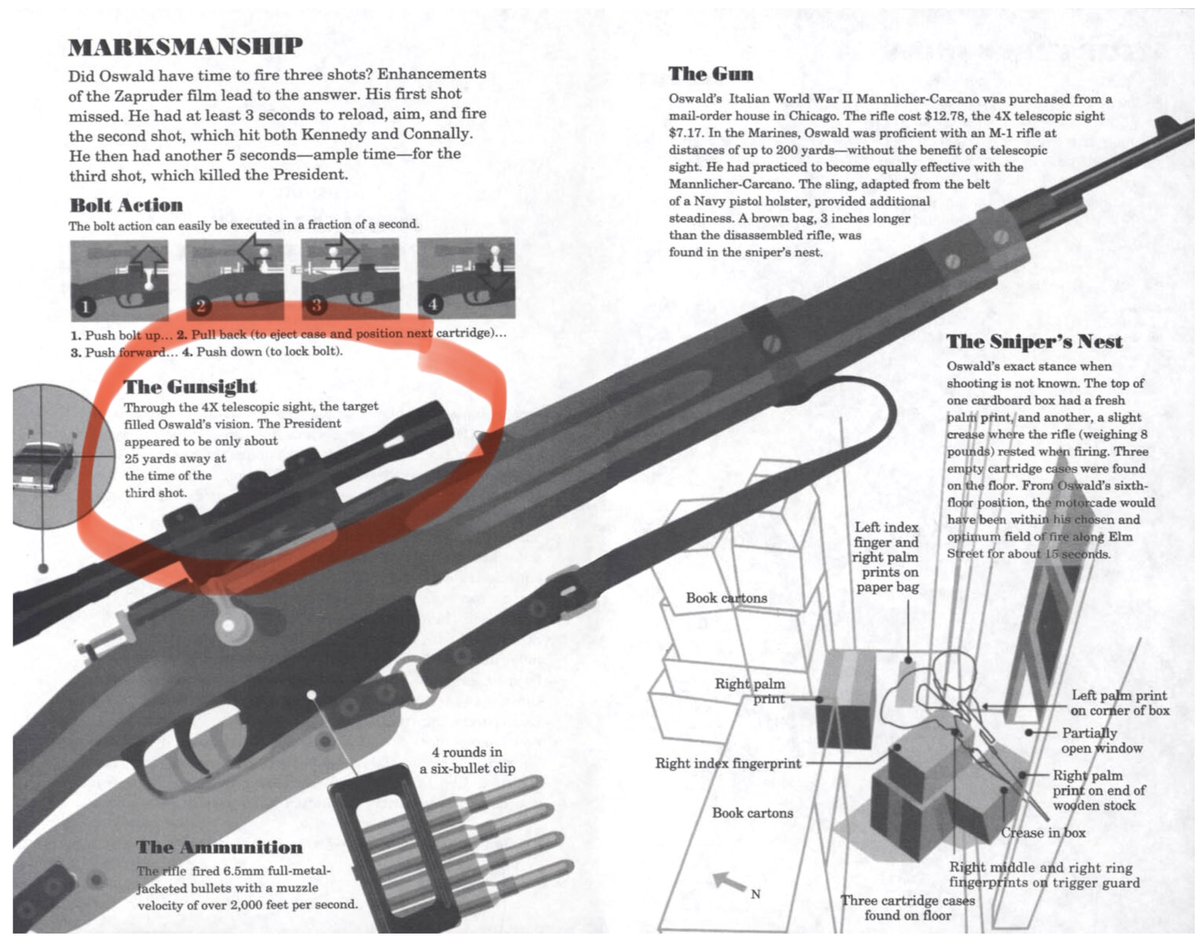
A reminder that through Oswald’s 4x scope, the 3rd and fatal JFK head shot looked like it was only 25 yards away — essentially a close, stationary target. Oswald was a Marine sharpshooter (scored 212). He could nail a 10-inch bull’s-eye from 200 yards standing, 8 times out of 10. Even when he was about to leave the Marines, unmotivated and hating the Corps, he still shot 191 to qualify as marksman. Questioning Oswald's ability was only popular with those unaware of his skill with a rifle.
Gerald Posner tweet media
LeoOD3@LeoOD3

@DreamsOfTaos @AdamNuurmi @geraldposner @benshapiro JFK was closer to Oswald than the target is to a Marine at the rifle range. Those shots were well within what was expected of an ordinary grunt

English
88
66
646
70.1K
Richard Gerraty retweetledi
David Starkey
David Starkey@DrDStarkeyCBE·
Kemi Badenoch has said achieving Net Zero by 2050 is “impossible” and she’ll repeal the Climate Change Act of 2008. But dragging the rest of her party with her will be like trying to sail a ship at anchor. When the former Conservative Chancellor and MP for Godalming and Ash South West Surrey says we must “be responsible” and “set an example” with our environmental policies, he reveals a party that STILL - even after the catastrophe of the 2024 general election - believes in loading costs onto British citizens in order to look good internationally. When will they get it?
English
78
166
847
21.2K
Richard Gerraty
Richard Gerraty@RichardGerraty·
Over forty years ago I learnt to not make notes at all in vivid clinical tutorials. I made notes an hour or two later. My purpose was not to miss the nuggets of gold from my excellent teachers, by distracting myself with getting something on paper. The notes then were the episode of crucial early recall. After making the notes, I found I didn’t need them, or revisiting them was the further consolidation in memory rather than mere recognition.
English
0
0
4
308
Ihtesham Ali
Ihtesham Ali@ihtesham2005·
A community college professor taught the same study skills lecture for 30 years, and the video quietly became one of the most watched educational recordings on the internet. His name is Marty Lobdell. He spent his career as a psychology professor watching students fail not because they were lazy, but because nobody had ever taught them how their brain actually works under the pressure of learning something hard. The lecture is called "Study Less Study Smart." Over 10 million views. Passed around in Reddit threads, Discord servers, and university study groups for over a decade. And the core insight buried inside it has been sitting in cognitive psychology research for years, waiting for someone to explain it in plain language. Here is the framework that completely changed how I think about effort. Your brain does not sustain focus the way you think it does. Studies tracking real students found that the average learner hits a wall somewhere between 25 and 30 minutes. After that, efficiency doesn't just decline. It collapses. You're still sitting at your desk, still looking at the page, but almost nothing is going in. Lobdell illustrated this with a student he knew personally. She set a goal of studying 6 hours a night, 5 nights a week, to pull herself out of academic probation. Thirty hours of studying per week. She failed every single class that quarter. She wasn't failing because she lacked effort. She was failing because she had confused time spent near books with time spent actually learning. The 25-minute crash hit her at 6:30pm every night. She spent the next five and a half hours sitting in the wreckage of her own focus and calling it studying. The fix sounds almost too simple. The moment you feel the slide, stop. Take five minutes. Do something that actually gives you a small reward. Then go back. That five-minute reset returns you to near full efficiency. Across a six-hour window, the difference is not marginal. It is the difference between thirty minutes of real learning and five and a half hours of it. The second thing he taught destroyed something I had believed about how memory actually works. Highlighting feels productive. Going back over your notes and recognizing everything feels like knowing. But recognition and recollection are two completely different cognitive processes, and your brain is very good at making you confuse them. You can see something you've read before and feel completely certain you understand it, even when you couldn't reconstruct a single sentence from memory if the page were blank. He proved this live in the room. He read 13 random letters to his audience. Almost nobody could recall them. Then he rearranged the same 13 letters into two words: Happy Thursday. The whole room got all 13 without effort. Same letters. Same count. The only thing that changed was meaning. The brain stores meaning. Not repetition. The moment new information connects to something you already understand, the retention changes entirely. This is what the cognitive psychology literature calls elaborative encoding, and it is the mechanism underneath every effective study technique. The third principle was the one that hit me hardest, and the one almost nobody applies. Lobdell cited research showing that 80 percent of your study time should be spent in active recitation, not passive reading. Close the material. Say it back in your own words. Teach it to someone else, or to an empty chair if no one is around. The struggle of retrieval is where the actual learning happens. Reading your notes again is watching someone else do the work. His parting line has stayed with me longer than almost anything else I have read about learning. He told the room that if what he shared didn't change their behavior, they hadn't actually learned it. It would just live in their heads as something they had heard once and felt good about. He was right. And most people leave every lecture exactly like that. The students who remember everything aren't putting in more hours. They stopped confusing the feeling of studying with the fact of it.
English
215
4.9K
18.7K
1.9M
Richard Gerraty
Richard Gerraty@RichardGerraty·
@SwipeWright Well written, measured, meeting your critic far more than half way, and some good analogies. It is not easy to argue effectively with someone from a completely different discipline.
English
0
0
9
395
Colin Wright
Colin Wright@SwipeWright·
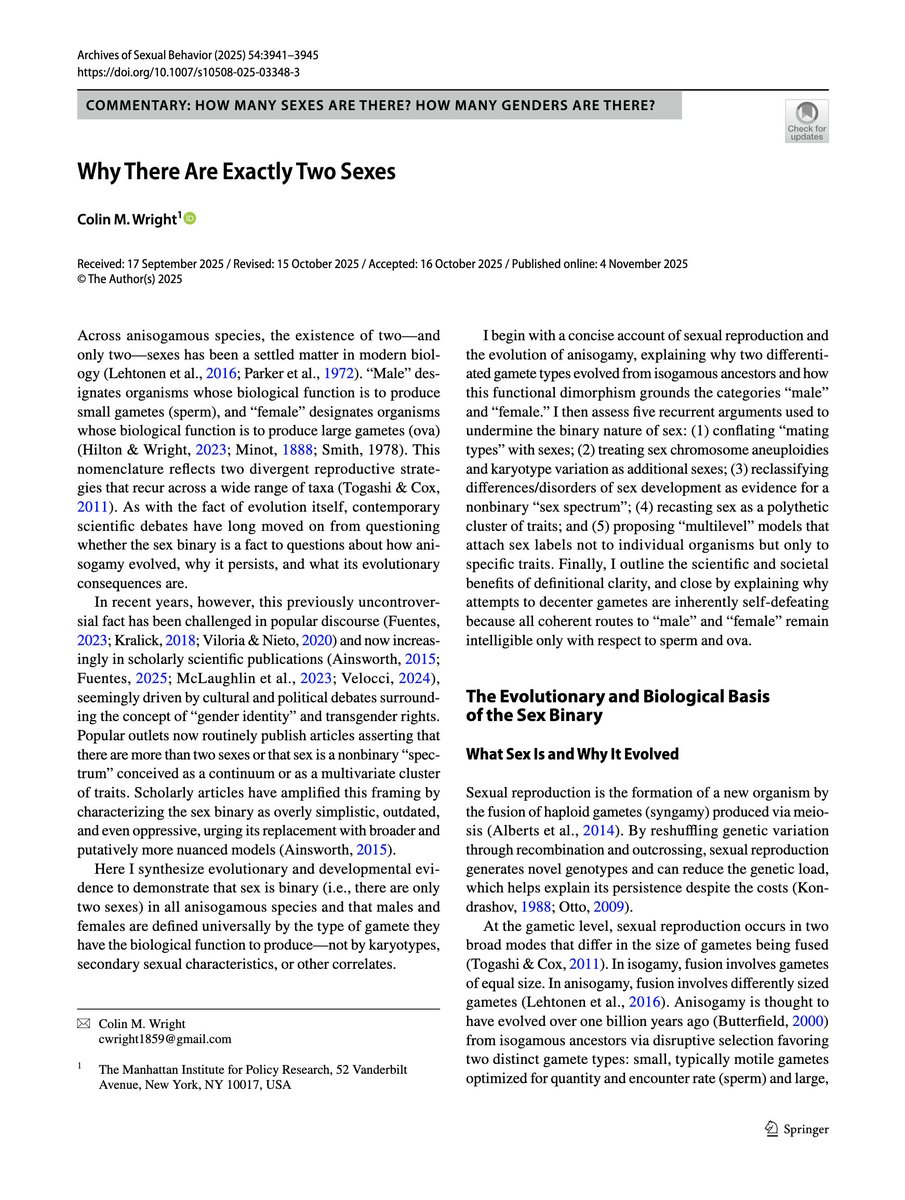
Since I started writing about sex pseudoscience, critics dismiss my arguments because I mainly published in popular news outlets instead of academic journals. Well, my scholarly article "Why There Are Exactly Two Sexes" published last year is now the most-read academic article on the subject. Only one scholar has written a formal critique of it, but from a "feminist epistemology" perspective. It was laughably nonsensical. I responded (link below). I am still waiting for a biologist who thinks I'm wrong to expose and embarrass me with formal, detailed take-down of my arguments. If I'm nothing more than an anti-trans bigot promoting "junk science," as the SPLC has claimed, publicly demolishing my supposedly crank views should be seen as a public service. And it should also be an easy way to add to your academic résumé. LINKS (all open access): -My paper "Why There Are Exactly Two Sexes":link.springer.com/article/10.100… -A critic's "feminist epistemology" response:link.springer.com/article/10.100… -My response to the critique:link.springer.com/article/10.100…
Colin Wright tweet media
English
108
1K
4.6K
107.5K
Richard Gerraty
Richard Gerraty@RichardGerraty·
@Peter_Fitz Liam Bartlett. Not hard to find. And you only heard what Bowen pretended he heard.
English
0
0
1
80
Peter FitzSimons
Peter FitzSimons@Peter_Fitz·
Not sure who the journalist is, but Bowen wiped the floor with him. The premise that our energy crisis is because we have too many renewables is ludicrous, intellectually dishonest and tailored tabloid trash. #Auspol
stranger@strangerous10

Chris Bowen fires back, schools & embarrasses Anti-renewables journo on importance of Renewables during a crisis & for refusing to let other journos ask questions “Solar energy has to travel 150 mill km from the sun, it doesn’t have to travel the 150km of the Strait of Hormuz”🔥

English
654
434
2.2K
122.2K