

Richard122
1.6K posts

Richard122
@Richardx1202
Fulltime web3. Research & Moderator
Đà Nẵng Katılım Ocak 2022
2.8K Takip Edilen2.2K Takipçiler

This is your Sunday reminder that the market has already forgiven you…
Your trading history hasn’t. 😂

English
Seeing Magnitude reviews happen is a good reminder:
Don't farm roles
Build relationships
Stay active
Support the ecosystem
Consistency > intensity
Magnitude is the key🔑
@SeismicSys
@NoxxW3

English

@Richardx1202 @SeismicSys @NoxxW3 your advice is good but fr why does it always have to be magnitude?
English

AI agents do not only need better intelligence.
They need money they can actually use.
An agent may be able to search for information, compare services, call an API and make a decision. But the workflow often stops when payment requires a credit card, a bank account or manual approval from a human.
That becomes a real infrastructure problem when agents begin interacting with other machines.
An agent may need to purchase a dataset, pay for one model inference, rent GPU capacity for several minutes or compensate another agent for completing part of a task.
Traditional payment systems were not designed for thousands of small, automated and global transactions between software processes.
Bringing USDT into the Bitcoin and Lightning stack introduces a different model.
USDT gives agents a relatively stable unit for pricing services and managing budgets. Bitcoin provides the underlying settlement foundation, while Lightning can support faster and lower cost transfers for frequent payments.
This could make pay per request infrastructure more practical.
Instead of subscribing to an entire service, an agent could pay only for the API calls, compute time or data it consumes.
Builders could also program spending rules directly into the agent.
The agent may receive a daily budget, limit how much it can spend per request, approve only specific service providers and generate a receipt for every transaction.
This is where the idea becomes more important than simple payments.
USDT on Bitcoin could become a coordination layer between agents, models, data providers, compute markets and applications operating across different countries and platforms.
The real unlock is not giving an AI agent a wallet.
It is giving software a predictable way to discover a service, evaluate its cost, pay for it and continue executing without leaving the product flow.
@utexocom @Utexoasia
English
Tiếng Việt

Weekend
Touch grass❌
Touch the bar✅
Show me your weekend!
@NoxxW3 | @xealistt | @heathcliff_eth
@SeismicSys

Xealist@xealistt
Touch the bar, not the grass this weekend
English
@vbhgbvn @get_optimum gmum em nè, cuối tuần vẫn chăm chỉ quá em
Tiếng Việt

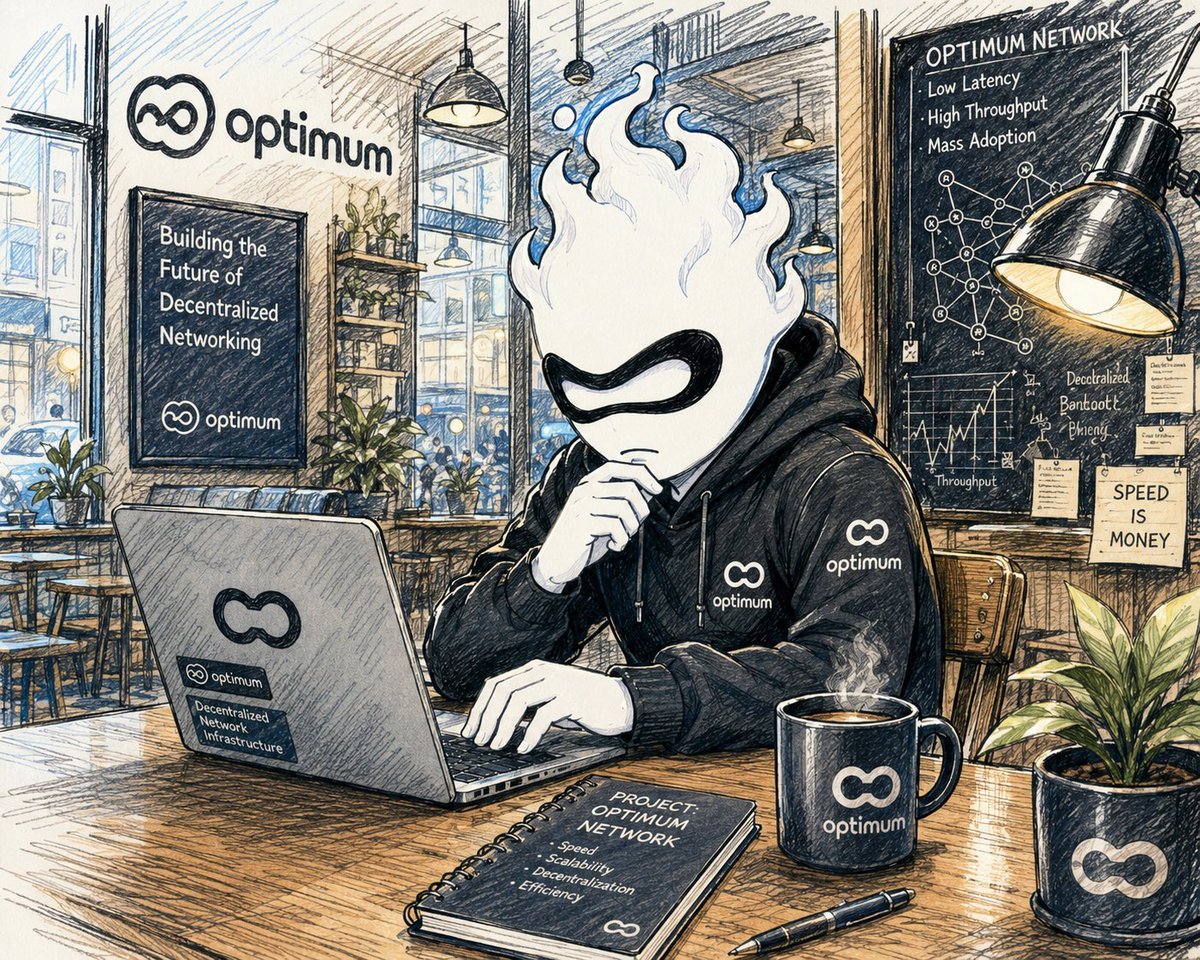
Why Speed Matters More Than Ever @get_optimum
In today’s digital economy, speed is more than performance—it’s value.
Everyone wants lower latency. But the real challenge is making networks faster without sacrificing decentralization.
English


In a world where every millisecond decides winners and losers, one undeniable truth remains: 𝐒𝐩𝐞𝐞𝐝 𝐢𝐬 𝐌𝐨𝐧𝐞𝐲 .
And as we’ve seen across industries competing down to the millisecond:
> HFT: +1ms speed advantage = +$100M/year. Funds spend tens of millions just to shave off microseconds.
> E-commerce: Amazon: +100ms page load = -1% revenue. Google: +0.5s = -20% traffic.
> Blockchain: Slow block propagation = stale/orphan → lost rewards. In MEV races, whoever is faster captures the value first.
When speed equals money everywhere else, it’s only natural that blockchain follows the same rule and Optimum makes it real
👉 @get_optimum leverages RLNC to accelerate propagation 6–20x, cut bandwidth by 90–95%, and help validators achieve higher & more stable staking yields.
The result:
faster networks = real money for validators, searchers, and stakers.
cc : @blockchainjeff @cryptooflashh @aqccapital


Cipher (❖,❖)@nnthanhthanh96
Ethereum validators: speed = yield. On Hoodi testnet, @get_optimum is showing: • Block & blob propagation 6–20x faster • Latency around 150ms • Stable attestations + big bandwidth savings This isn’t theory , it’s live data. If you’re running a node and care about MEV & rewards, you should be testing this network layer now. Feedback matters. Join the testnet, push it, and share your experience. 𝐒𝐩𝐞𝐞𝐝 𝐢𝐬 𝐦𝐨𝐧𝐞𝐲. Don’t get left behind. cc : @cryptooflashh @blockchainjeff @aqccapital
English

Finally, the Magnitude 8.0 milestone has been unlocked!
I want to express my gratitude to:
💙 The Seismic team for building such a promising project and always listening to the community.
🤝 All community members who have shared their knowledge and supported each other throughout this journey.
🚀 Those who have encouraged me to keep trying.
I will continue to be with Seismic in the next stages, contributing even more and hoping to see the project grow stronger in the future.
Thank you all for your continued support! ❤️
Magnitude is Key. @SeismicSys

English
English

☀️ GM everyone
Stay curious
Stay patient
The best opportunities usually reward consistency
@useTria @RiverdotInc @quipnetwork

English

Great products earn attention
Great infrastructure earns trust
Behind every breakthrough application is a foundation built to perform reliably, efficiently, and at scale
That's the future Optimum is building
Build with confidence. Scale without limits 👨💻
#Optimum

English
Tiếng Việt
Tiếng Việt
Tiếng Việt

Introducing mump2p: A Faster Way for Blockchain Nodes to Communicate
One of the most exciting technologies Optimum is building is mump2p. Although it's still in private testnet with leading Ethereum validators and node operators, the goal is straightforward: help blockchain nodes communicate faster and more efficiently.
To understand why this matters, let's look at what happens when you send a transaction on Ethereum.
Your transaction is first sent to an RPC node, then placed into the mempool, where it waits to be included in a block. Once a validator creates that block, it has to broadcast it across the network. Other validators need to receive and verify it before the block can be confirmed.
This broadcasting step is more important than many people realize. If blocks spread slowly, the entire network becomes slower. Validators may receive information later than others, reducing efficiency and increasing the chance of missed opportunities.
Today, Ethereum relies on Gossipsub to share blocks between nodes. It works well, but as the network grows and more data is transmitted, it can become slower and consume more bandwidth.
That's where mump2p comes in.
Instead of forwarding raw data like Gossipsub, mump2p uses Random Linear Network Coding (RLNC), a networking technology co-invented by Optimum's co-founder, Prof. Muriel Médard, during her research at MIT.
Rather than sending the same data repeatedly whenever packets are lost, RLNC encodes the data into smart combinations. This allows nodes to recover the original information even if some packets never arrive, reducing unnecessary retransmissions and making communication much more efficient.
The early results are impressive. Internal testing shows that mump2p can reduce propagation latency by more than 50% compared to Gossipsub. Even as message sizes increase and network traffic becomes heavier, mump2p continues to perform reliably while traditional approaches begin to struggle.
Although the current testing focuses on Ethereum, mump2p isn't limited to one blockchain. It's designed to work across different networks. Some chains, like Solana, already use erasure coding with Reed-Solomon, but RLNC offers greater flexibility and is better suited for large, decentralized environments.
At the end of the day, mump2p isn't trying to change how blockchains work. It's improving how information moves between nodes. Faster communication means faster block propagation, lower latency, better network efficiency, and ultimately a smoother experience for validators, developers, and everyday users.
@get_optimum
@aqccapital
JacklyNguyen@jacklynguyenn
When data is transmitted over the Internet, it's normal for some packets to get lost along the way. The traditional solution is to resend the missing packets. While this works for many everyday applications, it's not ideal for blockchain networks, where transactions need to propagate as quickly as possible. Repeated retransmissions increase network traffic and introduce unnecessary latency. That's where erasure coding comes in. Instead of waiting to resend lost data, the system generates extra redundant packets in advance. As long as the receiver collects enough of these packets, it can reconstruct the original data—even if some packets never arrive. Today, there are three common types of erasure coding: Reed-Solomon (RS) Fountain Code Random Linear Network Coding (RLNC) Reed-Solomon (RS) is one of the oldest and most widely used erasure coding techniques. It powers technologies such as CDs, DVDs, QR codes, and storage systems. While reliable, RS was designed for relatively stable environments and only performs encoding at the source. That makes it less suitable for decentralized blockchain networks, where thousands of nodes constantly exchange data. -------------------------------------------------- Fountain Codes are more flexible. Instead of producing a fixed number of encoded packets, they can generate an almost unlimited stream of them. The receiver simply collects enough unique packets to recover the original data, making Fountain Codes well suited for broadcasting and streaming applications where packet loss varies across users. -------------------------------------------------- RLNC takes the concept a step further. Not only can the sender encode data, but intermediate nodes can also combine and re-encode packets before forwarding them. This gives the network more opportunities to deliver useful information without relying on retransmissions. Think of it like sending a 100-piece jigsaw puzzle. With Reed-Solomon, you include a few extra backup pieces, so losing some pieces won't prevent the puzzle from being completed. Fountain Codes let you create as many backup pieces as needed, and the receiver only needs enough of them to reconstruct the picture. RLNC works differently. Every packet is a mathematical combination of multiple original pieces. As the packets travel through the network, intermediate nodes can create new combinations from the packets they receive. The receiver doesn't need the original packets—only enough independent combinations to reconstruct the complete data. This is why RLNC is particularly well suited for blockchain and Web3. It speeds up data propagation, reduces retransmissions, lowers bandwidth consumption, and ensures that critical information reaches more nodes even when the network experiences congestion or packet loss. For these reasons, @get_optimum has adopted RLNC as its core technology to accelerate the propagation of transactions, blocks, and data blobs, making blockchain networks faster, more efficient, and more resilient. @get_optimum @aqccapital
English
Tiếng Việt