

CLOUD
892 posts
CLOUD
@0xcloudlab
🧑💻 Mod & Researcher 🧑💻 Alpha and OG Support Early project
Katılım Kasım 2022
980 Takip Edilen539 Takipçiler

Complex Systems Fail at Their Boundaries
A system rarely fails because one component is weak
It fails because two components stop working together
Modern infrastructure is no longer built as a single monolithic system
It's an ecosystem of independent services, networks, protocols, and applications
The challenge isn't making each component powerful
It's making every connection reliable
1⃣Why boundaries create complexity?
Every distributed system has boundaries
Between nodes
Between networks
Between execution and storage
Between applications and infrastructure
Each boundary is a place where information must move accurately and efficiently
As ecosystems grow, these boundaries multiply
And with every new boundary comes new challenges:
🔹communication delays
🔹inconsistent state
🔹synchronization overhead
🔹interoperability issues
🔹cascading failures across dependencies
Ironically, individual components may perform perfectly
Yet the overall system can still struggle if communication between them breaks down
This is why the most resilient infrastructure doesn't only optimize individual performance
It optimizes interaction
Throughout the evolution of technology, the biggest breakthroughs often came from improving how independent systems connect
The internet standardized communication between networks
Cloud platforms unified distributed resources
Modern software relies on APIs and orchestration to keep services synchronized
Blockchain infrastructure is entering the same phase
As decentralized ecosystems become increasingly modular, the quality of coordination across system boundaries will determine how scalable they become
Projects like Optimum are exploring infrastructure that improves data propagation and coordination across decentralized environments helping separate components behave like one cohesive system instead of isolated parts
Because great infrastructure isn't measured by how strong each piece is
It's measured by how well every piece works together
2⃣Connections define the system
Users don't experience individual components
They experience the entire system
When boundaries disappear, everything feels seamless
When boundaries fail, every weakness becomes visible
The future of scalable infrastructure isn't about eliminating complexity
It's about ensuring complexity remains invisible through better coordination
▶️Strong connections build strong ecosystems
Components create capability
Connections create resilience
@aqccapital
#optimum

English


→ In crypto, speed isn't just performance. It's profit.
🛞 Speed is money. @get_optimum

Optimum@get_optimum
English

If you're staking 1,000 ETH (roughly $1.7 million at current prices), Optimum can quietly put an extra $898 per year (about 0.50 ETH) into your pocket.
That might not sound like a crazy amount at first, but when Ethereum staking yields are sitting around 2.7–3.5% these days, a consistent +1.71% boost is actually pretty meaningful - especially at this scale.
How? @get_optimum mump2p protocol uses advanced RLNC technology to make your blocks propagate 6–20x faster than the standard GossipSub. The result? Fewer missed attestations, fewer missed proposals, better MEV opportunities, and lower bandwidth costs - all without changing your existing setup or buying new hardware. You just run a lightweight sidecar.
In short, it’s one of the smartest, lowest-effort ways right now to squeeze more yield out of a large validator position.
What do you think ? worth exploring?
English

Scaling Blockchain Requires Better Networking
As blockchain adoption accelerates, the challenge is no longer only about increasing throughput.
The bigger question is how data can move across decentralized networks efficiently without compromising fairness or decentralization.
Optimum is tackling this networking bottleneck.
In a recent technical session, CEO and MIT professor Muriel Médard explained that every blockchain faces a natural propagation limit.
The constraint is not just computation or block size it is the network's ability to distribute information to validators around the world.
The Problem with Traditional Propagation
Ethereum currently relies on GossipSub, where nodes forward multiple copies of the same data through a decentralized mesh.
While this helps preserve decentralization, it also creates:
Redundant traffic
Higher bandwidth usage
Additional propagation delays
Uneven block delivery between validators
Validators located closer to block proposers often receive information earlier than validators in distant regions, creating a co-location advantage based on geography rather than participation.
How RLNC Changes the Model
Optimum uses Random Linear Network Coding (RLNC) instead of repeatedly transmitting identical copies of a block.
Validators receive encoded linear combinations of the original data and only need enough independent coded packets to reconstruct the block.
This approach can:
Reduce redundant network traffic
Improve bandwidth efficiency
Increase resilience to packet loss
Make block propagation more consistent across regions
Why It Matters
The goal is not simply to make Ethereum faster.
The goal is to reduce unnecessary networking overhead so decentralized systems can scale without amplifying geographic advantages.
Physical distance will always exist, but inefficient data distribution does not have to.
By improving how blocks propagate through the network, @get_optimum is helping build a more scalable, fair, and decentralized blockchain infrastructure.
@blockchainjeff
@aqccapital
@ada_pegasus
@cryptooflashh
@CryptoSundayz

English

Scaling Ethereum requires more than bigger blocks. Ethereum's upcoming Glamsterdam upgrade introduces ePBS, a new approach that restructures slot timing to support larger blocks and more blobs
Instead of requiring the entire block to reach validators within a few seconds, ePBS separates block components, giving more time for execution payloads and blob data to propagate. This helps improve scalability, but it doesn't completely solve the underlying networking challenge
⚡ How Optimum addresses the bottleneck
🔹 ePBS optimizes block timing, allowing different parts of a block to arrive at different deadlines
🔹The real bottleneck remains data propagation, especially as block sizes and network participation continue to grow
🔹Optimum uses Random Linear Network Coding (RLNC) to fundamentally improve how data moves across Ethereum
🔹Lower latency and lower propagation variance enable blocks to spread through the network more quickly and reliably
🔹Higher throughput allows the network to process more data without being limited by bandwidth constraints
🔹Performance scales with network growth, maintaining efficient propagation even as Ethereum becomes larger and more decentralized
Optimum isn't simply making Ethereum faster, it is improving the network layer that powers block propagation. By removing bandwidth bottlenecks with RLNC, Optimum helps create an Ethereum network capable of supporting larger blocks, higher throughput, and potentially shorter slot times without sacrificing decentralization
Scaling Layer 1 isn't just about increasing block size, it's about ensuring data can move efficiently across the entire network. That's where Optimum's technology makes the difference
@get_optimum

English

Speed has always mattered.
Now Optimum is proving it has measurable economic value.
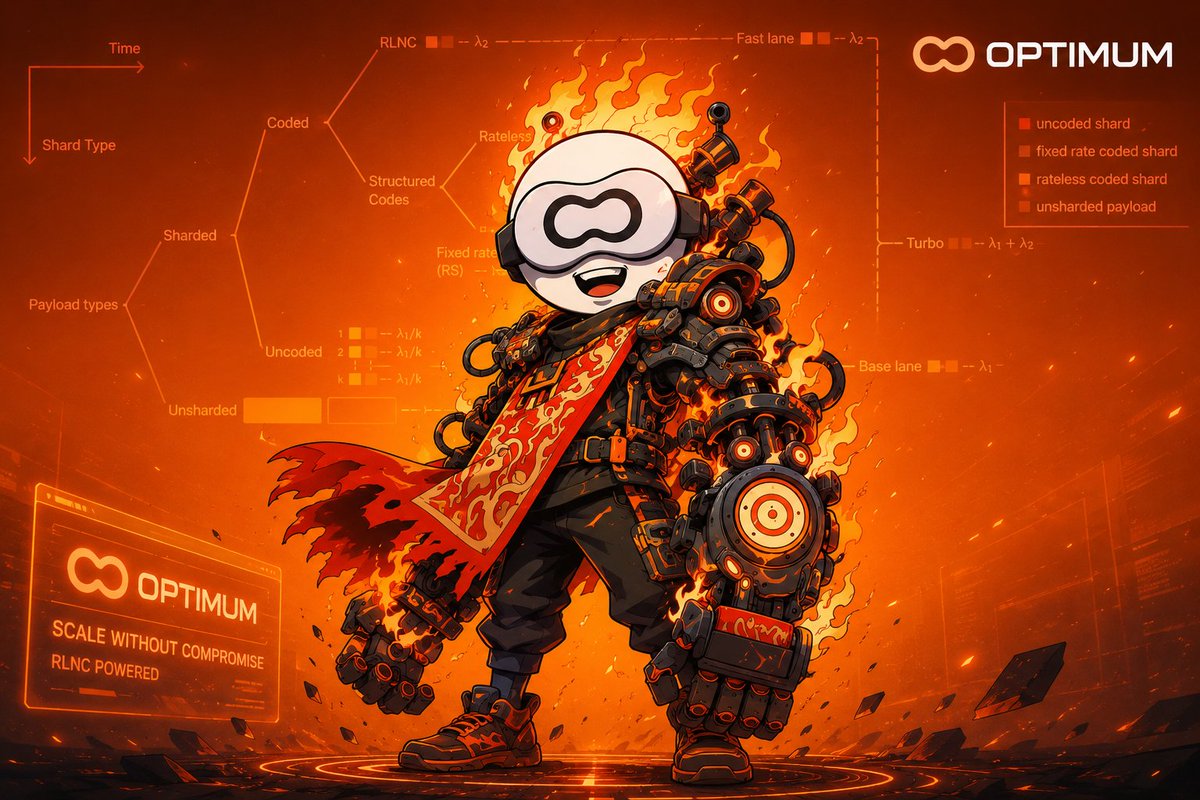
→Every RLNC shard increases the probability of decoding before the deadline, turning milliseconds into real validator revenue.
✍️Latency is no longer just a metric. It's an asset.
⚡ Speed is Money. @get_optimum
English

GMIC Seismic fam! 💜
Happy Monday!
Wishing everyone a week full of joy, positive energy, and big wins.
Let’s keep grinding, supporting each other, and showing some love for Seismic.
A little bit of work, a lot of energy, and a lot of dedication to the community! 🚀🌊
Have an amazing week, @SeismicSys fam! 🔥

English

Information Flow Is Becoming a Competitive Advantage
For many years, blockchain networks competed primarily on execution.
Higher throughput, lower fees, and faster block production became the benchmarks used to measure performance. While these metrics remain important, they no longer tell the entire story as decentralized systems continue to grow in both scale and complexity.
Every improvement in execution increases the amount of information that must be distributed across the network. Blocks become larger, applications exchange more data, and validators must process an increasing volume of information within the same consensus window. Under these conditions, the efficiency of information propagation becomes a competitive advantage in its own right.
This is why Optimum focuses on improving information flow rather than execution alone.
Using Random Linear Network Coding (RLNC), information is propagated as linearly independent coded packets, allowing receivers to reconstruct the original block after reaching the decoding threshold instead of waiting for specific packets to arrive. Intermediate nodes further improve propagation through recoding, continuously generating new useful coded packets without first decoding the original data.
The result is a network that makes more efficient use of available bandwidth, improves effective throughput, and increases information availability under real-world network conditions.
As blockchain ecosystems continue to evolve, execution performance alone will no longer define the strongest infrastructure. Networks will increasingly compete on how efficiently they distribute information across globally decentralized participants.
In the long run, the ability to move information efficiently may become just as important as the ability to process it.
References: Optimum Documentation • Optimum Engineering Blog • Muriel Médard's research on Network Coding and Random Linear Network Coding.
@get_optimum @blockchainjeff

English

The Hidden Layer of Blockchain
Everyone talks about faster execution.
But before a transaction is processed, data must reach the network first.
That’s where @get_optimum stands out.
By improving data propagation with advanced networking technologies like RLNC, Optimum aims to reduce latency, strengthen network resilience, and help decentralized systems communicate more efficiently.
Sometimes, the biggest innovation isn’t processing data faster it’s moving data smarter.
@get_optimum
@aqccapital
@blockchainjeff
@ada_pegasus

Thần Quang@thanquang9999
GMUM ☕ Every great network starts with a simple connection. Behind every transaction, every validator, and every block is one thing we often overlook: communication. That’s why @get_optimum is building where it matters most making data propagation faster, smarter, and more resilient for decentralized networks. The faster information flows, the stronger the ecosystem becomes. Here’s to another day of building, learning, and pushing Web3 infrastructure forward. GMUM, Optimum fam! @get_optimum @aqccapital @blockchainjeff @ada_pegasus
English

𝗛𝗼𝘄 𝗙𝗮𝘀𝘁𝗲𝗿 𝗣𝗿𝗼𝗽𝗮𝗴𝗮𝘁𝗶𝗼𝗻 𝗔𝗳𝗳𝗲𝗰𝘁𝘀 𝗕𝗹𝗼𝗰𝗸 𝗕𝘂𝗶𝗹𝗱𝗲𝗿 𝗘𝗰𝗼𝗻𝗼𝗺𝗶𝗰𝘀
While discussions around faster data propagation often focus on validators, the benefits also extend to block builders and relayers.
Block builders need time to construct high-value blocks, especially when extracting MEV. Relayers are responsible for efficiently distributing these blocks to validators. When propagation is slow, both groups have less time to operate effectively, which can lead to missed MEV opportunities and less efficient block delivery.
Faster propagation, such as what mump2p enables, gives block builders more time to optimize their blocks before submission. This can improve MEV extraction and overall block value. For relayers, quicker and more reliable data transmission helps improve the speed and consistency of block delivery across the network.
In addition, more efficient propagation reduces bandwidth usage, which can help lower operational costs for both block builders and relayers running large scale infrastructure.
As competition in block production increases, improvements in propagation speed can create advantages not only for validators but also for those responsible for building and relaying blocks.

vidang@vidangne
𝗥𝗟𝗡𝗖 𝗘𝘅𝗽𝗹𝗮𝗶𝗻𝗲𝗱 𝗦𝗶𝗺𝗽𝗹𝘆 In many blockchains, when a node receives new data, it copies and sends that same data to many other nodes. This creates a lot of duplicate traffic across the network. 𝗥𝗟𝗡𝗖 works differently. Instead of sending the same data repeatedly, RLNC breaks information into small pieces and mixes them into new combinations. These mixed pieces are sent out, and even if some are lost, the original data can still be reconstructed from the combinations that arrive. Think of it like sending a puzzle. Instead of mailing many full copies of the same puzzle, you send different combinations of the pieces. As long as enough combinations reach the other side, the full puzzle can still be completed. This approach reduces unnecessary data traffic and makes transmission more efficient. In blockchain, it allows blocks and data to move across the network faster and with less waste. @get_optimum uses RLNC in mump2p to improve how blocks propagate on Ethereum, helping validators achieve better performance with lower bandwidth usage. In simple terms, RLNC is a smarter way of moving information, one that wastes less and works better when conditions aren’t perfect.
English

Blockchains don't just need better execution. They need better communication.
Every block, transaction, and blob must reach thousands of distributed nodes before the network can move forward. As blockchain adoption grows, efficiently moving that data becomes an infrastructure challenge of its own.
🧩 That's the vision behind @get_optimum.
Rather than building another Layer 1 or changing consensus, Optimum is building a Universal Data Acceleration Network a permissionless network powered by RLNC, mump2p, and Flexnodes to improve how information propagates across blockchain ecosystems.
⚙️ The vision extends beyond a single product.
Today, mump2p focuses on accelerating data propagation. Looking ahead, the same Flexnode network is designed to support additional services like DeRAM and DeROM, creating a shared infrastructure for low-latency communication and memory across multiple blockchains.
📡 As more chains, validators, builders, and developers connect to the network, Flexnodes are intended to become a common layer that accelerates data movement wherever it's needed without requiring changes to blockchain consensus.
💡 Faster propagation is the first step.
The broader goal is to build the infrastructure that helps decentralized networks communicate at internet scale.
#Optimum #RLNC #Flexnodes

English
Everyone is asking what blockchain can do.
A better question is:
What kind of infrastructure does the next generation of blockchain actually need?
That’s where Rialo caught my attention.
Instead of focusing only on faster transactions, Rialo is exploring how blockchain can become a practical foundation for real-world applications.
The vision goes beyond moving assets.
It’s about enabling applications that are:
✦ Reactive to real-world events
✦ Scalable for growing ecosystems
✦ Built with privacy and security in mind
✦ Designed to simplify developer workflows
As Web3 matures, infrastructure will matter more than narratives.
The projects that quietly solve fundamental problems today could become the platforms that power tomorrow’s applications.
Excited to keep following Rialo’s journey and see how this vision evolves.
@RialoHQ

Thần Quang@thanquang9999
Congratulations to Rialo’s Members of the Week!* A huge shoutout to everyone recognized this week across the Rialocommunity. This recognition reflects more than just activity it celebrates consistency, meaningful contributions, helping newcomers, and genuine community engagement across both global and regional channels. Congratulations to all the amazing members who earned their place on the wall this week. Your energy, dedication, and willingness to support others are what make the community stronger every day. Keep building. Keep contributing. Keep inspiring. And to everyone else: your name could be next! @RialoHQ
English

Sunday mood:
Slow breakfast, soft jazz, sunlight through the window.
Walking through a garden, wildflowers dancing in the breeze…
Life is beautiful
gMum @get_optimum


English
Most people think private credit needs better smart contracts.
I think it needs better truth.
Smart contracts are deterministic. They execute exactly as programmed.
The real challenge is the data they depend on.
If borrower reports are delayed, manipulated, or incomplete, the contract still executes flawlessly… just on the wrong information.
Tokenization solves ownership.
Automation solves execution.
Neither solves verification.
The real infrastructure for onchain private credit isn't another lending protocol.
It's the verification layer that connects real world events to smart contracts with trustworthy data.
In private credit, the hardest problem isn't writing code. It's proving reality. @RialoHQ

Rialo@RialoHQ
Smart contract enforcement is valuable, but it is only the second piece. The first is being able to determine the truth about bespoke financial instruments with strong guarantees. Read the full breakdown: rialo.io/posts/bringing…
English


Most conversations about blockchain performance begin with execution speed.
Some focus on consensus.
Others debate rollups, ZK proofs, or data availability.
But before any of these matter, something much simpler has to happen.
Information has to reach the network.
Professor Muriel Médard CEO and Co-Founder of Optimum has been awarded the 2026 IEEE Richard W. Hamming Medal, recognizing her groundbreaking contributions to Network Coding, Information Theory, and Reliable Communications.
It's a remarkable achievement, but it also shines a light on an area of research that deserves far more attention in Web3.
Every blockchain depends on communication.
Blocks, attestations, blobs, and other consensus messages must be propagated quickly and reliably across thousands of nodes. The better information moves, the more efficiently the entire network can operate.
This is where Random Linear Network Coding (RLNC) offers a fundamentally different approach.
Instead of forwarding packets exactly as they are received, RLNC encodes them into mathematical combinations. Once enough independent coded packets arrive, the original data can be reconstructed, even if some packets never make it to their destination.
That change may sound subtle, but its impact can be significant.
• Faster data propagation
• Better bandwidth efficiency
• Greater resilience to packet loss
• Higher network throughput
• Improved scalability for decentralized systems
At Optimum, these ideas are being applied to build a decentralized communication layer for blockchain networks.
The vision isn't to replace consensus or execution.
It's to improve the way information flows before consensus even begins.
If blockchain is ultimately an information network, then improving how information travels may unlock just as much value as improving how transactions execute.
History has shown that foundational technologies often begin inside research labs long before they reshape an industry.
TCP/IP changed how computers communicate.
Public-key cryptography changed how we establish trust online.
Erasure coding transformed distributed storage.
Perhaps Network Coding will become another piece of that foundation for the next generation of decentralized infrastructure.
Congratulations to Professor Muriel Médard on this well-deserved recognition.
Sometimes the biggest innovations don't change the rules of the system.
They simply change how efficiently the system communicates.
@get_optimum @ada_pegasus

English

Decentralize to Scale: Infrastructure for an Onchain Digital Economy
Blockchain networks have traditionally faced a difficult tradeoff.
Increase performance, and networks risk becoming more centralized. Preserve decentralization, and latency, bandwidth limitations, and infrastructure costs can restrict scalability.
OptimumP2P is designed to remove this tradeoff.
At its core is Random Linear Network Coding, or RLNC, a data transmission technology built for large, globally distributed networks.
Instead of simply forwarding individual data packets, RLNC creates random linear combinations of packets. Nodes can then recode and forward data immediately, while receivers can reconstruct the original information from any sufficient combination of coded shards.
This provides three major technical advantages:
Early forwarding reduces the time nodes spend waiting for complete data.
In network recoding allows every participating node to improve data propagation.
Flexible decoding removes dependence on receiving specific packets from specific peers.
As the network grows, coding diversity increases. More nodes create more parallel data paths, reduce propagation bottlenecks, and improve network resilience.
In testing, OptimumP2P delivered between 600% and 3,000% lower latency than Gossipsub, Ethereum’s current data propagation method.
OptimumP2P also reduces bandwidth requirements. Any machine capable of running an Ethereum client can integrate the protocol, meaning performance improvements do not require excluding smaller validators or concentrating infrastructure among high-powered operators.
This could allow blockchains to support:
Larger blocks
Shorter block times
Higher transaction throughput
Lower network latency
More efficient bandwidth usage
Greater validator diversity
For validators, faster data propagation can improve proposal and attestation timing while reducing infrastructure costs.
For applications, it creates the performance foundation required for global payments, onchain order books, DePIN, gaming, social platforms, and latency sensitive DeFi.
For users, it means faster and cheaper transactions that remain reliable as network demand increases.
OptimumP2P turns decentralization from a scaling limitation into a scaling mechanism.
More nodes create stronger data propagation. Stronger propagation enables greater throughput. Greater throughput attracts more applications and network participation.
True blockchain scalability should emerge from decentralization, not come at its expense.
@get_optimum @aqccapital @ada_pegasus @blockchainjeff

English
𝗕𝘂𝗶𝗹𝗱𝗶𝗻𝗴 𝗳𝗼𝗿 𝗩𝗮𝗹𝗶𝗱𝗮𝘁𝗼𝗿𝘀, 𝗡𝗼𝘁 𝗝𝘂𝘀𝘁 𝗳𝗼𝗿 𝗛𝘆𝗽𝗲
In crypto, many projects chase hype with big promises and flashy launches. But real infrastructure is built differently, by listening to the people who actually run the network: the validators.
Validators don’t care about marketing. They care about practical things:
Can I add this without changing my whole setup?
Will it reduce missed attestations?
Will it help me capture more MEV or lower my bandwidth costs?
And most importantly, will it improve my returns?
This is the approach @get_optimum took with mump2p.
Instead of forcing major changes, they designed it as a lightweight sidecar. No consensus modifications. No big hardware upgrades. Validators can integrate it easily and start seeing benefits quickly.
By using RLNC, mump2p delivers significantly faster block propagation while cutting bandwidth usage by up to 90–95%. On testnet, it reached around 150ms average propagation, helping validators achieve more consistent attestations and better MEV capture.
These improvements aren’t just technical. They translate into real revenue gains, as shown in Optimum’s Earning Calculator. The focus has always been on solving actual operator problems, not creating hype.
In a space full of noise, Optimum chose to build quietly for the people securing the network every day. Because at the end of the day, good infrastructure isn’t made for attention, it’s made for the validators who run it.
𝗦𝗽𝗲𝗲𝗱 𝗶𝘀 𝗠𝗼𝗻𝗲𝘆. And it starts with solving real problems.

vidang@vidangne
𝗛𝗼𝘄 𝗙𝗮𝘀𝘁𝗲𝗿 𝗣𝗿𝗼𝗽𝗮𝗴𝗮𝘁𝗶𝗼𝗻 𝗔𝗳𝗳𝗲𝗰𝘁𝘀 𝗕𝗹𝗼𝗰𝗸 𝗕𝘂𝗶𝗹𝗱𝗲𝗿 𝗘𝗰𝗼𝗻𝗼𝗺𝗶𝗰𝘀 While discussions around faster data propagation often focus on validators, the benefits also extend to block builders and relayers. Block builders need time to construct high-value blocks, especially when extracting MEV. Relayers are responsible for efficiently distributing these blocks to validators. When propagation is slow, both groups have less time to operate effectively, which can lead to missed MEV opportunities and less efficient block delivery. Faster propagation, such as what mump2p enables, gives block builders more time to optimize their blocks before submission. This can improve MEV extraction and overall block value. For relayers, quicker and more reliable data transmission helps improve the speed and consistency of block delivery across the network. In addition, more efficient propagation reduces bandwidth usage, which can help lower operational costs for both block builders and relayers running large scale infrastructure. As competition in block production increases, improvements in propagation speed can create advantages not only for validators but also for those responsible for building and relaying blocks.
English

A new week is the perfect time to keep building, learning, and exploring the future of Bitcoin native payments.
As stablecoin adoption continues to grow, the demand for secure, private, and efficient payment infrastructure becomes more important than ever. @utexocom is helping shape that future by combining private execution, predictable fees, and Bitcoin backed settlement into a unified payment layer.
Every innovation starts with a strong foundation and Bitcoin provides exactly that.
Let's make this week another step toward a future where digital payments are faster, more private, and built on trust.
Happy Monday 🥰

English