Roberto

77 posts

Roberto

Roberto

@RobertoRoybal

Katılım Mart 2009
133 Takip Edilen34 Takipçiler
Roberto
Roberto@RobertoRoybal·
@FracSlap I’d like the PDF deck if possible
English
1
0
0
20
Roberto
Roberto@RobertoRoybal·
In addition to the analysis @stevenfiorillo performed here, the more important metrics are the results achieved by the allocation of tax receipts for the public good. California under @GavinNewsom has categorically and catastrophically failed to provide Californians with positive results to justify their high taxes. Despite very high tax revenues under Governor Gavin Newsom, California has struggled to translate spending into visible improvements in several key areas: •Homelessness: Billions of dollars have been spent on programs, yet California still has the largest homeless population in the U.S., with limited measurable reduction. •Housing affordability: Strict regulations and slow development have kept home prices and rents among the highest in the nation despite housing initiatives. •Infrastructure and projects: Large public projects (like high-speed rail) have faced massive cost overruns and delays, raising concerns about fiscal efficiency. •Public safety and quality-of-life issues: Rising concerns about crime, retail theft, and urban disorder in some cities reveals spending hasn’t improved outcomes.
English
0
0
0
95
Steven Fiorillo
Steven Fiorillo@stevenfiorillo·
There’s been a lot of back and forth about @GavinNewsom claims regarding taxes between Texas and California. People keep asking how that's even possible when Texas has no state income tax. The answer is likely that he's talking about the effective tax rate not just the state income tax line. Governor Newsom claimed that Texas taxes its lowest-earning residents more than California taxes its richest residents, and that the middle class in Texas pays more taxes than the middle class in California. I went through the actual data. He's half-right and half-wrong, and the half he's wrong about is the part that affects the majority of people. I will break it down without being political, and strictly by the numbers. I'm using the Institute on Taxation and Economic Policy (ITEP) "Who Pays?" 7th edition published in 2024. To my knowledge this is the only comprehensive analysis of state and local tax systems across all 50 states. It breaks down what families at every income level actually pay as a share of their income across all tax types including income, sales, excise, and property taxes. I can't prove this is where Mr. Newsom is pulling his data from, but it's my assumption, and I wanted to be transparent about my source from the start. One core concept to understand before diving in is the effective tax rate. This is not the rate printed in the tax code. It is the actual percentage of your total income that goes to taxes after every deduction, credit, exemption, and offset is applied across every type of tax you pay. It includes your state income tax, the sales tax on everything you buy, the property tax on your home or the portion passed through to you in higher rent, excise taxes on gas, tobacco, and alcohol, and even the share of business taxes that ultimately get absorbed by consumers, workers, and shareholders. Claim 1: "Texas taxes poor folks more than we tax our richest." My verdict: Governor Newsom is technically correct based on effective tax data in this case but technically isn't the whole story. According to ITEP's data, the bottom 20% of Texas earners pay a total effective state and local tax rate of 12.8% of their income. The top 1% of California earners pay 12.0%. So how can a state with no income tax end up taxing its poorest residents at a higher rate than a state with a 13.3% top income tax bracket charges its richest? The answer lies in what types of taxes each group pays. Texas has no income tax, but revenue has to come from somewhere. The two main revenue generators are sales and property taxes. The ITEP breakdown for the bottom 20% of Texas earners looks like this: sales and excise taxes take 8.1% of income, property taxes including pass-through to renters take 4.5%, and other taxes take 0.2%, for a total of 12.8%. The bottom 20% of Texans earn less than approximately $21,700. At that income level, nearly every dollar goes to rent, food, gas, and basic necessities. Almost everything they spend is subject to sales tax. Their rent includes their landlord's property tax passed through as higher rent. There is no offset, no credit, and no refund to ease the burden. On the other side, California's top 1% of households have an average income of roughly $2.14 million. The ITEP breakdown looks like this: personal and corporate income taxes take 9.2%, sales and excise taxes take 1.0%, property taxes take 1.7%, and other taxes take 0.1%, for a total of 12.0%. The distortion in the effective rate is that their sales and property tax rates as a share of income are very low because they typically save and invest most of their income rather than spending it on taxable goods. So 12.8% is higher than 12.0%. Newsom is technically accurate but there are aspects this claim doesn't tell you. The comparison pairs the absolute bottom of Texas's income distribution against the absolute top of California's income distribution. It is the single most dramatic comparison you can construct from the data, and it was likely designed to provoke outrage rather than inform. It tells you absolutely nothing about how the two systems compare for roughly 80% of residents who are neither the poorest Texans nor the richest Californians. The moment you move one step up the income ladder, the comparison reverses. The second 20% of Texans earning $21,700 to $40,800 pay 11.2%. The middle 20% pay 9.9%. The fourth 20% pay 8.8%. By the time you reach a household earning a median income, Texas's rate has already dropped below California's. The comparison only works at the extremes, and only in one specific direction. Claim 2: "Your middle class pays more taxes in Texas than our middle class in California." My verdict: Governor Newsom is incorrect. This claim falls apart when you look at the actual ITEP data. The middle 20% of Texans with household earnings of roughly $41,000 to $74,000, pay a 9.9% total effective rate. The equivalent group in California pays 10.4%. California is half a percentage point higher. When you look at the fourth quintile, households earning roughly $74,000 to $146,000, which is where the median household income falls in both states, the gap widens significantly. Texas charges 8.8% and California charges 11.0%, a 2.2% difference favoring Texas. There is no income group that can reasonably be classified as middle class where Texas comes out higher than California. The only groups where California is cheaper are the bottom two quintiles, households earning under approximately $48,000, which most people would characterize as working class or lower income, not middle class. California's median household income is approximately $92,000 and Texas's is approximately $80,000. At both of those income levels, you are firmly in the fourth quintile, where the difference favors Texas by roughly 2%. How California achieves a lower rate at the bottom If California has a higher sales tax and higher property taxes for the poorest renters, how does it end up with a lower total rate for its lowest earners? The answer is one line item: tax credits. ITEP's data shows that the bottom 20% of California earners have a personal income tax rate of negative 1.8%. California's refundable Earned Income Tax Credit (CalEITC) and refundable Young Child Tax Credit (YCTC) send more money back to these families than they collect in income tax. The state is making a net payment to its lowest-income residents through the tax code. Texas doesn't have a state income tax, so there is no mechanism to replicate this. When you strip out the income tax line and look only at sales, property, excise, and other taxes, the bottom 20% in California pays approximately 13.3% of their income. In Texas the same group pays 12.8%. Without the refundable credits, California's poorest would actually pay more than their Texas counterparts, not less. The entire advantage at the bottom rests on two specific tax credits that phase out by $32,900. The population math is important to discuss The question that matters is not which system is better in theory, it's how many actual people fall on each side of that crossover line. California's population is approximately 39 million. Quintiles divide the population into equal fifths, giving us roughly 7.8 million people per group. The bottom 40%, roughly 15.6 million Californians earning under $48,000, would pay less under California's tax system. The top 60%, roughly 23.4 million Californians earning above $48,000, would pay less under Texas's tax structure. The savings are not symmetric. A family in the bottom 20% saves roughly $150 per year under California's system. A family earning $110,000 saves roughly $2,400 per year in Texas. A household earning $200,000 saves roughly $7,000 in Texas. At $500,000 the savings in Texas reach roughly $20,000. The residents who benefit from California's system save minimal amounts compared to the majority of residents who pay more under the California tax code. My bottom line Governor Newsom's first claim that Texas taxes its poor more than California taxes its richest is technically correct, but it's a deliberately narrow comparison that pairs the extremes of two different populations and tells you nothing about the experience of most people. His second claim that the middle class pays more in Texas than in California is incorrect. By every measure in ITEP's data, middle-class Texans pay less. At the median household income the difference favors Texas by roughly 2%. The uncomfortable truth is this: California's progressive tax system does benefit its poorest residents, primarily through two narrowly targeted refundable tax credits. But the majority of working Californians, at least 55 to 60% of the population including the entire middle class, pay more under California's system than they would under Texas's. The advantage California provides at the bottom is modest in dollar terms. The additional burden it imposes on everyone else is substantial. I didn't even go down the rabbit hole of the cost of living, and if I did the gap would widen further. None of this is a political argument. It's policy and math. Progressive tax systems make a policy choice to concentrate the burden on upper earners and return money to lower earners. That is a legitimate design. But presenting that design as if it benefits everyone, or as if the only people who gain from Texas's system are the richest of the rich, is not supported by the numbers. The data shows the opposite. The majority pays more in California.
Gavin Newsom@GavinNewsom

Fox News refuses to report the truth: Texas and Florida are the REAL high-tax states.

English
23
14
117
20.9K
Roberto
Roberto@RobertoRoybal·
@pmarca @davidsenra listening to this podcast, I can’t help but think…We criticize managers who run companies they didn’t build. Yet we let career politicians with no foundational experience allocate trillions in government. The United States needs more proven founders and capital allocators—not more managerial politicians.
English
0
0
0
33
David Senra
David Senra@davidsenra·
Absolutely unhinged photo from my conversation with @pmarca Episode out tomorrow morning!
David Senra tweet media
English
32
22
684
31.9K
Roberto
Roberto@RobertoRoybal·
@DavidSacks @friedberg @chamath @Jason on the 2/13/26 pod, David Sacks mentioned that the big 4 hyper-scalers are estimated to spend $600 billion in 2026 CAPEX. It would be great to see a segment on All-In which quantifies this CAPEX spend to any other year in corporate history but then highlight the fact our U.S. Government now spends over $7 trillion per year. Our Congress and other political leaders in the U.S. are effectively the largest capital allocators in the World and most in positions that directly determine these capital flows are not qualified to be capital allocators. Y’all know how difficult it is to be a capital allocator with other people’s money when a return is expected. Herein lies the problem… no one in congress seems to expect a return on US taxpayer dollars, not even in the form of a desired outcome.
English
0
0
0
134
The All-In Podcast
The All-In Podcast@theallinpod·
David Friedberg: The Hidden Debt Crisis That Could Tank the Dollar “If the Democrats win the midterms and you end up with a Democrat in the White House in 2028, I think that there's a bigger problem afoot, which is all of the state and local obligations.” “We've talked about how Social Security looks like it's going to run out of money in a few years here. And there's a similar problem at the state and local level.” “You'll very likely see a federalization of that obligation, meaning that the federal government will step in to bail out or support those state and local governments, because otherwise there's gonna be a real kind of economic crisis afoot.” “So when you add that liability coming to hit this CBO report, which doesn't include any of that in the next 5-10 years, I think that could be not just the straw that breaks the camel's back, but the concrete that breaks the camel's back, and that's the thing I'm most worried about.” “There is a deep connection between what's going on with the socialist movements at a city level and now increasingly at a state level, and what we should expect to happen with the US dollar and how it relates to federal spending and federal deficits and federal debt. And these are going to be dragging each other into a bad place in the next couple of years, one way or the other.” “If it's very hard to cut spending or get Congress to approve budget cuts that we need to save ourselves from this debt death spiral, imagine how much worse it's going to be in the next couple of years if we have to bail out or federalize state and local debt and state and local pension obligations, it's going to be really nasty.” “If we can find a way to declare bankruptcy, to restructure the fiscal obligations or the pension obligations that sit at the state and local level, we may have a way out. But short of that, that's going to pile onto this federal problem.”
English
70
133
867
112.5K
Roberto
Roberto@RobertoRoybal·
Michael Shellenberger says the following which is a great summary to frame the context of your son’s project: In Germany - study by German scholars indicates nuclear and hydroelectric dams produce 75x and 35x more energy respectively than is required to make them (keep in mind that Germany is hostile to any negative claims about renewables so this is eye opening). 1. Solar, wind and biomass in contrast produce just 1.6x, 3.9x and 3.5x more energy respectively than is required to make them. 2. Coal, gas and oil produce about 30x more energy than is required to make them. 3. What this low energy return on energy invested has resulted in is people in industrialized economies have become parasites on the energy system because people require 10x more energy than we produce.
English
0
0
3
40
De La Rosa
De La Rosa@Tejanobrown·
My son’s science experiment this year. How much energy does it take to drill an Oil & Gas well and is the energy produced from it worth it? Would energy twitter care to help me make sure my son gets an A?
English
50
4
122
14.8K
Roberto
Roberto@RobertoRoybal·
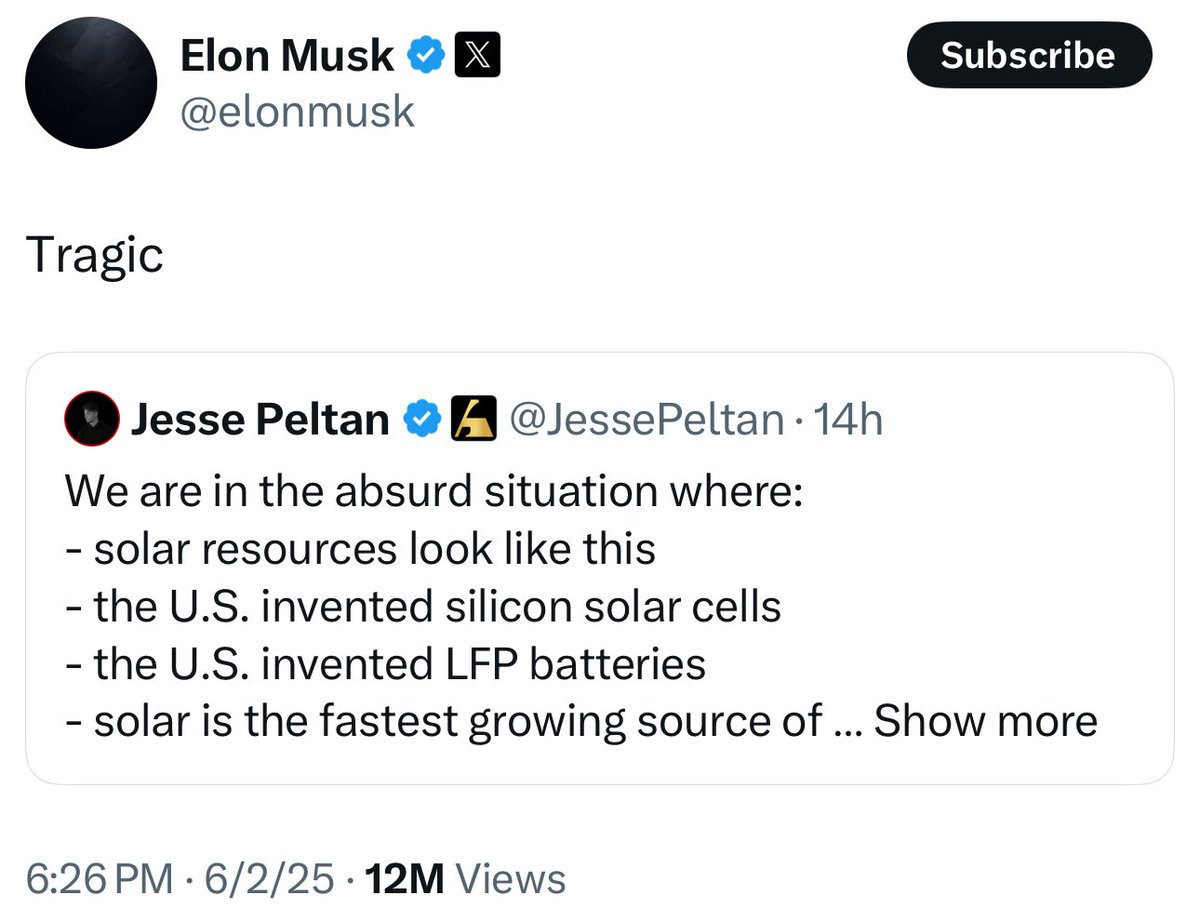
You should post the dollar amounts to refute what Elon and others are insinuating regarding subsidies for Solar and Wind vs. oil and gas. Elon keeps referring to oil and gas subsidies, but it is important to clarify with amounts that this is not an apples to apples comparison. So, Elon is terribly mistaken with this comparison and then one needs to factor in the energy density of a given source which reveals there is no legitimate reason to continue subsidizing wind and solar. In the U.S. we have the benefit of watching what transpired in Germany and Spain and we need to realize that we do not want to put U.S. citizens in the same dire position that Germany and Spain have put their citizens in. Germany specifically has been at this for decades and is worse off from an emissions standpoint compared to when they started down this road. Germany spent $5 trillion to $6 trillion, has higher emissions, and their citizens pay 5x what we pay for electricity in the U.S.. We need to learn from their mistakes.
English
1
0
5
284
Alex Epstein
Alex Epstein@AlexEpstein·
We are in the absurd situation where people claim solar is the cheapest, but are fighting to keep hundreds of billions in solar subsidies that are more expensive than all of the DOGE savings combined.
Alex Epstein tweet media
English
40
326
1.3K
31.1K
Roberto
Roberto@RobertoRoybal·
@AlexEpstein, Chamath @chamath is an investor in battery back-up. @BjornLomborg is the only one applying statistics to inane policy and Bjorn says the US has about 10 minutes of battery storage capacity. For solar and wind to be viable, US would need so much battery storage that we would need to spend about 1/3 of US GDP every year (this is about $9.6 Trillion, US GDP was $29 Trillion in 2024). These batteries only last about 15 years and you have to keep buying them. Currently, the US spends about 3%-4% of its GDP on buying electricity so it’s a bad deal to spend 33% of GDP for backup you’re going to have to replace. Is Bjorn accurate?
English
0
0
10
166
Alex Epstein
Alex Epstein@AlexEpstein·
180° wrong, @chamath. AI is running into power capacity issues because you and others have 1) advocated restrictions on fossil fuels and 2) advocated solar/wind subsidies that manipulate electricity markets to overinvest in unreliable power and underinvest in reliable power.
Chamath Palihapitiya@chamath

One of the oddest things in the House budget bill was cutting the private market incentives in energy markets. 81% of incremental power generation will be crippled by that single stroke of the pen. How do we compete in AI and compete against China? They have an abundance of power. We are woefully behind and need MORE power immediately. It’s almost like these guys want us to lose to China.

English
56
210
1.2K
66.7K
Roberto
Roberto@RobertoRoybal·
@jordanbpeterson Mr. Peterson, the more I learn about world politics, I am very interested in learning why German society seems to have a tendency to be susceptible to extremes? What can this be attributed to… from fascism to now extreme left policies. These extremes have obviously been to the detriment of their people. What is it that causes this extreme tendency in your opinion?
English
0
0
1
20
Roberto
Roberto@RobertoRoybal·
I don’t believe it was by design because on the podcast prior to this one, @chamath correctly stated 95% of all recent electric capacity added was renewable and that was in the context of the Biden inflation reduction act. I simply want the All-In guys to start to get the energy picture right and educate their listeners correctly about energy because I’ve heard them say things that make me believe they don’t completely correctly understand the energy picture and they are very smart and influential guys.
English
0
0
0
51
Roberto
Roberto@RobertoRoybal·
@chamath @theallinpod @friedberg @Jason @DavidSacks On the most recent pod Chamath stated 95% of all energy in US is sourced from renewables. This is dangerously incorrect and misleading. Love the Pod but please correct this. Chamath likely correctly stated last week that…
English
3
0
2
111
Roberto
Roberto@RobertoRoybal·
@morganhousel regarding your podcast yesterday around prediction, don’t you find it absolutely unbelievable that “advanced” civilizations such as the West can broadly believe in the prediction that is the apocalypse narrative premised on a year 2100 estimate by models that are attempting to model climate. These models are inherently unreliable because of the complex variability of the atmosphere (specifically oceans which truthfully cannot be modeled with today’s tech)? We went from being told in the 1970’s the World would freeze, to being told global warming would end the world in the 90’s/early 2000’s, to now climate change will end the world. I cannot understand this and there has been trillions of global taxpayer funds thrown at this prediction with trillions more committed.
English
0
0
0
18
Roberto
Roberto@RobertoRoybal·
@chamath On the most recent pod you stated “right now 95% of all energy we generate in America is sourced from renewables. This is dangerously incorrect and misleading. Love the Pod but please correct this. You likely correctly stated last week that 95% of incremental electricity capacity added in recent years was renewable. That is very different. Electricity makes up only 20% of energy supply, and renewables are still a very small portion of electricity supply. 80% of World energy supply is sourced from oil,nat gas and coal. Additionally, around 60% of electricity is sourced from natural gas and coal. Please have @BjornLomborg on your Pod. He knows these staticts and energy policy better than anyone. The All-In pod needs to get energy correct. It underpins world prosperity. 🙏please get it right, it’s too important.
English
3
0
17
1.7K
The All-In Podcast
The All-In Podcast@theallinpod·
e219: fixing the american dream with andrew schulz! 🇺🇸🇺🇸🇺🇸 @andrewschulz joins the besties for an incredible show: -- tariffs and trump -- fixing the dream: housing correction, social security reform -- his rise in comedy, the value of youtube and an independent fan base ++ much more! (0:00) the besties intro andrew schulz! (3:29) @friedberg hits a quick science corner on the future of fertility (9:35) reacting to @GavinNewsom's new podcast: genius or pandering? (19:36) tariff experiment so far: risks, communication issues, and more (30:44) why the american dream is broken and how to fix it: cracking the housing market, social security reform (55:45) aligning upside via increased stock market participation (1:11:23) how andrew blew up in comedy, going direct via youtube, building a cancel-proof following (1:22:25) state of america, conspiracy obsession, thoughts on trump and doge
English
243
109
1.1K
702.3K
Roberto
Roberto@RobertoRoybal·
On the most recent pod Chamath stated 95% of all energy in US is sourced from renewables. This is dangerously incorrect and misleading. Love the Pod but please correct this. Chamath likely correctly stated last week that 95% of incremental electricity capacity added in recent years was renewable. That is very different. Electricity makes up only 20% of energy supply, and renewables are still a very small portion of electricity supply. 80% of World energy supply is sourced from oil,nat gas and coal. Additionally, around 60% of electricity is sourced from natural gas and coal. Please have @BjornLomborg on your Pod. He knows these staticts and energy policy better than anyone. The All-In pod needs to get energy correct. It underpins world prosperity. 🙏please get it right, it’s too important.
English
1
0
5
782
Roberto
Roberto@RobertoRoybal·
It right.
English
0
0
0
45
Roberto
Roberto@RobertoRoybal·
and coal. Additionally, around 60% of electricity is sourced from natural gas and coal. Please have @BjornLomborg on your Pod. He knows these staticts and energy policy better than anyone. The All-In pod needs to get energy correct. It underpins world prosperity. 🙏please get…
English
1
0
0
91
Roberto
Roberto@RobertoRoybal·
@JTLonsdale Great quote to summarize this and other views which characterize success in this vein… “The bigotry of low expectations.”
English
0
0
0
24
Joe Lonsdale
Joe Lonsdale@JTLonsdale·
In general, we shouldn’t share dumb people/posts, but this is such a useful lesson to see how flawed the left’s model of the world is at a core level. Sadly, Reich was in the Clinton cabinet! I founded and helped build many innovative US companies that aren’t monopolies. I also scaled a top investment firm over many years, that helps others do the same. Each of these activities separately made me well over a billion dollars - they each took insight, hard work, and bold action; my work helped make many others tens of billions, and positively contributed to our great nation. Reich: Screw you, commie scum. Stop spewing these lies for naive folk.
Robert Reich@RBReich

There are basically 5 ways to accumulate a billion dollars: 1) Profiting from a monopoly 2) Insider-trading 3) Political payoffs 4) Fraud 5) Inheritance Don’t believe the self-made myth.

English
236
279
3.2K
196.2K
Roberto retweetledi
Robby Starbuck
Robby Starbuck@robbystarbuck·
Tommy warned the world before anyone was paying attention that gangs of migrants were raping young British girls and his country repaid him by censoring him, harassing him, protecting the rapists and by jailing him. Their media helped politicians cover it up. Free Tommy Robinson!
Elon Musk@elonmusk

Free Tommy Robinson! @TRobinsonNewEra

English
975
8.9K
41.4K
3.6M