Rodney A. Lambert

353 posts

Rodney A. Lambert

Rodney A. Lambert

@RodLambertCPA

Oxford, PA Katılım Aralık 2022
259 Takip Edilen107 Takipçiler
deathTouch
deathTouch@deathtouch2k·
@RodLambertCPA @A_May_MD @TripleGateCaptl My read was that he was saying they may need an adcom because of the novel MOA (which FDA sometimes does), not because of the safety risk. FWIW, a recently former FDA GE senior reviewer said to us they would be "extremely surprised" if obe got an adcom.
English
1
0
5
75
BoredCorso
BoredCorso@TripleGateCaptl·
$ABVX — strong framework, but it's using mgmt's background which seems to be inflated. The 0.3–0.7 (non-NMSC) / 0.7–1.4 (NMSC) ranges depend on thiopurine-treated cohorts: the 1.36 NMSC ceiling is literally Abbas year-5 thiopurine, plus a Kaneko "5× prostate" that I couldn't find in the paper. Thiopurine-naïve UC is ~0.3–0.5 / ~0.4–0.9 → events-to-signal drops well below 10–14. On NMSC: the ABX464-104 protocol (NCT04023396) discloses the N-Glu metabolite is phototoxic at clinically relevant exposure — a real drug-specific BCC/SCC mechanism. So skin cancers aren't purely background, even if manageable. Sources: Abbas 2014 → pubmed.ncbi.nlm.nih.gov/25244964/Kaneko 2024 → pubmed.ncbi.nlm.nih.gov/38592255/Proto… (NCT04023396) → cdn.clinicaltrials.gov/large-docs/96/…
deathTouch@deathtouch2k

Based on our conversations with the buy side and sell side, one thing is clear: the market is still struggling to define the actual safety bar for $ABVX. Specifically: how many non-NMSC events would ABTECT Maintenance Part 2 need to show before FDA reviewers or sophisticated pharma BD teams should become concerned that obefazimod may have a true carcinogenic signal, rather than background malignancy events in a refractory UC population? We provide our analysis and conclusions below. Said simply: under our assumptions, $ABVX would need to show a malignancy burden far beyond one or two incremental cancer cases before the bear case becomes statistically and biologically coherent. When a drug trial reports a handful of cancer cases, the natural question is: is this a real signal, or just bad luck? A drug study with 150 patients over one year will almost certainly see some cancers — because UC patients get cancer at a background rate even without any drug. In fact, even otherwise healthy people get cancer at a background rate without any drug. The real question is whether the number of cancers seen on the drug is more than we would expect by chance from that background rate alone. Enter statistics: the formal language of separating signal from bad luck. In this case: what is the event burden and pattern that is high enough, coherent enough, and biologically plausible enough to overcome a low causal prior to obefazimod being carcinogenic? This is exactly the kind of question Bayesian inference is useful for answering. Our Bayesian inference model asks a simple question: Given an estimated background non-NMSC incidence rate of ~0.5/100 PY, how many additional non-NMSC events would need to appear in the next ~450 PY of 50 mg exposure before the pooled 50 mg maintenance dataset begins to look meaningfully above UC background? At ~0.5/100 PY, the expected background incidence over ~450 PY is roughly 2–3 non-NMSC events. Our model suggests the upcoming 50 mg Part 2 update would need to show something closer to 10 additional events above background — roughly 14 total non-NMSC events in the pooled ~600 PY 50 mg maintenance dataset — before the posterior begins to suggest a >50% probability that the true obefazimod non-NMSC rate exceeds the upper bound of UC background. We favor a Bayesian inference framework in these cases because it contemplates the data through a lens similar to that of what we believe an FDA reviewer and pharma regulatory teams would look through: exposure-adjusted rates, confidence intervals around those rates, event heterogeneity, organ clustering, baseline UC cancer risk, prior therapy risk, timing of exposure, investigator attribution, and whether the pattern resembles a broader immunosuppressive AE phenotype. Most importantly, with this approach we do not need to assume obefazimod causes cancer. In fact, the causal prior should be low because there is no obvious a priori hypothesis for obefazimod causing cancer, including clean preclinical work, no clustering to a specific cancer type, no broader adverse event pattern associated with impaired immune surveillance, and investigator assessment that the disclosed prostate and breast cancer cases were unlikely related. Thus, the analysis is not whether “observed cancers divided by patient-years is greater than zero.”; that is coarser than the data allows. The question is whether the observed event pattern is adequate to overcome a low causal prior. We estimated background malignancy IRs across an aggregate 7000+ PY based on a synthesis of Colombel et al. (2017), Rubin et al. (2026), D’Haens et al. (2023), Swissmedic (2024), Sands et al. 2026, Abreu et al. (2022), and Sandborn et al. (2019), and arrived at an estimated non-NMSC IR of 0.5, which is the midpoint of the range provided by management in the Part 2 primer deck published earlier today (ir.abivax.com/static-files/7…). We use 0.5/100 PY as the non-NMSC IR as the background prior of our model. Our analysis allows us to use 7000 PY as the weight of that prior probability. Then, we ask how many non-NMSC events need to be observed in the ~450 PY from Part 2 for the aggregate obefazimod non-NMSC IR to indicate that the true obefazimod non-NMSC rate exceeds the UC patient background upper bound with at least 50% probability. We set the PY reported in ABTECT Maintenance Part 1 according to management feedback. An estimated background non-NMSC IR prior of 0.5/100 PY is at the midpoint of the range provided by $ABVX management and implies an expected 2-3 non-NMSC events per 450 PY. Our model suggests that the ABTECT Maintenance Part 2 update for the 50 mg dose would need to show 10 additional events over and above those background events in 450 PY (i.e., total of 14 non-NMSC events) before the pooled 600 PY maintenance dataset (Part 1 + Part 2) for the 50 mg dose to indicate a greater than 50% probability that the true obefazimod non-NMSC rate is greater than the upper bound of UC background rate, when the observed non-NMSC IR begins to possibly be considered elevated above background expectations. Even when we cut the prior probability weight in half to 3500 PY, the conclusions remain unchanged: ABTECT Maintenance Part 2 update for the 50 mg dose would need to show 7 additional non-NMSC events over and above the number of events expected given the background IR before the pooled 600 PY maintenance dataset (Part 1 + Part 2) for the 50 mg dose to indicate a greater than 50% probability that the true obefazimod non-NMSC rate is greater than the upper bound of UC background rate. Said differently, the key risk is not that another cancer event occurs; the UC and IBD literature documents an expected incident rate for non-NMSC at their background rate (0.3-0.7/100 PY). The key question is whether the next ~450 PY expected from the Part 2 50 mg arm is consistent with the drug-driven malignancy hypothesis: repeated non-NMSC events, organ clustering, biological patterning, exposure-duration logic, or a broader immune-surveillance signal. That is what our model tests. If the next cut instead shows low-count, disparate, background-plausible events, the current obefazimod-driven malignancy argument becomes increasingly difficult to sustain. But what about Rinvoq? They didn’t see a big imbalance? This is not a Rinvoq/Xeljanz-style RA safety signal, where a nearly 4,500-patient outcomes study produced a statistically significant malignancy and immunosuppressive AE cluster in line with an a priori safety hypothesis prior. So far, these few malignancy observations are easily explainable by the background rate of UC cancer in this population especially, and mechanistically, there is also no obvious reason to believe obefazimod should be carcinogenic. If anything, Qin et al. (miRNA-124 in Immune System and Immune Disorders - PMC) discuss miR-124 biology in anti-proliferative and anti-fibrotic contexts, though we would not underwrite an anti-cancer effect here. Against the magnitude of efficacy demonstrated by obefazimod to date: ~50% clinical remission versus ~10% placebo, plus large effects on endoscopic remission, HEMI, steroid-free remission, and sustained remission that is life-altering; these non-NMSC events do not appear to alter the risk-benefit equation. We do not think these disclosed data support a black box. A black box for what appears likely to be background artifact would risk causing net harm to patients by creating unnecessary friction around delivery of a novel and highly efficacious therapy. A brief comment on NMSCs: Based on our diligence, including conversations with former FDA review leadership responsible for evaluating new IBD drug approvals, NMSCs are most commonly basal cell carcinoma and cutaneous squamous cell carcinoma. Importantly, these cancers are: 1) very common; 2) very slow growing; 3) very visible; and as a result, 4) very treatable and curable. These cancers are rarely metastatic, and very rarely fatal. There is published evidence that IBD patients appear to be at elevated rates of NMSCs, hypothesized to result from either higher baseline persistent inflammatory processes and/or thiopurine use. In fact, clinical guidelines published in April 2025 following an expert panel from the American Gastroenterological Association Clinical Practice Update provided specific guidance that all adult patients with IBD should follow skin cancer primary prevention practices by avoiding excessive UV exposure, that patients on immunomodulators, anti-TNF biologic agents, or small molecules should undergo yearly total-body skin exam, and that patients with any history of thiopurine use should continue yearly total-body skin exam even after thiopurine cessation. In the cohort study, the incidence of NMSC was higher among patients with IBD compared to controls (IRR 1.64, 95% CI 1.51–1.78). Recent thiopurine use was associated with NMSC (adjusted OR 3.56, 95% CI 2.81–4.50), and persistent thiopurine use was associated with NMSC (adjusted OR 4.27, 95% CI 3.08–5.92). While, prior to our analysis, we were not concerned that the FDA or pharma would view elevated NMSC rates as a major issue, we were concerned that investors might continue to misclassify them as a serious systemic malignancy signal. However, based on recent conversations with other buysiders, we sense the market is beginning to understand that NMSCs are not a meaningful issue here: they are generally detectable, manageable, and already incorporated into the standard-of-care dermatologic monitoring framework physicians use for UC patients. For completeness, we repeat our Bayesian inference analysis as described above but for NMSC. Taking the NMSC background IR of 1/100 PY provided by management today, we expect 4.5 cases in a 450 PY dataset. Our model suggests that the ABTECT Maintenance Part 2 update for the 50 mg dose would need to show 12 to 13 additional events over and above those background events in 450 PY (i.e., total of 21 NMSC events) before the pooled 600 PY maintenance dataset (Part 1 + Part 2) for the 50 mg dose to indicate a greater than 50% probability that the true obefazimod NMSC rate is greater than the upper bound of UC background rate, when the observed NMSC IR begins to possibly be considered elevated above background expectations. In summary: The right conclusion is not that no cancer events occurred, or that no events will occur in the future. They will occur, not only because cancer risk is elevated in UC, but because cancer can occur in anyone, at any time, including otherwise healthy patients. We think the right conclusion is that the events that did occur look explainable by baseline patient risk, common cancer epidemiology, UC biology, and routine screening detection, rather than acting as evidence of an obefazimod-specific oncogenic signal. We think FDA reviewers and pharma regulatory teams are more likely to reach this conclusion than to view the disclosed cases as a coherent obefazimod-specific malignancy signal, making increasingly clear what we believe is a best-in-disease efficacy/risk profile in the lucrative maintenance setting for UC and substantially de-risking the company’s opportunity in Crohn’s. Disclosure: I/we may be long ABVX and may buy, sell, hedge, or otherwise change exposure at any time without notice. Not investment advice or a recommendation. Analysis reflects current views and assumptions based on public disclosures, published literature, and non-confidential conversations, and may change as new data become available. No compensation from ABVX or any third party.

English
4
0
22
7.7K
Rodney A. Lambert
Rodney A. Lambert@RodLambertCPA·
@A_May_MD @TripleGateCaptl @deathtouch2k Think the reason for $abvx price dislocation is that on the ABVX investor/KOL call, a KOL indicated that an AdCom might be needed. If no BB and safety is clear, why the need for AdCom? Keep in mind, KOLs are the most optimistic people on earth!
English
1
0
2
243
Rodney A. Lambert
Rodney A. Lambert@RodLambertCPA·
@A_May_MD @cluelessbio @Clarksterh Seems like $ABVX stock is broken right now. Think BP will determine the final price. Just having a hard time understanding how much value was destroyed by this safety debacle. Is this a temporary blip that no one will remember or will the bidding dry up?
English
2
0
4
774
Adam May
Adam May@A_May_MD·
Accumulating/accelerating of cases with longer time is discussed in FDA review docs. It is a known criterion the fda uses to evaluate these risks and was part of the problem for JAKis. It’s also a good thing for $ABVX, since their longer term (5-7 years) P2 dataset shows no such time-dependent risk. Every angle I look at this from = no black box.
English
3
1
26
2.1K
Adam May
Adam May@A_May_MD·
$ABVX seems to have (in the last hour or so?) quietly released a new corporate deck with 3 important slides at the end. All, in my opinion, providing strong new information showing that these cancer cases were unrelated to drug and equivalent to expected background noise. Most important is the slide on the 2 non-nonmelanoma skin cancers. BOTH of these were more indolent, low/intermediate subtypes of their respective cancer (prostate and breast). Not only does this mean that the cancers are less threatening, it also means that THEY ARE SLOWER GROWING CANCERS. Why is this particularly important? Because it means that the development of the cancers very (very) likely PREDATES THEIR ENROLLMENT IN THE TRIAL. Look into the doubling times of grade 2 (Gleason 7) prostate cancer and grade 2 NST breast carcinoma. These are slow-growing tumors that very likely existed before these patients ever even had a dose of obefazimod. That relates to another key finding on this slide - the prostate cancer case was identified via PSA screening at 8.5 months into the study (remember earlier is better). In the Guggenheim conference they had said it was confirmed at day 367...they must have been referring to the biopsy confirmation of the subtype, not PSA confirmation of the prostate cancer diagnosis. This new information speaks to an earlier diagnosis. The breast cancer patient was diagnosed even earlier than that! Only 6.8 months of Obe exposure. Also, these new slides give us actual information on the prior drug exposures - before this afternoon we knew that they were on some prior treatments, but we didn't know what...THE PROSTATE CANCER WAS PREVIOUSLY EXPOSED TO ***5*** DRUGS WITH LABELED CANCER WARNINGS BEFORE ENROLLING IN THE STUDY! 3 OF THEM HAD ***BLACK BOX WARNINGS*** FOR CANCER RISK! -Humira (black box) -Infliximab (black box) -Rinvoq (black box) -Entyvio (warnings and precautions) -Stelara (warnings and precautions) We also just got new info on the NMSC cases (which matter far less but which spooked the market anyway). How you can look at the details of these skin cancer cases and think they are related to the drug is beyond me (but then again, these details just got released - quietly, for some reason). First of all, ***ALL OF THE 4 50MG CASES OF NMSC OCCURED IN 6 MONTHS OR LESS!!! Again, too rapid to be reasonably assumed drug-related. The fact that they all happened in the first half of this study is actually extremely exculpating evidence for $ABVX. Other details: -4/5 were 60+ years old (STRONGLY associated with skin cancer risk) -3/5 had PRIOR SKIN CANCER ALREADY(!!!!!) -4/5 had prior exposure to other drugs that are known to increase skin cancer risk. Finally, they also added a slide discussing that some studies have shown the elevated risks of these cancers for UC patients at baseline. -~5x higher risk of prostate cancer in IBD patients -~2x higher risk of breast cancer in IBD patients Why did $ABVX add these 3 slides to the corporate deck randomly, silently, on a Friday afternoon? IDK. Legitimately good news in those slides! I'd have pressed released this info as soon as I had it, because the details really help alleviate the (already statistically misguided) concern that these cancers could've been caused by Obefazimod. Here's the link: ir.abivax.com/static-files/e…
Adam May tweet mediaAdam May tweet mediaAdam May tweet media
English
30
33
282
82.6K
Rodney A. Lambert
Rodney A. Lambert@RodLambertCPA·
@ipollit77 @seedy19tron This is a dumb question, couldn’t $ABVX just go for the lower 25mg dosage to avoid the BB warning? Delta is nearly the same as 50mg dosage with no clear signal of cancer?
English
3
0
1
803
Ipollit
Ipollit@ipollit77·
@seedy19tron JAKs only increase the risk of cancer in patients at risk, such as those aged 60 and older. While their prop in the P3 is barely increasing, cancer cases are popping up at the higher dosage. I don't know if the FDA will be convinced if $ABVX simply declares them to be unrelated
English
2
0
2
924
Seedy19
Seedy19@seedy19tron·
***Free alpha*** $ABVX Part 3 Don't need to wait for mgmt Part 2 (will just confirm the below) but pooled all the relevant data to end the debate once and for all. 4 Snippets: 1. ALL the possible MoA related or drug related proof in one sheet tested against all metrics that Obe cannot and is not causing cancer (remember 2 pathways by which a drug causes cancer in humans) ^keep snippet 1 in mind when going over the below, because then you know the rest of the data is just filtering through statistical noise, but for the purpose of informing everyone completed the below 2. Pooled Malignancy analysis, w/ pt level data 3. LT EAIR. FDA methodology. ALL approved UC drugs except Velsipity and Skyrizi 180 mg have shown malignancy events in their Ph 3 maint trials. None carry malignancy specific boxed warnings outside the JAK class. Obe miR 124 moa is NOT in any kinase family no class to associate with 4. Apple to apple comp with other drugs - NMSC rate (separate clinical category, FDA convention) also note Obe pts had azathioprine/prior NMSC/JAK history. Conclusion NO BB! *Dysplasia is a UC surveillance finding, not cancer. UC patients have ~0.5-2% per year background dysplasia detection on surveillance.
Seedy19 tweet mediaSeedy19 tweet mediaSeedy19 tweet mediaSeedy19 tweet media
Seedy19@seedy19tron

***Free alpha*** Part 2 Now many of you bought the dip and/or many of you are waiting for a certain price to breakeven, but IF $abvx go at it alone , what is fair price? (so any sale below this number you're selling below fair value and no M&A premium) Again 3 snippets: 1. Assumptions, imho opinion despite being one of the biggest bulls, I have taken conservative numbers and also factored in future dilution to fund launch till profitability 2. Full DCF projections up until the patents should hold ~2039 ( PMs like @Biohazard3737 shared that they had some of the best lawyers validate this and many sources have since then validated the fact protection should run to around 2039) 3. Value per share $153.17, still another 44% still to go ($106 right now) to accurately reflect what $abvx is worth without M&A (again super conservative numbers)

English
9
0
113
17.3K
Rodney A. Lambert
Rodney A. Lambert@RodLambertCPA·
@JackMan724444 @DeepSouthDoctor How do you arrive at those peak sales? KOL was cautious about positioning for obefazimod in ulcerative colitis (UC), with limited first-line uptake (~10-15%) versus stronger potential in later lines.
English
2
0
1
213
Jack Man
Jack Man@JackMan724444·
@DeepSouthDoctor Considering OBE will do 4 to 5 billion in peak sales and has patents out til 2039, I'd say $ABVX is stupidly undervalued. And thats not even taking into account if Crohns data hits, which is probably will
English
1
0
18
989
Keith Abrams
Keith Abrams@DeepSouthDoctor·
$ABVX - sold at $85, no shame in a 20% profit for a 1-day trade. While bullish on their lead drug, one of the things I find hardest to do is to value companies with potentially blockbuster drugs that have not yet come to market. At a $6.5B MC, doesn't seem under-valued to me.
Keith Abrams@DeepSouthDoctor

Bought 1/2 position in $ABVX at 70.30. Not my usual style, but think the odds of a rebound by end of week are greater than continued price degradation. Likely a short-term trade for me.

English
3
0
24
7.9K
Adam May
Adam May@A_May_MD·
At worst $ABVX is a *more effective* Rinvoq without the need for lab monitoring and with a far superior safety label (even if it does get 1 black box bullet point). It’s objectively better than Rinvoq in every way even in the *worst* case scenario, and the JAKis do several billion in IBD already (peaks will be higher). That’s why I really really don’t understand the $ABVX price action…even if you *do* think the cancer risk leads to a black box….it’s *severely* oversold at these prices…the drug replaces JAK inhibitors…
English
8
2
83
34.7K
Jack Man
Jack Man@JackMan724444·
@RodLambertCPA @seedy19tron @sleepydragon01 Seedy obviously is the goat with biotech but I agree with u. How could 3 year data released be much different than phase 3 maintenance. Must have something to do with placebo and trial design
English
1
0
1
442
Seedy19
Seedy19@seedy19tron·
If you’re just waking up $abvx is up 8.2% in $ terms from Fridays close in Paris. ~$132 , no news yet.
English
17
4
179
34.5K
Rodney A. Lambert
Rodney A. Lambert@RodLambertCPA·
@seedy19tron @sleepydragon01 But don’t you think the 3-year OLE was another de-risking event for obe $abvx? So Friday’s data AH was bullish not inconsequential IMO. Obviously ph3 maintenance delta is still a huge binary.
English
1
0
4
1.7K
Seedy19
Seedy19@seedy19tron·
@sleepydragon01 We already know that the effect deepens over time. Ph3 maint end point is 44w , not 144w so Friday AH inconsequential.
English
2
0
20
2.5K
Rodney A. Lambert
Rodney A. Lambert@RodLambertCPA·
@CatPunksters Especially considering that study 108 incorporated endoscopic healing/maintenance as a required component. Endoscopic data provides objective, visual evidence of direct mucosal healing in the gut lining, rather than relying solely on subjective patient-reported symptoms. $ABVX
English
0
0
9
1.1K
Rodney A. Lambert
Rodney A. Lambert@RodLambertCPA·
@JackMan724444 @biotech_jack Because broader Phase 3 population (induction responders, including partial ones) will show more attrition than pure OLE. Open label population was highly selected (ie already in clinical remission.) $abvx
English
1
0
9
1.8K
Jack Man
Jack Man@JackMan724444·
@biotech_jack I mean how could phase 3 maintenance not be good if phase 2a/2b are ?
English
4
1
6
1.7K
Biotech_Jack
Biotech_Jack@biotech_jack·
$ABVX The fact that Abivax is presenting new interim data from the open-label extension study (Phase 2a/2b) for ulcerative colitis (UC) alongside its quarterly results is a stroke of strategic genius. 1/
English
3
3
49
9.4K
Jack Man
Jack Man@JackMan724444·
@BiotechCLin If delta is 35 or over, the stock will be up massively.. @seedy19tron is predicting 35. We will see $ABVX
English
2
0
10
3.1K
Biotech C Lin
Biotech C Lin@BiotechCLin·
$ABVX 130 patients de-escalated to 25mg → 68% still in clinical remission at week 144. ITT/NRI. 80% completion rate. 7 years of clean safety. For the upcoming phase 3 maintenance data, delta forecast now improves from ~30pp to ~38pp based on my model.
English
4
3
55
6.1K
unemon
unemon@unemon1·
$ABVX … how Year looked like in Jan 7, 2026!
unemon tweet media
English
1
0
8
2.9K
Rodney A. Lambert
Rodney A. Lambert@RodLambertCPA·
@seedy19tron $abvx expected delta for obe maintenance is 20% to 30%…is that blended dosage, or just the 50mg cohort? Seems like 25mg is unnecessary given obe safety profile. Don’t think doctors in practice will ever dose down patients to 25mg.
English
1
0
3
1.9K
Rodney A. Lambert
Rodney A. Lambert@RodLambertCPA·
@seedy19tron @DominickCampag Aren’t you concerned that the placebo maintenance remission rate will drift much higher than the low pbo floor established during induction? Thinking this because of the "enriched" patient pool of responders only.
English
1
0
1
324
Seedy19
Seedy19@seedy19tron·
@DominickCampag I’m very confident. Hard to put a number on it as so many variables but I get 33-35% when running the numbers
English
3
0
18
1.6K
Seedy19
Seedy19@seedy19tron·
I’m no expert but could this be front running a potential oil supply overload? Iran and Russia sanctions get eased in the coming days , we’ve seen this regime likes to get a feeler of headlines before executing and easing of restrictions on both came up this week. Oil eases up, bond market takes a breather from circuit breaking territory and hopefully selfishly fuelled by good data at ASCO , a couple M&As and Q2 remaining positive catalysts $xbi out performs. The other clean explanation is someone with conviction that the Iran war premium is overstated and headlines will deescalate, which gets you to the same trade without assuming mnpi.
Seedy19 tweet media
English
8
6
56
21.8K
Rodney A. Lambert
Rodney A. Lambert@RodLambertCPA·
@DominickCampag @seedy19tron That’s a high bar..If delta is > 30%, obefazimod will be the undisputed first-line advanced oral treatment for Ulcerative Colitis (UC). Stock will moon and a bidding war will ensue IMO.
English
1
0
6
827
unemon
unemon@unemon1·
$ABVX .... France is not a Major hub for JNJ ... yet 2 weeks ago you see CEO and CEO ... + the whole Executive Team ... holding French Flags! Group visit to proof the French Government they really care about France .... Why do they need to do such a demonstration? ... So that an $ABVX deal does not get blocked? No news on this online FYI
unemon tweet mediaunemon tweet media
English
6
1
30
13.8K
BIOTECH SCANNER
BIOTECH SCANNER@BIOTECHSCANNER·
$AQST - Finally got a chance to listen to the earnings call and reading the presentation. I also noticed the debt refinancing. Overall the earnings call was as expected with the exception of AQST 108 being highlighted more than ever before and with good reason! Here are my thoughts on $AQST after the CRL. 1. I was very disappointed with the way management’s lack of awareness on the weakness of the human factor data. This totally blindsided me. If you go back to all my posts on AQST, I didn’t cover the human factor part once. It wasn’t even on my radar. Dan Barber also kept saying that the interactions he had with the FDA lead him to believe that Anaphylm would be approved. This is not true or that he was too optimistic. This was harmful to us as investors. So here we are back to square one. This CRL like any, is expensive, thus the debt refinancing. 2. I really like the new trial designs for both trials (HF and PK). The designs are very thorough and should be approved by the FDA to proceed. 3. The trials should be completed in several months. Thankfully these are not cancer trials. 4. Like I said earlier, Anaphylm is basically back to square one. It’s like none of the other trials meant anything to the FDA. The PK of Anaphylm will be evaluated and compared against epinephrine. I believe Anaphylm will pass with flying colors like before. 5. AQST 108 I have always thought that it has a better chance with atopic dermatitis than alopecia areata but if we can get both, it would be amazing. Atopic dermatitis is a very crowded market but AQST 108 brings a unique and first in class mechanism of action using topical epinephrine gel. This is very exciting. 6. No management is perfect. I believe they will get Anaphylm approved. If you have not sold you have not lost anything. I will look at the results of the trials carefully. Investing in biotech is tough. Patience is key. I will share what I will expecting from these trials as we get closer to the end of the trials.
English
6
2
34
3.8K
Rodney A. Lambert
Rodney A. Lambert@RodLambertCPA·
@unemon1 Wouldn’t the equity tranche include a risk premium, meaning a higher stock price valuation over and above the assumed buyout price. Just because even after a deal is officially announced, it could still, in theory, fall through?
English
0
0
2
303
unemon
unemon@unemon1·
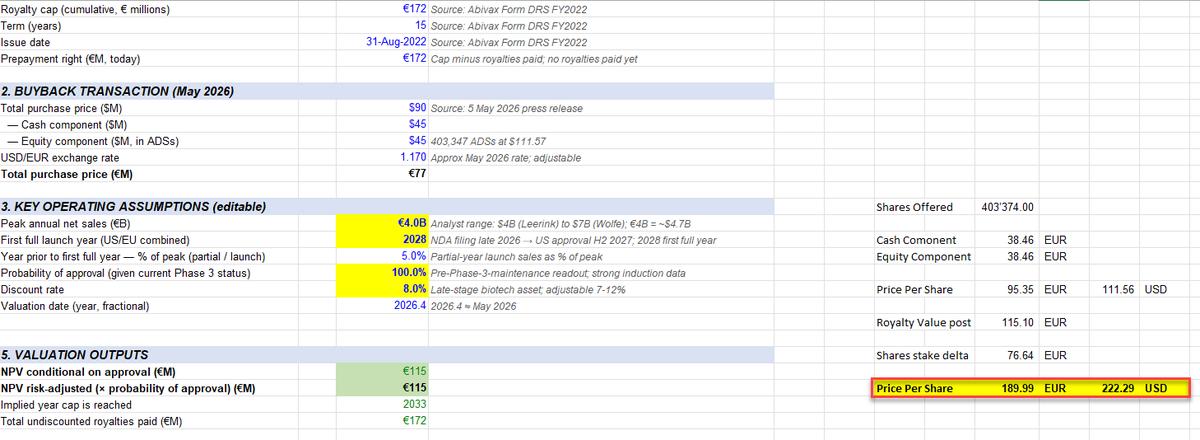
The $ABVX royalty buyback math is too precise to be a coincidence? ‼️Deal incoming at 222.29 USD per share? ‼️ Let me walk through it: The setup: - Royalty cap: €175m - ABVX bought it back for just €77m - Structure: 50% cash / 50% equity - Balance sheet: €500m cash+ planning a raise in June 🇫🇷Red flag #1: Why pay in equity at all?🇫🇷 - ABVX had more than half a billion in cash. They did NOT need to issue shares. Royalty buyouts are almost always done in cash. When equity is used, a lock-up is standard. - Here? No lock-up. None. 🇫🇷Red flag #2: The NPV math🇫🇷 - If maintenance data reads out positive and the asset is totally de-risked, the NPV of those royalties is ~€115m. - Royalty holders received €77m headline. So they took a ~33% haircut on de-risked value… voluntarily. Why would sophisticated counterparties do that? 🇫🇷Red flag #3: The make-whole price🇫🇷 - Run the math on the equity leg: if ABVX gets acquired at ~€190 / ~$222 per share, the royalty holders — thanks to the unlocked equity component — receive exactly €115m total. The full de-risked NPV. They get made whole. 🇫🇷Red flag #4: The rumored LLY offer🇫🇷 - The rumored Lilly bid? ~$225 / €192 per share. - That is almost precisely the make-whole price. Cushion of ~1% above the threshold — exactly the spread you'd expect if the buyback was reverse-engineered from an indicative bid. ‼️Putting it together:‼️ Equity used despite no need for equity ✅ No lock-up despite using equity ✅ Headline price implies haircut UNLESS stk rerates ✅ Stock re-rate price = rumored takeout price ✅ Each fact alone is explainable. Stacked together, they describe a structure where royalty holders accepted "cash today + optionality on a known catalyst" instead of full cash value. ‼️The open question: when?‼️ Coincidence? Possibly. But the numbers aren't approximate — they're exact. And the structure does work royalty buybacks normally don't need to do.
unemon tweet media
English
15
7
65
14.6K