Sabitlenmiş Tweet
RunMaestro.ai
125 posts

RunMaestro.ai
@RunMaestroAI
Maestro is a cross-platform desktop app for orchestrating your fleet of AI agents and projects. It's a high-velocity solution for multitasking keyboard hackers.
Austin, TX Katılım Şubat 2026
42 Takip Edilen166 Takipçiler

@coralflavorcom @kloss_xyz Specs. You can use OpenSpec, SpecKit, BMAD, built-in wizards. In the end you get details spec files, which get a fresh context per task. A visual Ralph Wiggum of sorts.
English

/goal is the best command in Codex, Claude Code, and Hermes right now.
And most are using it wrong.
They write "make no mistakes".
And pray.
Here's how to structure yours for a mission, to rank your uncertainties before acting, to kill scope creep, and to close every loop other prompts leave open.
/goal prompt [structure below]
GOAL:
CONTEXT:
CONSTRAINTS:
PRIORITY: (optional)
1.
2.
3.
PLAN:
DONE WHEN:
VERIFY:
OUTPUT:
STOP RULES:

English

@DavidKPiano Use them both! Have them debate one another. Create Maestro Cue pipelines where they can pass work between one another. These and dozens more flexible features from an open source and totally free cross-platform desktop orchestrator: runmaestro.ai
English

@RunMaestroAI @indigox maestro sounds interesting - are you handling multi-machine access too? thats what pushed me to build 49agents. being able to check agent status across my laptop, desktop, and an azure vm from one canvas was the real unlock

English

@Dever401 @intheworldofai Yes, having an agent act as your fiduciary to crack the whip and get the job done!
English

@RunMaestroAI @intheworldofai The moderator role is the interesting part. Multi-agent gets useful when one process owns synthesis: dedupe context, assign next actions, flag conflicts, and decide when a human has to review.
English

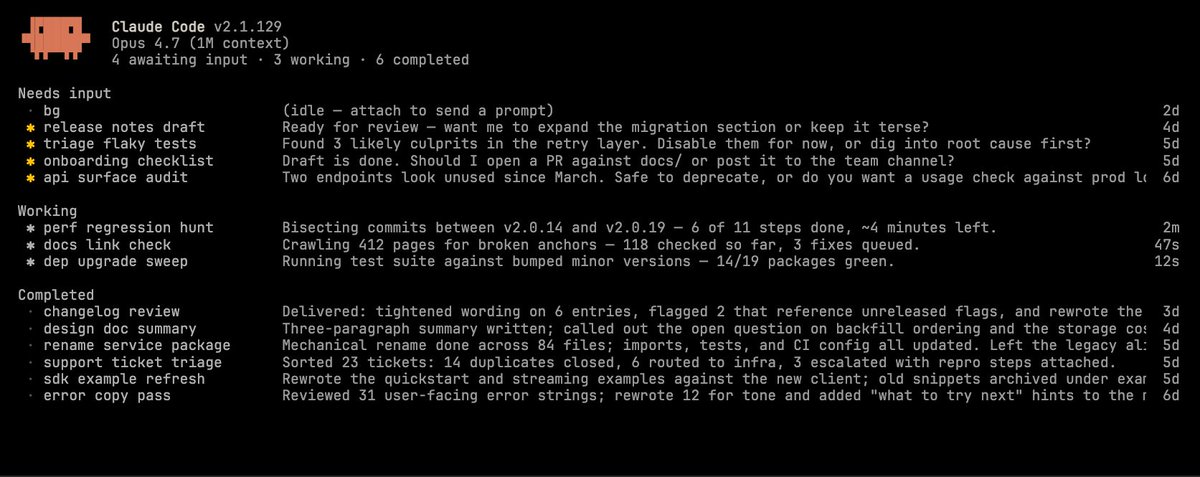
Claude Code Agent View is honestly a nice update.
Being able to manage multiple background Claude sessions from one interface, peek into agents, reply inline, and launch autonomous tasks with claude --bg pushes Claude Code much closer to a true multi-agent coding environment.
BUT… with Claude’s current rate limits, this gets painful fast 😭
Running multiple concurrent agents sounds amazing until you realize heavy workflows can still slam into usage limits pretty quickly. The UX is getting ahead of the actual available compute.

English

@thirteenua Smart split by task weight. Maestro runs OpenCode in one window alongside Claude Code, Codex, and Droid — Cue dispatches by trigger so the tab choice isn't a manual step. Same DeepSeek economics, less alt-tabbing. Open source, cross-platform. runmaestro.ai
English

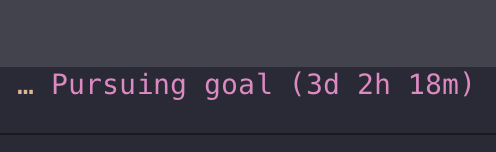
Nearly 3 days. Documented on Maestro Auto Run back on April 24 — markdown checklists, fresh sessions, then it grinds. There's even an Achievements ladder (11 conductor ranks) tracking cumulative unattended time. Works across Codex too, not just Claude Code. runmaestro.ai
English

@steipete @romainhuet is there a record for how long codex long-running tasks have run for? :)
English


@InduTripat82427 We support Spec-Kit, OpenSpec, and BMAD natively in our open source and cross-platform desktop orchestrator: RunMaestro.ai
Compatible with multiple providers today: Claude, Codex, Factory, Copilot, OpenCode with more coming.
English

GitHub just changed vibe coding forever
They dropped Spec Kit.
95k+ stars and 8k+ forks in just days.
The biggest problem with AI coding isn’t the model.
It’s vague prompts.
People type:
“Build me an app”
…then pray the agent doesn’t destroy the codebase halfway through.
Spec Kit fixes that with a specification-first workflow.
→ /speckit.constitution — rules, architecture, testing
→ /speckit.specify — define what to build
→ /speckit.clarify — AI asks questions first
→ /speckit.plan — choose the stack
→ /speckit.tasks — dependency-based task list
→ /speckit.implement — then the AI builds
The AI stops guessing.
That’s the real breakthrough.
Works with Claude Code, Cursor, Copilot, Gemini CLI, Codex and 25+ agents.
GitHub repo 👇
github.com/github/spec-kit
English

@KanikaBK We support Spec-Kit, OpenSpec, and Kiro natively in our open source and cross-platform desktop orchestrator: RunMaestro.ai
Compatible with multiple providers today: Claude, Codex, Factory, Copilot, OpenCode with more coming.
English

🤯 ANDREW NG JUST LAUNCHED A NEW COURSE: Spec-Driven Development with Coding Agents.
Not learning to code. Learning to control AI THAT CODES 20X FASTER THAN HUMAN.
40 hours→ 2 hours. 100% FREE
50% of dev jobs shift to this by 2026.
👇Here is what the course actually covers & why it matters if you build with AI agents.
English
@cyrilXBT Solid list. CLAUDE.md is table-stakes once you ship past one window — RunMaestro.ai handles the rest: document graphs, git-worktree isolation per session, SSH agents for remote boxes, group chat across Claude Code, Codex, OpenCode.
English

MOST PEOPLE OPEN CLAUDE CODE AND START TYPING.
The ones shipping real products learned these 12 concepts first.
Here is the complete breakdown:
CLAUDE.md — The permanent context file Claude reads before every session. Without it you start from zero every time. With it Claude knows your entire project before you type a word.
Permissions — Controls exactly what Claude Code can and cannot touch on your machine. Configure this before you let it run autonomously. Non-negotiable.
Plan Mode — Claude maps out the entire approach before writing a single line. Forces it to think before it acts. Use this on every complex task.
Checkpoints — Save states you can roll back to. Build in checkpoints before any major change. The safety net that makes aggressive building possible.
Skills — Reusable workflow files that give Claude specific capabilities on demand. Write a skill once. Call it forever. The compounding layer of Claude Code.
Hooks — Automated triggers that fire when specific events happen. A hook can run tests after every file save, log every action, or alert you when something breaks.
MCP — Model Context Protocol. Connects Claude Code to your actual tools. GitHub, Notion, Supabase, Slack. Without MCP Claude operates in isolation. With MCP it operates your entire stack.
Plugins — Extend what Claude Code can do beyond its defaults. Community-built extensions for specific workflows and tools.
Context — The information Claude holds in its working memory during a session. Understanding context limits explains why sessions degrade over time and how to reset them properly.
Slash Commands — Shorthand triggers for complex operations. Build your own. Call entire workflows with one word.
Compaction — How Claude Code compresses long conversations to stay within context limits without losing important information. Understanding this prevents degraded outputs in long sessions.
Subagents — Claude Code spinning up additional Claude instances to work on parallel tasks simultaneously. The multiplier that turns one session into a team.
Master these 12 and you are not a Claude Code user anymore.
You are a different category of builder entirely.
Bookmark this before you open the terminal.
Follow @cyrilXBT for the complete Claude Code masterclass.
English

@DavidOndrej1 That split tracks. Maestro just makes it one window — Codex tab for code, Claude Code tab for everything else, both live alongside OpenCode and Droid. Same routing, less alt-tabbing. Open source. runmaestro.ai
English

@mattlam_ @nuvolore @LLMJunky @OpenAI Slick. Maestro shipped QR-code mobile check-in months ago — works against Claude Code, Codex, OpenCode, and Droid, not just one CLI. Open source, cross-platform. runmaestro.ai
English

Built out a yolo /remote-control in the Codex cli using /goal.
- /remote-control starts a tiny server on laptop
- generates fresh token and qr code
- phone connects through webapp
- full sync between phone and laptop codex
- touch grass
A glimpse into what @OpenAI will cook up, we're just waiting on that Codex iOS now 👀
Also a demo of how powerful /goal is, especially prototyping, most of this was done overnight by Codex while I was sleeping lol
Matthew Lam@mattlam_
Codex just released remote control!! 👀 If you’ve ever wanted to continue your codex session while touching grass, OpenAI is making it happen, and with the Codex iOS incoming. - start a codex session on your local machine - remote control - continue on codex iOS
English

@trq212 Agent view is a clean addition for the multi-session crowd. Maestro orchestrates Claude Code alongside Codex, OpenCode, and Droid in one window with a moderator AI doing group chat synthesis across them. Same ergonomic instinct, broader scope. runmaestro.ai
English

Agent view is the best Claude Code native way to manage multiple sessions, kind of like tmux built for CC.
We spent a lot of time getting the details right, I hope you enjoy it.
Claude@claudeai
New in Claude Code: agent view. One list of all your sessions, available today as a research preview.
English

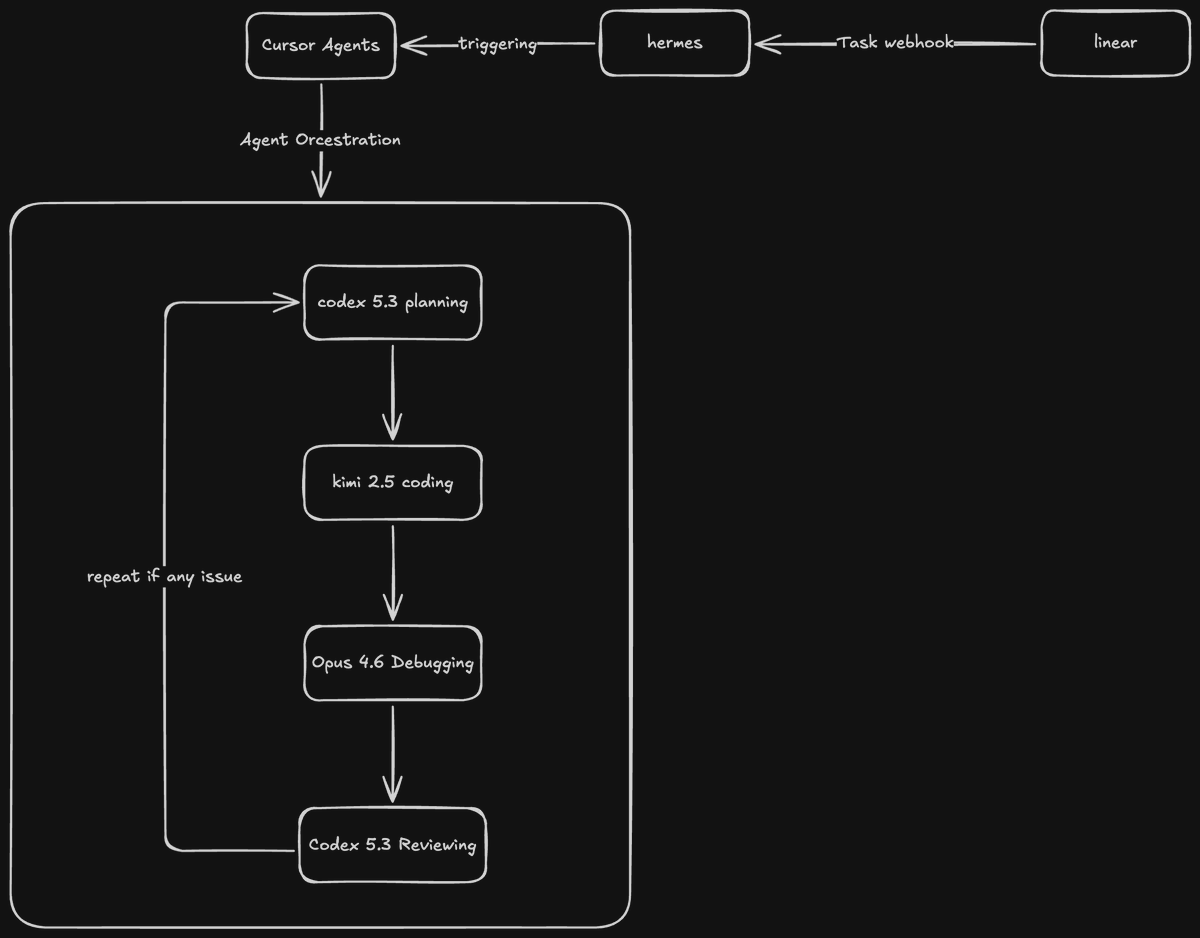
You can wire exactly that pipeline under Maestro Cue — Codex CLI for planning + review, OpenCode (Kimi-backed) for coding, Claude Code on Opus for debugging, all chained by event-driven triggers in one window. Human-in-loop is just another Cue subscription. runmaestro.ai
English

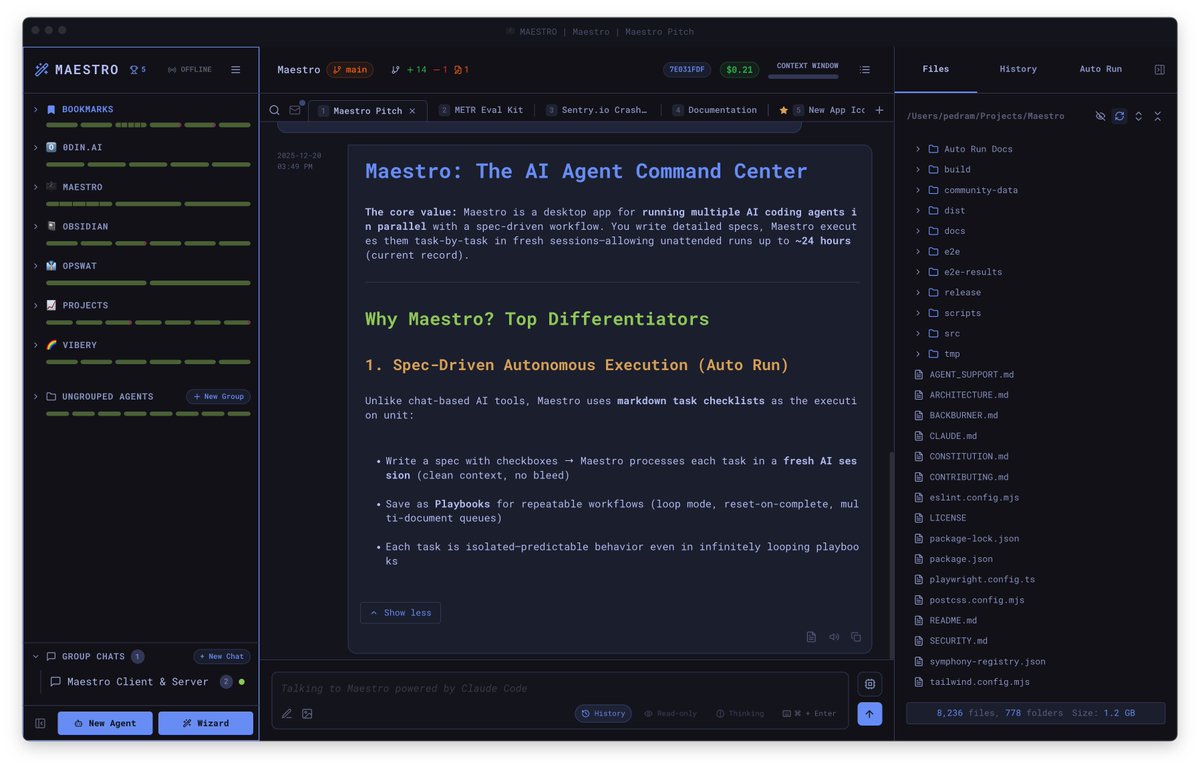
Give us a look see. Maestro is a Desktop AI Orchestration Command Center
Under active development. Open source, cross-platform, remote control, works over SSH, trigger based system, Ralph Wiggum GUI (Auto Run), file preview, document graph view... the list just goes on and on. Our top users have gotten over 2 days of continuous unattended runtime.
RunMaestro.ai
English

@DivyanshT91162 We support Spec-Kit, OpenSpec, and BDAM natively in our open source and cross-platform desktop orchestrator:
RunMaestro.ai
Compatible with multiple providers today: Claude, Codex, Factory, Copilot, OpenCode with more coming.
English

GitHub may have just killed vibe coding.
Their new repo “spec-kit” already has 92k+ stars — and it reveals where AI-driven development is actually heading.
Instead of telling your AI:
“Build me a todo app” and hoping for the best…
You run 6 commands that turn your idea into an executable specification:
• "/speckit.constitution" → defines project rules (quality, testing, UX)
• "/speckit.specify" → explains WHAT to build, not the tech
• "/speckit.clarify" → AI asks questions to remove ambiguity
• "/speckit.plan" → choose the stack and architecture
• "/speckit.tasks" → generates dependency-ordered tasks
• "/speckit.implement" → the agent builds it
The deliverable is no longer the code.
It’s a living specification your AI can read, debate, and execute.
Works with Claude Code, Copilot, Cursor, Codex, Gemini, and 25+ other agents.
The shift most people still don’t see:
“AI writes code” → “AI executes specifications.”
Intent-driven development is the next era of software development.
Repo👇
English

@RoundtableSpace Good thread. The "agent gets dumber" problem is why we built Maestro's agent group chat — a moderator AI synthesizes across agents that hold separate contexts, so no single one drowns under stale tokens. Document graphs handle the long tail. runmaestro.ai
English