Russell Varriale 🧠 🏭

2.3K posts

Russell Varriale 🧠 🏭 banner
Russell Varriale 🧠 🏭

Russell Varriale 🧠 🏭

@RussellVarriale

Co-founder @resolveBIM (YC W15) - accelerating construction 🏗️ with lightning fast plan reviews. Let's build.

New York Katılım Mart 2012
738 Takip Edilen494 Takipçiler
a16z
a16z@a16z·
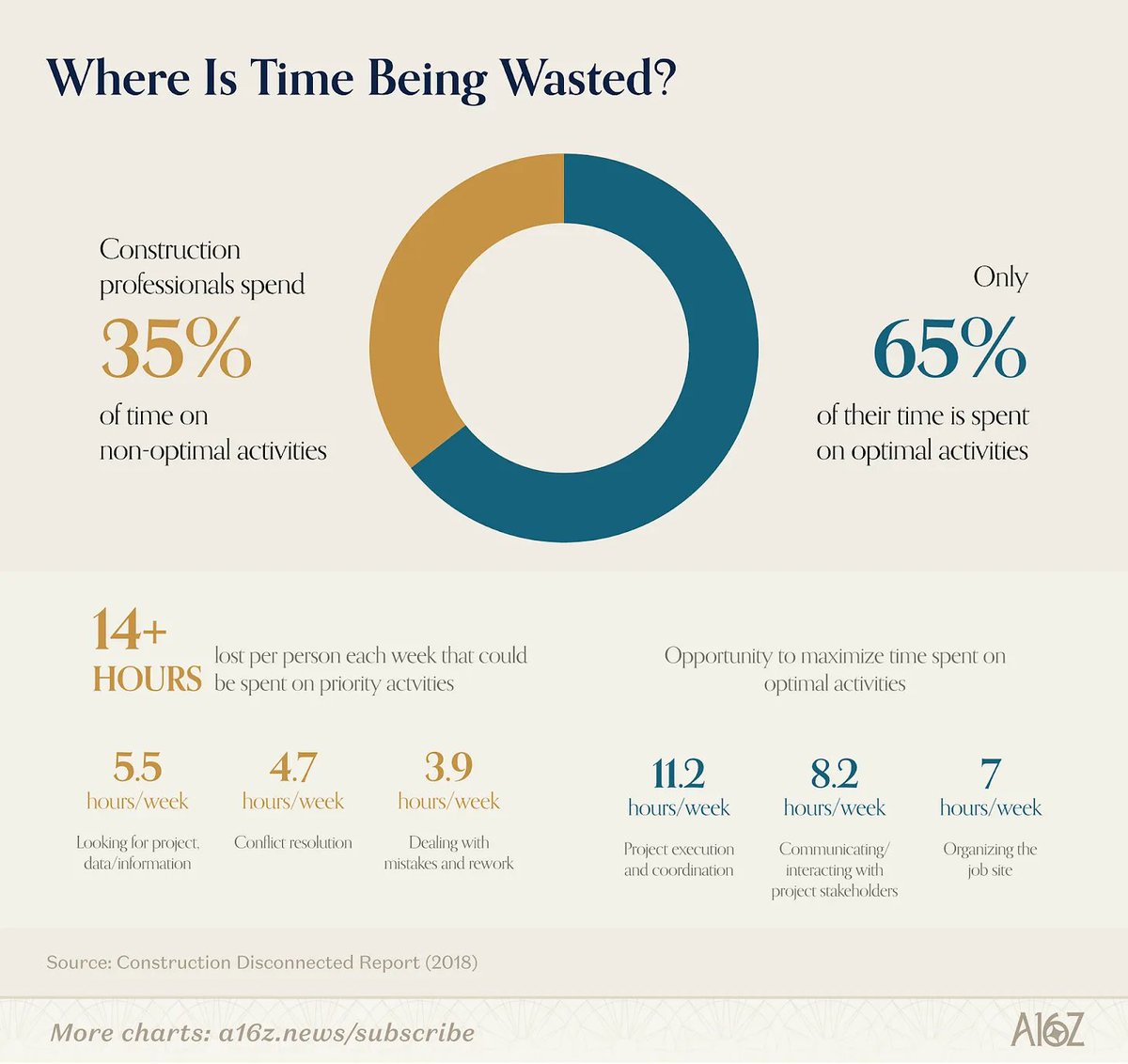
Every building you've ever been in was designed by software built in 1997. The architecture, engineering, and construction industry is one of the largest and least digitized industries in the world. Most of its software is stuck in the 90s. The consequences: 85% of construction projects exceed their budgets and three quarters finish late. The average construction dispute in North America is worth $60.1 million and takes nearly 12.5 months to resolve. LLMs make better software possible, and datacenter buildouts make the demand to fix this $13T industry higher than ever. Full piece: a16z.news/p/every-buildi… @joeschmidtiv @dhaber @CarolineGoggs @zabie_e
a16z tweet media
Joe Schmidt IV@joeschmidtiv

x.com/i/article/2038…

English
56
101
765
154.2K
Russell Varriale 🧠 🏭
Russell Varriale 🧠 🏭@RussellVarriale·
@Brett_Hanfling download weather channel or acuweather app. apple weather has been trash for a while. even today it’s 5 degrees off from the live temp. and that should be table stakes.
English
0
0
8
3.4K
Brett Hanfling
Brett Hanfling@Brett_Hanfling·
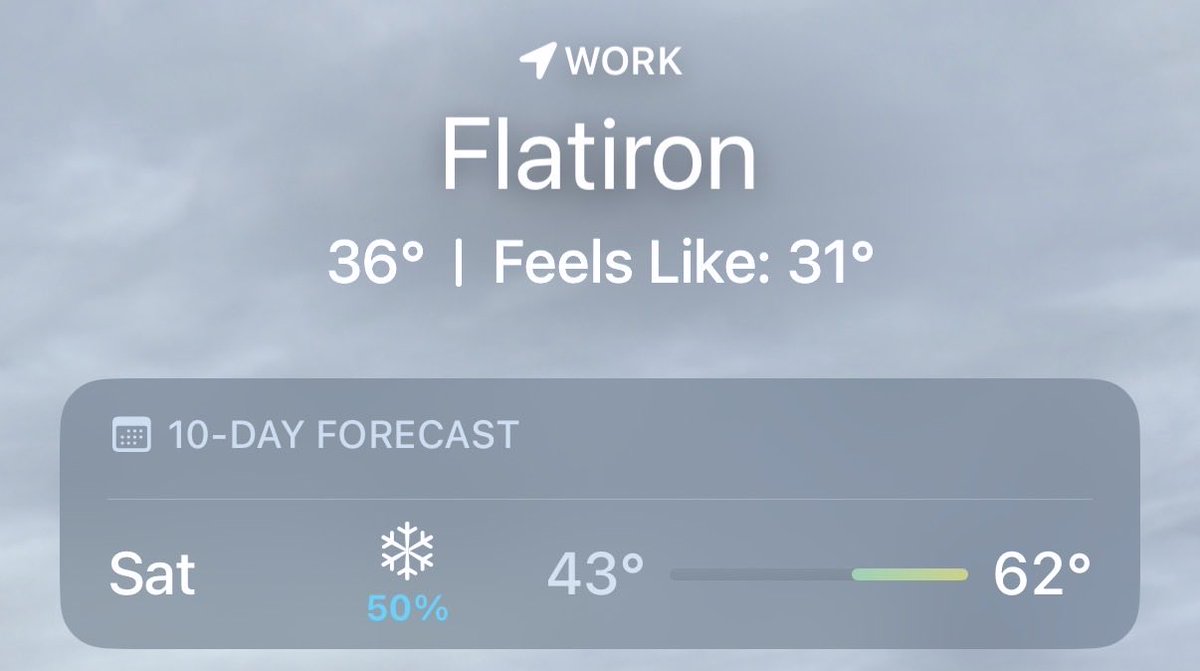
Hey NYC, Good news: next Saturday (March 8th) will be 62 degrees Bad news: it’s still gonna snow
Brett Hanfling tweet media
English
24
65
2.8K
147.6K
Garry Tan
Garry Tan@garrytan·
Americans spend $270B/yr on prisons, but social science keeps finding the same thing: it's not harsher sentences that deter crime. It's the *certainty of consequences*. Punishment severity barely moves the needle. Swift, reliable accountability does. We can have that. 👇
Garrett Langley@glangley

When it comes to preventing crime, the first response is often simple: harsher punishment. Long sentences, mandatory minimums, more incarceration. This is what most people’s intuition says should work. But there is another approach: make it harder to get away with crime in the first place. More eyes, faster identification. A world where committing a crime without getting caught is unthinkable. Since the 1980s, most of American criminal justice policy has been built on the first approach. But the most important finding in criminology is that it barely works. Daniel Nagin, a researcher at Carnegie Mellon University, has studied criminology for decades. His conclusion, confirmed by hundreds of studies and multiple meta-analyses: the certainty of being caught deters crime. The severity of punishment does not. The National Institute of Justice, the research arm of the Department of Justice, put it even more clearly: if criminals think there’s only a slim chance of being caught, even draconian punishments won’t deter them. This makes sense when you think about it. Most crimes are impulsive. Most criminals don’t know the specific penalties. Only half of all crimes are reported to police at all. Several analyses have found that three-strikes laws actually increase homicide rates, because offenders facing life sentences had nothing left to lose. So severity doesn’t deter. Certainty does. That changes how we need to go about public safety. How do we put this into practice? Swift, Certain, Fair is one approach that’s shown promise. Offenders serve their sentences in the community, where they can work and contribute, under conditions that make getting away with a breach impossible. South Dakota took this approach to drunk driving. Offenders could serve time in the community as long as they passed a sobriety test twice a day. A failed or skipped test meant a night or two behind bars, not a 3 month minimum sentence. The program halved reoffending. It was so effective that arrests for drunk driving and domestic violence fell by around 10% for the county. And it cost the taxpayer nothing: participants paid the $2 a day for testing out of their own pockets. The US spends $270 billion a year on criminal justice. The average cost to incarcerate one person is about $61,000 per year, about the same as the median full-time American worker earns in a year. In New York City, it’s $507,000, closer to the earnings of a surgeon. What are we getting for that money? A system where 60% of released prisoners are rearrested within two years, all while nearly half of violent crimes and over 80% of property crimes go unsolved. And prison doesn’t just fail to rehabilitate. The evidence suggests it makes reoffending more likely. A meta-analysis of 116 studies found that custodial sentences actually increase recidivism compared to non-custodial alternatives. Every year of incarceration decreases the likelihood of getting a job upon release. Our $270 billion buys us a system that manufactures the next generation of criminals. Then there’s the problem of age. Prisoners over 55 now make up 15% of the incarcerated population, up from 3.4% in 1991. Because of healthcare needs, they cost 2-3x as much as younger prisoners to incarcerate, a total of $16 billion a year. And for what? 84% of people released at age 60+ are never rearrested. In 2012, 178 elderly people sentenced to life imprisonment in Maryland were released after a court ruling. In the four years afterward, not one of them was rearrested for anything more serious than a traffic violation. Criminologists Lawrence Cohen and Marcus Felson argued that crime is most likely when three conditions are met: a motivated offender, a vulnerable victim, and the absence of a capable guardian. There will always be motivated offenders and vulnerable victims, but we can ensure that capable guardians are everywhere. This is where Flock Safety comes in. Flock operates in over 5,000 communities across 49 states. In Marietta, Georgia, areas with Flock cameras saw a 34% drop in crime, triple the citywide average. Communities we serve have reported up to 80% reductions in residential burglaries. Across all customers, Flock helps solve an estimated 700,000 crimes per year. And each new camera added to the network makes every other camera more valuable to the police departments, investigators, and first responders who rely on them. The deterrence research says severity doesn’t work. What works is the infrastructure of certainty. Cameras, networks, real-time alerts, cross-jurisdictional data sharing. A world where the odds of getting away with crime drop every year. That’s what Flock Safety is building. The goal is fewer victims, not more prison cells. The evidence says you can have both. Every community deserves that.

English
119
50
863
65.1K
me again
me again@quinncoherent·
nyc prewar apartment winter means leaving all your windows wide open so your bedroom doesn't turn into a sauna
English
35
278
5.2K
537.8K
Russell Varriale 🧠 🏭
Russell Varriale 🧠 🏭@RussellVarriale·
@sachinyadav699 look around the world - there are millions of unsolved problems. most of them just really fucking hard. we have AI now. go tackle them.
English
0
0
0
31
sachin.
sachin.@sachinyadav699·
Every idea feels taken. Every API already exists. Every SaaS has 12 competitors. So what do we even build now?
English
1.2K
827
12.6K
1.3M
Garry Tan
Garry Tan@garrytan·
The greatest period of creativity is just about to begin if you believe you can write the prompt for it
English
201
669
5.1K
260.5K
Russell Varriale 🧠 🏭
Russell Varriale 🧠 🏭@RussellVarriale·
@garrytan yes! everyone needs to focus on this. what is blocking us from food, housing, energy and healthcare going to zero.
English
0
0
0
8
Garry Tan
Garry Tan@garrytan·
The most important question for builders today is not building Web 2.0 faster The most important highest alpha thing to focus on is what can be built given now you have direct access to LATENT SPACE Intelligence is on tap. What can be done now that could never be done before?
English
115
48
791
40.8K
Balaji
Balaji@balajis·
If you broadly know what you want to get done, AI will help you get there faster. But in its current form, it can’t set the direction for you. And it doesn’t move at infinite speed. Moreover, it does speed up everyone else who does know what they want to do. So while AI does make exploratory work easier, goal setting and prioritization has never been more important.
English
73
50
662
48.4K
Balaji
Balaji@balajis·
AI is a tool. But you need to provide the goal.
English
238
127
1.5K
82.9K
Russell Varriale 🧠 🏭
Russell Varriale 🧠 🏭@RussellVarriale·
@pmarca from another perspective, the builder, it’s also going to infinity when anyone can just whip up a prototype and test without arguing. yin and yang. everything is nothing. only time is the constraint.
English
0
0
0
430
Marc Andreessen 🇺🇸
Marc Andreessen 🇺🇸@pmarca·
Overheard in Silicon Valley: “Marginal cost of arguing is going to zero.”
Marc Andreessen 🇺🇸 tweet media
English
241
328
4.1K
351.9K
Russell Varriale 🧠 🏭
Russell Varriale 🧠 🏭@RussellVarriale·
My 2013 epistemology class really feeling more relevant than ever
English
0
0
1
22
Russell Varriale 🧠 🏭
Russell Varriale 🧠 🏭@RussellVarriale·
@jasonlk everyone needs to recalibrate to solving the underlying problem that their original solution was supporting in the first place. Let’s just refocus for solving bigger harder problems now. 2003 - 2026 public SaaS mindset RIP 🪦 ✌️
English
0
0
0
77
Jason ✨👾SaaStr.Ai✨ Lemkin
So many SaaS and B2B leaders feel they are mostly safe from AI disruption because they are “systems of record.” For now that’s probably true in the sense that it insulates them from massive AI-driven churn. But does that create growth? I’m not so sure. The growth in spend, in usage, in everything is now in AI Agents or at least AI spend. If you don’t own the AI Agents that make your platform thrive, you won’t grow. Folks might not churn. But you won’t grow. That’s not enough.
Jason ✨👾SaaStr.Ai✨ Lemkin tweet media
English
16
3
20
4.5K
Suhail
Suhail@Suhail·
I am super confused by the OpenClaw setup. I can’t manage to get it to do anything with the browser unless I already have a tab open? Huh! I am going to presume user error given the hype. This is making me frustrated enough to consider bringing Mighty back 😂
English
108
1
240
60.4K
Russell Varriale 🧠 🏭
Russell Varriale 🧠 🏭@RussellVarriale·
@tszzl everyone freaking out about SaaS-pocalypse not letting their brain see that spacex level hard problems are everywhere to be solved now
English
0
0
0
10
Russell Varriale 🧠 🏭
Russell Varriale 🧠 🏭@RussellVarriale·
people just need to start thinking about solving bigger harder problems with far more complex orchestration. why can’t physical infrastructure be designed 95% faster? why does healthcare compliance need to take so long? etc. Let’s stop worrying about the world we’re leaving behind. Let’s start dreaming about the future that was impossible.
English
0
0
0
61
Ryan Hoover
Ryan Hoover@rrhoover·
It's comical when people claim "speed is the moat" when replicating features takes hours. The real moats (network effects, proprietary data, regulatory licenses, etc.) are increasingly important.
Chrys Bader@chrysb

x.com/i/article/2020…

English
39
23
423
79.9K
Russell Varriale 🧠 🏭
Russell Varriale 🧠 🏭@RussellVarriale·
Everyone is freaking out that you can clone a public SaaS in a few months and acting like the end game is your own custom payroll system. Brother. You’re missing the point.
English
1
0
0
65
Russell Varriale 🧠 🏭
Russell Varriale 🧠 🏭@RussellVarriale·
@ajhodls in the idea that basically all software will be owned and operated by a handful of frontier labs?
English
0
0
0
145
first check $500k-1M pre-seed
if you run a software company and aren’t seeking an exit in the next 3 years you are a likely candidate for extinction
English
25
3
85
11.9K