Sam Winter-Levy

1.4K posts

Sam Winter-Levy

Sam Winter-Levy

@SamWinterLevy

Fellow @CarnegieEndow, Technology + International Affairs. Previously poli sci PhD @ Princeton, @ForeignAffairs, @TheEconomist.

New Jersey, USA Katılım Eylül 2011
2K Takip Edilen1.3K Takipçiler
Sam Winter-Levy
Sam Winter-Levy@SamWinterLevy·
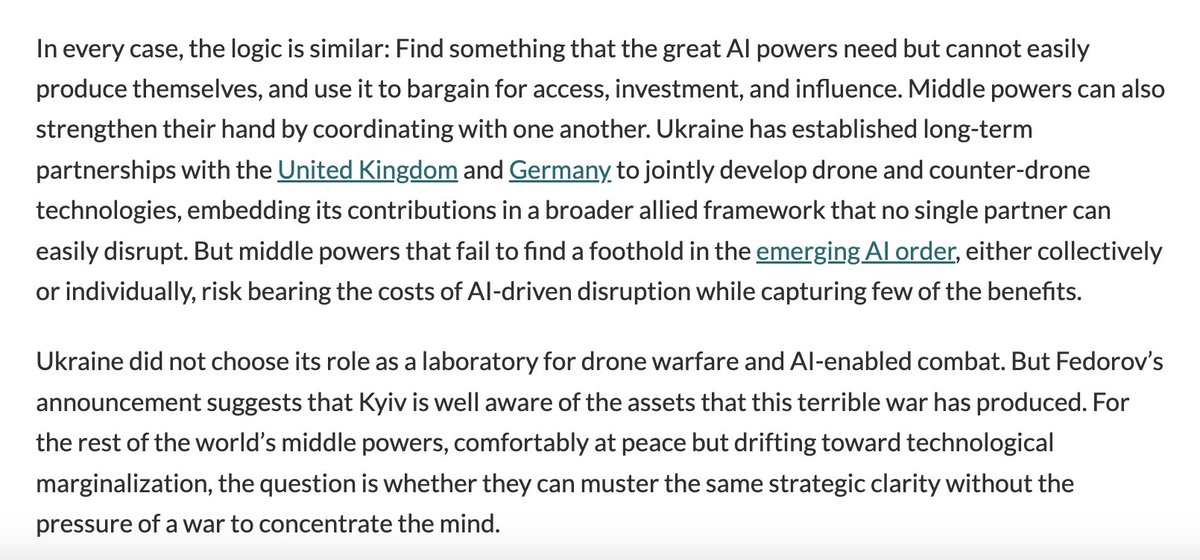
Middle powers should not be evaluating their manufacturing assets on near-term returns alone, but on their potential to serve as a strategic foothold in a changing world economy. That means screening of foreign investments to ensure critical domestic industries aren't offshored. As we argued in @ForeignAffairs: foreignaffairs.com/guest-pass/red…
Sam Winter-Levy tweet media
English
0
0
1
49
Sam Winter-Levy
Sam Winter-Levy@SamWinterLevy·
If you're a middle power, watch this space very carefully. One failure mode for AI-era industrial policy is that foreign investors recognize the future value of your manufacturing base before you do—and by the time you catch on, the assets that would have given you leverage in a changing world economy are already gone.
The Wall Street Journal@WSJ

Breaking: Jeff Bezos is in talks to raise $100 billion for a new fund that would buy manufacturing companies and use AI to automate them wsj.com/tech/jeff-bezo…

English
1
1
7
386
Sam Winter-Levy retweetledi

Thorsten Benner
Thorsten Benner@thorstenbenner·
Europe has exactly the manufacturing companies a guy like Bezos wants to acquire. Europeans should beware of a mass sell-out.
Thorsten Benner tweet media
English
4
30
76
4.5K
Sam Winter-Levy retweetledi
Megan McArdle
Megan McArdle@asymmetricinfo·
Really excellent op-ed in the Post today about how middle-powers like Europe and Canada should approach the AI race. It seems impossible that Europe, especially, will catch up—tight land use, shallow capital markets and high electricity prices. washingtonpost.com/opinions/2026/…
English
3
3
22
4.8K
Sam Winter-Levy retweetledi
Anton Leicht
Anton Leicht@anton_d_leicht·
Current geopolitics have Western democracies trying to chart a course more independent of America. That's sometimes prudent, but AI is different. For @washingtonpost, @SamWinterLevy and I argue middle power AI strategy has to be about better deals with the U.S. instead.
Anton Leicht tweet media
English
2
4
23
2.5K
Sam Winter-Levy
Sam Winter-Levy@SamWinterLevy·
Will AI end mutually assured destruction? @nikitaalalwani and I joined Luisa Rodriguez on the @80000Hours podcast for a fun (despite the topic!) conversation on subs, mobile missiles, missile defense, cyber threats to command-and-control, and why AI and nuclear experts urgently need to start talking to each other
English
2
5
6
530
Sam Winter-Levy retweetledi
sam manning
sam manning@sj_manning·
Nice write up + data visualization of our recent research on AI exposure and adaptive capacity on the @washingtonpost front page today! A really careful contextualization of findings here with other work on AI automation in the piece. h/t to @ShiraOvide and @kevinschaul
sam manning tweet media
English
4
16
100
11.1K
Sam Winter-Levy retweetledi
Toby Ord
Toby Ord@tobyordoxford·
@robertwiblin @nikitaalalwani @SamWinterLevy @CarnegieEndow The decoy mobile launchers and decoy submarine sounds are great examples of where one can predict the action (AIs will be able to see 2nd strike weapons are) yet fail to predict the reaction (states can add 100x as many decoys). Prediction of human affairs requires both.
English
1
2
12
735
Sam Winter-Levy retweetledi
Nathan Calvin
Nathan Calvin@_NathanCalvin·
Nikitaa and Sam are great! Excited to listen
Rob Wiblin@robertwiblin

A lot of people here believe that AI / AGI will end Mutually Assured Destruction, potentially leading to a nuclear war. @NikitaaLalwani and @SamWinterLevy at @CarnegieEndow disagree (mostly). 1. Would AI be able to locate all the nuclear submarines hiding in a vast, opaque ocean? (It's a heavier lift than you think.) 2. Would road-mobile launchers still be able to move and hide under cheap tunnels and netting, invisible to satellites? (Seems like yes.) 3. Would missile defence ever become so accurate that the United States could be reliably protected? (Probably not.) 4. Can we imagine an AI cybersecurity breakthrough that would allow countries to infiltrate their rivals’ nuclear command & control networks? (Yes plausibly, though they have countermeasures available.) 5. Though in a very rapid take-off scenario things could be very different. And governments should be preparing for that possibility now. I know a lot about this topic but learned many new things including: • You can create fake decoy road-mobile nuclear launchers far more cheaply than an attacker can build missiles to destroy them all. • States can easily play recordings of submarine sounds into underwater speakers all over the place as decoys. • Some nuclear command bunkers are buried 700 metres underground - deep enough to survive a direct nuclear hit on top of them • Oceans are actually getting noisier over time due to commercial shipping, which makes submarine detection harder, not easier. Nuclear submarines are so quiet they sometimes collide with each other underwater. On the 80,000 Hours Podcast anywhere you get podcasts. Links below. Enjoy! • AI experts are ignoring the most important variable in geopolitics (00:01:47) • AI vs nuclear submarines (00:10:43) • AI vs road-mobile missiles (00:22:56) • AI vs missile defence systems (00:29:34) • AI vs nuclear command, control, and communications (00:36:30) • Nuclear deterrence may hold, but that won’t stop arms racing (00:45:01) • Technological supremacy isn’t political supremacy (00:54:14) • Fast AI takeoff creates dangerous “windows of vulnerability” (00:58:29) • Book and movie recommendations (01:10:54)

English
0
4
17
3.3K
Sam Winter-Levy retweetledi
Rob Wiblin
Rob Wiblin@robertwiblin·
A lot of people here believe that AI / AGI will end Mutually Assured Destruction, potentially leading to a nuclear war. @NikitaaLalwani and @SamWinterLevy at @CarnegieEndow disagree (mostly). 1. Would AI be able to locate all the nuclear submarines hiding in a vast, opaque ocean? (It's a heavier lift than you think.) 2. Would road-mobile launchers still be able to move and hide under cheap tunnels and netting, invisible to satellites? (Seems like yes.) 3. Would missile defence ever become so accurate that the United States could be reliably protected? (Probably not.) 4. Can we imagine an AI cybersecurity breakthrough that would allow countries to infiltrate their rivals’ nuclear command & control networks? (Yes plausibly, though they have countermeasures available.) 5. Though in a very rapid take-off scenario things could be very different. And governments should be preparing for that possibility now. I know a lot about this topic but learned many new things including: • You can create fake decoy road-mobile nuclear launchers far more cheaply than an attacker can build missiles to destroy them all. • States can easily play recordings of submarine sounds into underwater speakers all over the place as decoys. • Some nuclear command bunkers are buried 700 metres underground - deep enough to survive a direct nuclear hit on top of them • Oceans are actually getting noisier over time due to commercial shipping, which makes submarine detection harder, not easier. Nuclear submarines are so quiet they sometimes collide with each other underwater. On the 80,000 Hours Podcast anywhere you get podcasts. Links below. Enjoy! • AI experts are ignoring the most important variable in geopolitics (00:01:47) • AI vs nuclear submarines (00:10:43) • AI vs road-mobile missiles (00:22:56) • AI vs missile defence systems (00:29:34) • AI vs nuclear command, control, and communications (00:36:30) • Nuclear deterrence may hold, but that won’t stop arms racing (00:45:01) • Technological supremacy isn’t political supremacy (00:54:14) • Fast AI takeoff creates dangerous “windows of vulnerability” (00:58:29) • Book and movie recommendations (01:10:54)
English
3
10
44
8.8K
Sam Winter-Levy retweetledi
Georgia Adamson
Georgia Adamson@GeorgiaCAdamson·
The American AI Export Program is the Trump administration’s flagship initiative to spread US AI across the world. But so far, it’s not going too well: - It’s months behind schedule - It lacks the financial firepower to actually steer industry investment decisions - It faces mounting distrust from foreign partners wary of dependence on the US @fiiiiiist , @SamWinterLevy, and I offer 9 recommendations to put the Exports Program on track. ⬇️ 1. Prioritize markets where American AI presence is contested or weak. The program shouldn't subsidize markets where American industry already leads. Agencies should direct financing toward emerging strategic markets like Brazil, Egypt, and Indonesia, where American and Chinese firms are actively competing and government support can actually tip the balance. 2. Don't just offer data center-scale packages. Few markets have gigawatt-scale demand. A program that prioritizes packages this size will miss large parts of the world, including emerging markets that the program should be targeting. Smaller deployments that meet actual AI demand offer more lasting advantages than compelling headlines. 3. Let industry lead the messaging. Foreign governments are not driven by US geopolitical concerns. Partners that have spent years resisting pressure to pick sides in US-China competition won't respond to that framing. Commerce and State should focus on concrete, country-specific issues and let American companies take the lead. 4. Judge program success by long-term adoption and utilization. The program's success should be measured by sustained demand, not by dollar values announced at signing ceremonies. Commerce, OSTP, and State should track time-to-operation, utilization rates, contract renewals, and private capital mobilized rather than headline investment figures. 5. Clarify that US-operated cloud services count as an export. The executive order does not state whether AI "deployment" means physical hardware sales to foreign customers, or delivering compute as part of managed cloud services. OSTP and Commerce should resolve this ambiguity. Cloud has a bunch of properties that match the program’s goals. It’s typically faster to deploy, more scalable, more sticky, and offers national security advantages that direct chip shipments cannot. 6. Implement baseline security guardrails for packages that export substantial compute abroad. Some markets could become subject to new export restrictions as US policy evolves. Rather than treating export promotion and control as separate levers, Commerce should establish security requirements now so that industry deployments aren't negatively impacted later. 7. Drop the consortia requirement for American-only proposals. Requiring US companies to form consortia even when operating alone adds coordination costs, creates accountability confusion, and may freeze out smaller players. Agencies should clarify that consortium formation isn't required when American companies are exporting without foreign partners, preserving the option for larger voluntary consortia where they make sense. 8. Take foreign partners' sovereignty concerns seriously. Many countries want American AI without American dependency. In-country data centers and confidential computing give partners jurisdictional control while keeping American companies operating their own infrastructure. 9. Bundle exports with sovereign evaluation toolkits. Partners should be able to verify what they're buying, and the US should look to build trust in US tech. CAISI can develop evaluation toolkits that let countries independently assess US models' performance and safety, exporting US standards alongside its technology. You can read the full piece here: ifp.org/americas-ai-ex…
Georgia Adamson tweet media
English
2
14
64
7.1K
Sam Winter-Levy
Sam Winter-Levy@SamWinterLevy·
Shared some thoughts with the @FT on Iran's strikes against Amazon data centers in the Gulf
Sam Winter-Levy tweet mediaSam Winter-Levy tweet media
English
1
5
10
1.4K