Sasha Ayad, LPC

10K posts

Sasha Ayad, LPC banner
Sasha Ayad, LPC

Sasha Ayad, LPC

@SashaLPC

I’m a therapist who believes “gender” is actually a metaphor. I don’t care about your politics. I try to hold an ideology-free perspective on personal identity

Katılım Kasım 2016
1.8K Takip Edilen13.1K Takipçiler
Deep Squats, Shallow Thoughts
Deep Squats, Shallow Thoughts@wolfstrength·
Maybe it’s just today’s super HD cameras revealing what was always there but we couldn’t see, but on the surface it looks like female bodybuilders today have a lot more masculinization than they did in previous generations. Even comparing the ones in less extreme divisions today to the actual bodybuilder of before. Any thoughts about that?
English
4
0
8
3.2K
SilverFoxLeo
SilverFoxLeo@BowTiedHRT·
Definitely was being coached by some clown who had her using everything a girl doesn’t need. Mast is so unnecessary for women. Tren sparingly is okay. She definitely ran a bunch of Nand which is an absolute no no. And I’ll bet a couple of dollars her coach had her cutting with Clen and pushing Nolva like it was 1988. We see some pretty terrible protocols in men’s TRT and blast cycles but nothing compares to the disastrous protocols women are encouraged to use by their coaches in bodybuilding. Bunch of zero knowledge manipulative predators masquerading as coaches in the female bodybuilding world.
Massimo@Rainmaker1973

What 3 years of steroids can do: 29 years old vs 32 years old. Overuse of steriods cause collagen degradation and can weaken the skin on a face significantly.


English
35
4
189
82.5K
Sasha Ayad, LPC retweetledi
Dr. Lemma
Dr. Lemma@DoctorLemma·
In 1975, developmental psychologist Dr. Edward Tronick sat a mother and her baby face to face and filmed what happened when the mother suddenly stopped responding. First the mother plays normally, smiling, talking, making eye contact. The baby mirrors everything, laughing, pointing, babbling back. Then the mother goes blank. No expression, no response, nothing. Within seconds the baby notices. She smiles harder. Points. Waves. Screeches. Uses every tool she has to get her mother back. When nothing works, she turns away, loses control of her posture, and collapses into herself with what Tronick described as “a withdrawn, hopeless facial expression.” The moment the mother re-engages, the baby recovers almost instantly. Three minutes of emotional absence from a parent did that to an infant. It became one of the most replicated findings in developmental psychology. This was 1975, before smartphones existed. Now look around any park, restaurant, or living room. How many babies are looking up at a parent who is scrolling instead of looking back?
English
860
12.2K
55.3K
3.1M
Sasha Ayad, LPC
Sasha Ayad, LPC@SashaLPC·
@benryanwriter Wow, this is so fascinating! You seem to have lived many incredible lives already, with much more to come, hopefully!
English
0
0
1
230
Benjamin Ryan
Benjamin Ryan@benryanwriter·
I lived in Paris for a while when I was 21, which unfortunately didn't give me any leg up when I decided to take up ballet when I was 29. I got decent enough after 13 years of very serious study and could take pro class without embarrassing myself. I quit when the pandemic made me stop and I realized what life was like without my left hip hurting all the time. The body was simply never meant to turn out at the hips like that. And I very good natural turnout as it is. Good grief. For people who know ballet, I studied under Gelsey Kirkland for a year when I was 34. Which was great since she's a legend and all and absolutely no one gives corrections like her, but also dystopian, because what was I doing spending 20 hours a week, every day but Sunday, dancing in a Russian-style ballet academy populated largely by 12 to 15 year old girls, some of whom were so mean they made me cry one time?
Benjamin Ryan@benryanwriter

Me, 10 years ago today, in my ballet days. 🇫🇷

English
23
1
170
42.5K
Sasha Ayad, LPC
Sasha Ayad, LPC@SashaLPC·
445 comments on a video with 7.2k views! This is awesome
Sasha Ayad, LPC tweet media
English
10
0
49
2.9K
Sasha Ayad, LPC
Sasha Ayad, LPC@SashaLPC·
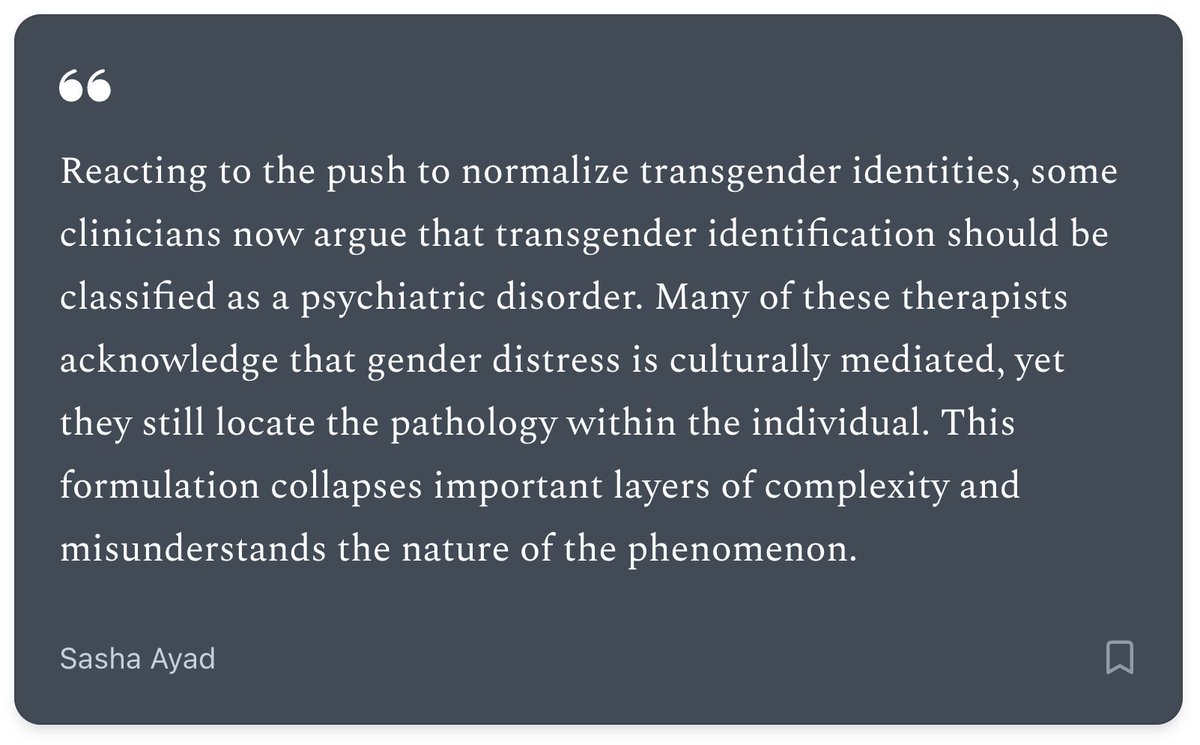
A Clarification: In a recent essay, I outlined my opinion about several different errors that clinicians make when working with gender-dysphoric adolescents and young adults. I posted one short quote (below) with a statement that I don’t agree with some clinicians who seek to pathologize trans identities. In the full article, I discuss 6 different errors I see. I highlight the serious flaws in "gender affirmation," which will be familiar to most people here. Anyone who has followed my work will recognize critiques about blindly affirming - critiques that I've been writing and speaking publicly about for nearly a decade now. But in the piece, I also address therapists who, like myself, aim to help young people manage their underlying distress first, understand how gender identity may be operating in a maladaptive way, and encourage non-medicalized and reality-based strategies to feel better. Sometimes therapists with this approach treat the adolescent as though he or she is broken and in need of fixing. Sometimes therapists come out and say (in the first or second session) that the client’s trans identity is likely not real or sign that other things are amiss. Sometimes these therapists pathologize their client’s identity before taking the time to understand a specific formulation of what’s going on, what function the identity is serving, or before taking the time to build trust and a relationship with the client. I'm a pragmatist and I know that different approaches may work for different people. So if any of the above help a client to be more curious, more flexible and more willing to engage meaningfully with the therapy process, then great. But after talking with hundreds of families, I've observed that well-meaning therapists implying (or telling) a young person that their identity is mistaken and/or a sign of something else being wrong, or a mental illness or a psychopathology…this will only cause the client to shut down, withdraw and become even more guarded. I’m not going to rewrite the entire piece here, but I wanted to clarify that piece is my opinion about errors therapists are making in their clinical work. It’s not about political advocacy. It’s not about social movements. It's not about organizational strategy educational campaigns, or legislative maneuvers. It's about therapy. In fact, if you read it, you’ll notice that I directly encourage therapists to stay out of political currents altogether. While politics have largely forced the idea of gender identity inot so many families’ lives, I still believe clinicians should attempt to be apolitical and to be supremely sensitive to what will and won't work in the therapy room. This doesn’t mean clinicians shouldn’t have reality-based formulations about what is hurting or harming their clients. If you felt confused by that single X post or the quote from my article, I encourage you to read the whole thing and look at the quote in context. I’ll pin it above at the top of my feed 👆🏼
Sasha Ayad, LPC tweet media
Sasha Ayad, LPC@SashaLPC

I strongly disagree with the push to psycopathologize trans identities True clinical work begins when we understand “trans” not as an essence or an illness, but as a strategy—one that can be explored, understood, and either relinquished or refined through the therapeutic process.

English
5
10
64
6.5K
Sasha Ayad, LPC
Sasha Ayad, LPC@SashaLPC·
I strongly disagree with the push to psycopathologize trans identities True clinical work begins when we understand “trans” not as an essence or an illness, but as a strategy—one that can be explored, understood, and either relinquished or refined through the therapeutic process.

Sasha Ayad, LPC tweet media
English
89
19
182
37.9K
Sasha Ayad, LPC
Sasha Ayad, LPC@SashaLPC·
@jbvconnor This article had nothing to do with Stella. This article was about stories I've heard from parents who took their child to a therapist and the article is about the common things therapists do wrong in my opinion
English
1
0
3
516
Sasha Ayad, LPC
Sasha Ayad, LPC@SashaLPC·
@_Happy2BeMe_ @VitoComedy Well that's not how we successfully help or rehabilitate people with dangerous beliefs. Anyone experienced in this area will say the same thing.
English
4
0
4
488
Happy2BeMe💚🤍💜
Happy2BeMe💚🤍💜@_Happy2BeMe_·
@SashaLPC @VitoComedy When a religious belief harms others, & destroys the rights of others, then yes, they should be treated as someone with a psychopathology. Some religious beliefs/ideologies are still the reason for wars, rapes, murders, & for giving women & girls fewer rights than animals have.
English
1
0
22
484
Sasha Ayad, LPC
Sasha Ayad, LPC@SashaLPC·
That parallel makes no sense. Nobody thinks their depression is the key to their "authentic self" and the pathway to true freedom. Identities hold a great deal of personal meaning to people, even if they are maladaptive. Everyone wants to get rid of their depression but today's trans-identified youth protect their identity like their life depends on it.
English
3
0
2
135
Erin Friday, Esq.
Erin Friday, Esq.@ErinFriday75490·
@kimber_tweets @SashaLPC So the reasoning is then that giving the diagnosis of “depression” makes it resistant to treatment? That’s nonsense.
English
1
0
1
132
Sasha Ayad, LPC
Sasha Ayad, LPC@SashaLPC·
@fringetranny If someone had told you this in the midst of your transition or while you were pursuing transition, do you think it would have been helpful, or made you defensive?
English
2
0
1
120
CisTransXX
CisTransXX@fringetranny·
@SashaLPC It is a strategy—it’s a coping mechanism. I know because I lived it and then realized what I was actually doing by being “trans”. So yes, it’s a strategy, but it’s one born from mental illness.
English
1
0
10
108
Sasha Ayad, LPC
Sasha Ayad, LPC@SashaLPC·
@TruthIsKindness @blueboatmom I explain more in the full piece, too. It's possible to help a client to understand where their thinking is flawed, but I've never seen it effective for anyone to tell a person that their identity is a pathology or make them feel like they are broken or crazy
English
0
0
2
28
Can't Tell
Can't Tell@TruthIsKindness·
@SashaLPC @blueboatmom Thank you so much for your response! I completely agree about the practice, I guess my only disagreement is about how you conceptualize it. But I understand that it may be very hard to think GI is pathological while also staying with the client and not pushing them away.
English
1
0
2
33
Sasha Ayad, LPC
Sasha Ayad, LPC@SashaLPC·
@VitoComedy And how is that? If a religious person goes to a therapist, are they told they have a psychopathology?
English
9
0
17
1.5K
FOLLOW MAX COOL
FOLLOW MAX COOL@VitoComedy·
@SashaLPC It's a spiritual belief based on nothing. It should be treated like any other religious delusion.
English
1
1
46
4.6K
Sasha Ayad, LPC
Sasha Ayad, LPC@SashaLPC·
Thanks for your thoughts and questions. My point is very simple: If you are a parent or therapist or anyone trying to care for someone who holds a trans identity, if you view it purely as psychopathology, you won't be able to join with the person to help them better explore what it means, why they're feeling this way, and what are some other options to feel better. All you'll end up doing is alienating the person, implying they are "broken" and you will have no credibility or good will with him or her. Remember the identity is seen as the path to happiness. How does telling someone their path to happiness is actually a mental illness (psychopathology) help them to be more curious or flexibile? I've seen this over and over and over. It simply doesn't work and I'm ultimately a pragmatist. I don't believe in doing things that have negative or counterproductive repercussions.
English
1
0
2
31
Can't Tell
Can't Tell@TruthIsKindness·
@blueboatmom @SashaLPC I get that & I think she's wonderful. I just don't think that seeing GI as a pathological strategy goes against that flexibility. & I think that a belief conflicting with reality is pathological, even if it gives the client something they need. But I'm open to changing my mind.
English
1
0
2
25
Sasha Ayad, LPC
Sasha Ayad, LPC@SashaLPC·
@bjportraits Well, if it doesn't work to help the person, why "should" anyone do it? If it creates more of a backlash and digging in deeper, why "should" therapists take this approach?
English
1
0
0
119
Jennifer Bilek
Jennifer Bilek@bjportraits·
That would be my point. I said "should." Short of deprogrammers, for kids who have been effectively indoctrinated, there is only the "clinical" process. Kids need to understand what has happened to them. Therapy personalizes a corporate attack. Their vulnerabilities are being capitalized on.
English
1
1
4
173
Jennifer Bilek
Jennifer Bilek@bjportraits·
True clinical work around gender identity indoctrination should begin with the understanding that “tran$” is a tech and corporate strategy to indoctrinate kids to believe their reproductive systems are compartmentalized, interchangeable commodities. Kids should be made to understand this is not personal to their feelings of alienation, brought on by any number of issues, but that their feelings of alienation are being capitalized on. They should be armed with information about how marketing propaganda like this works, and how much money corporations are making by selling sex denialism. This can be explored, and understood, through the therapeutic process successfully, only when practicing therapists realize corporate indoctrination at every single front of the culture, is not the same thing as an organic social contagion such as anorexia. Anorexia was never promoted specifically, in every inch of society as a positive lifestyle. Propaganda is at the root of sex-denialism. Marketing drives it, not social contagion. Sex denialism has been specifically marketed to children because they are the generation that will be most impacted by the burgeoning tech repro market, that actually does chop reproductive characteristics and capacities into marketable goods. Stay human, and don't buy into a medical cure for propaganda. The first step is to get your kids away from the propaganda and to inform them about marketing propaganda, not reinforce this as a personal problem.
Sasha Ayad, LPC@SashaLPC

I strongly disagree with the push to psycopathologize trans identities True clinical work begins when we understand “trans” not as an essence or an illness, but as a strategy—one that can be explored, understood, and either relinquished or refined through the therapeutic process.


English
6
16
41
1.8K