
Sabitlenmiş Tweet
Amanda
15K posts


Amanda
@ShaulaetLesath
There are no systems failures, only systems designs. Some are more sophisticated than others. All do as per design.
The Universe Katılım Aralık 2019
263 Takip Edilen1.6K Takipçiler

@DanielPriestley @CharlotteCGill I know, but the socialists think that socialism will work better if they socialist harder, the path will be a highway shortly. Exhausting!!
English

@ShaulaetLesath @CharlotteCGill There is another path
Daniel Priestley@DanielPriestley
About 250 years ago a quirky moral philosopher named Adam Smith discovered a chain of logic whereby the selfish desires of man would result in widespread prosperity. It’s one of the greatest discoveries of all time. Here’s how it goes… 1.Selfish desire seeks wealth, status, security. No virtue required. This is the raw material, as unpromising as it sounds. 2. In a market with property rights, you can’t take, you must trade. Theft and fraud are policed, so the only legal route to someone else’s money is offering them something they want more. Self-interest is channelled through voluntary exchange. This is the crucial valve: the baker serves your bread not from benevolence, but because it’s how he gets paid. 3.Every voluntary trade creates value for both sides. Nobody trades unless they prefer what they’re getting to what they’re giving. So each transaction is positive-sum by construction. Wealth isn’t moved; it’s made. 4.Competition forces the selfish to serve better. You’re not the only one chasing that customer’s money. To win, you must offer more value, lower prices, or something new. Greed disciplined by rivalry becomes, functionally, service. The customer becomes the boss of every capitalist. 5.Prices emerge as signals of what people actually want. Millions of trades compress dispersed knowledge - scarcity, preference, urgency - into a single number. No planner needed. High prices shout “make more of this” and falling prices say “stop making this.” The cure for high prices IS high prices. 6.Profit directs capital toward unmet needs. Profit is the reward for spotting something people want but can’t get, and losses are the punishment for guessing wrong. Capital flows automatically toward solving problems and away from waste - a self-correcting search algorithm running on selfishness. The profit motive pulls the greedy person towards genuine service and efficiency. 7.The pursuit of advantage drives innovation. The only durable way to out-earn competitors is to do something new - create a better product, a cheaper process. Each entrepreneur trying to get rich makes the previous solution obsolete and the average person’s life better. 8.Specialisation and scale compound productivity. Competition pushes everyone toward what they do best; trade lets them exchange it. Output per person rises. 9.Rising productivity spreads as falling prices and rising wages. Competition doesn’t let producers keep the gains forever - they’re competed away to consumers. The luxuries of one generation (cars, flights, antibiotics, computing) become the staples of the next. The rich get richer, but the poor get richer too. 10. Prosperity becomes self-reinforcing and civilising. Wealth funds education, health, science, and even the welfare state that redistributes it. Commerce rewards trust, reliability, and cooperation with strangers (doux commerce). A system built on self-interest ends up producing the most extensive cooperation network in human history: millions of strangers coordinating to put breakfast on your table. The hockey stick after 1800: from ~$3/day for all of human history to a 30-fold rise in living standards wherever this system took hold is pure magic.
English
11 logical steps that take you from fair-minded socialism to totalitarianism and economic collapse …
1.The desire to reduce inequality requires redistribution. You can’t equalise outcomes without taking from some and giving to others. This is definitional, not sinister.
2.Redistribution requires measurement and control of production. To redistribute wealth, the state must know who has what, who earns what, and increasingly, who produces what. Surveillance of economic life becomes a prerequisite.
3.People respond to redistribution by changing behaviour. Capital flees, high earners reduce effort or emigrate, assets get hidden. The policy underperforms its projections.
4.Underperformance is blamed on sabotage, not incentives. Politically, admitting the model failed is impossible. So the shortfall must be someone’s fault - speculators, hoarders, the rich - an enemy class is named and blamed.
5.Closing the loopholes requires expanding coercion. Exit taxes, capital controls, mandatory disclosures, criminalising avoidance. Each patch requires more state power than the last, because each patch creates new evasion.
6.Economic control becomes control of livelihoods. Once the state directs capital, sets prices, or dominates employment, your income depends on political compliance. Dissent now has a career cost.
7.Central planning cannot adequately process information without real price data. Prices are compressed knowledge; abolish or distort them and the government planners are blind to reality.
8. Shortages appear. Shortages require rationing. Rationing requires deciding who gets what - pure discretionary power.
9.Discretionary power selects for ruthless administrators. The worst authoritarians get on top: a system requiring people to override individual choices for the collective good attracts and promotes those most comfortable doing so. The scrupulous exit; the zealous ascend.
10.The project can’t survive open opposition, so speech narrows. If the plan is morally mandatory, opposing it is immoral. Criticism becomes sabotage; media, education, and civil society get conscripted to defend the project. The single goal crowds out pluralism, because pluralism is disagreement about goals.
11.Reversal is now impossible through normal politics. The state controls jobs, capital, information, and enforcement. Institutions that could check it depend on it. What began as compassion has become a machine that no one can switch off - and everyone must pretend is working
… until it collapses and adherence to reality is restored.
The Telegraph@Telegraph
Andy Burnham is set to launch a £38bn tax raid on the wealthy to fund a spending spree in office, analysis by Reform UK has found. 🔗 telegraph.co.uk/politics/2026/…
English
@DanielPriestley @Collectors_Way Well you weren’t born in a Third World socialist country. Great start!
English
@Collectors_Way Literally wrote a chapter in one of my books about exactly that - most of my success comes from being born at the right time and in the right place. With that said, you know very little about what I’ve been through.
English
@RestoreBritain Kids mustn’t see bad stuff online but no problem parading the bad shit through the streets and in schools. Porn and freak everywhere!!
English

A social media curfew for teenagers is all about introducing Digital ID.
A Restore Britain Government will repeal the curfew, and end all attempts to force Digital ID on the British people.
English
@HJB_News__ @KatieM12121 How did that man manage to be in the same room as a 4 year old French girl?
English

In France a Sub-Saharan man has raped a 4-year-old French girl and they impose 18 months in Prison on him.
The family and neighbors don't understand anything, they see it as an injustice and demand a Fair Sentence with the years of Prison that they would demand for a native.
English
Amanda retweetledi

Jolyon has upset the trans activists. It'd take a heart of stone not to laugh.

English
When BBC asks why you aren’t paying their ‘license’ fee 👇🏼
Allison Pearson@AllisonPearson
Wow, the insensitivity and arrogance on display here @DazeAghaji
English
Amanda retweetledi

We grew up watching hand drawn Disney and now it's gone. We don't talk about this enough.
Every frame of this video was painted by hand, by a human being. Every single one...
To put that into perspective: to make Snow White and the Seven Dwarfs, Disney employed around 750 artists for three years, and they produced nearly two million individual paintings. More than 700 of the backgrounds were painted in watercolour. Over 150 people worked in a single department whose only job was to ink and paint the transparent sheets, called cels, that the characters were drawn on.
It all ended within our lifetime.
According to the Smithsonian, The Little Mermaid, released in 1989, was the last Disney feature made with the hand-painted cel method. The very next film, one year later, went digital.
And something was lost in that transition. In every frame of the old films, a human hand physically touched the surface. A person sat at a desk, held a brush, and made a decision. Two million small decisions, made by hundreds of people, most of whose names we will never know.
But the deepest difference is that the old animators knew they were making a cartoon. They did not try to copy the world. They stretched it, exaggerated it, bent it out of shape, because they understood something we seem to have forgotten: a drawing that imitates life exactly feels dead.
Walt Disney even had a name for this: he called it the plausible impossible.
Today, everything chases realism. And somehow, the more real it looks, the less alive it feels...
I started my newsletter because the past is full of beauty, and fewer and fewer people take the time to show it to us anymore. Every week I try to. If that is something you'd like to be part of, you can join through the link in my bio, and if you'd like to support my work, a paid subscription is what makes it possible.
Thanks for reading.
English
@divyans42236 @annbauerwriter @SJ_Murray Did you hurt yourself jumping to the conclusion that I was criticising your post? In reality I was agreeing with it and adding a point that needs reinforcing given Western culture’s hallowed independence status. Anyway, thanks for the chat.
English

@ShaulaetLesath @annbauerwriter @SJ_Murray Like read this post, few days ago I wrote this post for the same reason.

English

"Literacy created the conditions for inner concentration, extended focus, and logical deduction. It allowed for a new kind of rational, linear, and analytical thought."
That's what we're giving up by not reading. Concentration, focus, logic.
It shows.
theatlantic.com/magazine/2026/…
English
@divyans42236 @annbauerwriter @SJ_Murray “one just needs inner alignment, to know oneself and their inner world.” - it’s true that we need this, but it’s not all we need. We also need to be witnessed and reflected. Community is super important and imagining that we can live as islands is false.
English
Not just the crisis of attention but also Seneca and many other stoics, Cynics and Skeptics had solutions for crisis of "loneliness", the term used a lot these days.
We throw lots of buzzwords. But Greeks had very simple solutions; we generally overcomplicate it.
To be Frank, loneliness is not the absence of people but a state of mind, that constantly tells us you need someone to fulfill yourself; else you're incomplete.
But what if you're around a bunch of people but still feeling empty, just showing up fake smiles or to pretend as a social person to show up the inner hollowness.
As Seneca said "We suffer more in imagination than in reality".
The reality is there are several things happening in the world but they are not meant for every individual to live a happy life, one just needs inner alignment, to know oneself and their inner world.
Most of the discussions revolve around superficial stuff and external things but barely there is any discussion that talks deeply about the inner world.
In the pre-Socratic Era, thinkers like Thales, Pythagoras, Anaximander were interested in the external world, cosmos, mechanics and the motion of the bodies.
This is where Socrates becomes really important. He took things inwards---devised a method called "Elenchus" to examine one's own beliefs, conditionings, the words we use through dialectical method.
We are studying about several stuff present all over around the world. But what do we know about the inner world, our thoughts, our beliefs and our desires. Where are they coming from? Are they truly our own? Or just absorbed from external world.
We live without questioning these things and that's what makes our life mechanical.
Addressing these questions are actually what builds the authentic self.
As Socrates said " An unexamined life is not worth living".
And from this he never meant to give up. But an invitation to inquire and question and that's ultimately seeds the plant of freedom, not just external but most importantly inner freedom and how to live with authenticity and maximal clarity of mind. And that's the central virtue.
A person might look social and humorous in the group but still enslaved in the inner world.
And this is the tragedy of the modern life. While it's not about ancient or modern; but a very common issue in how people mostly live.
English
@HouseGOP Socialism is thriving in the world
In some ways America is a backward country, not having basics like free universal healthcare as do all other liberal democracies.
Issues of poverty and crime are dire compared with Europe.
Social democracy, as in Europe, is the way forward.
English

Our parents' generation defeated socialism abroad.
Ours has to defeat it at home.
English
@OffGuardian0 @JeffreyPeel And so the answer is to disconnect from the cloud, engage in real life & sunshine, and kick fear to the kerb.
English

The Empire has been uploaded to the cloud. It is everywhere and nowhere. A vast underground fungus connecting seemingly separate poisonous mushrooms, miles apart. A symbiotic, self-sustaining, nexus of institutions shaping a corporate hivemind. It sucks in fear at one end and spits out legislation at the other.
English
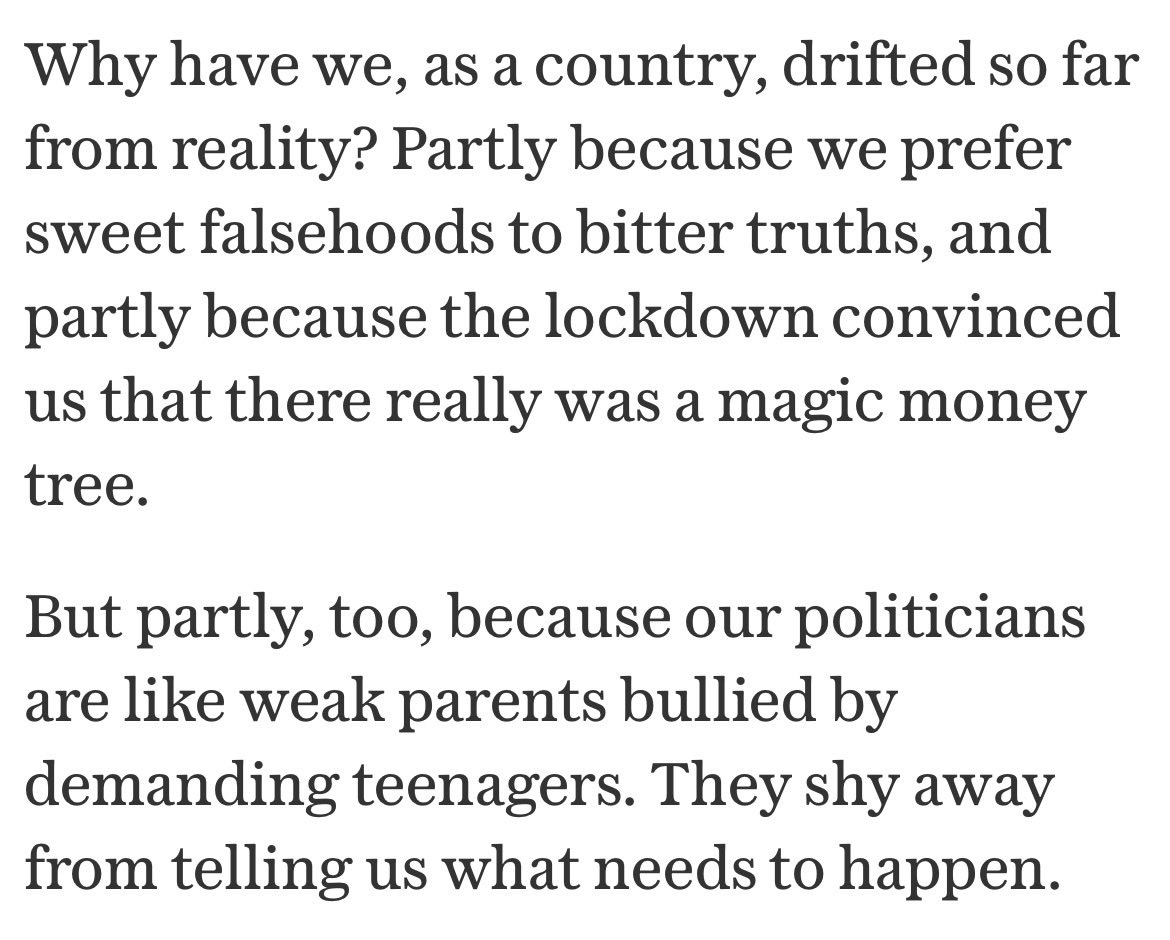
@Francis_Hoar It’s because we believe that politicians are our parents and most of us can’t see that they are weak and we are delusional.
English
@Deepee66 @jimhamilton4 @ProfTimNoakes I hope they weren’t too disappointed. The Boks are Champions after all.
English

@ShaulaetLesath @jimhamilton4 @ProfTimNoakes Hahaha Touché
I heard Kyle's family Ubered there to watch the game.
English

Scotland have a team that is capable of winning today down in South Africa. Been here and said it before……
Scotland by 8.
English

@kathrynhall_ But, and I ask this in all sincerity, what would you have them do instead? Lots of people called for apologies from AB and PT - now they have given them. I'm not sure on-going struggle sessions help anyone tbh.
English

Putting out an apology for saying something when you are in the public eye that you obviously said because you meant it, only to then be piled on by thousands making you realise your comments were unwarranted, unwelcome, and really quite vile, doesn't mean that you are really a nice person. It means you've been caught being vile, you've shown your true colours, and discovered you're not some kind of messiah on free speech but someone who, actually, needs to engage brain before opening mouth or writing a post on social media.
Absolutely pathetic. And that goes for all the people who have disrespected an elderly lady's death and been piled on for it.
English
@jeffreytucker @rosehorowitch @EpochTimes My reason for not reading is that life is too stressful or too frantic, fast. I recently lost internet connectivity for two days and I guzzled three books. I need some quiet to acquire more quiet.
English

Hardly anyone is reading real books anymore. We are not illiterate. We are postliterate. This is the thesis of a terrifying article in The Atlantic by @rosehorowitch. Here are my thoughts.
Just How Postliterate Are We? theepochtimes.com/opinion/just-h… via @epochtimes
English
@SamaHoole @ProfTimNoakes No, that will be: Sugar for energy. The bit about a spoonful helping the medicine go down is true, and tragic.
English

"Red meat gives you cancer" is the single most successful piece of dietary propaganda of your lifetime. In 2022 a team at the University of Washington built a tool specifically to catch scientists overstating weak links, pointed it at red meat, and the whole scare collapsed on the spot.
They graded the evidence tying unprocessed red meat to the six diseases it supposedly causes. Bowel cancer. Breast cancer. Heart disease. Type 2 diabetes. Both kinds of stroke.
The verdict, printed in Nature Medicine, was two stars out of five. Weak evidence for four of them. For both types of stroke, no link at all. Zero.
Two stars is the score that tool hands out to things nobody has ever built a public health campaign around. It is the statistical equivalent of a shrug in a white coat.
So sit with the arithmetic. For half a century you were told a lamb chop was a slow heart attack and a steak was a tumour with gravy on it. Doctors repeated it. Governments funded it. Your own mother nagged you about it. And when somebody finally graded the evidence honestly, it came back barely louder than the hum of the fridge it was stored in.
Nobody was lying to you, exactly. They were just repeating something confidently for fifty years without ever checking whether it was true, then acting wounded when someone did.
The oldest food on earth, the one thing every human ancestor reached for first, and they built a moral panic on top of it with two stars of evidence and a straight face.
You were never eating dangerously. You were eating like a human being.

English
@anish1 @peterrhague You left out self awareness. Most important and missing in TB and KS.
English

@peterrhague Tony Blair was a lawyer for most of his career and he made a decent prime minister, so your assessment is simplistic and reductionist
A good leader should have a combination of vision, intellect, wisdom, charisma, empathy and the ability to make fiendishly complex decisions
English

While we are doing our autopsies of Keir Starmer’s unimpressive premiership, I’d like to suggest he is a prime example of a certain personality type that causes us problems.
He has been a high achiever his whole life. From the 11+ onwards he passed tests and ascended every hierarchy he found himself in. This, I believe, shaped his worldview in a way that made him absolutely unsuited for the office.
For Starmer, you accept the rules of the system, you play the game, and when you win you get rewards. Number 10 was just the last objective that he earned by mechanically playing society like a video game - it was his by right for ticking all the boxes correctly.
His visible confusion and inability to grasp the job of actual leadership is, I think, a result of never having had to deal with the world beyond whichever social game he was playing at the time. Law is such a bounded game where a rigid, goal oriented thinker like Starmer can and did thrive.
A better leader would be someone who has some experience doing something which contacts base reality, where outcomes are not socially determined. Business, STEM, the military etc all fall into this category. Those people who spend their careers in the purely social feedback loops of law and politics do I think make poor leaders even if they excel at the process that gets them to the leadership.
English
@ProfTimNoakes If Haarland played football in the streets of London he would get points on his licence.
English
How does he fuel such speed and training?
`@blvkray
Wait till you realize this is how Haaland trains to beat them
English