Sabitlenmiş Tweet

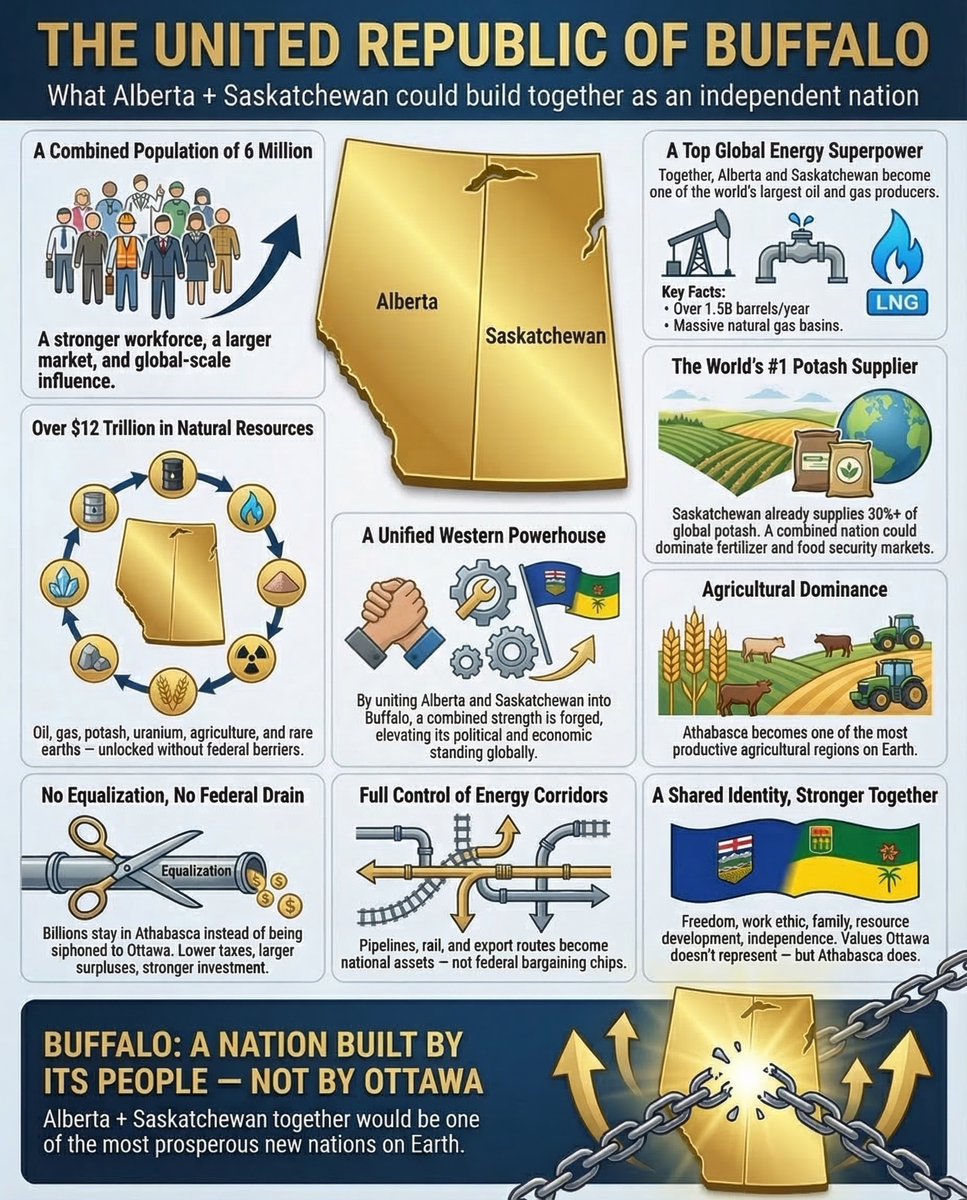
Just want to put this very useful information on Alberta Independence out there for those with questions. This is from "The Value of Freedom" report put out by The Alberta Prosperity Project.
Detailed summary
"The Value of Freedom," a draft fiscal plan published by the Alberta Prosperity Project in June 2025, outlines a comprehensive economic and policy framework for an independent Alberta. The document argues that independence would allow Alberta to retain its full tax contributions, eliminate federal over-contributions, and implement a "small government" approach to maximize provincial wealth.
Core Financial Case for Independence
The plan centers on the retention of annual federal tax contributions and the establishment of independent financial systems.
Tax Retention: Alberta is estimated to contribute $68–75 billion annually to federal revenues, but receives only $22–26 billion back in transfers. Independence would yield a net fiscal gain of $44–47 billion per year.
Total Revenue: Combined with existing provincial revenues ($74.1 billion for 2025-26), the total revenue for a sovereign Alberta is projected at $142.1–149.1 billion annually.
The Alberta Pension Plan (APP): The plan proposes a transfer of $167 billion from the Canada Pension Plan (CPP)—a conservative half of the $334 billion the authors claim is owed—resulting in an estimated asset base of $183.7 billion by 2026.
Fiscal Surplus: After replacing federal services, the province would see an annual surplus of $29.4–48.3 billion, enabling massive tax reductions.
Replacement of Federal Services
To function as a sovereign nation, Alberta would need to establish or enhance services currently provided by the federal government.
Key Policy Proposals
The document details specific strategies for governance, social issues, and the environment.
1. Indigenous Sovereignty
The plan seeks to recast the relationship with Indigenous peoples by recognizing them as sovereign, self-governing nations. It proposes constitutionally enshrining 1.6 million hectares of reserve land as inalienably owned by these nations, allocating an additional 1.6 million hectares of Crown land, and sharing 100% of resource revenues from those lands.
2. Environmental Strategy
Moving away from "external climate agendas," the strategy focuses on natural carbon sequestration. By utilizing Alberta’s 12.1 million hectares of grasslands and 6.6–7.9 million hectares of mountain forests for rotational grazing and reforestation, the province aims to sequester 37–122 million tonnes of CO2e annually.
3. Immigration and Deportation
The plan adopts a points-based system (modeled after the 2005 FSWP) prioritizing skilled workers and "like-minded" Canadians. It includes a strict policy for automatic deportation of any non-citizen (PR or work permit holder) convicted of a criminal offense resulting in a jail sentence.
Long-Term Economic Vision (2045)
A "High Growth" scenario speculates on the results of massive deregulation and resource expansion by 2045.
Production Tripling: Projected growth of oil production from 3.8 million to 9.5 million barrels per day and natural gas from 11 to 21 billion cubic feet per day.
Economic Impact: Total economic activity of $8.2 trillion over 20 years, creating up to 450,000 new jobs.
The Heritage Fund: Through mandated resource contributions, the fund is projected to grow to $1.3–1.4 trillion, generating ~$52–56 billion in annual returns for future stability.
Tax Overhaul: The plan suggests eliminating personal income tax, reducing corporate tax to 10%, and replacing property taxes with a frontage and hectare-based fee.

English