
Sabitlenmiş Tweet
Starry Starry Nightman 🟧
4.2K posts


Starry Starry Nightman 🟧
@StarryStarryN17
Bitcoin plus Nothing npub1qjy9v40d5l8mndf7686az0yc05pyer084n5ysetm2krma6c06qcs75wtw8
Eleusis Katılım Mart 2020
1.3K Takip Edilen794 Takipçiler
Starry Starry Nightman 🟧 retweetledi

@CrisReed Thanks Cris 👊. I never threw up from the drawdowns but I definitely have had imposter syndrome multiple times along the way. I agree Bitcoin puts hair on your chest. Holding Equities is a cake walk now
English

Bitcoin has taught me how to handle vol.
I can’t tell how valuable it is if you can.
English
Starry Starry Nightman 🟧 retweetledi

Bitcoin has fixed supply of 21M, yet is becoming more distributed over time.
US dollar supply is increasing by a rate 7% annually, yet is becoming more concentrated all the time.
English
Starry Starry Nightman 🟧 retweetledi
Starry Starry Nightman 🟧 retweetledi

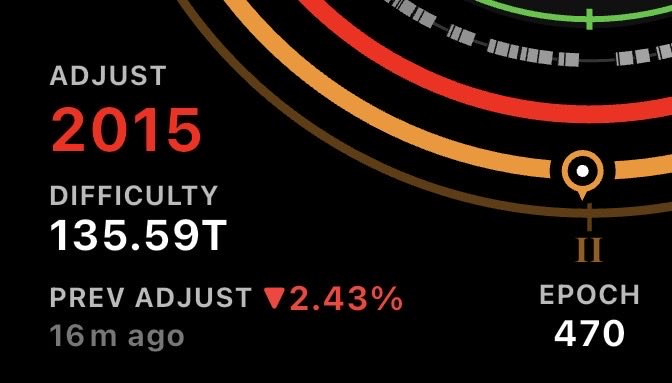
🔴Difficulty epoch 470
⛏️135.59T
⬇️2.43% difficulty decrease
Go find a block!
English
Starry Starry Nightman 🟧 retweetledi

In 1948, a 32-year-old at Bell Labs published a paper nobody fully understood.
Engineers found it too mathematical. Mathematicians found it too engineering-focused. One prominent mathematician reviewed it negatively.
That paper - "A Mathematical Theory of Communication", became the founding document of the digital age.
The man was Claude Shannon. Father of Information Theory.
At 21, he wrote the most important master's thesis of the 20th century.
Working at MIT on an early mechanical computer, Shannon noticed its relay switches had exactly two states - open or closed. He had just taken a philosophy course introducing Boolean algebra, which also operated on two values: true and false.
Nobody had ever connected these two things.
His 1937 thesis proved that Boolean algebra and electrical circuits are mathematically identical, and that any logical operation could be built from simple switches.
Howard Gardner called it "possibly the most important, and also the most famous, master's thesis of the century."
Every digital computer ever built traces back to this insight.
At 29, he proved that perfect encryption exists.
During WWII, Shannon worked on classified cryptography at Bell Labs. His work contributed to SIGSALY, the secure voice system used for confidential communications between Roosevelt and Churchill.
In a classified 1945 memorandum, he mathematically proved the one-time pad provides perfect secrecy, unbreakable not just computationally, but provably, permanently, against an adversary with infinite power.
When declassified in 1949, it transformed cryptography from an art into a science. It laid the foundations for DES, AES, and every modern encryption standard.
At 32, he defined what information is.
His 1948 paper introduced one equation:
H = −Σ p(x) log p(x)
Shannon entropy. The average uncertainty in a probability distribution. The minimum bits required to encode a message.
Three things followed:
> He defined the bit - the fundamental unit of all information. His colleague John Tukey coined the name.
> He proved the channel capacity theorem, every communication channel has a maximum rate of reliable transmission. You can approach it. You can never exceed it.
> He unified telegraph, telephone, and radio into a single mathematical framework for the first time.
Robert Lucky of Bell Labs called it the greatest work "in the annals of technological thought."
Where his equation lives in AI today:
Cross-entropy loss - the function training every classifier and language model, is derived directly from H. Decision tree splits use information gain, which is H applied to data. Perplexity, the standard LLM evaluation metric, is an exponentiation of cross-entropy.
Every time a neural network trains, Shannon's formula runs inside it.
He also built the first AI learning device.
In 1950, Shannon built Theseus, a mechanical mouse that navigated a maze through trial and error, learned the correct path, and repeated it perfectly. Mazin Gilbert of Bell Labs said: "Theseus inspired the whole field of AI."
That same year he published the first paper on programming a computer to play chess. He co-organized the 1956 Dartmouth Workshop, the founding event of AI as a field.
The man:
He rode a unicycle through Bell Labs hallways while juggling. He built a flame-throwing trumpet, a rocket-powered Frisbee, and Styrofoam shoes to walk on the lake behind his house.
He called his home Entropy House.
When asked what motivated him: "I was motivated by curiosity. Never by the desire for financial gain. I just wondered how things were put together."
In 1985, he appeared unexpectedly at a conference in Brighton. The crowd mobbed him for autographs. Persuaded to speak at the banquet, he talked briefly, then pulled three balls from his pockets and juggled instead.
One engineer said: "It was as if Newton had showed up at a physics conference."
He died in 2001 after a decade with Alzheimer's, the cruel irony of information slowly leaving the mind of the man who defined what information was.
Claude, the AI model, is named after Claude Shannon, the mathematician who laid the foundation for the digital world we rely on today.

English
Starry Starry Nightman 🟧 retweetledi
Starry Starry Nightman 🟧 retweetledi
.@crossbordercap explains why debt to GDP is the wrong metric. What matters is debt to liquidity.
This is one of the clearest breakdowns of how the modern financial system actually works and why defaults are never an option for policymakers.
@TheBitcoinLayer
English
Starry Starry Nightman 🟧 retweetledi
For additional context I suggested to @JohnCarreyrou to speak with Blockstream cofounder Greg Maxwell who is legendary in his ability to debunk faketoshi’s, knew the code base intimately and Adam personally.
I believe phrased it as “if your thesis and evidence can survive 10m of talking with Greg I’d be shocked” and offered to connect him to Greg.
I just now confirmed with Greg that he had no requests for contact or comment from anyone at the NY Times.
Purposefully avoiding talking to people who can debunk your story narrative isn’t reporting.
Austin Hill@austinhill
How many former colleagues, cofounders of @Blockstream, investors in @Blockstream did you talk to in those 18 months ? How many of them gave you long lists of reasons @adam3us isn’t Satoshi? How many of his cofounders who worked with him day in and day out told you that after all their time with him they are more convinced then ever, that @adam3us is not Satoshi and that the game of Satoshi hunting is stupid and dangerous and carries real world consequences for the safety and security of people who fall under that gaze? How many coders of Bitcoin who cofounded Blockstream with Adam did you talk with about Adam’s horrible Windows C++ coding experience and suggested coding stylometry was a better method of analysis and to compare coding styles and it would likely disprove your thesis? How many people told you that they’ve known Adam for almost 30yrs, employed him, cofounded companies with him (including @blockstream) and have actually spent decades working with him think he satoshi? Was it all a grand conspiracy while we struggled to raise capital, manage burn rates, find supporters and build a real business that Adam was secretly sitting on Satoshi ‘s stash of bitcoin play acting the entrepreneur in need of capital? There’s a lot of stuff you left out of the article John that didn’t fit the story you wanted to tell and I have a recorded conversations with you to prove that. Disappointing, but not unexpected which is why Adam clearly knew you were Satoshi hunting every time you met him (including Vegas) - because I told him you were chasing this story.
English
Starry Starry Nightman 🟧 retweetledi
Drone powered Autonomous Umbrella’s are the future I’m here for.
English
Starry Starry Nightman 🟧 retweetledi

Digital credit products like $SATA are known for stripping out Bitcoin volatility while delivering attractive base stated yields.
What’s under appreciated is how they also serve as a potential attractive option for equity investors seeking shelter from general market volatility and uncertainty who don't want to give up their desired returns.
Tax-advantaged ROC dividends with yields above the S&P 500’s average annual returns.
It starts with fixed income.
It doesn’t end there.
English
Starry Starry Nightman 🟧 retweetledi

My $STRC discussion with @MadBitcoin_, @alberto_mera, and @DBATTAGLIAYtube. One of my favorite and most enjoyable podcast conversations to date.
0:01 – Introduction to the Episode
0:30 – Guest Introductions
1:04 – Overview of Bitcoin Strategy
1:31 – Designing Preferred Instruments
2:25 – Transition from Convertible Debt
3:23 – Launch and Success of STRK
4:14 – Evolution to STRC
5:02 – STRC's Unique Features
6:12 – Addressing Investor Concerns
7:33 – Innovation in Stability
8:29 – STRC's Market Position
9:46 – STRC as a Safe Haven
11:10 – Strategic Use in Portfolios
12:55 – STRC's Role in Capital Raising
14:25 – Future Growth Projections
15:44 – Risk Management and Strategy
17:14 – STRC's Potential Impact on S&P 500
18:45 – Regulatory Challenges and Opportunities
20:09 – Understanding Volatility and Sharpe Ratio
21:35 – Achieving High Sharpe Ratios
23:55 – Lessons from Financial Experiments
25:24 – Guidelines for Bitcoin Treasury Companies
27:51 – Leveraging STRC in Global Markets
30:28 – STRC as a Financial Backbone
32:32 – Expanding the Bitcoin Ecosystem
34:06 – Addressing Market Limits and Growth
36:42 – Balancing Growth and Stability
39:50 – Long-term Vision for Bitcoin
42:14 – Strategic Accumulation of Bitcoin
44:26 – Risk Management and Future Planning
46:16 – Addressing Market Manipulation Concerns
48:09 – Financialization and Market Dynamics
50:32 – Institutional Adoption and Impact
52:22 – Key Risks and Management Strategies
54:16 – Competitive Landscape and Strategic Positioning
56:33 – Leadership and Succession Planning
58:32 – Focus on Core Strengths and Opportunities
60:09 – Closing Remarks and Future Invitations
English