Supetintelligent Sales Blog

5.4K posts

Supetintelligent Sales Blog banner
Supetintelligent Sales Blog

Supetintelligent Sales Blog

@SuperSalesAI

AI Transformation for GTM teams.

Brooklyn, NY Katılım Mayıs 2016
4.8K Takip Edilen2.6K Takipçiler
Tejas Gawande
Tejas Gawande@tejgw·
Cursor for Slides is finally here Watch the first 47 seconds. Then try going back to your old deck tool Reply "Chronicle" + RT to get two months of Pro for free. Make sure you follow so I can DM you asap.
English
1.8K
978
3K
801.1K
Tejas Gawande
Tejas Gawande@tejgw·
@Chronicle_HQ Bonus: Reply "Chronicle" to get 2 months of Pro for free. Make sure you follow so I can DM you. Repost to help a small team reach more people.
English
66
2
30
6.6K
Supetintelligent Sales Blog
Supetintelligent Sales Blog@SuperSalesAI·
Ilya has a good analogy here. Imagine reading a mystery novel that doesn’t reveal the killer’s name until the last word in the book. If an LLM could predict the last word more accurately than humans, wouldn’t that suggest a level of understanding beyond simple autocomplete? And isn’t intelligence the ability to choose the right answer or do the right thing more often than most?
English
0
0
2
53
BeforeAGI
BeforeAGI@BeforeAGI13·
@gb_neocarbone @BenjaminDEKR Describe would mean after they happened. LLMS cannot predict anything right now. Unless you are suggesting he has a state of the art advanced model that nobody has seen yet. Otherwise you'd have trading bots killing the markets but it is not the case.
English
2
0
0
588
Benjamin De Kraker
Benjamin De Kraker@BenjaminDEKR·
What if Claude 5 is advising Dario and has already Anticipated All Possible Scenarios
English
136
166
4K
161.4K
Varun Anand
Varun Anand@vxanand·
Our new Head of Sales Development has one job: don't embarrass us. Here's an inside look at how we're building @Clay's first ever SDR team: You might be thinking, "Wait, what's up with that? I thought Clay was making it so there would never be SDRs ever again?" Wrong. So, I sat down with Rob Cook to walk through how we're re-thinking the SDR role in the age of AI. We get into: - What Clay-powered SDRs actually do all day - The two types of salespeople we're hiring and why the goal is to turn them into one - Our key success metrics for the ClayDR team (it's not just pipeline) - When to go bespoke vs. scale: How we decide between 10 custom touches for always-on accounts and many-to-one plays for awareness - Why "don't embarrass us" is actually the most important charter and what that means for how our SDRs engage with prospects Plus, much, much more. In the end, Rob shares why it bothers him so much when folks say they feel badly for SDRs and "how hard the job is." And why our #1 goal is to bring the joy back to business development. Watch below 👇
English
7
7
183
43.5K
Supetintelligent Sales Blog
Supetintelligent Sales Blog@SuperSalesAI·
@zackbshapiro Large doc reviews may still require software harnesses that allow for LLM analysis at scale. Still can’t run 10 million pages of documents through Claude desktop, even if it would do a great job with each one.
English
0
0
1
421
JJ Englert
JJ Englert@JJEnglert·
I built the ultimate GTM Engineer AI Toolkit that handles prospect research, outreach writing, meeting prep, and more in minutes. This is a beginner-friendly walkthrough that shows you exactly how to set it up, use it at work, and personalize it to your business. It can: - Research real prospects and companies - Score accounts against your ICP - Write personalized cold outreach sequences - Generate meeting prep briefs before calls - Help you build a repeatable prospecting pipeline - All using a free toolkit + Claude Code / Codex. This is for SDRs, founders, marketers, and GTM operators who want to use AI to do more at work without buying another expensive tool. I break down the full workflow step by step in the video. 👇 Comment "GTM GUIDE" and I’ll send you the full toolkit. (make sure you're following me so I can DM you)
English
994
30
524
124.3K
Simão
Simão@simao_etc·
Cold outreach converts at ~2%. We wanted to break that. So we built personalized landing pages for every prospect. Each one shows their pain points, a custom message, and a live AI search with real candidates from their industry. Here’s how we’re using AI for super personalised outreach at scale for Talent Pro at @TalentProtocol
Simão tweet media
English
3
3
13
856
Amir Efrati
Amir Efrati@amir·
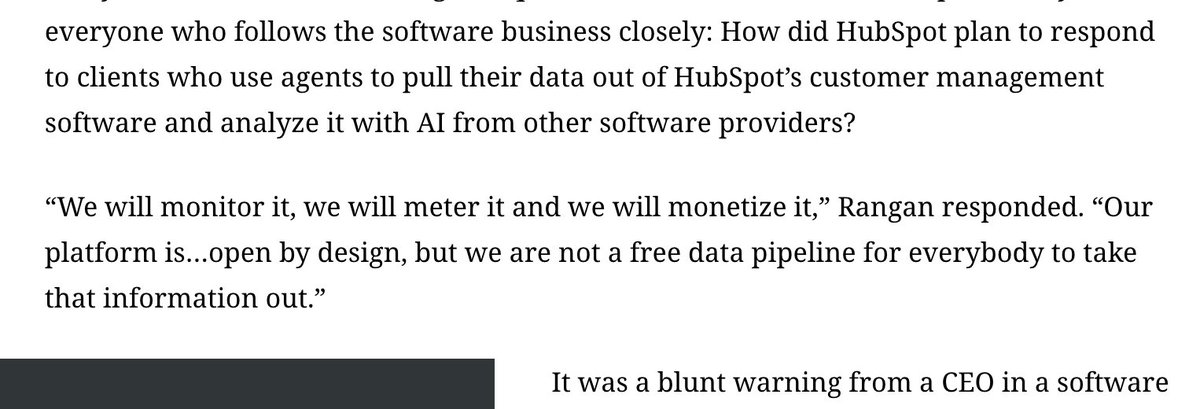
🤖🫰Enterprise apps from Microsoft to HubSpot are plotting to extract fees from the AI agents that access their services.
Amir Efrati tweet media
English
13
14
182
247.4K
TJP
TJP@4intheflames·
@Geiger_Capital But they are partnering with intuit and Docusign and other old school software companies. This seems to throw a wrench in the theory AI will destroy them. AI just just making them more efficient
English
5
0
48
14.5K
Geiger Capital
Geiger Capital@Geiger_Capital·
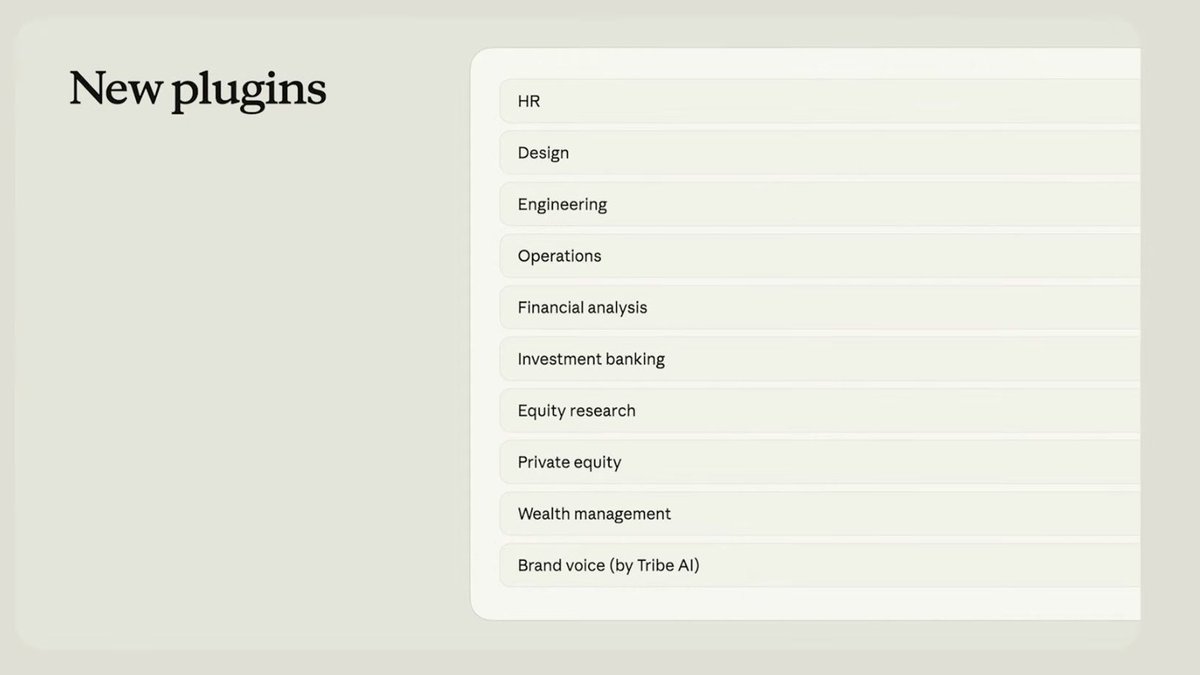
*ANTHROPIC LINKS AI AGENT WITH TOOLS FOR INVESTMENT BANKING, HR It’s over. Half of analyst seats will be gone in 5 years.
Geiger Capital tweet media
English
328
482
6.1K
1.2M
PolyAI
PolyAI@polyaivoice·
PolyAI has raised $200M from Nvidia, Khosla Ventures, and multiple top VCs. We're one of the fastest-growing companies in the UK, and we handle 500M+ calls for: • Marriott • PG&E • Gordon Ramsay's restaurants • And 3,000 more real deployments Which means that if you've ever called them, chances are you've talked to our voice agents. Every restaurant we onboard books thousands in revenue within 30 days. But how? Because PolyAI works 24/7, answering every call in <2 seconds, and we also: • switch between 45+ languages • handle payments & cancellations • verify identities • and even upsell your services If you want to try creating an agent with PolyAI, we built Agent Studio Lite to make it easy. Just enter any URL, and in 5 minutes it will analyze your website and build a working agent. We're opening early access to a limited number of people. Comment "PolyAI" and we'll add you to the waitlist and give you 3 months for free!
English
1.5K
593
4.9K
3.5M
Supetintelligent Sales Blog
Supetintelligent Sales Blog@SuperSalesAI·
@GergelyOrosz because hubspot doesn't actually let you do a lot more sales, just helps you track your sales efforts better. If hubspot and CRMs actually did drive more sales, they would be sticky AF.
English
0
0
0
22
Gergely Orosz
Gergely Orosz@GergelyOrosz·
In theory, of course you could rebuild HubSpot from the ground up. Same way as you could just rebuilt Kubernetes (or some part of it.) In reality: why the hell would you spend so much time and effort, if it's not your core competency? To build something worse in the end
English
22
1
63
9.1K
Supetintelligent Sales Blog
Supetintelligent Sales Blog@SuperSalesAI·
@gregisenberg what's your vision on how to monetize skills, Greg? Do people sell skills or do they sell agents with the right skills. Skills alone without agent isn't enough
English
0
0
0
87
GREG ISENBERG
GREG ISENBERG@gregisenberg·
WELCOME TO THE SKILL ERA OF THE INTERNET for the last 15 years, if you wanted to build a serious software company, you built a product and exposed an api. that was the move. you created functionality… payments, messaging, email, search, analytics… and then you let developers plug into it. the companies that won owned the pipes. stripe owned payments. twilio owned messaging. sendgrid owned email. the api was the distribution layer. once you were integrated, you were embedded. that model made sense in a world where execution was scarce. llms compress execution into a prompt. so the center of gravity shifts. in this cycle, you build expertise and package it as a skill. an api is a doorway into a function. here’s how to send an email. here’s how to process a payment. here’s how to fetch this data. it’s precise. mechanical. bounded. a skill is a doorway into judgment. here’s how to audit a landing page like a serious growth operator. here’s how to structure a legal intake so you catch the real risk. here’s how to clean and enrich messy directory data so it actually turns into revenue. you’re encoding a way of thinking. and that changes how companies are built and how they scale. in the api era, distribution meant convincing developers to integrate you. you needed docs. sdk’s. developer evangelism. you fought for a place inside someone else’s codebase. in the skill era, distribution means becoming part of someone’s agent workflow. a founder opens claude code. they type /seo-audit. your skill runs. it frames the output. it structures the analysis. it guides the decisions. your expertise lives inside the execution layer itself. you aren’t pulling users into your interface. you’re embedding your thinking into theirs. that changes company design. the old playbook looked like this: build saas design ui onboard users drive retention expand seats the new playbook looks more like this: encode a high-leverage playbook package it as a skill let agents call it thousands of times per day the interface shrinks. the leverage expands. a strong skill doesn’t serve one user at a time. it serves fleets of agents. one installation can mean your methodology is invoked across hundreds of companies automatically. the scaling curve looks less like seats and more like invocations. what’s happening underneath all of this is simple: software used to be the executor. now software is the orchestrator. next, expertise becomes infrastructure. in the api era, the winners owned the pipes. in the skill era, the winners own the patterns. patterns for closing deals. patterns for pricing. patterns for positioning. patterns for enrichment. patterns for research. many new companies will look surprisingly small on the surface. a tight repo. a handful of powerful skill files. maybe 2–5 people maintaining and improving them. but those skills will sit inside thousands of workflows, shaping decisions at scale. and it’s creating a new class of companies built less around dashboards and more around encoded judgment. THIS IS THE SKILL ERA OF THE INTERNET. welcome.
Craig Weiss@craigzLiszt

skills are the new apis so many new companies are just going to be skills

English
195
191
1.9K
238.8K
Supetintelligent Sales Blog
Supetintelligent Sales Blog@SuperSalesAI·
Agree, except for the 21 year old part. Because skills rewards operators, they reward people with experience. Yes, you can A/B test your way to the right answer, or you can have a decade of experience that lets you do so intuitively and with the nuance that methodology often requires.
English
0
0
0
12
prinz
prinz@deredleritt3r·
To clarify, with GPT-5.2 Pro, hallucinations these days are an *extremely* small concern, because they *almost never* happen. It's far more likely that the model has failed to correctly analyze some statute or didn't take into account some potentially applicable case. In other words, if I find myself watching the model like a hawk, it's completely for the same reason as why I would find myself watching a junior associate like a hawk. The result of the above is that GPT-5.2 Pro is *extremely* useful in my legal work. And if the model is *extremely* useful in my legal work, then I think it's fair to say that "hallucinations aren't a problem"!
English
6
1
219
4.9K
Gary Marcus
Gary Marcus@GaryMarcus·
How did this work out? Are LLM hallucinations largely gone by now? So now the @FT platforms the same guy saying most the of the tasks lawyers and accountants do will be replaced in 12-18 months? From the same company that said that GPT-5 would be a giant humpback whale that would blow away PhDs? Where is the accountability? The concern about CEOs’ conflicts of interest in selling these narratives? The view from skeptics?
Mustafa Suleyman@mustafasuleyman

LLM hallucinations will be largely eliminated by 2025. that’s a huge deal. the implications are far more profound than the threat of the models getting things a bit wrong today.

English
134
190
1.6K
246.9K
Jacob Klug
Jacob Klug@Jacobsklug·
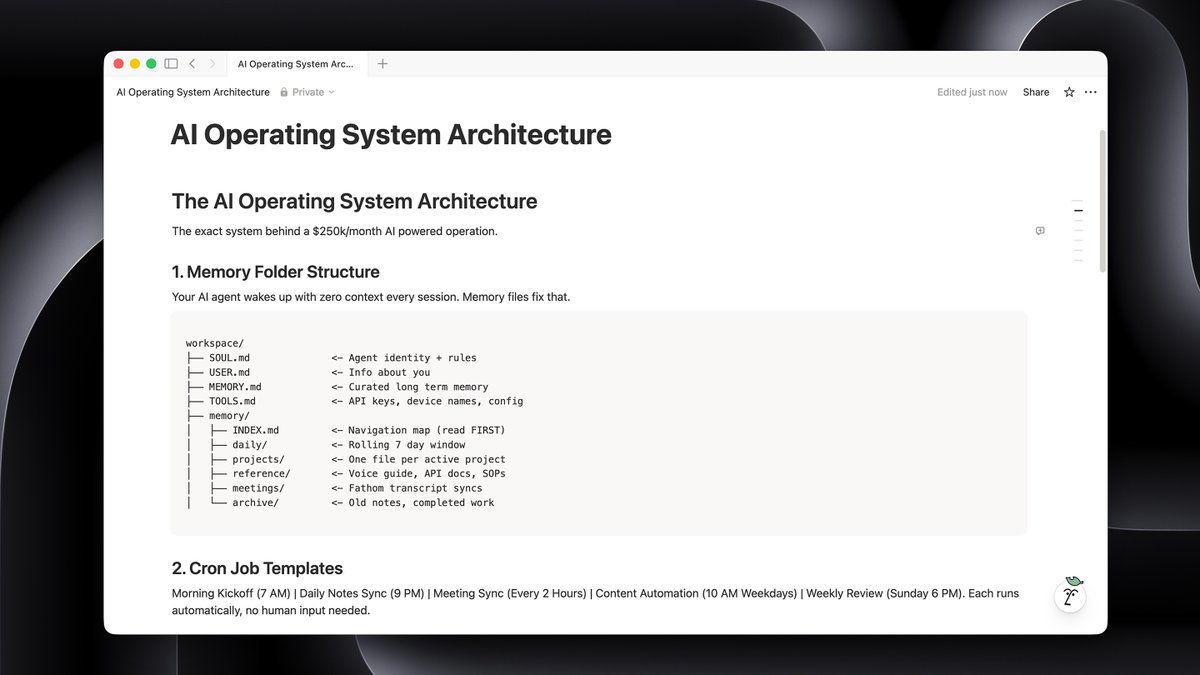
I'm giving away my entire @openclaw architecture. Behind my $250k/month agency. After weeks of building, I've dialled in the exact system that runs my business 24/7. What's included: • Memory folder structure (how to organize agent context) • Cron job templates (daily briefs, meeting syncs, content automation) • How to build a custom dashboard in @lovable • API reference doc (so your agent never forgets its tools) • Voice training method (85 posts to teach it your style) • Supabase schema for dashboard connection Comment "OS" and follow. I'll DM it to you. P.S. This will probably blow up so give me some time to reply.
Jacob Klug tweet media
English
5.9K
287
3.7K
398.4K
Jacob Klug
Jacob Klug@Jacobsklug·
YC just announced their looking for AI-Native agencies. The agency model is about to split into two completely different businesses: A) Agencies that sell labor B) Agencies that sell leverage Only one survives long term. AI-native agencies don’t scale by hiring more people. They scale by building systems that replace people. The playbook looks like this: → Find a workflow clients already overpay for → Build an AI tool that does it 10x faster → Use services to fund development → Turn repeated work into proprietary IP → Eventually sell the tool, not the time The real shift: Agencies used to be talent businesses. Now they’re becoming software companies with cash flow. Most people will miss this window because they’re still optimizing delivery instead of building leverage. That’s the opportunity. I'm launching a community of like-minded builders trying to build their own AI-native agency. I'm going to share everything I know having built my own 7-figure AI agency. Looking for motivated people ready to learn & build. Drop a comment, I'll personally reach out.
Jacob Klug tweet media
English
758
116
1.8K
191.2K
Postmodern liberalism
Postmodern liberalism@myname93353387·
@keshavrao_ @BoringBiz_ Salesforce can also use AI. The point was that no one is going to be building their CRMs in-house. Whichever way you slice it, AI or not you just don't have the margins for it.
English
1
0
0
259
Boring_Business
Boring_Business@BoringBiz_·
This is the best explanation I have heard of how AI is impacting the software landscape. Not just the stocks, but the actual fundamentals of the businesses underneath From AI Czar David Sacks himself "You take a product like Salesforce that deals with all your customer contracts and revenue. You are not going to replace that with code that has been spit out of a coding assistant that has not been fully vetted Think about how many bug reports on Salesforce's code base over the last 25 years. Maybe millions of them. That system has been tested across thousands of large customers and enterprises The idea that you are just going to rip out that system and replace with code that has been probabilistically generated by an AI engine yesterday, with a small team to maintain it internally, just does not seem realistic to me"
English
260
362
3.9K
483K
Supetintelligent Sales Blog
Supetintelligent Sales Blog@SuperSalesAI·
@alexalbert__ Describe a use case you’ve benefited from? Trying to understand when it makes sense to incur the cost. Any non coding use cases?
English
0
0
0
610
Aakash Gupta
Aakash Gupta@aakashgupta·
This is a dopamine loop, and it’s one of the most powerful ones humans have ever encountered. Every time you prompt an AI and get a useful result back in seconds, your brain gets a hit. Variable-ratio reinforcement, same mechanism as slot machines, except the reward is real: actual output, actual progress, actual leverage on your ideas. Traditional work follows a delayed-reward structure. You write code for 6 hours, maybe it compiles, maybe you get feedback in a week. The gap between effort and reward is wide enough that motivation decays constantly. AI compresses that loop to seconds. Effort → reward → effort → reward. Your prefrontal cortex stays engaged because the next payoff is always one prompt away. This is why people describe it as “fun” when they’re actually working 14-hour days. The subjective experience of effort disappears when reward frequency is high enough. The “harder than ever” part is real too. When your bottleneck shifts from execution to imagination, you run out of excuses to stop. There’s no “waiting on the build” or “blocked by review.” Every idea you have can be tested immediately, which means your brain never gets a natural stopping point. People who thrive on this are selecting for a specific neurotype: high novelty-seeking, high conscientiousness, tolerance for rapid context-switching. That’s maybe 10-15% of the population. The other 85% will experience the same tools as overwhelming, not energizing. And that split is going to define the next decade of who captures value from AI and who gets displaced by it.
Nat Eliason@nateliason

Nearly every ambitious person I know who has dived into AI is working harder than ever, and longer hours than ever. Fascinating dynamic tbh. I have NEVER worked this hard, nor had this much fun with work.

English
208
489
4.6K
563K