Teddy Tawil

55 posts

Teddy Tawil

Teddy Tawil

@TawilTeddy

@gen_analysis prev @CarnegieEndow @yale @sanalabs

Katılım Ağustos 2020
416 Takip Edilen346 Takipçiler
Sabitlenmiş Tweet
Teddy Tawil
Teddy Tawil@TawilTeddy·
🧵I spent 9 months building a detailed new global model of AI data center finances along with @alasdairpr and @SamWinterLevy. It shows which factors are driving $10+ billion investment decisions, who will control a key strategic asset of this century, and what policymakers can do to steer results while minimizing harms to the public. It’s part of a new @CarnegieEndow & @CEIPTechProgram report. Here are five key findings:
Teddy Tawil tweet media
English
5
18
68
16.1K
Teddy Tawil retweetledi
Josh Zoffer
Josh Zoffer@joshzoff·
Fantastic report from @SamWinterLevy and the @CarnegieEndow team, worth reading as we all digest the news from NY and elsewhere -- today, America's ability to procure, build, and scale compute capacity is an (increasingly rare) industrial advantage for us. As we navigate the costs and benefits of data centers and build the policy architecture to ensure their economic impulse is a force for good (jobs, energy investment, etc.) important to consider the geostrategic context around these issues. carnegieendowment.org/research/2026/…
English
0
4
13
2.5K
Tom Reed
Tom Reed@mentalgeorge·
Should Europe build AGI? Yes, if it could - but it can't. That's more or less my take-away from speaking to @anton_d_leicht. We talk about how middle powers might spend $500b to shoot for a non-American superintelligence, how to secure a slice of lightcone if they don't, and much more. 00:00 Why most countries face bleak AI futures 06:10 How middle powers can strike AI deals 12:17 The $500 billion AI moonshot 24:54 Would the US crush allied AI? 37:42 Is AI dependence catastrophic? 47:47 Policies to avoid mass AI layoffs 1:10:52 Why "pausing superintelligence" fails 1:21:08 Is an American AI monopoly safe? (Also - it brings me great pleasure to announce I've joined the 80,000 hours podcast. More to come from me).
English
13
18
123
14.6K
Teddy Tawil
Teddy Tawil@TawilTeddy·
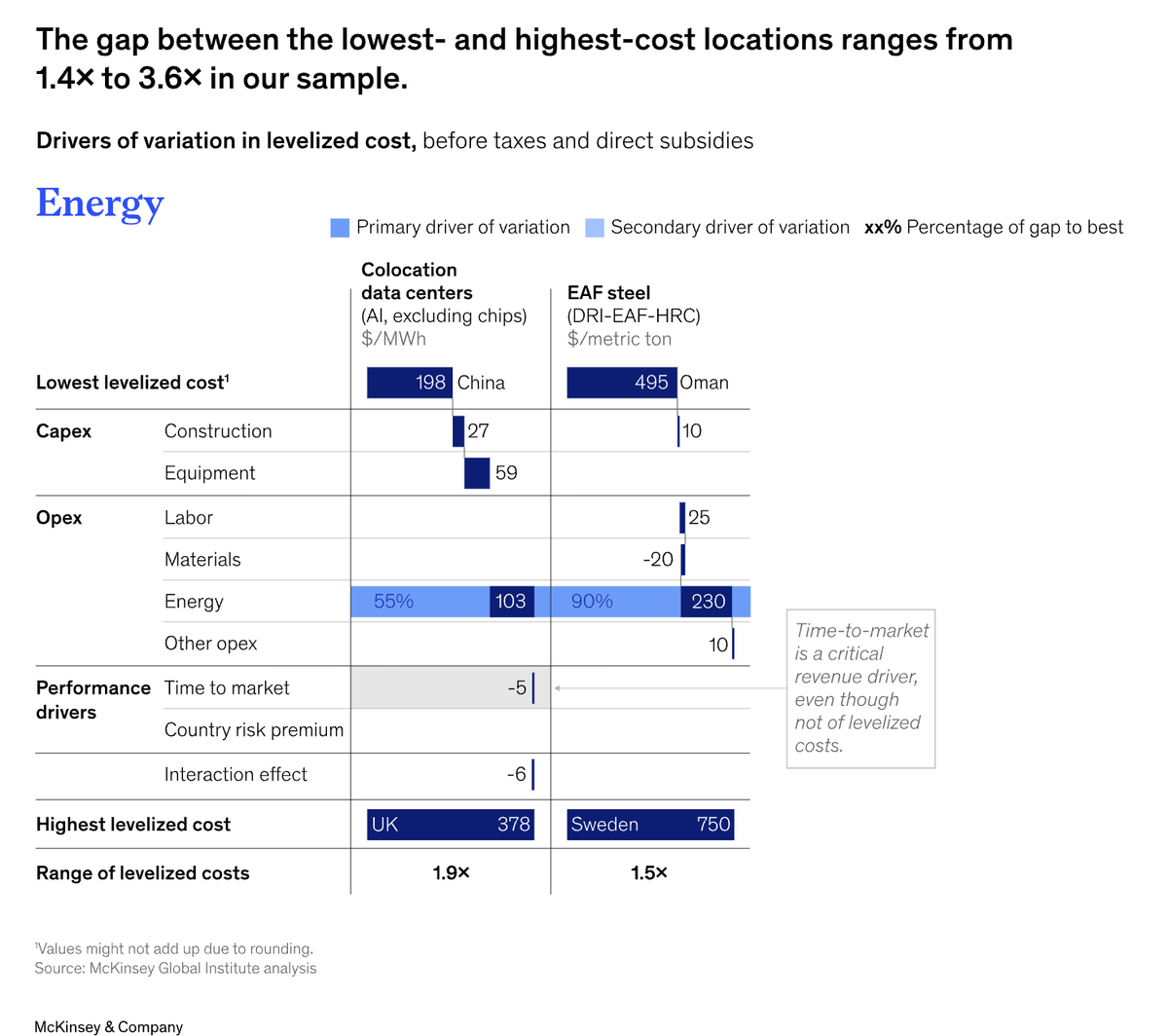
I am one of the authors of the Carnegie model… +1 to Archie’s answer and super happy to see others working on this! On top of what Archie and the McKinsey report discuss, I will just add that McKinsey’s calculation excludes the cost of IT hardware, which comprises most of total CapEx (see the figure below) and is much less location-sensitive. When you include IT hardware, the cost differences look smaller in percent terms. To give a highly stylized example, suppose construction costs were $1 vs. $2—that would be a 100% difference. If you added $3 of location-insensitive costs to both sides, making the total costs $4 vs. $5, the difference is only 25%. There are some other small differences (20-year lifecycle vs. 12, different assumptions around utilization, liquid-cooled vs. air-cooled, etc.), but they do not appear to be as important. Relatedly, would also shout out @amelia__michael, who has also done great work for @GovAIOrg comparing costs in the US vs. the UAE. (Disclosure: I’ll be joining McKinsey in a few months, but I was not involved in this work and am speaking only in my personal capacity.)
Teddy Tawil tweet media
English
0
0
2
50
Archie Hall
Archie Hall@ArchieHall·
McKinsey finds that data centres are nearly twice as expensive in Britain as in China, driven by capex and (especially) energy costs.
Archie Hall tweet media
English
11
26
126
99.3K
Teddy Tawil retweetledi
Azeem Azhar
Azeem Azhar@azeem·
The GenAI economy has generated $110 billion in sales over the past 12 months. It is growing fast. On an annualized basis, the revenue run rate exceeds $175 billion. These numbers took us several months to construct, and as far as we know, it’s the first bottom-up, deduplicated measure of consumer and enterprise AI spending across the full stack. We are releasing this research today in our first The State of the AI Economy report. intelligence.exponentialview.co
Azeem Azhar tweet media
English
83
429
1.9K
1.5M
Teddy Tawil retweetledi
Simon Grimm
Simon Grimm@Simon__Grimm·
The US data center buildout is the world's largest infrastructure project. But it faces one bottleneck: a slow and centrally planned electric grid. Twenty years ago, a power plant waited 20 months for interconnection. Now it is 55 months. In a new Works in Progress piece, we explain how America's grid got stuck, and how a few market mechanisms could fix it. worksinprogress.co/issue/why-amer… Compared to the rest of the economy, electric grids barely use prices to allocate scarcity. There is a queue, but no paid fast lane. And you can only connect if the grid can guarantee near-100% uptime, even if you would happily accept 99% uptime in exchange for connecting your data center one year earlier. As a result, you get a fast-growing number of interconnection requests, each requiring coordination with the others, producing gridlock. The fix is not better central planning, but a few basic market mechanisms: let firms pay for priority queueing, and let flexible users connect faster by accepting 99% uptime and managing interruptions with batteries or behind-the-meter power generation. With those simple fixes, the United States data center boom could move much faster.
Simon Grimm tweet media
Sam Bowman@s8mb

The main energy constraint on data centre buildout is not the price of electricity, it is the time it takes to get connected to the grid. Fixing this would cost billpayers and taxpayers nothing, reduce electricity prices, and make it vastly faster to build new data centres in America, Britain and much of Europe. In a new Works in Progress article we explain the problem and how to solve it. worksinprogress.co/issue/why-amer… In Texas alone, there are 143.5 gigawatts of data centres in the queue to get connected, compared to total peak demand in Texas of 85.9 GW. It is a problem on the supply and demand side. The wait time to connect a generator to the grid has risen from 20 months in 2005 to 55 months. Some of this is fake: 72 percent of generator connection requests since 2000 were eventually withdrawn. You grab your place in the queue and wait until you reach the front before you have to actually deliver. The queue thus becomes congested and slower for the most valuable projects that could move fast if they could pay for fast-track access. xAI's Colossus project in Memphis was offered 8 MW of grid power – enough to power a few thousand toasters. It built 422 megawatts of onsite gas turbines instead. Most projects are considering this approach now, but this is more expensive and less reliable than the grid, and makes data centres noisier for locals. Adding data centres to the grid usually lowers costs for everyone else, because they spread the fixed costs out and they absorb cheap excess electricity that is produced at off-peak times overnight and on sunny days. Many data centres would be happy to disconnect when there is very high demand and run off batteries and gas. One study found that 76 gigawatts’ worth of new loads could be added (across an area covering most of the US) if these new loads were willing to disconnect during just 22 hours per year. The solution is simple: add a paid-for fast track option so high priority projects can pay to get connected immediately, and give grid access in exchange for unplugging during periods of peak demand. This would add massive amounts of new electricity supply and make it faster to build the gigawatts of data centres that we need. Solving high electricity prices is very hard. Solving slow grid connections is very easy. We can do it right away and *reduce* bills for everyone.

English
3
20
86
12.8K
Teddy Tawil
Teddy Tawil@TawilTeddy·
Excellent article complementing the work that @alasdairpr @SamWinterLevy & I have done for @CarnegieEndow and showing how to address the time to power problem
Sam Bowman@s8mb

The main energy constraint on data centre buildout is not the price of electricity, it is the time it takes to get connected to the grid. Fixing this would cost billpayers and taxpayers nothing, reduce electricity prices, and make it vastly faster to build new data centres in America, Britain and much of Europe. In a new Works in Progress article we explain the problem and how to solve it. worksinprogress.co/issue/why-amer… In Texas alone, there are 143.5 gigawatts of data centres in the queue to get connected, compared to total peak demand in Texas of 85.9 GW. It is a problem on the supply and demand side. The wait time to connect a generator to the grid has risen from 20 months in 2005 to 55 months. Some of this is fake: 72 percent of generator connection requests since 2000 were eventually withdrawn. You grab your place in the queue and wait until you reach the front before you have to actually deliver. The queue thus becomes congested and slower for the most valuable projects that could move fast if they could pay for fast-track access. xAI's Colossus project in Memphis was offered 8 MW of grid power – enough to power a few thousand toasters. It built 422 megawatts of onsite gas turbines instead. Most projects are considering this approach now, but this is more expensive and less reliable than the grid, and makes data centres noisier for locals. Adding data centres to the grid usually lowers costs for everyone else, because they spread the fixed costs out and they absorb cheap excess electricity that is produced at off-peak times overnight and on sunny days. Many data centres would be happy to disconnect when there is very high demand and run off batteries and gas. One study found that 76 gigawatts’ worth of new loads could be added (across an area covering most of the US) if these new loads were willing to disconnect during just 22 hours per year. The solution is simple: add a paid-for fast track option so high priority projects can pay to get connected immediately, and give grid access in exchange for unplugging during periods of peak demand. This would add massive amounts of new electricity supply and make it faster to build the gigawatts of data centres that we need. Solving high electricity prices is very hard. Solving slow grid connections is very easy. We can do it right away and *reduce* bills for everyone.

English
1
2
8
3.7K
Teddy Tawil retweetledi
Sam Winter-Levy
Sam Winter-Levy@SamWinterLevy·
A smarter US policy would find ways to draw on this kind of allied industrial scale, so a US-led coalition can dominate not just chips but the broader AI value chain:
Sam Winter-Levy tweet media
English
1
3
14
9.1K
Teddy Tawil retweetledi
Alasdair Phillips-Robins
Alasdair Phillips-Robins@alasdairpr·
We've got the full text of the Lutnick letter. Anthropic may well want to resolve this out of court, but the letter is legally deeply flawed: 1. There's no "export" here to restrict. The letter relies on EAR § 744.22, which allows BIS to restrict the export of "items" if there's an unacceptable risk they'll be used by adversary military or intelligence services. But Anthropic provides software-, or AI-, as-a-service, and services are not covered by export controls. Congress has considered adding remote access provisions that would cover digital services—the House passed a bill doing this in January—but these proposals are not yet law, and the current definitions of "item," "software," and "technology" in the statute (50 USC § 4801) and regulations (EAR § 772.1) do not cover services. 2. This restriction is geographically much broader than the underlying law allows. Section 744.22 applies to military and intelligence activities of a list of specific countries, include China and Russia. But the letter imposes worldwide restrictions. It's not clear how allowing nationals of close allies access to Mythos/Fable enables Chinese or Russian military or intelligence activity. G7 governments have asked for their access to be restored; under this law, it should be. 3. There are serious First Amendment problems. It's murky legal territory what 1A rights a developer has in its models, but US residents (even non-citizens) have 1A rights to receive information, which are likely being violated by the shutoff. Any speech restriction has to be narrowly tailored to the governmental interest. This is likely overbroad, in part because it covers citizens of countries not listed in the law. 4. In fact, the letter is so badly drafted it might not restrict API/chatbot access at all. It bars the export, reexport, and transfer of "Anthropic’s Claude Mythos 5 Model and Claude Fable 5 Model." The "model" in common parlance means the model weights, or perhaps the weights and the associated code and environment. As long as the weights are on a U.S. server, virtual access to the model through a structured interface doesn't "export" or "transfer" the model anywhere. Only information—queries and outputs—is transferred, not "the model." Anthropic may have over complied to show good faith, but it's not clear this order truly required shutting off model access. Stepping back, the administration reportedly believes there are serious security vulnerabilities created by the reported jailbreak and Anthropic hasn't done enough to address them. That may be true, we can't tell for sure from the outside. But the export control laws are not a roving license to ban unsafe products or punish companies the White House thinks are irresponsible. If the administration fears dangerous AI models, it should work with Congress to write laws to govern them.
Andrew Curran@AndrewCurran_

Bloomberg has a copy of the letter Commerce Secretary Howard Lutnick wrote to Dario Amodei on Friday. When the full PDF becomes available I will post it. Except: 'Until further notice, you must submit an application for an individually-validated license prior to the export, reexport, or transfer (in-country), including deemed export or deemed reexport, of the Mythos or Fable models to any destination worldwide or to any 'foreign person' wherever located'

English
28
84
565
105.7K
Teddy Tawil retweetledi
Sam Winter-Levy
Sam Winter-Levy@SamWinterLevy·
It’s been a bad week for promoting the US tech stack worldwide. To make things worse, the admin’s flagship export promotion policy is doing little to help. As @TawilTeddy and I argue in @just_security, on its current trajectory the AI exports program risks doing little more than claiming credit for deals that US firms were going to close anyway.
Sam Winter-Levy tweet media
English
1
6
12
1.7K
Teddy Tawil
Teddy Tawil@TawilTeddy·
All great thoughts. Addressing each: On European power prices: You’re right that power is significantly more expensive in some parts of Europe (sometimes ≥2x U.S. prices when you consider network fees), so it starts to become an important factor. However, there are still places—particularly the Nordics—where power prices are quite competitive. The team at @ember_energy has done some great work surveying grids and wait times across Europe, and I highly recommend @paczyzak’s Enersite prototype tool enersite.app. On data center backlash: With grids becoming overwhelmed, it isn’t easy to find sites where time to power is low. That’s one reason why it’s important to provide real benefits to communities and hear their concerns when developers do find suitable sites. Even when a site falls through, there are factors that mitigate the financial cost. Expensive IT equipment is usually bought at the very end of the process, which lowers exposure. Third parties also often find suitable sites and sell them to hyperscalers, which means those developers take on much of the risk. I’m not an expert on SMRs or nat gas flaring so will defer to those who are. With that said, we looked at the most common current BTM power methods (industrial and aeroderivative gas turbines, and medium/high-speed reciprocating engines) for our model.
English
1
0
1
32
Teddy Tawil
Teddy Tawil@TawilTeddy·
🧵I spent 9 months building a detailed new global model of AI data center finances along with @alasdairpr and @SamWinterLevy. It shows which factors are driving $10+ billion investment decisions, who will control a key strategic asset of this century, and what policymakers can do to steer results while minimizing harms to the public. It’s part of a new @CarnegieEndow & @CEIPTechProgram report. Here are five key findings:
Teddy Tawil tweet media
English
5
18
68
16.1K
Teddy Tawil retweetledi
Anton Leicht
Anton Leicht@anton_d_leicht·
i'm very excited about this new report on compute in the free world. these days, I think this is the most immediately important issue in middle power AI policy: compute policy is the one clear way to turn strategic awareness into actual AI policy. there are four ways to do that: the first is making compute deals for frontier access. frontier labs need a lot of reliable compute very fast. as the report points out, US capacity to provide that is straining as political pushback increases and sites and turbines run out. If a middle power can get datacenters up and running fast enough, that makes for a great negotiating position - in exchange, they could ask for access to the same models as the American market, and for preferential access to the capacity provided by its local compute. the second is controlling compute capacity as an anchor for regulatory and fiscal participation. with past technological trends driven by the US, middle powers had an easier time getting their policy views in and skimming off some tax revenue because America needed their markets. but insofar as AI supply remains constrained, that will be much harder. so it's very helpful for a middle powers to retain another lever to keep firms sufficiently involved to enable taxation and some regulation. third is developing on-shore compute capacity to create optionality for future catching-up. once the compute is in your country, there are in principle ultimae rationes you can take: turn off the power, nationalise, expropriate, and so on. if the race to advanced AI actually does turn existential, middle powers that control some compute at least have a tangible desparation play available. and if that's true for enough middle powers, they could even band together and catch up to some relevant level of capability. fourth and most ambitious is building out compute capacity as a broadly leveragable access - not unlike natural resources like oil. a country that controls a sizable portion of global compute supply can spin that into actual influence. for instance, if you control 5-10% of global compute, you can throttle compute supply in a financialised market and cause price shocks not unlike OPEC rationing. to make that work, you don't only need datacenters today - you have to be and remain prohibitively good at building them so the world continues to send you their chips. but at the limit, for some countries with large funds and abundant power (Norway?), this is the maximally effective compute play. but all of this starts with actually being an effective and attractive buyer of compute and host of datacenters. that, in turn, comes down to a range of factors this report explores in great depth. one of the most encouraging takeaways is: hard, near-immutable factors like energy prices are surmountable. tractable and policy-sensitive factors, especially time to power, matter most. as long as the compute scramble continues, there's still time and room for middle powers to act ambitiously on compute!
Teddy Tawil@TawilTeddy

🧵I spent 9 months building a detailed new global model of AI data center finances along with @alasdairpr and @SamWinterLevy. It shows which factors are driving $10+ billion investment decisions, who will control a key strategic asset of this century, and what policymakers can do to steer results while minimizing harms to the public. It’s part of a new @CarnegieEndow & @CEIPTechProgram report. Here are five key findings:

English
3
16
77
11.8K
Michelle Nie
Michelle Nie@michellesnie·
Excellent report by @alasdairpr @TawilTeddy @SamWinterLevy highlighting the importance of a compute coalition among democratic allies. Whoever holds the most compute holds the most leverage and power over how AI is developed, and we cannot cede that leverage to authoritarian nations.
Teddy Tawil@TawilTeddy

🧵I spent 9 months building a detailed new global model of AI data center finances along with @alasdairpr and @SamWinterLevy. It shows which factors are driving $10+ billion investment decisions, who will control a key strategic asset of this century, and what policymakers can do to steer results while minimizing harms to the public. It’s part of a new @CarnegieEndow & @CEIPTechProgram report. Here are five key findings:

English
1
0
5
466
Teddy Tawil retweetledi
Simon Grimm
Simon Grimm@Simon__Grimm·
In 2027, the world will spend $1 trillion on data centers. That's nearly 1% of world GDP. The resulting infrastructure will largely bypass Europe. @alasdairpr, @SamWinterLevy and @TawilTeddy have written an extremely detailed report on how to change this. Highly recommended.
Alasdair Phillips-Robins@alasdairpr

New: America can’t build the world’s AI infrastructure alone. We need the scale only our allies can provide, but they are currently missing out on the biggest industrial mobilization since World War II. @SamWinterLevy, @TawilTeddy, and I go deep into the economics of the AI infrastructure boom and propose a way forward for democracies to shape the trajectory of, and reap the benefits from, transformative AI.

English
2
6
27
1.9K
Nikhil Mulani
Nikhil Mulani@nikhilmulani·
Great new @CEIPTechProgram report on the global data center buildout: “The current trajectory risks ceding greater control over the future of AI and its economic benefits to authoritarian governments. But if democracies work together, they can improve their collective position"
Teddy Tawil@TawilTeddy

🧵I spent 9 months building a detailed new global model of AI data center finances along with @alasdairpr and @SamWinterLevy. It shows which factors are driving $10+ billion investment decisions, who will control a key strategic asset of this century, and what policymakers can do to steer results while minimizing harms to the public. It’s part of a new @CarnegieEndow & @CEIPTechProgram report. Here are five key findings:

English
1
0
4
608
Teddy Tawil retweetledi
Alasdair Phillips-Robins
Alasdair Phillips-Robins@alasdairpr·
New: America can’t build the world’s AI infrastructure alone. We need the scale only our allies can provide, but they are currently missing out on the biggest industrial mobilization since World War II. @SamWinterLevy, @TawilTeddy, and I go deep into the economics of the AI infrastructure boom and propose a way forward for democracies to shape the trajectory of, and reap the benefits from, transformative AI.
Alasdair Phillips-Robins tweet mediaAlasdair Phillips-Robins tweet media
English
1
6
20
6.6K