Hua Bai

1.3K posts

Hua Bai banner
Hua Bai

Hua Bai

@TheBaiLab

Professor at Iowa State University, Studying aging and autophagy, mitochondria, Peroxisome...
Ames, IA Katılım Ağustos 2011
1K Takip Edilen948 Takipçiler
Sabitlenmiş Tweet
Hua Bai
Hua Bai@TheBaiLab·
New publication from the lab @pnas . With the collaboration of Dr. Ping Kang @pingkang0, we uncovered how developmental NF-kB signaling links developmental timing (time to maturity) to lifespan😊😊pnas.org/doi/10.1073/pn…
English
3
15
88
8.3K
Jorge I. Castillo-Quan, MD, PhD
Jorge I. Castillo-Quan, MD, PhD@CastilloQuan_JI·
Excited to share that in mid-August I'll be opening the Castillo–Quan Laboratory (CORA Lab) as a tenure-track Assistant Professor at Ohio University! We study stress responses, homeostasis & healthy aging in C. elegans. Recruiting two PhD students for Aug 2027. Join us @ohiou!
Jorge I. Castillo-Quan, MD, PhD tweet mediaJorge I. Castillo-Quan, MD, PhD tweet mediaJorge I. Castillo-Quan, MD, PhD tweet mediaJorge I. Castillo-Quan, MD, PhD tweet media
Athens, OH 🇺🇸 English
2
2
15
268
Hua Bai retweetledi
News from Science
News from Science@NewsfromScience·
A gene therapy given to a 13-month-old boy has, years later, led to a tumor in his brain after the virus carrying the gene inserted part of it directly into his DNA, researchers report. The mass was safely removed, but his case appears to be the first time a gene therapy delivered directly into the body has been linked to cancer. Learn more: scim.ag/49vonz8
News from Science tweet media
English
6
11
48
6.2K
Hua Bai retweetledi
오창명
오창명@changmyung1981·
A foundation model for every cell. Single-cell biology has entered the foundation model era. Researchers developed Universal Cell Embedding (UCE)—a zero-shot foundation model that learns a shared latent space across 36 million cells, 300+ datasets, 50 tissues, and 8 species, enabling direct mapping of entirely new datasets without retraining or cell-type labels. Key findings: • UCE was trained using self-supervised learning, producing a universal embedding that captures biological variation while remaining robust to batch effects and experimental noise. • Unlike existing methods, new datasets can be embedded immediately—without fine-tuning, annotation, feature selection, or dataset-specific model training. • The resulting Integrated Mega-scale Atlas (IMA) contains 36 million cells spanning >1,000 annotated cell types, providing a common reference space for cell biology. • On the unseen Tabula Sapiens v2 atlas, UCE outperformed existing transformer-based single-cell foundation models in both cell-type conservation and batch correction, matching or exceeding specialized integration methods despite requiring no retraining. • Because genes are represented through protein language model embeddings, UCE generalized to species never encountered during training, including green monkey, naked mole rat, and chicken, accurately transferring cell identities across evolution. • The embedding space displayed emergent biological organization: developmental lineages, tissue relationships, immune hierarchies, and cross-species correspondence arose naturally despite the absence of supervised labels. • UCE also enabled hypothesis generation by identifying previously unrecognized Norn-like erythropoietin-associated cells in lung and heart datasets, demonstrating how universal embeddings can uncover biologically meaningful cell states beyond their tissue of origin. Rather than serving as another batch-correction algorithm, UCE establishes a foundation model for cell biology—analogous to large language models for text—allowing any newly generated single-cell dataset to be projected into a common biological coordinate system for annotation, comparison, and discovery. Paper: Rosen Y, Roohani Y, Agrawal A, et al. Universal cell embedding provides a foundation model for cell biology. Nature (2026). DOI: 10.1038/s41586-026-10689-z.
오창명 tweet media
English
1
13
90
8.1K
Hua Bai retweetledi
Umberto León Domínguez 🧠 🤖
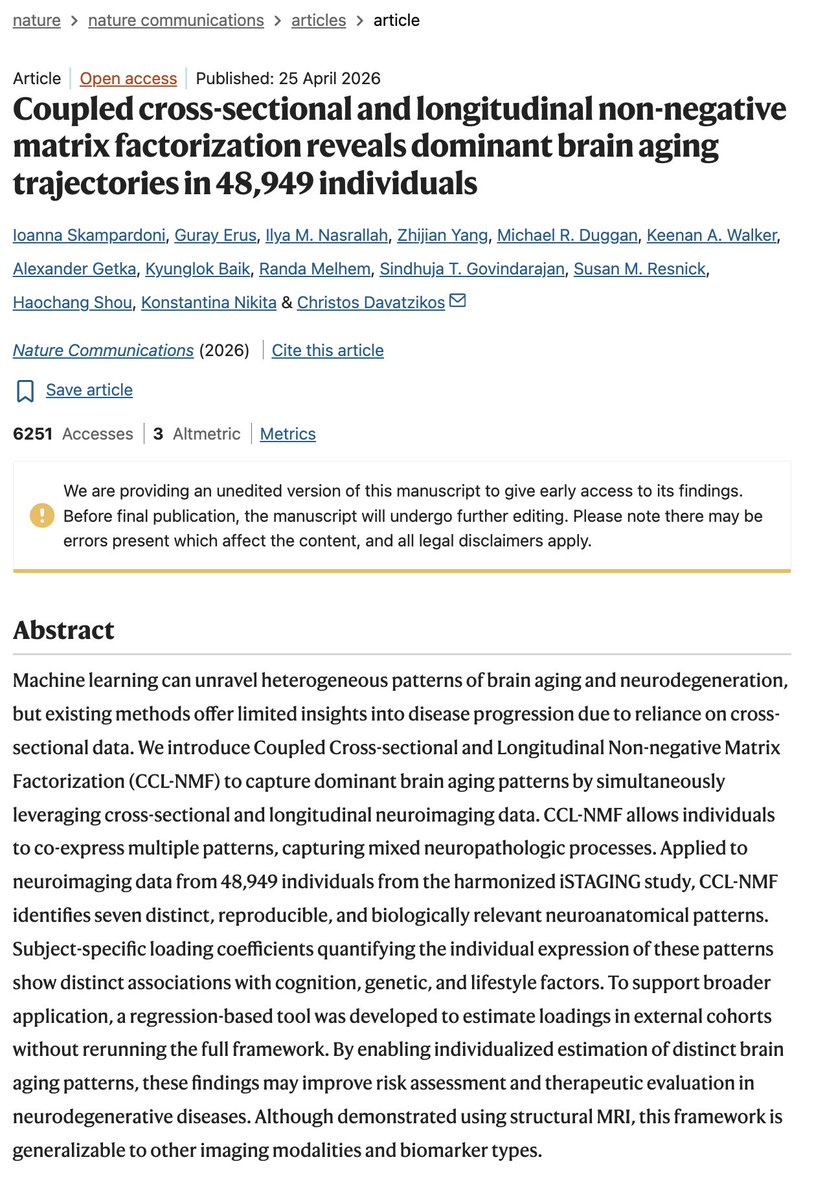
De acuerdo con un estudio que analizó casi 49,000 individuos mediante resonancia magnética estructural y datos longitudinales; el envejecimiento cerebral no sigue una única trayectoria, sino que se organiza en siete trayectorias neuroanatómicas principales de atrofia cerebral, las cuales pueden coexistir en un mismo individuo con distinta intensidad. Trayectorias principales del envejecimiento cerebral 1. Trayectoria orbitofrontal-subcortical Caracterizada por atrofia en el putamen, caudado, giro orbitario, giro recto y región subcallosa. Se asocia principalmente con obesidad e hipertensión. 2. Trayectoria temporal medial Presenta atrofia en el hipocampo, lóbulo temporal medial, polo temporal, giro temporal y giro fusiforme. Constituye la trayectoria con mayor relación con la enfermedad de Alzheimer, la acumulación de amiloide y tau, el deterioro cognitivo y la progresión desde deterioro cognitivo leve hacia demencia. 3. Trayectoria fronto-occípito-temporal Comprende atrofia en el giro frontal inferior, regiones occipitales y parte del lóbulo temporal. Se relaciona principalmente con el envejecimiento cronológico y representa un patrón ampliamente distribuido en la población envejecida. 4. Trayectoria frontoparietal medial Afecta el giro frontal superior y medio, precúneo, corteza cingulada media y posterior, área motora suplementaria y lóbulo parietal superior. Se asocia principalmente con depósitos de proteína tau. 5. Trayectoria perisilviana Incluye atrofia de la ínsula, opérculos frontal y central, planum polare y giro cingulado anterior. Se relaciona con factores de riesgo cardiovascular, especialmente hipertensión, obesidad e hiperintensidades de la sustancia blanca. 6. Trayectoria de ganglios basales profundos Caracterizada por atrofia en el núcleo accumbens, globo pálido y tálamo. Se asocia con obesidad e hiperintensidades de la sustancia blanca, sugiriendo un componente vascular. 7. Trayectoria cerebelo-occipital medial Comprende atrofia del cerebelo, cúneo, corteza calcarina y giro lingual. En este estudio no mostró asociaciones significativas con biomarcadores de enfermedad de Alzheimer ni con factores cardiovasculares, lo que sugiere una contribución diferente dentro de la heterogeneidad del envejecimiento cerebral. Fuente: nature.com/articles/s4146…
Umberto León Domínguez 🧠 🤖 tweet media
Español
0
23
47
2.1K
Hua Bai retweetledi
rk_seamless
rk_seamless@rk115877·
NIHが統合ゲノム・電子健康記録(EHR)データベース「All of Us」researchallofus.orgのデータ公開。 53万の全ゲノム配列と、約48万のEMRデータが紐づけ😮 NIH's All of Us Research Program is now the largest integrated genomics and health database in the world nih.gov/news-events/ne…
日本語
0
41
173
21.7K
Hua Bai retweetledi
Perrimon Lab
Perrimon Lab@PerrimonLab·
New paper: Lipid metabolism of hepatocyte-like cells supports intestinal tumor growth in Drosophila. Huang K, Miao T, Chen Y, Dantas E, Sanford J, Asara JM, Moon SJ, Hu Y, Wang K, Han M, Goncalves M, Perrimon N. Nat Commun. 2026 Jul 3. doi: 10.1038 s41467-026-75074-w.
English
0
6
12
1.6K
Hua Bai retweetledi
Marios Georgakis
Marios Georgakis@MariosGeorgakis·
The All of Us program announced earlier this week a new data release from 747,000 participants, including: 👉 535,000 whole-genome sequences 👉 Electronic health record data from 482,000 participants 👉 Combined proteomics and transcriptomics from ~8,000 participants 👉 Fitbit wearable data from 68,000 participants This is already the world's largest genomic resource integrated with longitudinal clinical data, surpassing resources such as FinnGen and UK Biobank. It's remarkable to think that the program launched only in May 2018 and has already generated a resource of this scale, contributing to more than 1,000 publications. Importantly, as with all longitudinal population resources, its value is likely to compound over time as additional follow-up datapoints from each participant accumulate. Building, expanding, and enriching foundational resources like All of Us is one of the highest-return investments we can make in biomedical research.
Marios Georgakis tweet media
English
5
37
136
13.9K
Hua Bai retweetledi
Eric Topol
Eric Topol@EricTopol·
The cancer-Alzheimer's paradox, an inverse correlation, with an unexplained mechanism "The risk of Alzheimer’s disease in patients with cancer is significantly reduced, and the risk of cancer in patients with Alzheimer’s disease is halved." nature.com/articles/s4151…
English
52
287
1.2K
234.6K
Hua Bai retweetledi
Prof. Nikolai Slavov
Prof. Nikolai Slavov@slavov_n·
Since the 1960s, the genetic code has been used to predict protein sequences from DNA and mRNA sequences.  Our @Nature article demonstrates that these predictions miss thousands of protein sequences present in human tissues. Across >1,000 human samples, we identified numerous abundant proteins whose amino acid sequences differ from those predicted by the genetic code. These proteins are not rare translation byproducts. They accumulate to thousands of copies per cell. Some are more abundant than the proteins predicted by the genetic code from the same transcripts. Their abundance reflects a combination of alternate RNA decoding mechanisms — including codon-anticodon mismatches, tRNA abundance, and RNA modifications — and selective stabilization of the resulting proteins. The last factor – protein stability – emerges as a major determinant of protein abundance across proteins, proteoforms and cell types: #Proteostasis" target="_blank" rel="nofollow noopener">slavovlab.net/research.htm#P… Alternate RNA decoding is pervasive across functional groups of proteins, healthy and diseased tissues. It affects proteins playing key roles in neurodegeneration, and some alternately decoded proteins show strong enrichment in tumors compared to their surrounding tissues. This discovery has been a long and exhilarating journey with Shira Tsour and the @slavovLab team. It started in 2019 and proceeded through many challenges and thrilling highs. A journey that has opened new perspectives that we long to explore! 1/
Prof. Nikolai Slavov tweet media
Slavov Laboratory@slavovLab

We report many proteins not predicted by the genetic code. They are stable & abundant O( 10³ ) copies / cell. Generative mechanisms include codon-anticodon mismatches & RNA modifications. Their abundance depends on codon frequency & protein stability. biorxiv.org/content/10.110…

English
18
236
782
118.1K
Hua Bai retweetledi
墓碑科技
墓碑科技@mubeitech·
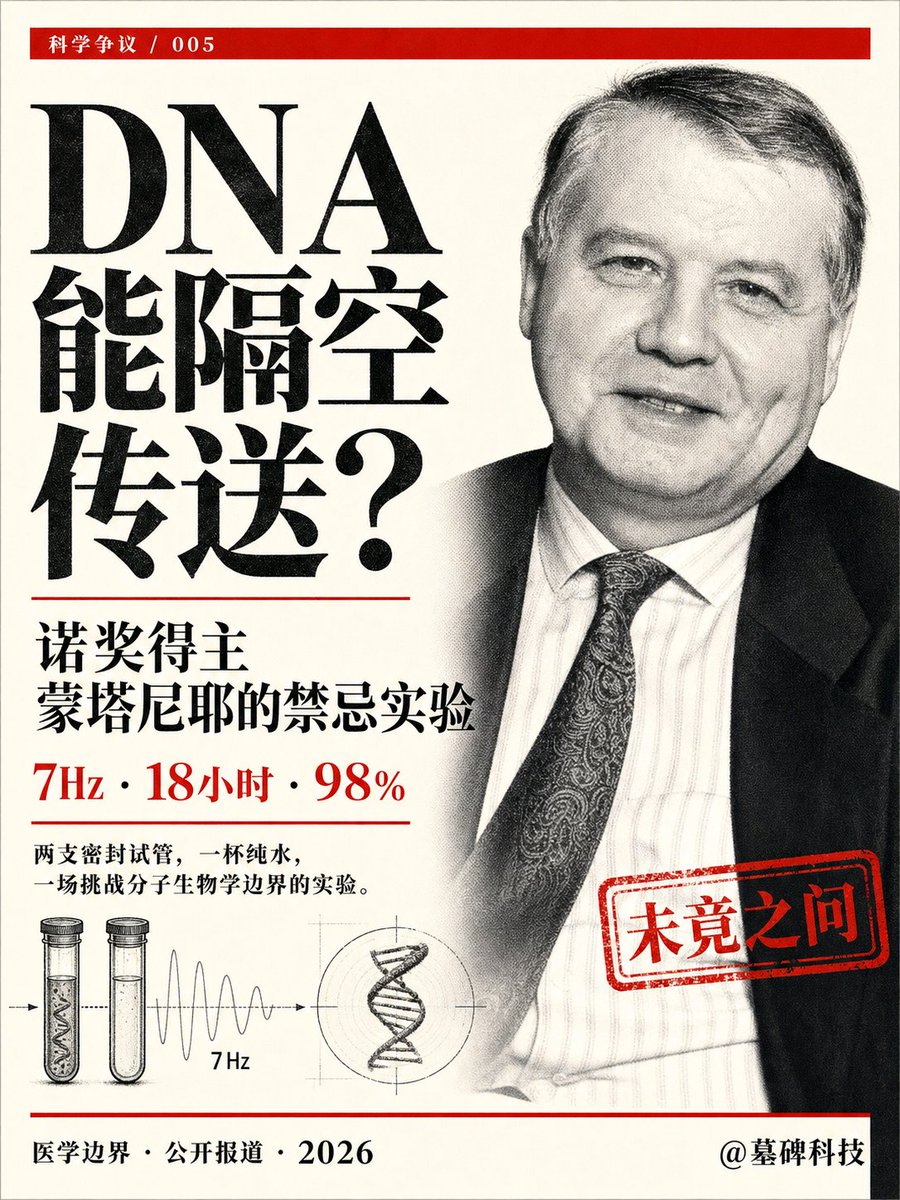
一个拿了诺贝尔奖、发现HIV病毒的医学界泰斗,居然因为证明了“DNA能隔空传送”而被自己的国家扫地出门。 这位牛人叫 Luc Montagnier。 2008年他刚拿了诺贝尔生理学或医学奖,在法国顶级科研机构巴斯德研究所干了50年,是绝对的国宝级科学家。 但他动了不该动的蛋糕。 2009年,他做了一个直接掀翻现代分子生物学地基的实验。 两个密封的试管。 一号管,装了溶有细菌DNA的水。 二号管,纯净无菌水,里面什么都没有。 他把两个管子并排放着,没有任何物理接触,然后用 7Hz 的微弱电磁场照射了18个小时。 接下来,奇迹发生了。 他对二号管里那杯原本什么都没有的纯水,进行了 PCR 基因扩增。 结果,这杯纯水里居然凭空“长”出了和一号管一模一样的DNA序列。 准确率高达 98%。 物理实体没有发生任何位移,隔空跨越边界的,只有电磁信号。 一号管的 DNA 发射了某种电磁频率,二号管的水接收了信号,然后自我重组,把这个基因结构给“画”了出来。 这就是 DNA 的电磁传送。 水有记忆,也能充当信号的接收器。 Montagnier 兴奋地发表了论文,甚至 :未来医学的天下属于电磁,不属于化学。 结果,法国学术界一夜之间集体破防。 曾经的国家英雄,转眼就被媒体 and 同行扣上了“伪科学”的帽子。 逼得他不得不离开法国,并留下一句话:“这里存在一种来自无知者的智力恐怖。” 最后,是中共国的上海交通大学给了他资金和实验室,让他把这个研究继续做了下去。 为什么西方学术界和制药巨头这么害怕这个理论? 因为如果人体是一个以水为介质的电磁信号网络,不单是化学分子的堆砌; 如果治病不需要吃高价药,只需要修复受损的电磁信号; 那么,现在这个建立在化学分子、抗生素、高价靶向药之上的万亿美元医药帝国,将在瞬间土崩瓦解。 2022年,Montagnier 教授去世了。 主流媒体在写讣告时,极力歌颂他发现 HIV 的功绩,却对这个改变人类命运的电磁实验只字不提。 他们可以抹去一个科学家的名字,但抹不掉已经发射出去的信号。
墓碑科技 tweet media
中文
41
122
327
27.1K
Hua Bai retweetledi
Eric Topol
Eric Topol@EricTopol·
That's a lot of spatial human proteomics! >13,000 proteins ~3,0000 samples 58 major tissues types 25 cancer types nature.com/articles/s4158…
Eric Topol tweet media
English
9
165
501
43.5K
Hua Bai retweetledi
Daisy Ding
Daisy Ding@daisyding_·
To solve aging, we first need to measure it. Excited to share our study in @NatureMedicine! Different cell types age at different rates within our body. From a tube of blood, we track aging across 40+ cell types, from immune cells to neurons, revealing signatures that forecast disease risk and resilience. @wysscoray 🧵1/9
Daisy Ding tweet media
English
14
114
535
63.2K
Hua Bai retweetledi
Cell Press
Cell Press@CellPressNews·
Why do some organs age faster than others? By integrating multi-omics and genetic data, researchers mapped organ-specific aging clocks and uncovered distinct molecular pathways driving heterogeneous aging across the body. #Impactfulpapers @CellGenomics dlvr.it/TT0KPz
English
1
9
29
2.5K
Hua Bai retweetledi
Bryan Johnson
Bryan Johnson@bryan_johnson·
This is biblical. A woman in her eighties. Ten years into Alzheimer's. Hadn't spoken a full sentence in five years. Takes one, 5 gram dose of psilocybin. She slept 19 hours and woke up and spoke for hours about her life, recognized family and held real conversations. She regained bladder control after five years, walked on her own. and dressed herself. Gains held for weeks.
Bryan Johnson tweet media
English
1.3K
8.7K
74.8K
3.7M
Hua Bai retweetledi
狮国游民
狮国游民@SgLittlesmart·
C盘最恶心的四大害虫 随便一清就是几十G
中文
59
91
267
34.6K
Hua Bai retweetledi
Eric Topol
Eric Topol@EricTopol·
AI of radiologist read as normal mammograms shown to detect high-risk of breast cancer out several years "Artificial intelligence scores from sequential mammograms in individuals diagnosed with breast cancer showed elevated scores up to 10 years before diagnosis" a retrospective study, but supported by prospective study in 3-5 year time horizon pubs.rsna.org/doi/10.1148/ra… erictopol.substack.com/p/why-all-mamm…
English
19
67
276
82.4K
Hua Bai retweetledi
NIH Innovates
NIH Innovates@NIH_Innovates·
Join Dr. Regina Barzilay for the 2026 Joseph Leiter NLM/MLA Lecture on how AI is revolutionizing disease discovery! 🧬💻 🗓️ June 10, 2026 | 2-3 PM ET 🔗 Join here: bit.ly/4v0FSQK #MLA26
NIH Innovates tweet media
English
1
5
21
3.8K