Daisy Ding

68 posts

Daisy Ding

Daisy Ding

@daisyding_

ai, aging, precision medicine | phd @stanford, postdoc @wysscoray, chief of staff to vinod @khoslaventures | views are my own

Menlo Park, CA Katılım Kasım 2017
163 Takip Edilen472 Takipçiler
Sabitlenmiş Tweet
Daisy Ding
Daisy Ding@daisyding_·
To solve aging, we first need to measure it. Excited to share our study in @NatureMedicine! Different cell types age at different rates within our body. From a tube of blood, we track aging across 40+ cell types, from immune cells to neurons, revealing signatures that forecast disease risk and resilience. @wysscoray 🧵1/9
Daisy Ding tweet media
English
14
114
536
62.8K
Gabriele Corso
Gabriele Corso@GabriCorso·
Big news from Boltz - our biggest update yet! 🚀 Today we’re releasing two new state-of-the-art models for protein and small molecule design with extensive wet lab validation and a new API to run all of our models on scalable GPUs wherever you (or your agents) work! 🔥
English
34
241
1.1K
135.8K
Daisy Ding
Daisy Ding@daisyding_·
To solve aging, we first need to measure it. Excited to share our study in @NatureMedicine! Different cell types age at different rates within our body. From a tube of blood, we track aging across 40+ cell types, from immune cells to neurons, revealing signatures that forecast disease risk and resilience. @wysscoray 🧵1/9
Daisy Ding tweet media
English
14
114
536
62.8K
Sid Sijbrandij
Sid Sijbrandij@sytses·
Daisy did an amazing job quantifying aging. There is a lot of noise out there, but this is the straight science that shows how aging unfolds. Our organs can age at different speeds. Turns out you can measure it with the proteins found in blood plasma. Great stuff!
Daisy Ding@daisyding_

To solve aging, we first need to measure it. Excited to share our study in @NatureMedicine! Different cell types age at different rates within our body. From a tube of blood, we track aging across 40+ cell types, from immune cells to neurons, revealing signatures that forecast disease risk and resilience. @wysscoray 🧵1/9

English
3
1
19
4.4K
Daisy Ding
Daisy Ding@daisyding_·
More aged cell types → worse survival. Mortality rose in a clear dose-response pattern with cumulative cellular aging burden. 5/9
Daisy Ding tweet media
English
1
0
18
1.5K
Daisy Ding
Daisy Ding@daisyding_·
@sytses Thank you so much, Sid! Exciting to see how much insight into aging we can now read from blood proteins 🩸🧪
English
0
0
1
98
Daisy Ding
Daisy Ding@daisyding_·
@QuanquanGu Would be cool to design anti-aging drugs with your platform!
English
1
0
3
215
Daisy Ding
Daisy Ding@daisyding_·
@WilliamWallace Thank you for highlighting our work! Here's a simple breakdown of our study: x.com/daisyding_/sta…
Daisy Ding@daisyding_

To solve aging, we first need to measure it. Excited to share our study in @NatureMedicine! Different cell types age at different rates within our body. From a tube of blood, we track aging across 40+ cell types, from immune cells to neurons, revealing signatures that forecast disease risk and resilience. @wysscoray 🧵1/9

English
0
1
10
579
William A. Wallace, Ph.D.
William A. Wallace, Ph.D.@WilliamWallace·
One of the largest (and most important) aging studies ever run: 60,542 people, 7,000+ blood proteins, 40+ cell types, 15 years of follow-up. Your organs age at different speeds, and lifestyle moves it. Extreme muscle aging meant 12.7x ALS risk. Extreme astrocyte aging predicted Alzheimer's as strongly as APOE4.
William A. Wallace, Ph.D. tweet media
English
3
33
173
11.3K
Daisy Ding
Daisy Ding@daisyding_·
@AriyoshiMd Thank you for covering our work! Here's a simple breakdown of our study: x.com/daisyding_/sta…
Daisy Ding@daisyding_

To solve aging, we first need to measure it. Excited to share our study in @NatureMedicine! Different cell types age at different rates within our body. From a tube of blood, we track aging across 40+ cell types, from immune cells to neurons, revealing signatures that forecast disease risk and resilience. @wysscoray 🧵1/9

English
0
0
2
237
Nobuhiro Ariyoshi MD
Nobuhiro Ariyoshi MD@AriyoshiMd·
血液検査で「どの細胞が老けているか」を推定できるかもしれない、という研究(nature medicine) 約6万人の血液中タンパク質を解析し、脳・免疫・筋肉・肺など40種類以上の細胞ごとの老化度を推定。 結果、老化は全身で一斉に進むのではなく、細胞ごとにバラバラに進む可能性が示された。 たとえば、 ・アストロサイトの老化はアルツハイマー病 ・骨格筋細胞の老化はALS ・肺の上皮細胞の老化は肺がんリスクと関連 まだ診断に使える段階ではないが、将来の予防医療は「年齢」ではなく「どの細胞が先に老けているか」を見る時代になるかも
Nobuhiro Ariyoshi MD tweet media
日本語
4
46
206
10.5K
Daisy Ding retweetledi
Eric Topol
Eric Topol@EricTopol·
This is one of the most important papers advancing the science of aging. Now at the cell level. Another outgrowth of the era of high-throughput proteomics.
Eric Topol@EricTopol

Within our body, different cell types exhibit a varying pace of aging. Discovery of how that can be tracked by cellular proteomics, from a tube of blood, and what that means for health outcomes, For example, the clock of brain astrocytes and development of Alzheimer's disease. @NatureMedicine @wysscoray This takes organ clocks to the next level! nature.com/articles/s4159…

English
5
73
406
70.1K
Daisy Ding
Daisy Ding@daisyding_·
@EricTopol Thank you @EricTopol for highlighting our work! Here's a simple breakdown of our study: x.com/daisyding_/sta…
Daisy Ding@daisyding_

To solve aging, we first need to measure it. Excited to share our study in @NatureMedicine! Different cell types age at different rates within our body. From a tube of blood, we track aging across 40+ cell types, from immune cells to neurons, revealing signatures that forecast disease risk and resilience. @wysscoray 🧵1/9

English
0
0
9
652
Eric Topol
Eric Topol@EricTopol·
Within our body, different cell types exhibit a varying pace of aging. Discovery of how that can be tracked by cellular proteomics, from a tube of blood, and what that means for health outcomes, For example, the clock of brain astrocytes and development of Alzheimer's disease. @NatureMedicine @wysscoray This takes organ clocks to the next level! nature.com/articles/s4159…
Eric Topol tweet media
English
12
75
322
108.9K
Daisy Ding
Daisy Ding@daisyding_·
We leveraged the plasma proteome: 7k+ proteins measured in 60k+ individuals across three independent cohorts. We built cell-type aging clocks and found that accelerated / youthful cellular aging predicts mortality, future disease, and resilience. 4/9
Daisy Ding tweet media
English
1
2
29
2.1K
Daisy Ding
Daisy Ding@daisyding_·
Aging is not a single clock ticking uniformly across the body. It unfolds across biological scales: cells → organs → individuals. Lifespan reflects the integration of aging rates across these levels. Cells shape organ function and disease vulnerability. So we asked: can we measure aging at cellular resolution in humans? 3/9
Daisy Ding tweet media
English
2
3
30
1.9K
Daisy Ding
Daisy Ding@daisyding_·
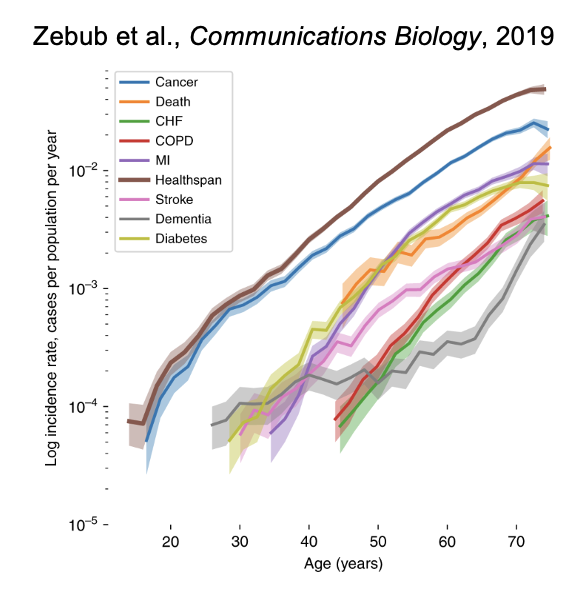
Aging is a central driver of many diseases, from neurodegeneration to cancer. But not everyone ages along the same trajectory. Why do some people remain resilient while others become vulnerable? 2/9
Daisy Ding tweet media
English
1
2
26
2.4K