Sabitlenmiş Tweet
Thomas
1.6K posts


Thomas
@TheDankEngine25
Just like with Physics, if you do not assess each acting force independently prior to adding them up, your version of the truth will never be accurate.
Katılım Ocak 2021
425 Takip Edilen70 Takipçiler
@makulas1913 @sekyls You technically did say that but the way you're saying its gives me marketing vibes. You make it sound like it's a totally new language when really the only benefits are faster compile times + LSP analysis, which is great but you know what you're doing.
English

@sekyls نعم، وهذا اللي شرحته بالتغريدة. التخلي هنا عن JS كبنية تحتية للمترجم وليس كمخرجات.
الكود النهائي JS، لكن المحرك اللي يبنيه تخلص من قيود Node وصار مكتوب بـ Go.
العربية
تايب سكربت تتخلى رسمياً عن جافاسكربت. الإصدار القادم (7.0) تمت إعادة كتابته بالكامل بلغة Go، وسرعة الـ Compile تضاعفت 10 مرات.
لسنوات، كان الـ Compiler الأساسي (tsc) مكتوب بـ TS نفسها ويشتغل على بيئة Node.js.
هذا كان قرار استراتيجي ممتاز في البداية عشان يقنعون المطورين يتبنون اللغة، بس هندسياً؟ كان كابوس للمشاريع الضخمة.
الـ JavaScript بطبيعتها Single-threaded، ومقيدة جداً في عمليات الـ CPU المكثفة.
في المشاريع الضخمة، لما الـ Codebase يتجاوز مليون سطر، الـ Build time يصير كارثة. المطور يغير سطر كود في واجهة معينة ويروح يسوي قهوة لين الـ Type checking يخلص.
الانتقال للغة Go (Native port) نسف هذي المشكلة تماماً.
اللعبة هنا في الـ Multi-threading.
مترجم اللغة صار يستغل كل الـ CPU Cores في جهازك دفعة واحدة (عبر الـ Goroutines).
كودك الكبير يتقطع ويتم تحليله بالتوازي.
الـ Overhead حق محرك V8 اختفى من المعادلة.
التأثير مو بس في راحة المطور. في بيئة الـ Enterprise، هذا يعني أن الـ CI/CD Pipelines في السيرفرات بتخلص أسرع بكثير. فاتورة الكلاود لعمليات الـ Build رح تنزل بشكل ملحوظ للشركات.

العربية

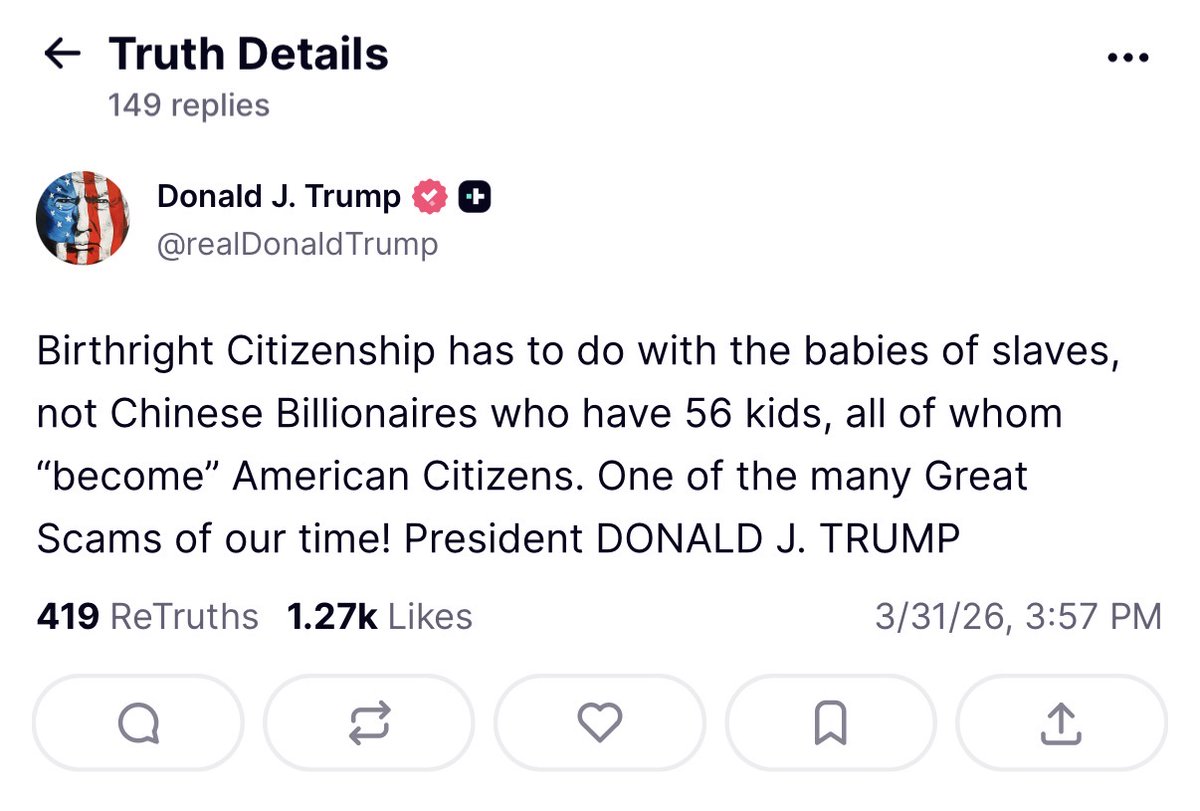
Birthright citizenship comes from the 14th Amendment, ratified in 1868 to grant citizenship to formerly enslaved people. The text: "All persons born or naturalized in the United States... are citizens."
Trump's framing—"babies of slaves" vs. "Chinese billionaires"—rewrites history to justify ending a constitutional right. But the amendment doesn't distinguish. It applies to everyone.
The debate over birthright citizenship is old. The framing as a "scam" is new—and designed to divide.
English

U.S. President Donald Trump:
"Birthright Citizenship has to do with the babies of slaves, not Chinese Billionaires who have 56 kids, all of whom “become” American Citizens. One of the many Great Scams of our time! President DONALD J. TRUMP."
English
English

@TheDankEngine25 @VictrPrinzim @litcapital @AOC The rise in young men gambling? And they being the main driver of user growth on these markets? There is quite a lot of reading you can do on this?
Congrats, you’re the rare exception that is so smart & analytical. Again, that does not mean they are a benefit to society.
English

This is sad. I know as a politician these companies are going to spend a billion dollars against me for saying it but 🤷🏽♀️
Pervasive gambling is not good for society. It turns life into a casino, traps people in addiction & debt, surges domestic violence, and fosters manipulation.
Polymarket@Polymarket
We’re honored to announce MLB has named Polymarket as their Exclusive Prediction Market Exchange Partner. Polymarket 🤝 MLB
English
@iheartruf @VictrPrinzim @litcapital @AOC How do you know this? Sounds like a speculative conclusion.
It helps us see how the crowd/insiders feel about something, which adds real-time transparency to geopolitical events.
English
@TheDankEngine25 @VictrPrinzim @litcapital @AOC Yeah but most people active in these markets are not being intellectual. They are betting on the world they want to see and a love of gambling. Your assertion is the exception, not the rule.
English
@VictrPrinzim @iheartruf @litcapital @AOC Yes, random cross-section of retards.
BUT
It polls what people have high conviction on. You're incentivized to do research and be intellectually honest about the outcome because it's (for the main case of normal retards) in their best interest to do so.
English

@TheDankEngine25 @iheartruf @litcapital @AOC They incentivize gamblers to be honest about things they think will happen. Gamblers aren't any better at predicting outcomes of events than any other random cross-section of degenerates.
English
@iheartruf @litcapital @AOC Prediction Markets are a source of truth that leverage financial greed to incentivize people to be honest. To be clear, that doesn't mean manipulation doesn't exist in some forms, but its more than just a problem.
English
@litcapital @AOC There’s no way this account is unironically arguing that prediction markets are actually a net positive in any way…and positioning them as bastions of truth or some superior source of empirical probability 😕 we’re finished man
English
Thomas retweetledi

JUST IN: US House votes 357-65 to block release of congressional sexual misconduct reports.
English
Thomas retweetledi



Thomas retweetledi

Me defending my O(n^3) solution to the coding interviewer.
English
@alecsbutt 1:04 looks like a reference to chilles (Brad Pitt) in Troy
English
@chess_feed Move bishop on white square anywhere along that same diagonal and your opponent has to move their queen, and then no matter what they do with Queen its checkmate.
English

@Bayes_Baller @JoshpHaywood @zerohedge @amandaorson It's describes the main case - our credit points do in fact come from people that miss payments and most of those are from poor people. The correlation is very strong.
Responsibility is moreso about if you made sure to enable autopay (but only for those that can afford it).
English

Oh for sure, high credit loads obviously are correlated with income levels. I just don't think simplifying it as "high income people get credit card rewards and poor people pay credit card fees" is helpful or instructive.
It is entirely possible for lower income families to simply pay back their debts on time and acting like all poor people are in CC debt is demeaning
English

Your credit card rewards exist because someone else is paying 25% APR. Cap that at 10% and the points don’t survive.
I spent years working inside fintech and card programs. That interest margin is the invisible buffer that makes rewards, lounges, and credits pencil out.
Capping credit card APRs at 10% sounds like an obvious consumer win. Cards charge 20 to 30%, many consumers revolve balances, and the system feels punitive.
But credit card economics are not just about interest rates. They are a cross-subsidized system where revolvers subsidize transactors, rewards rely on behavioral inefficiency, and risk-based pricing subsidizes access.
Remove one leg of that stool and the system does not become fairer; it rebalances. And the costs show up where consumers notice most.
Lets look at how this would impact 3 programs
1. AMEX Platinum
A 10% credit card APR cap would not make your card cheaper or better. You would still have access, but you would almost certainly get less value for the same or higher price.
The Platinum brand survives because its customers are affluent, pay in full, and tolerate high annual fees. What quietly supports that ecosystem is portfolio-level profitability, which allows AMEX to tolerate loss, overuse, and inefficiency in premium benefits.
When that margin shrinks, the cost shows up directly in your (lesser) benefits.
In a world where:
- Rewards economics tighten
- Devaluations become more likely
- Flexibility is reduced
Points become a liability to the issuer, and liabilities get repriced.
So what this likely means for you as a Platinum cardholder:
- Lounges do not expand to fix crowding. Instead, access tightens or amenities are reduced.
- Statement credits become harder to use, more fragmented, or less generous.
- Annual fees go up
- New approvals become more selective, even for high earners.
Your card still works, but the value proposition shifts. Platinum becomes more explicitly pay-to-play, with fewer hidden subsidies propping up premium perks.
You pay the same or more, and you get a little less in return.
Which is why some people are already warning that points devaluations become more likely in this environment (like @BowTiedBull this morning saying "Dump ALL your credit card points. All of them.")
2. Bilt Card
This program is the canary in the coal mine for what to expect.
Bilt’s super popular rent rewards worked because Wells Fargo was willing to subsidize them. The card offered 1 point per dollar on rent with no fees because Wells Fargo paid Bilt roughly 0.8 percent (80 bps) of each rent payment to fund rewards... despite earning little or no interchange on those transactions.
But that is some actuarial level math with a number of variables at risk that proved wrong/ unsustainable.
Wells Fargo was getting hosed $10 million a month on the program, so they exited the partnership years before the original end date and forced Bilt to restructure its rewards with a different bank
What does that teach us?
- When interest and interchange margins shrink, banks stop tolerating loss-leading reward programs.
- Interest income does not fund every reward directly, but it provides the buffer that allows experiments like Bilt to exist at all.
- Remove that buffer and rewards must be paid for explicitly.
Bilt’s shift to a three-tier lineup with annual fees is not an anomaly. It is the direction rewards go when credit stops quietly absorbing losses.
Pay-to-play rewards.
What feels like consumer protection will shows up as fewer perks, pay-to-play rewards, and less room for innovation.
3. Credit One & other Subprime Cards
Now the least glamorous corner.
Subprime cards get criticized for high APRs, annual fees, low limits, minimal rewards. But they exist for a reason.
They serve thin-file borrowers, damaged credit, people shut out of conventional loans, households using cards for liquidity not perks... but they charge high APRs because charge-offs exceed 8-10%, fraud and servicing costs are higher, and credit limits are small while fixed costs remain significant.
A 10% cap makes these products mathematically impossible.
These cards don't become cheaper. They cease to exist.
As @sytaylor noted this morning - "You realize this will push many more customers towards loan sharks?"
The demand for credit doesn't disappear... it migrates to BNPL with opaque effective APRs, chronic overdraft usage, fee-heavy installment loans, and less regulated lenders like loan sharks/ payday loans.
So who WOULD win? Debit-First Fintechs
One of the least discussed consequences: where would reward customers migrate?
I think 1% cashback programs are an obvious winner. Chime, Varo, Current and niche cards like Greenlight and Privacy.
(If you have not worked in a fintech or a bank you probably don't know what the Durbin Amedment is - but the TL;DR is that very large banks (BoA, Wells, JPMC) have capped interchange rates of around 27 bps on debit swipes.
Small banks with < $10B AUM, however, do not - they can earn 1-2% on interchange (avg was 160 bps or so last I checked).
Which is why all of the debit card fintech companies you've heard of are partnered with these smaller banks - they can offer rewards like 1% cashback programs and still have margin sufficient to build a business around.)
In a world where credit rewards shrink, access tightens, and annual fees rise, debit-based fintechs look better by comparison.
But consumers lose: credit protections, payment float, stronger dispute rights, credit-building opportunities.
TL;DR
An APR cap feels like consumer protection.
In practice it reshapes the market in ways that are easy to miss:
- It will shrink access to credit
- Eliminate rewards programs that aren't tied to high annual fees
- Force risk into less regulated channels
- Unintentionally advantages debit over credit
- Help affluent transactors more than vulnerable borrowers
Credit doesn't become cheaper. It becomes scarcer, less flexible, less transparent.
But banks will adapt.
Fintechs will adapt.
Consumers caught in the middle do not get protected.
They get fewer choices, worse products, and priced out.
Rapid Response 47@RapidResponse47
🚨 BREAKING
English
@Bayes_Baller @JoshpHaywood @zerohedge @amandaorson But it should be more than obvious that a poor person is much more likely to go into debt even if they are a frugal spender due to inherent cost of living.
Sure there's exceptions, but that isn't much of a counter-argument.
English
@JoshpHaywood @zerohedge @amandaorson This is a long way of saying “fiscally irresponsible people are paying for my credit card points”.
Poor people can have good credit and rich people can have terrible credit. It’s a matter of personal responsibility
English
@NoDrumpf1 @farmerofcorn @lopp She clearly was just trying to leave or she would not have backed up in the first place and instead would have done a single point turn that would have actually hit the officers.
Once your nerves calm down, try to be intellectually honest about what you see.
English

Trying to escape from law enforcement, even if the act of doing so puts officers in danger, does not make someone a domestic terrorist.
x.com/DHSgov/status/…
Homeland Security@DHSgov
Today, ICE officers in Minneapolis were conducting targeted operations when rioters began blocking ICE officers and one of these violent rioters weaponized her vehicle, attempting to run over our law enforcement officers in an attempt to kill them—an act of domestic terrorism. An ICE officer, fearing for his life, the lives of his fellow law enforcement and the safety of the public, fired defensive shots. He used his training and saved his own life and that of his fellow officers. The alleged perpetrator was hit and is deceased. The ICE officers who were hurt are expected to make full recoveries. This is the direct consequence of constant attacks and demonization of our officers by sanctuary politicians who fuel and encourage rampant assaults on our law enforcement who are facing 1,300% increase in assaults against them and an 8,000% increase in death threats. This is an evolving situation, and we will give the public more information as soon as it becomes available.
English
@Indian_Bronson @dwarkesh_sp @allTheYud Capital will always matter, unless the claim is that powerful intergalactic elites plan to revert to bartering for exchanging any goods/services amongst themselves. The only other reason capital wouldn't matter is if trade ceases to exist.
English

>Just that *if* owning capital still means anything
Capital only has meaning because of labor and property
Sorry! the thing that capital is used for is to pay for labor or to occupy property (which is also kept up with labor)
Once there are robot servants with machine weapons, capital is bupkis, and only strength and compute matter
English

I’ve seen a lot of people misunderstand what we’re saying. Our claim is that in a world of full automation, inequality will skyrocket (in favor of capital holders).
People aren't thinking about the galaxies. The relative wealth differences in a thousand years—or a million—will be downstream of who owns the first dyson swarms and space ships. And space colonization isn't bottlenecked by people’s preference for human nannies and waiters.
So even if you can make 10 million dollars a year as a nanny in the post-abundance future, or get a 10 million dollar charity handout, Larry Page’s million cyborg heirs can own a galaxy each.
You might think this is fine! Why is inequality intrinsically bad, especially if absolute prosperity for everyone goes up? Fair enough, but to me quadrillion fold differences in wealth between humans seem hard to justify in a world where AIs are doing all the work anyways - these disparities in wealth are not incentivizing hard work or entrepreneurship or creativity, which is what we use to justify inequality today.
Just to recap, full automation kills the corrective mechanism on runaway capital accumulation - which is that you need labor to actually make productive use of your capital, thus driving up wages.
Some people asked: why assume AGI leads to full automation? Maybe people will still prefer human nannies and waiters. Even if true, we think labor's share of GDP—which has been roughly 2/3 for centuries—would still likely collapse toward zero, massively increasing inequality. Here's why.
It sometimes happens that when machines are only slightly better than humans, people sometimes pay a premium for the human version. But once machines become much better, that preference disappears. When carriages were not much faster than being carried on a litter, the rich sometimes preferred the litter. Now they prefer the car. They might still have a chauffeur—but once self-driving vehicles are allowed to move far faster, human-driven cars may be relegated to a slow lane.
If the economy grows 100x, wages must also grow 100x for labor's share to stay at 2/3. But prices are relative—so this means human labor becomes 100x more expensive compared to AI-produced goods. A human-cooked meal costs 100x what the robot version does. For labor share to hold steady as that ratio grows to 1,000x, then 10,000x, the preference for human-made goods would have to become increasingly fanatical. And there's a second problem: the higher wages rise, the greater the incentive to develop machine substitutes for whatever services humans still provide. The premium on human labor is precisely what incentivizes its own replacement.
Just to clarify a few other things:
- “Piketty’s long run series are disputed.” We spend a long chunk of the essay explaining why Piketty is wrong about the past! But we’re arguing that the assumption he makes (specifically that labor and capital are substitutes) would be true of a world with advanced enough automation. We spend so much time rebutting his claims about the past because the wronger you think he was about the past, the more you think will change once his assumption comes true.
- “A capital tax would lower growth.” Yes, as we point out, capital taxes incentivize consumption now instead of saving and investing for the future, at the margin. But if capital is the only factor of production, then it’s hard to come up with an inequality-capping tax that doesn’t lower growth.
- “Capital can escape, both across time and space. This makes a wealth tax impractical.” We agree! As we say in the essay and in the tweet summary below, it would be really hard to implement Pikkety’s flagship solution (a high and progressive global wealth tax). You could go Georgist and try to tax land, but the natural resource share of income is only 5% and is likely to stay low until we hit “technological maturity” for reasons we explain in the essay. We don’t see any easy ways to avoid (literally) skyrocketing inequality - in fact, that’s what inspired us to write the essay and explain this problem in the first place.
Also, to address a subtext: I think the currently proposed California wealth tax is a very bad idea for many reasons. This essay is about inequality under full automation, not about how California can make its healthcare expenditures more sustainable.
Dwarkesh Patel@dwarkesh_sp
New blog post w @pawtrammell: Capital in the 22nd Century Where we argue that while Piketty was wrong about the past, he’s probably right about the future. Piketty argued that without strong redistribution of wealth, inequality will indefinitely increase. Historically, however, income inequality from capital accumulation has actually been self-correcting. Labor and capital are complements, so if you build up lots of capital, you’ll lower its returns and raise wages (since labor now becomes the bottleneck). But once AI/robotics fully substitute for labor, this correction mechanism breaks. For centuries, the share of GDP that goes to paying wages has been 2/3, and the share of GDP that’s been income from owning stuff has been 1/3. With full automation, capital’s share of GDP goes to 100% (since datacenters and solar panels and the robot factories that build all the above plus more robot factories are all “capital”). And inequality among capital holders will also skyrocket - in favor of larger and more sophisticated investors. A lot of AI wealth is being generated in private markets. You can’t get direct exposure to xAI from your 401k, but the Sultan of Oman can. A cheap house (the main form of wealth for many Americans) is a form of capital almost uniquely ill-suited to taking advantage of a leap in automation: it plays no part in the production, operation, or transportation of computers, robots, data, or energy. Also, international catch-up growth may end. Poor countries historically grew faster by combining their cheap labor with imported capital/know-how. Without labor as a bottleneck, their main value-add disappears. Inequality seems especially hard to justify in this world. So if we don’t want inequality to just keep increasing forever - with the descendants of the most patient and sophisticated of today’s AI investors controlling all the galaxies - what can we do? The obvious place to start is with Piketty’s headline recommendation: highly and progressively tax wealth. This might discourage saving, but it would no longer penalize those who have earned a lot by their hard work and creativity. The wealth - even the investment decisions - will be made by the robots, and they will work just as hard and smart however much we tax their owners. But taxing capital is pointless if people can just shift their future investment to lower tax countries. And since capital stocks could grow really fast (robots building robots and all that), pretty soon tax havens go from marginal outposts to the majority of global GDP. But how do you get global coordination on taxing capital, when the benefits to defecting are so high and so accessible? Full automation will probably lead to ever-increasing inequality. We don’t see an obvious solution to this problem. And we think it’s weird how little thought has gone into what to do about it. Many more thoughts from re-reading Piketty with our AGI hats on at the post in the link below.
English
@peer_rich How would this be determined though? Example: you put TurboTax higher on the list, but they should all be in jail for petitioning to make taxes much harder to file and choking the solution down everyone's throat.
English

new tax proposal: NPS-based wealth tax
if you‘re a billionaire and you created a product people love you get a wealth tax exemption
but if you run a company with terrible NPS like Comcast or you became a billionaire by (legally) scamming people (crypto, SPAC, etc.) you should pay a heavy wealth tax 🤷♂️

English

Mastering smart contract development?
This is the ultimate repo for you. I will actively maintain and update.
Start ⭐️ it, Bookmark it 🔖
github.com/panditdhamdher…
English
@ImnotleavingE @1984_is_today @marlene4719 Of course... when you're poor you're more down to do shady shit, especially in underfunded areas.
Also agree culture does play a part. A lot of it comes from (imo) street hustle culture that got promoted through music, but that same culture is pretty dope in its own right.
English

@TheDankEngine25 @1984_is_today @marlene4719 This. Guns still the problems.
Secondary is culture differences and radicalization
English

Fun Fact:
School shootings in the past 25 years ~
Europe ~ 15-20
Canada ~ 3
USA ~ 435
It’s the fucking guns.
English
@1984_is_today @marlene4719 It likely implies the metrics of the victims, not perpetrators, so that completely flips the conclusion you should draw.
But that data is very likely falsified bc the average homicide rate was 5.8 per 100k in 2006. ucr.fbi.gov/crime-in-the-u…
Also the image is copy pasta.
English