The Stock Doc

1.7K posts

The Stock Doc

The Stock Doc

@The_StockDoc

if my response seems sarcastic it probably is

Katılım Şubat 2018
285 Takip Edilen936 Takipçiler
The Stock Doc
The Stock Doc@The_StockDoc·
@nikitabier Remove the massive amount of imposter accounts, get rid of all the bots, tag or remove posts that are clearly AI/bot-written (“it’s not X, it’s Y”)
English
0
0
0
14
Nikita Bier
Nikita Bier@nikitabier·
Every time we do a user survey. What would make X better for you? Normal Person: > Maybe a podcast feature? Guy who reposted 370 videos from TikTok using Scheduled Posts, has never opened the app, and has a bot writing replies: > *Foaming from mouth* > Gib…more…money….
English
2K
444
13.1K
884.1K
The Stock Doc
The Stock Doc@The_StockDoc·
That’s completely incorrect. Medical school is a master class in pharmacology, physiology, pathology, and much more. And it’s more hours than a full-time job. RNs are great, don’t get me wrong, but they’re not experts in these areas. Someone who completes med school is already a doctor.
English
0
0
1
19
Happy Mom
Happy Mom@LL32868·
Respectfully, you don’t know very much than most RNs when you enter residency. The RNs I know have a vast experience and level of knowledge that they use to support new residents. Residency is still training. You are still be trained to be proficient in your profession and lucky to still get paid to continue this education.
English
1
0
0
115
Joseph Younis, MD
Joseph Younis, MD@YounisJoseph·
I actually agree with a lot of this report. Crazy stats: 1. Nurse practitioners and PAs who never attend medical school make 2x that of a resident physician 2. Resident wages haven’t changed in decades 3. The Match DOES force you to accept whatever you get
House Judiciary GOP 🇺🇸🇺🇸🇺🇸@JudiciaryGOP

#BREAKING: New Report Exposes How Medical Residency Hiring Monopoly Harms Patients and Doctors Newly obtained documents reveal how the Match placement system for resident physicians operates as a monopoly in the medical residency hiring market. Its monopolistic practices harm resident physicians, impede patients' access to care, and constrain the growth of America's physician workforce. A special-interest antitrust exemption currently shields the Match’s anticompetitive conduct from scrutiny, allowing it to harm the public while avoiding judicial oversight. Read the full report here: judiciary.house.gov/sites/evo-subs…

English
28
95
916
146.9K
The Stock Doc retweetledi
Hiroo Onoda
Hiroo Onoda@OnodaCapital·
Appears to be a springtime occurrence
Hiroo Onoda tweet media
Andrew Curran@AndrewCurran_

Three weeks ago there were rumors that one of the labs had completed its largest ever successful training run, and that the model that emerged from it performed far above both internal expectations and what people assumed the scaling laws would predict. At the time these were only rumors, and no lab was attached to them. But in light of what we now know about Mythos, they look more credible, and the lab was probably Anthropic. Around the same time there were also rumors that one of the frontier labs had made an architectural breakthrough. If you are in enough group chats, you hear claims like this constantly, and most turn out to be nothing. But if Anthropic found that training above a certain scale, or in a certain way at that scale, produces capabilities that sit far above the prior trendline, then that is an architectural breakthrough. I think the leaked blog post was real, but still a draft. Mythos and Capybara were both candidate names for the new tier, though Mythos may now have enough mindshare that they end up keeping it. The specific rumor in early March was that the run produced a model roughly twice as performant as expected. That remains unconfirmed. What is confirmed is that Anthropic told Fortune the new model is a 'step change,' a sudden 2x would certainly fit the definition. We will find out in April how much of this is true. My own view is that the broad shape of this is correct even if some of the numbers are wrong. And if it is substantially accurate, then it also casts OpenAI's recent restructuring in a new light. If very large training runs are about to become essential to staying in the game, then a lot of their recent decisions, like dropping Sora, make even more sense strategically. For the public, this would mean the best models in the world are about to become much more expensive to serve, and therefore much more expensive to use. That will put pressure on rate limits, pricing, and subscription plans that are already subsidized to some unknown degree. Instead of becoming too cheap to meter, frontier intelligence may be about to become too expensive for most of humanity to afford. Second-order effects; compute, memory, and energy are about to become much more important than they already are. In the blog they describe the new model as not just an improvement, but having 'dramatically higher scores' than Opus 4.6 in coding and reasoning, and as being 'far ahead' of any other current models. If this is the new reality, then scale is about to become king in a whole new way. It would also mean, as usual, that Jensen wins again.

English
1
2
76
13K
The Stock Doc retweetledi
Kaushik
Kaushik@WisemanCap·
Piper on $APP We spoke with an ad-monetization expert about APP and the mobile gaming landscape given competitive headlines. The key take: nothing has changed for APP or their market share on the demand or supply-side. They continue to out-execute peers and all signs point toward strong E-Com adoption. Reiterate OW, $650 PT.
English
7
10
120
13K
The Stock Doc
The Stock Doc@The_StockDoc·
I wish there were a filter to screen all the AI-written twitter replies. Trolls were the problem before, now the “it’s not x, it’s y” bots make it unreadable.
English
0
0
1
170
The Stock Doc
The Stock Doc@The_StockDoc·
This is a phenomenal idea and one example of where AI will really help in medicine: reducing monotonous and mindless tasks of charting to legal and billing specifications.
OpenEvidence@EvidenceOpen

Medical billing is broken. We built Coding Intelligence™ to fix this. Automatically generate CPT codes, E/M levels with MDM rationale and ICD-10 diagnoses from your documentation and the latest clinical guidelines. Live now in Visits for verified U.S. clinicians.

English
0
0
1
73
The Stock Doc retweetledi
Kaushik
Kaushik@WisemanCap·
$APP Down Premarket on Comments about Meta Challenge. - comments circulated early noting Meta is working to compete more directly with APP even though checks indicate APP has a strong competitive moat. - Buffer its own reporting noting APP is unlikely to give up market share due to strength of Max mediation tools.
English
5
10
60
15K
The Stock Doc retweetledi
Marc Lehman
Marc Lehman@markflowchatter·
So the DRAMs $MU / NAND $SNDK smoked today on a Google post dated last night Yet the abstract is from April 28 2025 Deepseek Bs moment arxiv.org/abs/2504.19874
English
10
10
116
26.6K
MacroValue
MacroValue@pradeeepk·
Positive for hyperscalers as cost of inference goes down $AMZN $MSFT $GOOGL & capex buys more for same Positive for logic $AVGO $AMD as memory bottlenecks eases. $NVDA mixed as groq may not be needed Negative for storage as NAND demand to store KV cache overflow eases $SNDK Big negative for memory $MU
Google Research@GoogleResearch

Introducing TurboQuant: Our new compression algorithm that reduces LLM key-value cache memory by at least 6x and delivers up to 8x speedup, all with zero accuracy loss, redefining AI efficiency. Read the blog to learn how it achieves these results: goo.gle/4bsq2qI

English
11
9
39
13.9K
The Stock Doc
The Stock Doc@The_StockDoc·
@rubicon59 $CRDO entirely unappreciated despite mind blowing top and bottom line results. Only a matter of time before the market figures it out.
English
0
0
5
247
rubicon59
rubicon59@rubicon59·
IDK much about trading and catching sentiment turns, but I would challenge anyone to find a better fundamental deal than $DLO and $CRDO right now.
English
8
2
60
9.1K
The Stock Doc
The Stock Doc@The_StockDoc·
@grok The market is interpreting this announcement as bearish for $MU and $SNDK. Please explain Jevons paradox and what the likely long-term effects will actually be for these companies.
Google Research@GoogleResearch

Introducing TurboQuant: Our new compression algorithm that reduces LLM key-value cache memory by at least 6x and delivers up to 8x speedup, all with zero accuracy loss, redefining AI efficiency. Read the blog to learn how it achieves these results: goo.gle/4bsq2qI

English
1
1
2
505
The Stock Doc retweetledi
Serenity
Serenity@aleabitoreddit·
Woah Nanya was my long earlier in the year... Did not expect $SNDK to take a $1B+ stake in it just now. Fact that Sandisk is taking stakes in companies like Nanya, means bottleneck in legacy memory might be bigger / more underpriced than marketes thought. Massive implications for others like Macronix + other TW companies. Or... $SNDK just has too much money from NAND price hiking and needed somewhere to spend it?
Serenity tweet media
English
25
24
408
65.2K
The Stock Doc retweetledi
Nietzsche F. Capital
Nietzsche F. Capital@Nietschecapital·
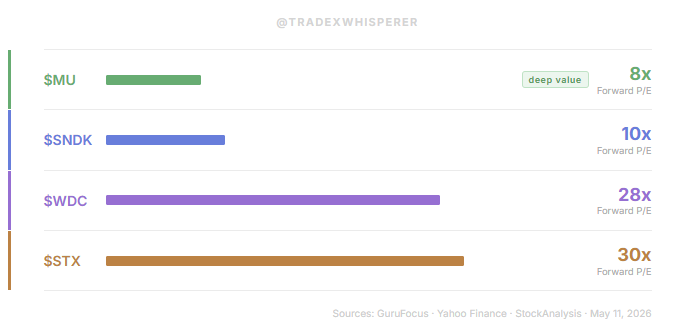
if $mu trades at forward 4x PE every other semiconductor stock should be trading at 1x PE and then we can call everything cyclical
English
8
3
84
8.2K
*Walter Bloomberg
*Walter Bloomberg@DeItaone·
TRUMP APPROVAL FALLS TO 36%, LOWEST SINCE RETURN TO WHITE HOUSE, REUTERS/IPSOS POLL FINDS
English
173
399
3.5K
287.2K
The Stock Doc
The Stock Doc@The_StockDoc·
$MU continues to be an mispriced. Jensen just said last week that "Physical AI is a $50 trillion market." There are structural supply constraints that will take at least 3-5 years to resolve if we listen to earnings calls. Micron is an undervalued opportunity.
The Stock Doc@The_StockDoc

Micron $MU just posted 75% sequential revenue growth, almost 3x last year’s revenue accompanied by exploding margins, and the stock sold off. Below I'll explain why I think that happened, and why I think it’s wrong. First, you have to understand how cyclicals such as semis have operated in the past. Historically, it has been a series of "boom and bust" repeats. New cycle starts, orders ramp up, companies begin to expand to have supply meet demand, their P/Es look really low as earnings grow, and then *poof* the stock evaporates overnight as the reality sets in that now there is a supply glut and prices fall. In these kinds of cyclicals, it's counterintuitive to think but when P/Es are the lowest is typically when it's the worst time to buy the stock. "This time is different" is the most expensive phrase in investing. There are countless blown-up accounts of people who thought this time was indeed different when it wasn't. If Micron (and the AI trade) is still investable, we have to determine whether this mantra is, in fact, bulletproof. With $MU destroying every conceivable expectation (and even aspiration) on both the top and bottom lines and P/E looking lower than ever, are we at the top? If we look to history, then yes. Margins are through the roof (typically suggesting a top). Yet, demand is so far above supply that even after massive expansion Micron sees their ability to fulfill customer orders even less as a total percent than prior. Let's look at the last few cycles for comparison: - PCs (80s-90s) - internet/telecom (late 90s) - smartphones (2010s) - COVID pull-forward (early 2020s) What is common to those cycles that is different today? Is there a difference? Well, looking at those catalysts it is pretty clear these were each single-vector markets. Huge markets, but single-vector. What's different now is concurrent multi-vector demand. AI training, AI inference, agentic AI, sovereign AI programs, EVs/autonomous vehicles, robotics, and edge compute are all on the board. The Mag-7 are spending $680 billion dollars AI / data center CapEx this year alone. Fortune Business Insights estimates the global autonomous & self-driving vehicle market could hit $41.75 trillion by 2034 and each of those vehicles needs well over 3,000 microchips. Not to mention we’re barely scratching the surface on robots. $NVDA CEO Jensen Huang said yesterday on @theallinpod that "Physical AI is a $50 trillion market." Simultaneously there are structural supply constraints that will take at least 3-5 years to resolve if we listen to earnings calls. This includes things like advanced packaging, HBM, NAND, and connectivity solutions and includes companies such as $CRDO, $ALAB, $LITE, $SNDK, and many others (full disclosure, I’m long all these names). Pricing power only diminishes when supply outweighs demand. And listening to these earnings calls, there is a common theme: demand is insatiable and no one is able to meet it. In prior cycles, peak margins meant supply was about to catch up. This time, even at peak margins, $TSMC advanced packaging is booked through mid-2027 and HBM/NAND supply is structurally short: the usual pressure valve doesn’t exist yet. With structural supply constraints extending through at least 2027 and concurrent demand vectors unlike anything in prior cycles, I think the odds favor duration over collapse – and I’m positioned accordingly.

English
1
0
1
580