Alex

1.5K posts

Alex banner
Alex

Alex

@TheeAlex

Meandering Between Philosophy, History and Revolutionary Finance

Katılım Mayıs 2025
315 Takip Edilen157 Takipçiler
Sabitlenmiş Tweet
Alex
Alex@TheeAlex·
we’ve somehow successfully decentralized finance, and that is applaudable but honestly, money is just one layer of freedom what about the stories we consume? or the news that shapes our minds? when a few at the top controls that, the proletariat reality itself becomes distorted the same way cash enables anonymity, at least to a large extent, we also need the vpn for truth i am afraid but it’s high time we have decentralized MEDIA outlets
English
2
0
9
664
Three Words
Three Words@III___Words·
@TheeAlex @Polymarket Have you seen how many people voted for Trump after he promised them no new wars, low prices and draining the swamp?
English
2
0
1
38
Polymarket
Polymarket@Polymarket·
JUST IN: Turkish YouTuber sentenced to 45,376 years in prison for convincing over 100,000 people to invest in virtual cows.
English
1K
994
10K
1.1M
Alex
Alex@TheeAlex·
honestly, this means with the right placement of words, you can literally convince anyone to do anything even to the point of paying the ultimate price think for a second, how terrorist would garb themselves with IED and detonate themselves at the point of target, all based on ideologies and brainwashing
English
1
0
1
22
Shimataver
Shimataver@shimataver·
@TheeAlex @Polymarket I agree. And as a film producer myself who is always needing to convince people to go to the cinema and see my film, I will gladly sign up for the course 🤣
English
1
0
1
27
probability god
probability god@probabilitygod·
@TheeAlex yeah, crypto was designed from ground up in order to server as a modular, interoperable and open financial ecosystem, and there's no other party that could benefit from this other than agents.
English
1
0
1
23
probability god
probability god@probabilitygod·
crypto will speedrun from “finance cosplay” to actual financial infrastructure the moment agents start interacting directly with the payments ecosystem. the interoperability of crypto/blockchain allows for seamless integration of complex financial services, transactions and opinions through a public, transparent ledger on top of a verifiable world computer. through a unified interface(wallet + smart contract function call) anyone (human or agent) can interact with financial primitives globally. just think about it. through a wallet alone you can: > lend and borrow funds > participate in speculative/prediction markets > raise capital through ICOs/token sales > exchange value globally with minimal fees and latency > get exposure to tradfi assets and their associated geopolitical/economic events > provide liquidity and earn yield > coordinate organizations through DAOs/multisigs > access programmable stablecoin payment rails 24/7 there’s no web2 payments system that natively supports all of this through a single composable infrastructure layer. and this becomes even more important once agents start transacting autonomously. eventually: > agents will pay for inference/compute > agents will buy APIs and datasets > agents will hedge geopolitical/economic exposure through prediction markets > agents will hire other agents for specialized tasks > agents will coordinate capital allocation through onchain organizations an AI trading agent interacting with polymarket, hyperliquid and a lending protocol simultaneously reality today. imagine what happens when agents performance maximizes. there’s a historic opportunity in building the infrastructure layer above which agentic payments and autonomous economic coordination become reality.
Anti Fund@Antifund

Crypto looked like finance cosplay until software started treating money like an API. The interesting companies now are not selling tokens. They are turning payments, incentives, and coordination into product primitives.

English
5
2
21
851
Alex
Alex@TheeAlex·
I say this even though ai agents potentials are still at their infancy stage and also discussions around x402 which was once the topic dejure, parroted by all of ct seems to be observing a 7th day rest. we are currently in the dispensation where, as an existing or new age builder, offering an ai agent (trading co-pilot) that can be retrofitted to a user’s risk appetite should be a low hanging fruit, especially for products centered around speculation on price action the ecosystem is gradually moving from users only wanting to speculate to wanting intelligent systems that can interpret opportunities and execute within their predefined risk appetite. people don't have the luxury of time to monitor charts all day; they want adaptive agents that can do majority of the heavy lifting for them builders of products like trojan, axiom, gmgn etc. understood early that this was not just a feature, but a strong prerequisite for user acquisition and retention. once a product becomes embedded into a user’s trading workflow and decision making process, switching costs naturally become higher, just like the pain that comes with migrating from the apple ecosystem to the android community
English
0
0
2
35
Alex
Alex@TheeAlex·
honestly, this is def a huge step for democratizing private market exposure, but it still only captures a slice of the full upside the synergy here would give traders exposure to valuation movements, not actual ownership of the underlying company’s stockk. since these contracts settle within a fixed range (0–100) the upside is inherently capped unlike holding real stocks, where holders can enjoy asymmetrical returns if the company eventually does ipo also the resolution layer. the markets depend on npm as the source of truth, but the valuation and settlement process remains largely obscure to inquisitive traders since it is offchain. so despite the onchain interface, users are still relying on a centralized “trust me” oracl model rather than blockchain’s fully verifiable transparency l feels more like an intermediary step toward tokenized private equity than the final form itself; nevertheless, a foot in the door is a win regardless
English
0
0
1
10
probability god
probability god@probabilitygod·
this is actually huge through polymarke's partnership with nasdaq private markets, traders can now get exposure to private company valuations (openai, anthropic, spacex etc) onchain. in other words ppl can own a part of a company that could literally change the trajectory of technology just by depositing some usdc > NPM essentially provides institutional infrastructure for secondary trading of pre-IPO/private company equity. it helps employees, VCs, founders and accredited investors buy/sell shares of private companies before public listing valuations are derived from actual secondary market activity and settlement infrastructure npm's being used as a resolution source for the associated event contracts on polymarket. for example, the event on anthropic's valuation is resolved based on npm's pricing page. hyperfinancialization of reality is actually manifesting itself onchain in real time. a market for everything. one primitive at a time.
probability god tweet mediaprobability god tweet media
Polymarket@Polymarket

We're excited to announce our exclusive partnership with Nasdaq Private Market. Retail traders can now get exposure to private companies, one of the historically most profitable asset classes, exclusively through Polymarket.

English
3
1
9
425
Alex
Alex@TheeAlex·
@maxyatsuk @PolymarketDevs yes you are right, the ux plays a major role in the whole infrastructure. one unintentional infrastructural sleight of hand, and you get millions liquidated. can you kindly share the link to the whole discovery :)
English
0
0
0
21
Max
Max@maxyatsuk·
I’d separate two things here. For users, yes – it may feel like a parlay with editing features. But under the hood, the guardrails probably need to be much closer to market structure / execution rules: 1. no fake liquidity from isolated dead combo books 2. clear pricing from underlying markets 3. routing + arbitrage to keep combo prices aligned 4. limits around unresolved / manipulated / illiquid legs 5. very clear UX for what happens when you edit a position The biggest “gameable” surface is probably not the combinatorial logic itself, but bad pricing, weak routing, or users misunderstanding what exposure they actually bought.
English
1
0
1
56
Max
Max@maxyatsuk·
Polymarket may be building the biggest upgrade prediction markets have ever seen I’ve been digging through the new Polymarket v2 contracts and found something much bigger than “parlays are coming.” Under the hood, this looks like infrastructure for trading entire probabilistic scenarios. A new contract called Combinatorial Module was deployed and verified on Amoy testnet, and the deployer is linked to an address Polygonscan labels as Polymarket: Deployer 1. So this does not look theoretical anymore. The core idea is simple: instead of trading isolated events, traders could trade entire chains of outcomes as a single position. Right now prediction markets mostly work like this: 1. Trump wins 2. BTC above $150k 3. Fed cuts rates 4. Recession in 2026 Each market exists independently. But real traders rarely think in isolated events. They think in causal chains. For example: If Trump wins, crypto gets a regulatory tailwind, BTC rallies, risk-on returns, and capital rotates back into high-beta assets. The interesting part is that the new module allows this exact structure to become one position: 1.1 Trump wins 1.2 AND BTC > $150k 1.3 AND Fed cuts rates Not three separate bets. One asset, one payout, one expression of a worldview. And if all legs resolve correctly, the position pays out $1. That means traders can buy cheap convex exposure to an entire macro thesis. If the market prices the scenario at 8¢ and the full chain plays out, the position settles for $1. This is where prediction markets start looking less like betting apps and more like probability derivatives. What makes this even more interesting is that the module appears to work cross-category. Sports, politics, crypto, macro, geopolitics — anything represented as binary/negrisk conditions can theoretically be combined. The contract supports up to 50 legs in a single structure. And the positions are not static. The code includes mechanics for: – splitting positions – merging them – extracting legs – recombining scenarios – compressing resolved conditions – and wrapping existing binary markets into combinatorial positions. In other words: this is not just “build a parlay and wait.” It is closer to building dynamic scenario structures that evolve as the world changes. The NO-side is where things become especially interesting! There is a very important distinction here: NO(A AND B AND C) is NOT the same thing as: NO(A) AND NO(B) AND NO(C) The first one is the complement of the entire scenario: NOT(A AND B AND C) meaning the structure fails if any part of the chain breaks. That subtle difference is why these markets become much more sophisticated than standard YES/NO betting. The market is no longer pricing isolated outcomes. It is pricing the stability of an entire connected narrative. This opens the door to a completely different class of products. At that point, prediction markets stop being “Will X happen?” They become: “Which version of the future is currently mispriced?” There are still two massive open problems. The first is liquidity. Every scenario gets its own conditionId / positionId, but the contract itself does not imply that every combination will have its own standalone orderbook. And if liquidity fragments across millions of possible scenarios, the system breaks immediately. Which means the real unlock is probably synthetic pricing and routing: using liquidity from underlying markets to construct and price scenario positions dynamically. The second challenge is UX. Because probability algebra gets confusing very quickly. Most users will not intuitively understand the difference between: NO(A AND B) and: NO(A) AND NO(B) So the challenge is no longer just building markets. It is building interfaces that make complex probabilistic structures understandable to humans. If Polymarket solves liquidity and UX, v2 may become much more than a prediction market upgrade. It could become the first real probability trading layer for the internet. Bullish. Huge W @devjoshstevens @mustafap0ly @Polymarket @PolymarketDevs @SuhailKakar
Max tweet media
English
33
13
124
16.5K
Alex
Alex@TheeAlex·
the Lazarus attack on bybit happened in similar manner in fact, one of the current winning points of tradfi is that in the case of events like that, there is an insurance mechanism set in place. institutional would operate in the crypto space with skepticism (which means Lower traffic of funds) unless there are safety nets put in place for cases like this. which begs the question, how can we install those guardrails without dislocating the structural strength of decentralization?
English
0
0
1
13
Shei
Shei@0xshei·
Imagine losing $36,000 just because you sent the wrong currency or typed the wrong account number That's the reality of crypto today... unsupported currency, incorrect address, and your funds could be gone forever Who's building the safeguard layer for this?
English
3
0
4
170
Alex
Alex@TheeAlex·
@DMLDeFi @Baheet_ nice nice!!! you should have used this statement as a quote tweet instead of a comment though
English
1
0
1
12
DML
DML@DMLDeFi·
this is actually one of the biggest untapped opportunities in prediction markets right now. everyone is fighting over the same liquidity.. crypto, sports, US elections, macro headlines. but the real long-tail markets are still ghost towns. things like, african elections, local music trends, creator economy outcomes, internet culture, regional business events, onchain governance, gaming ecosystems, weather in emerging markets, visa approvals, school admissions, reality TV, TikTok trends, startup launches… people underestimate how massive these niche information markets can become when communities already exist around them. the hardest part isn’t even the frontend. it’s, resolution systems, liquidity bootstrapping, trust, market creation tooling, distribution because long tail markets only work if creation becomes insanely cheap and resolution becomes reliable. right now most platforms still operate like top down casinos. the winner will probably feel more like YouTube + Reddit + financial markets combined. and honestly, web3 is one of the few environments where this can actually work globally.
English
2
0
1
94
Baheet
Baheet@Baheet_·
we are yet to see a prediction markets that serves the long tail markets almost every prediction platform is focused on crypto, sport and usa politics this is a gap yet to be filled…. Who’s building?
English
42
1
88
14.2K
Alex
Alex@TheeAlex·
Yeah. the biggest example of the wisdom of the crowds that a prediction market enthusiast would use to strong-arm critics is the last U.S. presidential election. but deep onchain analysis revealed that 3% of the accounts generated almost all of the volume in favor of Trump, making most people believe insiders knew Trump was actually winning, when in reality, it was all superficial. a textbook example of how PM can be distorted to manufacture reality.
English
0
0
1
16
Crypto Bet
Crypto Bet@CryptoBetsss·
We’re going to talk about how wrong Polymarket was on Eurovision at some point. Bulgaria, baby. Wisdom of the crowd.
English
1
0
1
36
Alex
Alex@TheeAlex·
we're all aware that insider trading isn't a new found error, I mean, it happens in almost all tradfi sector, what makes the outcry towards prediction market ballistic, is the blockchain transparency. the moment markets relating to geopolitics are created on polymarket, you have simultaneously created the incentive rails for insiders to monetize MNPI. ironically, the very transparency crypto prides itself on may become the bane of prediction markets. a privacy layer may eventually become necessary if these info leaks, becomes a threat to national security. btw, anyone knows the curation process of events on @Polymarket before they become tradeable live markets? would love to get in touch with anyone who works on that aspect :)
English
0
0
1
103
Alex
Alex@TheeAlex·
@probabilitygod prediction market overrides the concept of proxy exposure
English
0
0
1
6
probability god
probability god@probabilitygod·
rn i'm watching the piers morgan debate between professor jiang, steve keen and steve moore (former trump economic advisor) about the current iran-us situation and something interesting stood out to me. steve moore’s thesis was basically: > everything in the economy is a derivative of energy > if access to energy gets disrupted (e.g. strait of hormuz), oil prices spike, inflation returns, financial conditions tighten and political fallout follows > americans hate high gas prices, so if oil pumps hard, trump gets punished politically during the midterms what’s interesting is that despite being a former white house economist, he still indirectly quantified geopolitical risk through proxy assets, specifically oil futures contracts. he literally said he looked at 3-month oil futures to estimate whether the situation would deescalate or spiral further. but this is exactly where prediction markets become interesting. instead of inferring geopolitical probabilities through secondary asset reactions, prediction markets allow you to directly access the market-implied probability of the event itself. for example: > “US-Iran permanent peace deal by X date” > “Will the Strait of Hormuz close?” > “Will the US enter direct conflict with Iran?” these are direct probabilistic representations of geopolitical outcomes. institutional/state/corporate finance clearly needs mechanisms to quantify geopolitical risk, assess future outcomes and hedge against political/economic scenarios right now, they mostly do this indirectly through commodities, FX, rates, equities etc. prediction markets abstract this process into the pure event layer itself. this is basically the same argument IBKR CEO Thomas Peterffy made when explaining the rationale behind ForecastTrader product they launched a couple of months ago. the global economy increasingly needs a way to quantify future states of the world. prediction markets are probably the most capital-efficient mechanism we currently have for distilling decentralized knowledge + financial incentives into a single dynamic number: the YES share price. the debate: youtube.com/watch?v=dbVdnL…
YouTube video
YouTube
probability god tweet mediaprobability god tweet media
English
9
1
41
1.1K
Alex
Alex@TheeAlex·
a bit unrelated, but let me say this for the first time. one of the most interesting contrarian bets of the coming decades is probably the solar energy sector. having exposure rn, might feel like engaging in a faustian bargain in the short term, but the long-term upside could be astronomical. and here’s the crazy part: the earth currently receives more energy from the sun in a single hour (173,000 TWh) than humanity consumes in an entire year (160,000 TWh) that means humanity is currently capturing only a microscopic fraction of the solar energy constantly hitting the planet. what makes this even more interesting is that: everything in the economy is downstream of energy, talk of; AI, manufacturing, logistics, semiconductors, defense systems, EVs and data centers all require increasing amounts of electricity. at the same time, the global economy is still heavily exposed to fragile oil supply chains, geopolitical chokepoints and energy shocks. solar changes that architecture entirely. there’s no strait of hormuz for sunlight. no opec for sunlight. no sanctions regime for sunlight. which is why i think the next few decades may involve one of the largest repricings of energy infrastructure in modern history toward the most abundant energy source humanity has access to.
probability god@probabilitygod

rn i'm watching the piers morgan debate between professor jiang, steve keen and steve moore (former trump economic advisor) about the current iran-us situation and something interesting stood out to me. steve moore’s thesis was basically: > everything in the economy is a derivative of energy > if access to energy gets disrupted (e.g. strait of hormuz), oil prices spike, inflation returns, financial conditions tighten and political fallout follows > americans hate high gas prices, so if oil pumps hard, trump gets punished politically during the midterms what’s interesting is that despite being a former white house economist, he still indirectly quantified geopolitical risk through proxy assets, specifically oil futures contracts. he literally said he looked at 3-month oil futures to estimate whether the situation would deescalate or spiral further. but this is exactly where prediction markets become interesting. instead of inferring geopolitical probabilities through secondary asset reactions, prediction markets allow you to directly access the market-implied probability of the event itself. for example: > “US-Iran permanent peace deal by X date” > “Will the Strait of Hormuz close?” > “Will the US enter direct conflict with Iran?” these are direct probabilistic representations of geopolitical outcomes. institutional/state/corporate finance clearly needs mechanisms to quantify geopolitical risk, assess future outcomes and hedge against political/economic scenarios right now, they mostly do this indirectly through commodities, FX, rates, equities etc. prediction markets abstract this process into the pure event layer itself. this is basically the same argument IBKR CEO Thomas Peterffy made when explaining the rationale behind ForecastTrader product they launched a couple of months ago. the global economy increasingly needs a way to quantify future states of the world. prediction markets are probably the most capital-efficient mechanism we currently have for distilling decentralized knowledge + financial incentives into a single dynamic number: the YES share price. the debate: youtube.com/watch?v=dbVdnL…

English
0
0
6
117
Alex
Alex@TheeAlex·
@Ommiii_ Kalshi eating good these days 👀
English
1
0
1
15
Omar
Omar@Ommiii_·
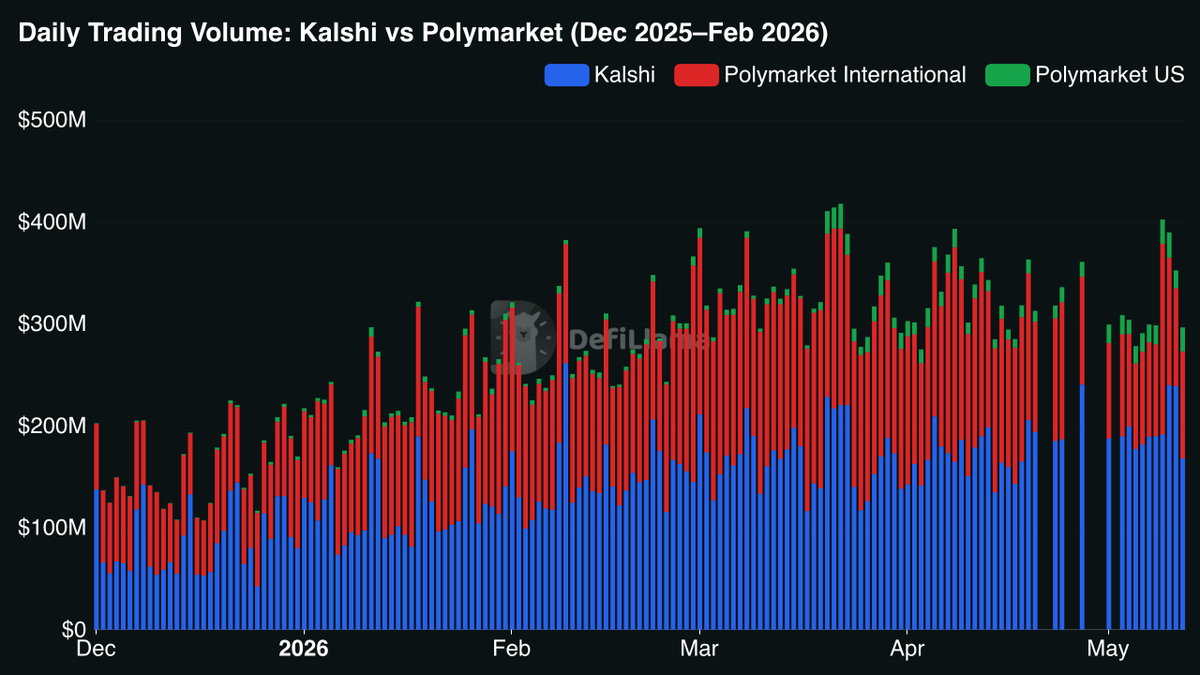
Polymarket just opened iOS to US users, and it needs it because US revenue has been slipping. Last 30 days (US) - Volume: $340M — down 15.5% - Fees: $6.46M — down 15.5% - Revenue: $1.62M — down 51.7% Fees and revenue are diverging. But that's the web-only product. For context, Kalshi has had an iOS app since 2022. Exciting stuff as now there is full mobile distribution to the largest crypto-native audience in the world. The US market is proven. Polymarket International is holding strong, revenue up 34.3% despite volume dipping. The next 60-90 days could be an interesting watch. Source: @DefiLlama
Omar tweet media
InGame@InGameHQ

Polymarket has finally fully opened access to its U.S. exchange for iOS users, ending its waitlist more than six months after it first accepted bets on its Commodity Futures Trading Commission (CFTC)-registered platform.

English
1
2
5
307
Alex
Alex@TheeAlex·
the disastrous impact of colonialism on the African continent wasn’t the wealth, resources, and manpower that were extracted, despite how horrific it was, but rather the psychological systems of tyranny and barbaric control that were left behind. so most of the times, whenever you witness an African security agencies brutalizing their civilians for trivial reason such as stepping on an armed officer’s shadow, they are often replicating the blueprint of ruling which involves subjugation, control, and extraction by the colonial master, which wasn't in any manner intended for egalitarian leadership Alkebulan truly needs deliverance
Dr. Chinonso Egemba@aproko_doctor

What happened at the University of Uyo Teaching Hospital yesterday is a national disgrace and must not be treated lightly! Calling on @officialEFCC to promote lawful conduct; to publicly call the officers involved in the act to order, @Fmohnigeria @nighealthwatch to protect our healthcare system, and the presidency @NGRPresident and @NGRSenate to look into this, so this doesn’t happen to any healthcare worker again. @UN @WHO @WHONigeria @UNICEF_Nigeria Justice must prevail. Say NO TO VIOLENCE AGAINST MEDICAL PRACTITIONERS. Enough is Enough.

English
0
0
2
78
Alex
Alex@TheeAlex·
@DeFi_Recker well, it all boils down to how you define gambling 😅
English
0
0
1
35
RECKER
RECKER@DeFi_Recker·
@TheeAlex Just gambling being rebranded to prediction markets 😂
English
1
0
1
24
Alex
Alex@TheeAlex·
in the feudal era, lands were rented out to the lowest class today we rent everything from housing, cars, software, cloud infrastructure, access to audience and even digital identity. i guess nothing really changed, twas only rebranded
English
1
0
3
45