

Throne Science
348 posts

Throne Science
@ThroneScience
Throne tracks gut health vitals and hydration with every flush.
Austin, TX Katılım Kasım 2022
3 Takip Edilen3.7K Takipçiler
NEW FEATURE: Throne’s Gut Health Coach is now live.
Connect the dots between your diet, lifestyle, and behaviors to your personalized gut health data with our newest feature, the Gut Health Coach.
🔗 Throne is a smart sensor that attaches to your toilet and automatically tracks your gut health and hydration without any manual logging.
🆕 Our Gut Health Coach combines your gut health and hydration score with daily journal entries to tell you what is actually helping and hurting your gut.
How it works:
📓 Log what happened in your day in your own words such as a late night meal, a morning workout, or eight hours of sleep the night before.
📊 After five or more logs of any factor, the Coach displays each factor on a scale from Hurts to Helps and identifies patterns using your journal entries and gut health score. Over time, the Coach uses that data to suggest specific things you can take action on to improve your gut health.
Note: The Gut Health Coach is currently in beta. In order to use the feature, you'll need to ensure your app is updated with the latest release. Features and insights will continue to improve as we learn, and your insights become more personalized the more you use it.
The Gut Health Coach is available exclusively in the Throne app. Tap the link to get yours.
#ThroneScience #GutHealthCoach #PersonalizedInsight #GutHealth
English
Want to learn more about why certain foods show up in your poop and what it means? We have you covered.
thronescience.com/blog/why-do-co…
English
Here's an interesting gut health fact: a spoonful of corn can give you a rough idea of how quickly food moves through your digestive system.
The outer layer of a corn kernel is rich in cellulose, a fiber your body cannot fully break down. The inside gets digested, but parts of that yellow shell often remain visible in your poop, making corn a handy little marker.
Eat some, note the time, and watch for when you first see it again. The gap gives you a rough estimate of how long it took to travel from plate to toilet.
Researchers tried this with 175 health-science students. The median transit time was about 29 hours, but individual results ranged from 1 hour to 99. Gut speed varies enormously from person to person.
Around 1-3 days is a reasonable ballpark. A much faster result may go along with diarrhea or unusually rapid transit, while a much slower one may suggest things are moving sluggishly.
But remember, one corn test isn't a diagnosis, and the result can shift depending on what you ate, how well you chewed, stress and your usual bowel habits.
Try it this week. Your inner dashboard may be a lot more knowable than you think.
English
Throne Science retweetledi

NEW ON THE POD: This episode covers something Claims Denied hasn't touched before: the world's first passive gut health monitoring device.
I sat down with @ScottHickle, co-founder of @ThroneScience, for a deep dive into the tech behind hands-free gut health, hydration, and urinary health monitoring — and yes, that means talking about poop for an hour.
It turns out to be one of the most fascinating conversations on the pod yet, covering real technology, wild behavior-change data, and a long-term vision for cancer screening.
Listen to the full episode (link in the comments) to hear:
• How Throne's monitor clips onto your toilet, identifies users via Bluetooth, and runs entirely in the background with no sample collection and no manual logging
• How Whoop's former CTO ended up joining the team after a hospital stay with ulcerative colitis
• What three years of obsessive product development looks like when building a camera for the most intimate room in someone's home
• What longitudinal gut health data reveals that elimination diets and manual stool logs can't
• How Oura Ring's decade-long arc — from 2,400 Kickstarter units to an $11 billion valuation — shapes Throne's own go-to-market patience
• The roadmap toward detecting microscopic blood in stool, and why that could make Throne a smoke detector for colon cancer, bladder cancer, and more
TIMESTAMPS
(00:00) Scott's origin story: pivoting from nurse staffing to smart toilets after a poker game and a very candid conversation with his geriatrician mom
(08:00) How Throne actually works — motion sensors, Bluetooth handshake, downward-facing camera, and why guests' privacy is protected
(16:00) The hydration engagement loop that's driving 68% behavior change in two weeks — and why the skeptics are wrong
(22:00) Clinical validation, research partnerships, and the long game toward microscopic blood detection for cancer screening
(32:00) The AI Gut Health Coach roadmap: personal experiments, dietary trigger identification, and building toward population-level "gastro types"
(46:00) Go-to-market beyond DTC — clinician dashboards, nursing facility use cases, and the payor reimbursement thesis
(52:00) Why putting a camera in your toilet is the new getting into a stranger's car — and the Oura Ring growth curve as the strategic template

English

There hasn’t been any real innovation in toilets since the carpet-covered toilet and it’s a damn shame.
English
A scientist once asked thousands of strangers to mail him their poop. It rewrote what we know about the gut.
The American Gut Project, led by microbiome researcher Rob Knight, did something no traditional lab could afford: it turned tens of thousands of ordinary people into citizen scientists, each mailing in a sample and a survey. It became one of the largest studies of the human microbiome ever assembled, built almost entirely on volunteers and raw curiosity.
The headline finding was almost comically simple. The single biggest predictor of a diverse, resilient microbiome wasn't whether someone was vegan or ate meat, and it definitely wasn't how many supplements they took. It was plant diversity. People who ate 30 or more different types of plants a week had noticeably more diverse gut communities than people who ate 10 or fewer. Different plants, not just more plants.
That one number, 30 plants a week, has helped shape mainstream gut-health advice ever since, and it came from strangers willing to do something slightly gross for the sake of science.
Sometimes the breakthrough isn't a fancier machine or a bigger budget. It's asking enough people the right question, and trusting that ordinary bodies have extraordinary things to tell us.
English
Forget counting supplements. Count plants. Not volume, but variety.
One of the most consistent findings in gut research is also one of the easiest to act on: people who eat around 30 different plants a week tend to have the most diverse, resilient microbiomes. The key word is different. Thirty servings of the same three vegetables doesn't do it. Variety does, because different plants carry different fibers, and different fibers feed different microbes. A diverse plate builds a diverse gut.
The good news is that "plant" is a generous category. Vegetables and fruit count, but so do whole grains, beans and lentils, nuts and seeds, and even dried herbs and spices in relatively small amounts. A sprinkle of oregano, a spoon of mixed seeds, a handful of a bean you don't usually buy: each one nudges the tally up. Most people are closer than they think to hitting that 30 plant goal.
So count, once, for a single week. Tick off every distinct plant you eat. You'll spot your ruts fast, and you'll spot the easy wins even faster.
Then play the only game that matters here: this week, add one plant you don't normally eat. Next week, add another. That's the whole strategy. Small, boring, but powerful for your gut health.

English
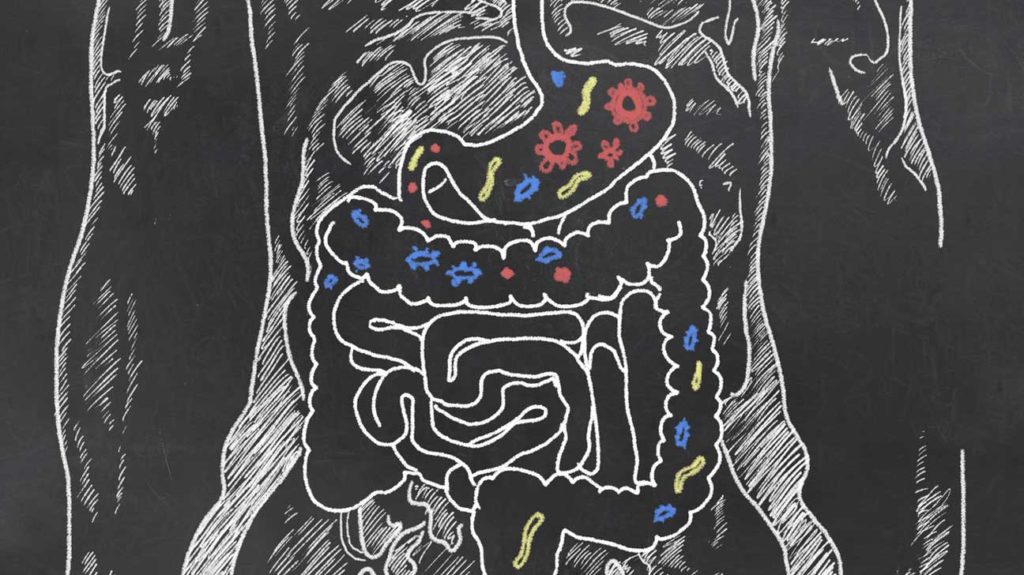
That growl in your stomach when you haven't eaten isn't always simple hunger. Sometimes it's your gut's cleanup crew.
Between meals, once your digestion starts to wind down, your gut switches on a slow cleanup wave called the migrating motor complex.
Every 90 minutes or so on an empty stomach, it sweeps leftover food, debris, and stray bacteria from your stomach down through the small intestine, keeping everything moving and stopping bacteria from overstaying their welcome.
That rumble can be the migrating motor complex at work. It gets loudest when your stomach is empty, which is exactly why it tends to be thought of as a hunger signal.
The wave only runs between meals. Graze all day, snack every hour, and you never give your migrating motor complex a clear shift to work. A little space between meals gives your gut the maintenance time it needs to stay healthy.
None of this means you should ignore real hunger, delay meals when you need food, or turn normal gut noise into a rule.
The growl is information, not an emergency. Your body narrates far more than we give it credit for, and the more you understand it, the less mysterious your own insides become.
English
Throne Science retweetledi

I analyzed 427 days of my @ThroneScience data (gut health and hydration) overlapped with my @WHOOP data (sleep and recovery).
A few patterns stood out:
1/ Skipping a morning bowel movement is associated with roughly a 16-point lower recovery score. Days where I have an early, consistent morning BM show meaningfully higher recovery and HRV, and this held even after I removed weekends. 🤯
2/ Gut timing and HRV move together. Better morning regularity lines up with higher HRV, which fits my hunch that stress shows up in my gut –I'm FAR more regular on days I'm not stressed.
3/ *How many times* I go does NOT track recovery. But *when* and *how consistently* I go does. A higher share of BMs in the first four hours after waking, an earlier first BM, and more consistent day-to-day timing all line up with higher recovery. Regularity beat frequency as my single strongest gut health predictor.
4/ I have a strong weekly rhythm. Recovery peaks midweek and craters on Saturday. Sleep performance drops on weekends and my gut timing slides almost an hour later. Sleep, gut, and recovery all cycle together, with the weekend as the shared low point. 🙃
5/ To my surprise, my hydration metrics barely moved with sleep or recovery. Not the result I expected, but that's the whole point of measuring instead of assuming.
One nuance kept hydration in the game, though. When poor sleep AND poor hydration hit on the same day, the recovery cost was worse than either alone, and worse than just adding the two together. Poor sleep by itself cost me about 9 recovery points. Poor hydration by itself, almost nothing. Both at once cost more than the sum. Hydration wasn't a primary driver, but it was a compounding one.
It's early, and I'm fortunate to be generally healthy, but it's indescribably cool to me to be able to learn new things about how my health moves that would have been *literally impossible* to find a few short years ago!!

English
What does it take to build a health device people actually trust? Often, it starts with first-hand experience.
Our co-founder & Chief Product Officer, @JohnCapodilupo, was one of the earliest founders and builders in wearables — he built @WHOOP into a household name.
While building it, he was diagnosed with ulcerative colitis, and John has been quite open about sharing his journey ever since, so others can understand how he manages his health over time.
He joined @bowelmomentspod for one of his most personal conversations yet.
He talks through his IBD diagnosis, the realities of managing a chronic gut condition, and why the microbiome is still one of the biggest unsolved stories in health.
John connects that narrative to what he's building now with @ThroneScience – a smart sensor that clips on to your toilet to make gut health something you can track passively, every day.
Throne turns guesswork into longitudinal data that can reveal patterns a single snapshot never could.
An honest, generous conversation about IBD, data, and building from lived experience.
🎧 Full episode in the comments
English
@ScottHickle's dad believes in Throne. So much that he's testing gen two of our device with his own blood.
True commitment, from a true king.
Here's to every dad that gives it their all 👑
#Dad #ThankYouDad
English
Click to read the Ultimate Guide to Poop -
thronescience.com/blog/the-ultim…
English
You sit. You poop. And receive the most detailed health report every day.
Yet you turn away, flush, and miss out on what your body was trying to tell you.
We created The Ultimate Guide to Poop to change that. Because getting curious about your poop is the first step to taking control of your gut health, your digestion, and what your body is signaling every single day. 🚽💩
#UltimateGuide #GetCurious #ThroneScience

English
We are honored to have been selected as an honorable mention in the On the Rise: 0-4 Years in Business list as part of the @FastCompany 2026 World Changing Ideas Awards. To everyone who has believed in us and our mission, thank you!
#FCWorldChangingIdeas #ThroneScience

English
Throne Science retweetledi

@richardludlow @ThroneScience Yes it's the best
San Diego, CA 🇺🇸 English