
Sabitlenmiş Tweet
sats
3.5K posts


Ok this thread is blowing my mind and I'm not sure I can handle the stupidity

Mark E. Jeftovic@jeftovic
Fascinating
English

AI tools have gotten seriously good. It's hard to point to a specific change, as with many things it's an emergent property of many small things coming together.
Claude 4.7 can now string together enough tool calls in a series to competently execute long tasks where it would otherwise fail. ChatGPT Pro can repeatedly look over the same document over and over without context length degrading output into a sloppy mush. Dispatch can control your desktop applications. Agent steering is now possible even without using Hermes/OpenClaw. So you can via voice notes tell Claude to control Codex to run a 12 hour coding /goal, which it will do and even summarize the results to you nicely. Codex is great at execution, Claude is better and front-end and visualizing, cleaning up a bulky data harvest project into something presentable.
Visualization is incredible: setting up a webpage with pages you swipe between gives you superpowers beyond what a PDF/powerpoint-based pitch deck could do. .JSX or .HTML-based visualizations built-in in Claude are also excellent, as are ChatGPT Images 2.0.
The "needle in the haystack"-scores across models (MRCR) have risen from 20-40% to >90% at 250k context length. Still >75% at 1M context length. I think this is the key ingredient to how these models subtly got better. Being able to recall a single sentence within a long conversation is what helps the model course-correct and stay on track. It's what catapulted Claude's METR score by 3x between Opus 4.5 and 4.6, from ~5 hours to ~15 hours (length of human-time tasks it can handle).
Compacting features are still rough but get the job done somewhat okay. Less errors. I've found that I'm more likely to hit the Claude Max (5x) session limit before I hit "context length issues" or another fault that breaks the task. When it exceeds its maximum tool call limit, it competently picks up where it left off.
Not sure what this all means. But we've reached the stage where these tools are starting to feel "whole" in a way. With scaffolding improvements and RL-training on tool call sequences, LLM capabilities are starting to exceed what I think most people thought was possible or expected.
If it's not working for you, you're probably still managing to use these tools wrong (starting to become an impressive achievement on its own tbh).
English
@_bschmidtchen @reactorworld looks really cool! would be a lot more impressive if it can simulate real physics. I think that’s goal? A model that can learn and understand real world.
English

Real-time World Models are the next AI frontier.
Today, we @reactorworld are taking the first step towards this reality: our early preview lets you experience worlds generated in real-time, running on our global low-latency infrastructure.
Try it now: reactor.inc
English
@caprioleio I mean pricr is pumping though? So if BTC was down because quantum bad, I guess quantum is solved now?
English

Paul Tudor Jones was the first and biggest Bitcoin bull on Wall St. In before Saylor in 2020.
He's famous for his quote:
"Bitcoin is the fastest horse"
Here's what he just said in this week's podcast:
"Bitcoin is unequivocally the best inflation hedge that there is. The problem with it is… cyber warfare & quantum computing."
One of the best investors of our lifetime, a hugely influential and respected veteran and once mega Bitcoin bull, Paul spoke primarily to the threat of quantum computing when Bitcoin was raised.
Bitcoin cannot ignore the Quantum threat, and implementing post-quantum signatures should be our only priority.
English
@NoahKingJr Innovate. LLMs are still very bad at coming up with novel solutions.
English


I'm 22 years old and Claude Code is deteriorating my brain.
Every single day for the last 6 months I've had 6 to 8 Claude Code terminals open, waiting for a response just so I can hit 'enter' 75% of the time. And it's doing something to me.
In convos with a couple of friends, it's been a point that's been brought up pretty frequently.
None of us feel as sharp as we used to.
I don't know if it's just us, or others in their 20s are feeling the same thing, but it's something I've been thinking about a lot.
P.S. I know this is a problem with my reliability/usage of it, not Claude Code itself, but the effects are real nonetheless
English

Now that I finished my PhD, I have time to learn Claude Code. It did an amazing job refactoring and improved my model’s simulation run time from 13 mins to ~20 sec. But it uses a lot of token. I maxxed out before it was done making a different change. Sucks to be poor lol.
English

@AchimWar @nic_carter @rgomezcram just thought of this. one of the first seminal paper in my asser pricing class!
English


Polymarket prices are highly accurate in predicting future events. The source of that accuracy is less obvious.
In a new working paper, we find it is not the “wisdom of crowds,” but a small minority of informed traders.
Fewer than 3% of accounts appear to drive price discovery; most perform no better than chance.
The majority generates most of the volume but little of the information, effectively funding the informed minority.
Check the paper here: papers.ssrn.com/sol3/papers.cf…

English

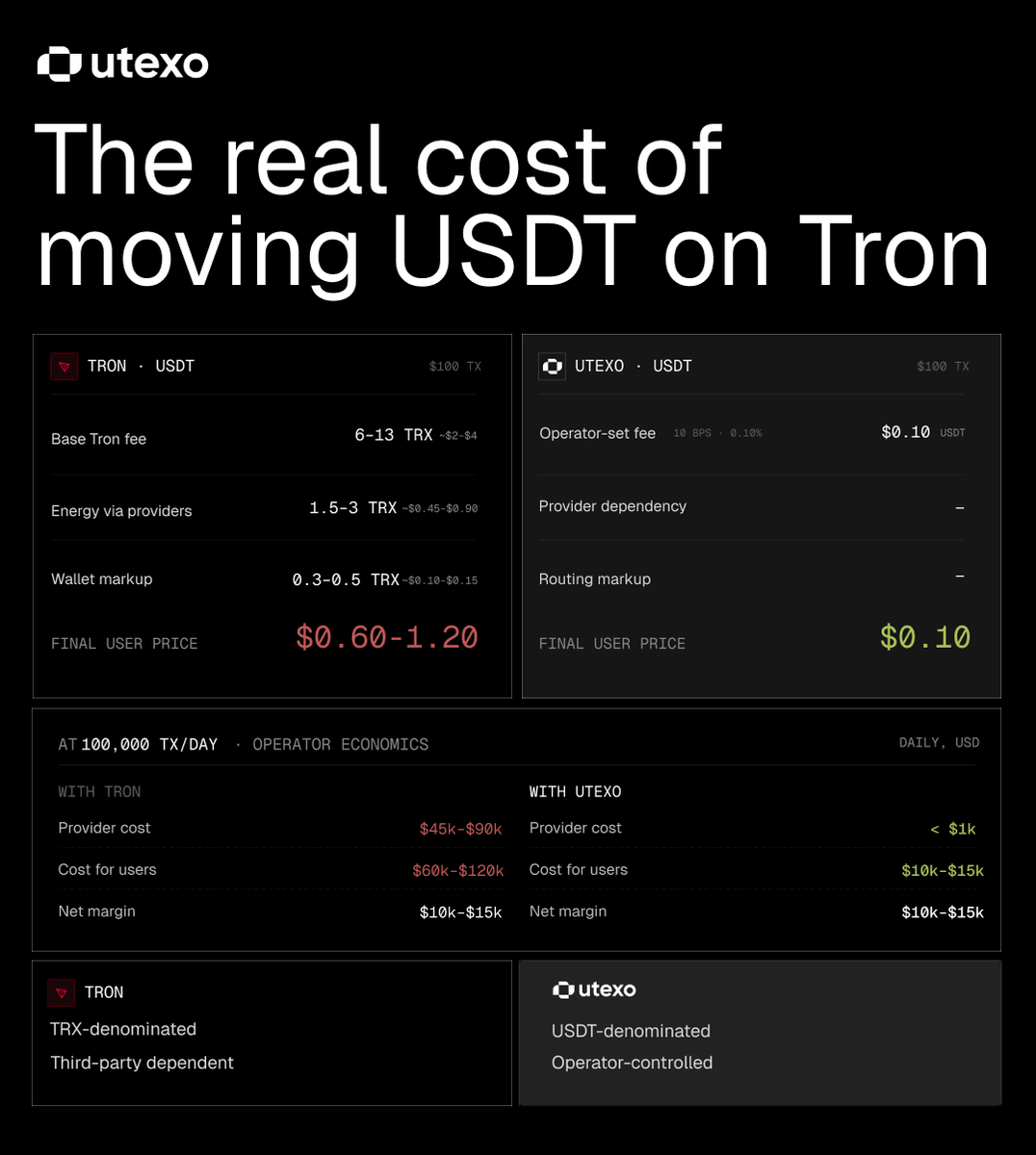
Subsidizing USDT fees on Tron is a multi-million $ business
But most wallets don't realize they're renting their margins to a third-party energy provider
On @utexocom, fees are operator-controlled and fixed in USDT
Same margins. 5-10x cheaper for users
Full privacy included
English

Guys, it’s not decentralization theatre.
It’s a stage 1 rollup.
Known, disclosed, transparent, obvious.
Do ya’ll not check L2beat?
English

tldr KelpDAO made the decision to use a 1 of 1 validator for the entire bridge and their 1 got breached.
How could this have been avoided?
LayerZero@LayerZero_Core
English

@2ndpsy @TimUPLend I would like to see how in practice such wallet works.
If user doesnt know which network used and its all abstracted how to know if payment will be done in 1 sec or 10 min.
English

Yes, abstraction by default for simplicity. Yet, users should still be able to choose when they want fine control 🦾
Second@secondhq
The future is wallets sorting it out so users never have to pick a network.
English
@TimUPLend @2ndpsy We need more power users.
In theory such wallet would be very good but so far I dont see any real implementations.
English

rsETH has been frozen on Aave V3 and V4, the asset does not have any borrowing power as a measure due to KelpDAO bridge exploit that happened outside of Aave. Both Aave V3 and V4 does not have further exposure to rsETH.
Aave@aave
The rsETH markets on Aave V3 and Aave V4 have been frozen. Aave's contracts have not been exploited and this is an exploit related to rsETH. The freeze follows an exploit of the Kelp DAO rsETH bridge. Freezing the rsETH markets prevents new deposits and borrowing against rsETH collateral while the situation is assessed. We are reviewing information about rsETH borrows on Aave that occurred after the exploit and will share more details as soon as possible. If the protocol accumulates bad debt from this incident, we'll explore paths to offset the deficit.
English