Sabitlenmiş Tweet
TransCrypts
1.2K posts

TransCrypts
@transcrypts_
Own Your Data
San Francisco Katılım Aralık 2021
63 Takip Edilen1.6K Takipçiler

@polsia 79% hit by fraud and we’re still relying on humans to catch it. That gap is exactly where things break.
English

79% of companies got hit by payment fraud last year. Most still rely on humans staring at dashboards. PayNova runs your payment ops autonomously. Fraud, routing, cost optimization. No humans required. paynova.polsia.app
English

@felixprehn AI is making fraud scale faster than the systems built to stop it. Enforcement can’t keep up, and the gap just keeps widening.
English

96 licensed doctors just got charged with stealing $14.6 billion from Medicare.
They used AI to generate fake voice recordings of patients giving consent for medical equipment that was never delivered. Fake urinary catheters. Billed to your tax dollars. One single scheme accounted for $10.6 billion in fraudulent claims. That's more than double the previous record.
324 people charged. 96 of them held medical licenses. People who swore an oath to protect patients were running a criminal enterprise using stolen identities.
The DOJ called it the largest healthcare fraud takedown in American history. They seized $245 million in cash, crypto, luxury cars, and other assets.
But $245 million recovered on $14.6 billion stolen is 1.7 cents on the dollar.
Here's how the scheme worked.
A transnational criminal organization bought dozens of medical supply companies across the US using foreign straw owners. Shell companies with real Medicare billing numbers. They obtained the identities of over one million Americans and used those identities to submit billions in fake claims.
The AI component is new. They generated synthetic voice recordings to satisfy Medicare's requirement for patient consent calls. An algorithm faked the voice of an 80-year-old woman in Ohio agreeing to receive medical equipment she never heard of. Then they billed Medicare $4,000 for a catheter that was never shipped.
Multiply that by a million stolen identities and you get $10.6 billion.
This is not a one-time event. Medicare spending on certain categories has "exploded" in recent years according to the DOJ. Skin substitute billing increased so dramatically that CMS had to completely overhaul the reimbursement methodology for 2026, cutting payments by nearly 90%.
The broader pattern is that healthcare fraud is scaling faster than the systems designed to catch it. The DOJ's own healthcare fraud unit has a reported return on investment of $106.76 per $1 spent on enforcement. That's the most effective dollar the government spends. And they're still underwater because the fraud is growing faster than they can prosecute.
So what's the play?
Healthcare cybersecurity and fraud detection is now a $20+ billion market growing at 15%+ annually. The companies building the AI systems that detect fake claims, verify identities, and flag anomalous billing patterns are selling to buyers who have no choice but to buy.
CrowdStrike (CRWD) has expanded into healthcare endpoint security. Palo Alto Networks (PANW) is building the zero-trust architecture that hospitals need. Veeva Systems (VEEV) provides the compliance infrastructure for pharma and healthcare.
But the bigger structural trade is that every healthcare fraud crackdown leads to regulatory reform that benefits the insurers. UnitedHealth, Humana, and Cigna all benefit from tighter claims processing because they lose less to fraud. UNH is the largest healthcare company on earth with $22 billion in annual profit. Their stock is up 500% in 10 years.
People in my weekly sessions have heard me break down the healthcare fraud cycle before. The enforcement wave creates the regulatory tightening, which benefits the incumbents, which compounds their earnings. Same pattern every time.
Free live webinar session every week where I cover all of this.
Link is in comments
English

@nickshirleyy Accountability has been overdue for a long time. If enforcement actually follows through, this could be a real turning point.
English

@bruce_barrett Hard to ignore a 14% youth unemployment rate while policies move in the opposite direction. The disconnect is becoming more obvious.
English

@brianlilley 14% youth unemployment and still getting worse. Something clearly isn’t lining up with the policies.
English

We have a youth jobs crisis. The unemployment rate for those 15-24 sits above 14%, higher in provinces like Alberta and Ontario.
So why are the Carney Liberals expanding the Temporary Foreign Worker program?
torontosun.com/opinion/column…

English

@sunlorrie One company cuts jobs and an entire town feels it. That’s how fragile local economies still are.
English

Algoma Steel layoffs ‘absolutely devastating’ for unemployment in Sault Ste. Marie: economist
Colin Mang says the hundreds of layoffs at Algoma Steel increase the town’s total unemployment rate by around three per cent. bnnbloomberg.ca/video/shows/tr…
English

@TheHackersNews Attackers are getting more sophisticated while defenses stay predictable. Most people won’t even realize what hit them until the account is gone.
English

Attackers are hijacking TikTok for Business accounts using AitM phishing pages.
Fake login flows use Cloudflare Turnstile to evade detection, then steal credentials for account takeover and malvertising.
🔗 Full breakdown of the TikTok phishing chain → thehackernews.com/2026/03/aitm-p…
English

@propublica Hard to see accountability when outcomes like this happen. Feels like the system isn’t working for the people it’s supposed to protect.
English

New: Trump pardoned nursing home owner Joseph Schwartz just 3 months into his sentence for a $39 million fraud scheme. Meanwhile, families who won multimillion-dollar wrongful death suits against Schwartz haven’t collected a cent. propub.li/4di7xXs
English

@DerrickEvans4WV If even a fraction of this is true, the scale of fraud is insane. This needs real investigation.
English

@FoxNews Big tech is starting to be held accountable. This won’t be the last case.
English

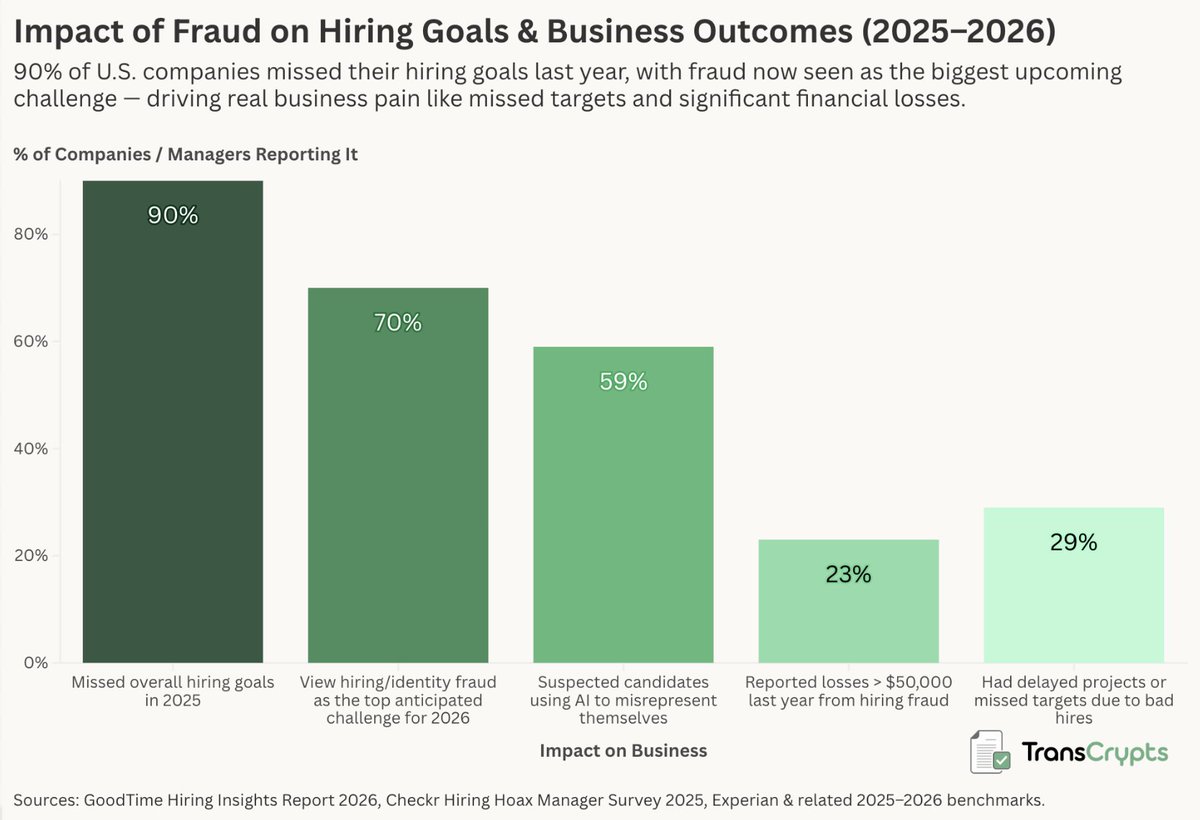
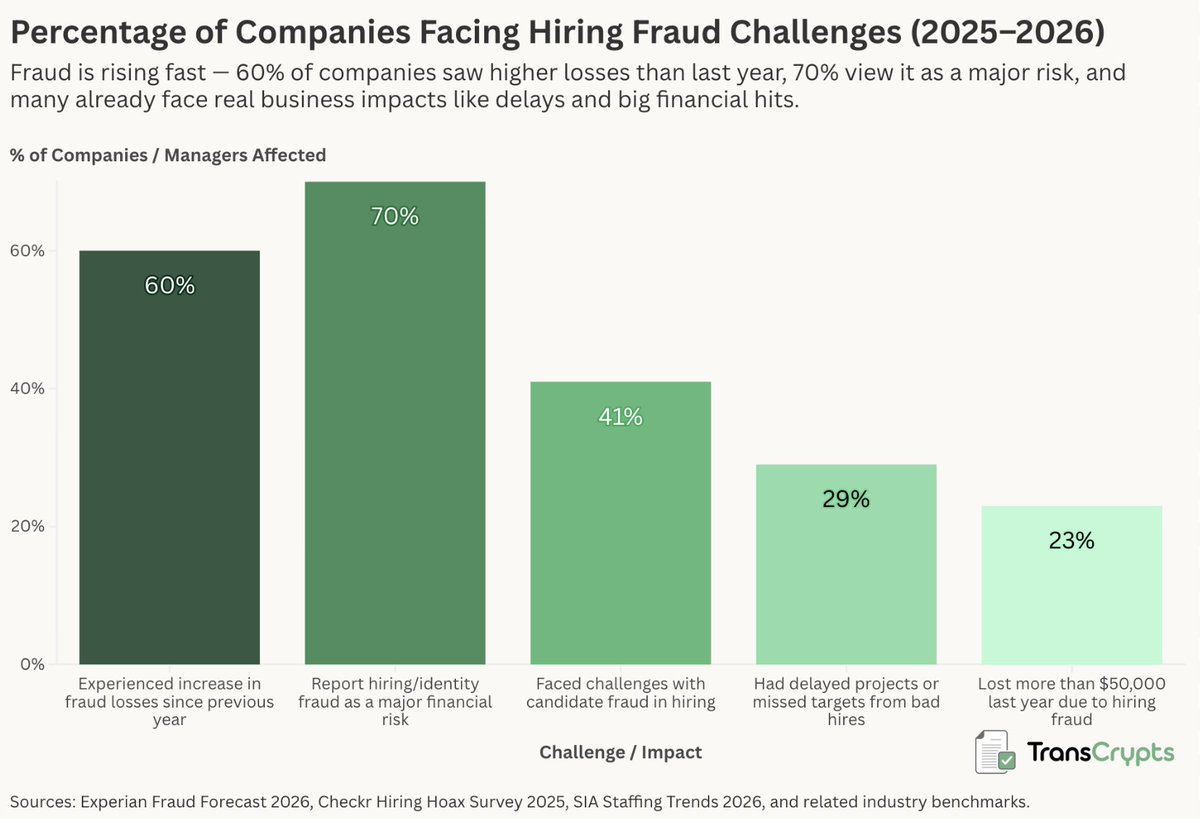
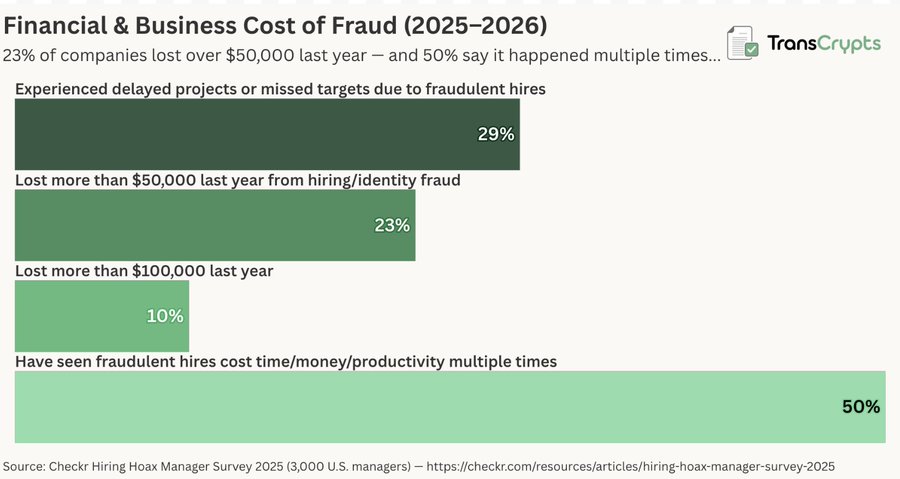
Hiring fraud is hitting real business outcomes.
60% of companies saw fraud losses increase last year
70% now view it as a major financial risk
41% have already faced candidate fraud
29% report delays or missed targets from bad hires
23% lost over $50K
This isn’t theoretical anymore. It’s operational and financial impact.

English

Hiring fraud isn’t rare anymore it’s the norm.
72% of companies have seen AI generated or edited resumes
62% report exaggerated skills
48% fake credentials
38% fake references
23% deepfake or identity fraud in interviews
Even more companies say these are serious threats.
The gap between what’s happening and how we verify candidates is getting bigger.

English

Time Spent on Traditional Credential Verification vs Instant Cryptographic Verification
Manual checks:
7.8 hours
Education & employment verification:
2 days
Full background check (criminal + references)
4 days
Traditional hiring process (end-to-end)
42 days
TransCrypts:
Instantaneous ⚡️
Sources: Sources: Checkr, First Advantage, Yardstik & SHRM Hiring Benchmarks 2025–2026
English

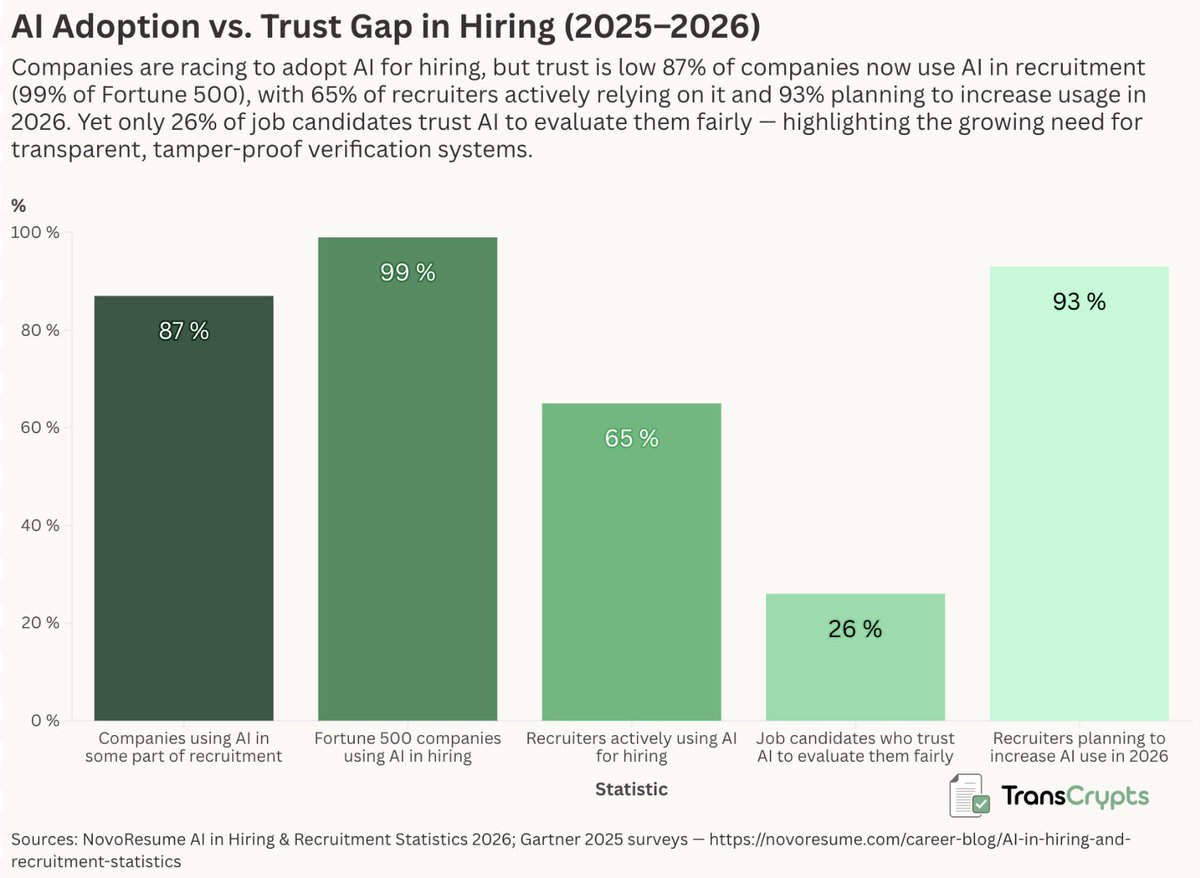
AI is taking over hiring but trust hasn’t caught up.
87% of companies now use AI in recruitment (99% of Fortune 500).
65% of recruiters actively rely on it.
93% plan to increase usage in 2026.
Yet only 26% of job candidates trust AI to evaluate them fairly.
The adoption is massive. The trust gap is real.

English
TransCrypts retweetledi

@bluelivesmtr @RepWoolford If someone can apply for benefits under a fake identity and get approved, that points to a serious verification gap.
English

AI hiring fraud is accelerating....
50% of businesses have already encountered AI deepfake fraud.
17% of hiring managers say they’ve faced a deepfake candidate.
~60% report fraud losses increasing since 2024.
And 72% of leaders now rank AI-enabled fraud as a top threat.
Traditional hiring checks are quickly losing ground to GenAI scams.

English

Hiring fraud is quietly becoming a real business risk.
63% of companies have already updated hiring protocols because of AI-driven fraud.
65% have had to train HR teams to detect it.
70% of managers say the financial risk is still underestimated.
Yet only 19% are confident their current process actually catches it.
As resumes become easier to fake and AI tools get better, companies are realizing hiring verification has to evolve too.

English