I stand with 804 !

3.5K posts

I stand with 804 !

I stand with 804 !

@TrdrForLife

Sing like no one’s listening, love like you’ve never been hurt, dance like nobody’s watching, and live like it’s heaven on earth.

Katılım Ağustos 2011
117 Takip Edilen89 Takipçiler
Sabitlenmiş Tweet
I stand with 804 !
I stand with 804 !@TrdrForLife·
Imran Khan Zindabad ! Pakistan Paindabad ! Pakistani Generals Murdabad !
I stand with 804 ! tweet media
Eesti
1
0
1
112
I stand with 804 ! retweetledi
TheValueist
TheValueist@TheValueist·
$INTC $TSM $GFS $AMKR SCOPE AND SCREEN The publicly identifiable US universe of companies with semiconductor wafer-fabrication, foundry, specialty microfabrication, or advanced-packaging facilities is substantially broader than the leading-edge logic names typically associated with CHIPS Act reshoring. The relevant set includes pure-play foundries, IDMs with captive fabs, specialty analog and power manufacturers, compound-semiconductor and RF operators, silicon photonics and InP/GaAs/GaN producers, MEMS foundries, defense-trusted microelectronics foundries, OSATs, wafer-level packaging providers, and advanced-substrate companies. The definition used here includes operational facilities, under-construction facilities, and publicly announced facilities with sufficiently specific disclosed US locations. It excludes design-only fabless companies, administrative-only locations, universities and national labs unless a corporate or nonprofit operating entity is clearly identified, conventional EMS assembly without semiconductor-grade packaging, and historical facilities that appear closed, sold, or no longer controlled by the named company. SIA’s own ecosystem map is explicitly not exhaustive, so the list below should be treated as the best publicly disclosed corporate universe as of May 14, 2026, rather than a guarantee of classified, proprietary, or otherwise undisclosed microelectronics capacity. The SIA investment tracker indicates that post-CHIPS Act US semiconductor commitments have exceeded $645.3B across more than 140 projects in 30 states, with federal awards announced for 35 companies and 52 projects, underscoring the breadth of the reshoring footprint but also the uneven maturity of announced versus operational capacity. (Semiconductor Industry Association) US SEMICONDUCTOR FABRICATION AND ADVANCED PACKAGING COMPANY UNIVERSE Intel Corporation — INTC — Intel has the broadest domestic front-end and back-end manufacturing footprint among US-headquartered logic manufacturers. Key US assets include leading-edge logic capacity in Chandler, Arizona, where Fab 52 and Fab 62 are central to Intel’s advanced-node expansion; planned leading-edge fabs in New Albany, Ohio, with timing that has shifted toward 2030-2031; major R&D and process-development operations in Hillsboro, Oregon, including high-NA EUV-related work; and Rio Rancho, New Mexico, which has been positioned as a major domestic advanced-packaging hub. Intel’s New Mexico site is particularly strategic because it supports high-volume advanced packaging, including EMIB and Foveros-related capabilities, making Intel one of the few US operators with both leading-edge wafer fabrication and advanced 2.5D/3D packaging infrastructure at domestic scale. (Semiconductor Industry Association) Taiwan Semiconductor Manufacturing Company — TSM / 2330.TW — TSMC’s US footprint includes Phoenix, Arizona, where the company is building a multi-fab advanced logic campus. Public disclosures describe the first Arizona fab as 4nm, the second as 3nm/2nm-class with nanosheet technology, and later capacity as 2nm or more advanced. TSMC has also disclosed a broader Arizona investment plan that includes 6 wafer fabs, 2 advanced packaging facilities, and an R&D center, implying that the US site is evolving from a single front-end fab project into a broader domestic manufacturing cluster. Separately, TSMC controls the Camas, Washington, fab through TSMC Washington, historically a mature-node 200mm facility. Arizona’s strategic significance is unusually high because it introduces external foundry capacity for leading-edge logic on US soil, although volume ramp, cost structure, customer allocation, labor productivity, and tool-install timelines remain core execution variables. (Semiconductor Industry Association) Samsung Electronics — 005930.KS / SSNLF — Samsung’s US semiconductor manufacturing footprint includes Austin, Texas, and Taylor, Texas. The Taylor campus has been described as including 2 new leading-edge logic fabs for 4nm and 2nm-class production, an R&D fab, and advanced packaging capacity relevant to 3D HBM and 2.5D integration. The Austin facility is also being expanded or modernized for differentiated process technologies, including FD-SOI applications for aerospace, defense, automotive, and other specialty markets. Samsung’s US role is strategically important because it provides a second non-US-headquartered leading-edge foundry option in the US, but the domestic footprint remains dependent on the cadence of Taylor tool installation, customer commitments, and the company’s competitive position against TSMC at advanced nodes. (Semiconductor Industry Association) GlobalFoundries — GFS — GlobalFoundries operates major US foundry assets in Malta, New York, and Essex Junction/Burlington, Vermont. Malta is the company’s flagship 300mm US fab and is being expanded with additional capacity and a planned new fab to support RF, automotive, aerospace, defense, and mixed-signal demand. The Vermont site is a 200mm facility being revitalized for high-volume GaN-on-silicon and other specialty technologies. GFS is not a leading-edge logic competitor at 3nm/2nm, but it is highly relevant for differentiated mature and specialty nodes where supply assurance, RF content, power management, silicon photonics, and defense-trusted manufacturing are often more important than transistor-density leadership. (Semiconductor Industry Association) Texas Instruments — TXN — Texas Instruments has one of the most strategically significant domestic analog and embedded-processing manufacturing footprints. US assets include Richardson, Texas, where RFAB1 and RFAB2 are 300mm analog fabs; Sherman, Texas, where TI is building a large 300mm manufacturing campus with up to 4 connected fabs; Lehi, Utah, where LFAB1 and LFAB2 form a major 300mm analog and embedded-processing capacity base; and Dallas, Texas, where DMOS6 is part of the legacy analog manufacturing network. TI’s domestic 300mm analog strategy creates structural cost advantages versus 200mm analog peers and provides unusually high US-based wafer capacity for industrial, automotive, power-management, and embedded applications. (Texas Instruments) Micron Technology — MU — Micron’s US footprint includes Boise, Idaho, Manassas, Virginia, and the planned Clay, New York, megafab complex. Boise is intended to combine high-volume DRAM production with R&D, including a large cleanroom footprint. Manassas is a legacy DRAM and specialty memory fab being modernized for 1-alpha node output and continued automotive, industrial, and defense-related memory supply. Clay, New York, is planned as a multi-fab leading-edge DRAM campus. The investment case relevance is that Micron represents the core US-based DRAM reshoring vehicle, but the timeline for New York capacity, memory-cycle cyclicality, and HBM/AI memory capital allocation remain critical gating variables. (Semiconductor Industry Association) onsemi — ON — onsemi operates US wafer manufacturing assets in Gresham, Oregon; Mountain Top, Pennsylvania; East Fishkill, New York; and Hudson, New Hampshire. Gresham is a 200mm wafer fab supporting CMOS, BCD, EEPROM, and power technologies. Mountain Top is a 200mm wafer fab focused on MOSFET and related power processes. East Fishkill is strategically important as a 300mm fab for power discrete and image-sensor-related production and has been described as a DoD-trusted manufacturing site. Hudson is relevant to onsemi’s SiC supply chain. onsemi’s US asset base is materially weighted toward power semiconductors, analog, image sensors, and automotive/industrial end markets rather than leading-edge logic. (onsemi) Analog Devices — ADI — Analog Devices has US manufacturing facilities in Beaverton, Oregon; Camas, Washington; and Chelmsford, Massachusetts. The Oregon and Washington sites support analog wafer fabrication around 180nm/350nm-class process technologies, while Chelmsford includes RF, microwave, packaging, and test operations. ADI’s US footprint is strategically relevant because the company’s analog, mixed-signal, RF, and high-performance signal-chain products often have long life cycles, high qualification barriers, and defense/industrial importance, making domestic continuity more significant than cutting-edge node migration. (Semiconductor Industry Association) NXP Semiconductors — NXPI — NXP operates 4 US wafer fabs: 2 in Austin, Texas, and 2 in Chandler, Arizona. These facilities support MCUs, MPUs, power management, RF transceivers, RF amplifiers, sensors, and automotive/industrial products. Chandler has also included GaN-related RF manufacturing for 5G, aerospace, defense, and radar, although NXP disclosed plans in late 2025 to cease its radio-power product line and close the RF GaN fab by 2027. NXP therefore remains a major US mature-node and mixed-signal manufacturer, but its GaN footprint should be treated as a declining or transitional asset rather than a durable growth platform. (NXP) Microchip Technology — MCHP — Microchip’s active US fabrication assets include Gresham, Oregon, and Colorado Springs, Colorado. These facilities support microcontrollers, analog, mixed-signal, power-management, and specialty semiconductor products, with CHIPS-related support tied to increasing output at mature-node facilities. Microchip closed the Tempe, Arizona, fab in 2024, so the relevant US footprint should be framed around Oregon and Colorado rather than legacy Arizona wafer capacity. The strategic value is mature-node supply assurance for embedded control, aerospace, defense, automotive, and industrial applications. (Semiconductor Industry Association) SkyWater Technology — SKYT — SkyWater operates a trusted foundry in Bloomington, Minnesota, focused on 90nm/130nm-class mixed-signal, rad-hard, superconducting, carbon-nanotube, photonics, and defense-related process development and production. SkyWater also acquired Infineon’s Austin, Texas, 200mm Fab 25 in 2025, adding 130nm to 65nm capacity, high-voltage BCD infrastructure, and additional foundry scale. In advanced packaging, SkyWater Florida in Osceola County is positioned around fan-out wafer-level packaging, Deca M-Series technology, and heterogeneous integration. SkyWater is therefore one of the few small-cap public pure-play US foundry exposures, but it remains more specialty/defense/mature-node oriented than leading-edge logic oriented. (Semiconductor Industry Association) Diodes Incorporated — DIOD — Diodes owns the South Portland, Maine, 8-inch wafer fab acquired from onsemi in 2022. The facility includes a large cleanroom footprint and supports analog, power, CMOS, BCDMOS, BiCMOS, and bipolar process technologies across roughly 0.18µm to 1.5µm nodes. The asset fits Diodes’ model as a discrete, analog, and mixed-signal manufacturer with US mature-node capacity serving automotive, industrial, and broad-based electronics demand. (Diodes Incorporated) LA Semiconductor — Private/no direct ticker — LA Semiconductor owns the Pocatello, Idaho, 200mm fab acquired from onsemi. The site includes a 57,000-square-foot cleanroom and process technologies from roughly 0.18µm to 1.5µm, with custom process, prototype, assembly, probe, and test capabilities. The facility has faced financial and operating stress, including 2026 layoff disclosures and outside support efforts, so the asset should be viewed as strategically relevant but commercially uncertain. (lasemiconductor.com) Tower Semiconductor — TSEM — Tower has US specialty foundry operations in Newport Beach, California, and San Antonio, Texas. Newport Beach supports silicon photonics, analog/mixed-signal, and specialty process technologies spanning approximately 0.50µm to 0.13µm. The US sites are part of Tower’s broader specialty-foundry portfolio, which is focused on analog, RF, power management, imaging, and silicon photonics rather than leading-edge digital logic. (SEC) Alpha and Omega Semiconductor — AOSL — Alpha and Omega Semiconductor controls Jireh Semiconductor, its wholly owned in-house wafer fab in Hillsboro, Oregon. The facility supports AOS’s power semiconductor manufacturing model, particularly MOSFET and power-management products. The US fab is relevant because AOS is not solely outsourced to Asian foundries and maintains domestic wafer capability for part of its power-device portfolio. (Alpha & Omega Semiconductor) X-FAB Silicon Foundries — XFAB.PA — X-FAB operates a Lubbock, Texas, SiC and specialty semiconductor foundry. The facility is described as the only high-volume SiC foundry in the US and supports power semiconductor applications, including automotive and industrial customers. X-FAB also has wafer-level packaging and 3D-integration capabilities within its broader process portfolio. The company is a meaningful US specialty foundry exposure, particularly for SiC, analog, MEMS, and mixed-signal applications. (Semiconductor Industry Association) Polar Semiconductor — Private/no direct ticker — Polar operates a Bloomington, Minnesota, fab focused on sensor and power semiconductor manufacturing. The facility is being expanded with CHIPS support to double US production and transform Polar into a majority US-owned commercial foundry. UMC has also disclosed a memorandum of understanding with Polar to explore 8-inch chip production in the US using Polar’s expanded Minnesota fab. Polar is strategically relevant as a mature-node power and sensor foundry asset but remains less liquid and less transparent than public foundry peers. (Semiconductor Industry Association) Everspin Technologies — MRAM — Everspin operates an integrated magnetic fab line in Chandler, Arizona, co-located with NXP. The facility supports MRAM and TMR sensor wafer manufacturing across nodes including 180nm and 130nm, with additional technology partnerships used for higher-volume MRAM nodes. Everspin’s US fab is highly specialized rather than broad-based, but it is one of the clearest domestic nonvolatile memory manufacturing assets outside conventional DRAM and NAND. (everspin.com) HP Inc. — HPQ — HP’s Corvallis, Oregon, site includes specialty mature-node lab-to-fab and commercial manufacturing capabilities tied to microfluidics, printhead, and related semiconductor-derived devices. This is not a merchant foundry comparable to GFS, Tower, or SkyWater; however, it represents domestic semiconductor microfabrication and commercial device manufacturing capacity with process know-how in thin films, MEMS-like structures, and high-volume precision fabrication. (Semiconductor Industry Association) Renesas Electronics — 6723.T / RNECY — Renesas has a Palm Bay, Florida, wafer fabrication, assembly, and test operation focused on analog, mixed-signal, high-reliability, and radiation-hardened semiconductor products. The facility is associated with MIL-PRF-38535-qualified manufacturing and wafer fabrication for high-reliability applications. Renesas also owns Transphorm in Goleta, California, following its 2024 acquisition, adding US GaN power semiconductor R&D and related capability, although the Palm Bay facility is the clearer disclosed US wafer-fab asset. (Renesas Electronics) Wolfspeed — WOLF — Wolfspeed’s US footprint includes Siler City, North Carolina, and Marcy, New York. Siler City is focused on SiC wafer manufacturing and has been described as the largest US SiC wafer manufacturing site and a high-volume 200mm SiC wafer facility. Marcy is an automated 200mm SiC power device fab. Wolfspeed exited Chapter 11 in 2025 with a reorganized equity structure, so the operating assets remain strategically important, but the capital structure reset materially changed legacy equity economics. (Semiconductor Industry Association) Robert Bosch GmbH — Private/no direct ticker — Bosch owns the Roseville, California, 200mm SiC fab acquired through the TSI Semiconductors transaction. The site is being converted for SiC front-end and back-end processing, with first chips expected in 2026. Bosch’s US SiC facility is strategically relevant for automotive electrification, industrial power electronics, and domestic SiC device supply, but Bosch remains privately held and not directly investable through public equity. (Semiconductor Industry Association) Coherent Corp. — COHR — Coherent has US compound-semiconductor assets in Sherman, Texas, and Easton, Pennsylvania. Sherman supports 150mm InP optoelectronics manufacturing, including a large facility positioned around InP wafer production for optical communications and related applications. Easton supports SiC substrates, epitaxy, back-end processing, and testing. Coherent’s US footprint is strategically tied to optical interconnects, datacenter infrastructure, power electronics, and compound-semiconductor materials. (Semiconductor Industry Association) MACOM Technology Solutions — MTSI — MACOM operates US compound-semiconductor manufacturing in Lowell, Massachusetts, and Morrisville, North Carolina. These facilities support GaN and GaAs process technologies, including 100mm and 150mm capability, and are relevant to RF, microwave, millimeter-wave, defense, aerospace, and high-frequency communications applications. MACOM is one of the more direct public-market exposures to US-based RF compound-semiconductor manufacturing. (Semiconductor Industry Association) Qorvo — QRVO — Qorvo operates US wafer fabs in North Carolina, Oregon, and Texas, and has assembly/test operations in Texas. Its Richardson, Texas, site is a DoD Category 1A Trusted Source foundry spanning design, wafer fabrication, post-processing, packaging, assembly, and testing, with GaN and GaAs foundry processes. Qorvo’s domestic footprint is particularly important for RF front-end, defense radar, communications, and high-performance RF applications, although a substantial portion of broader Qorvo manufacturing and packaging also remains global. (Qorvo, Inc.) Skyworks Solutions — SWKS — Skyworks has US semiconductor wafer fabrication in Newbury Park, California, and Woburn, Massachusetts. These sites are associated with RF, analog, and mixed-signal production, while the company’s broader SAW/TC-SAW/BAW and assembly/test footprint includes international manufacturing. The US fabs are relevant to RF front-end modules, wireless infrastructure, aerospace/defense adjacency, and high-performance analog content. (Skyworks Solutions, Inc.) Broadcom — AVGO — Broadcom owns US manufacturing facilities in Fort Collins, Colorado, and Breinigsville, Pennsylvania. Fort Collins is strategically associated with FBAR filter production, while Breinigsville is tied to InP-based wafers for fiber optics. Broadcom’s US semiconductor manufacturing is not a broad foundry business, but it is highly relevant for vertically integrated RF filters and optical components, both of which are critical for wireless and datacenter infrastructure. (Broadcom Inc.) Nokia / Infinera — NOK / NOKIA.HE — Nokia acquired Infinera in 2025, making Infinera’s US photonic integrated circuit assets part of Nokia. The relevant US facilities include San Jose, California, where InP PIC fabrication/foundry capability includes a cleanroom footprint, and Bethlehem, Pennsylvania, where advanced test and packaging for InP PICs includes 2.5D, 3D, and co-packaged optics-related work. The asset set is strategically important to optical transport, datacenter interconnect, coherent optics, and co-packaged optics roadmaps. (Semiconductor Industry Association) Lumentum Holdings — LITE — Lumentum has announced a Greensboro, North Carolina, facility for advanced InP-based optical devices serving AI datacenter demand. The project includes a 6-inch InP line and is expected to ramp later in the decade, with volume ramp discussed for 2028. Lumentum’s US manufacturing relevance is tied to high-speed optical transceivers, datacenter photonics, and laser components rather than traditional silicon logic. (Lumentum Investor Relations) Applied Optoelectronics — AAOI — Applied Optoelectronics has expanded its Houston-area manufacturing footprint, including facilities around Sugar Land, Texas, for optical components, lasers, semiconductor products, and transceivers. The company is vertically integrated in optical communications components, but public disclosures do not describe the US footprint as a merchant wafer foundry. The company should therefore be classified as a US optical-semiconductor manufacturing and assembly operator rather than a conventional silicon fab or OSAT. (Applied Optoelectronics, Inc.) Rocket Lab USA / SolAero — RKLB — Rocket Lab’s SolAero business operates in Albuquerque, New Mexico, with production of space-grade solar cells and radiation-resistant compound semiconductor products. The CHIPS-supported expansion is intended to increase production capacity for satellite and space applications. This is a specialty compound-semiconductor manufacturing asset serving aerospace and defense end markets, not a general-purpose wafer foundry. (Semiconductor Industry Association) Akash Systems — Private/no direct ticker — Akash Systems is developing a West Oakland, California, fab for diamond-cooled semiconductor substrates, devices, and systems. Public CHIPS-related disclosures describe a new cleanroom and manufacturing footprint focused on Diamond Cooling technology. The facility is relevant to thermal management constraints in high-power RF, satellite, and AI infrastructure, but it remains an emerging private-company manufacturing asset rather than an established high-volume foundry. (Semiconductor Industry Association) SemiQ — Private/no direct ticker — SemiQ operates in Lake Forest, California, with cleanroom, wafer probe, wafer saw, epitaxy, wafer metrology, and SiC product capabilities. The company manufactures SiC diodes and MOSFETs and maintains custom epi-related capabilities. SemiQ is a private US SiC device and manufacturing participant, with strategic relevance to power electronics, although it is much smaller than Wolfspeed, Bosch, Coherent, or onsemi. (rellpower.com) Navitas Semiconductor — NVTS — Navitas has announced an initial investment in a 3-reactor SiC epitaxy growth facility at its Torrance, California, headquarters and acquired GeneSiC as part of its expansion into SiC. Navitas remains primarily fabless for GaN and SiC device production, using external manufacturing partners such as TSMC and X-FAB, so its US footprint should be characterized as SiC epitaxy/R&D and related manufacturing capability rather than a full disclosed domestic wafer fab. (Navitas Semiconductor)
English
1
1
13
7.2K
Nutty
Nutty@NuttyCLD·
The AI power trade is getting louder. But the real question may not be who announces the biggest power plan. It may be who can turn power on first. That is why Bloom Energy became such an interesting signal in the AI power story. Not because it answered everything. But because it pointed to a bigger shift: When AI cannot wait for the grid, time-to-power becomes a bottleneck of its own. The useful investor question is simple: Which bottleneck monetizes first?
Nutty@NuttyCLD

x.com/i/article/2050…

English
4
7
122
45K
I stand with 804 ! retweetledi
FundaAI
FundaAI@FundaAI·
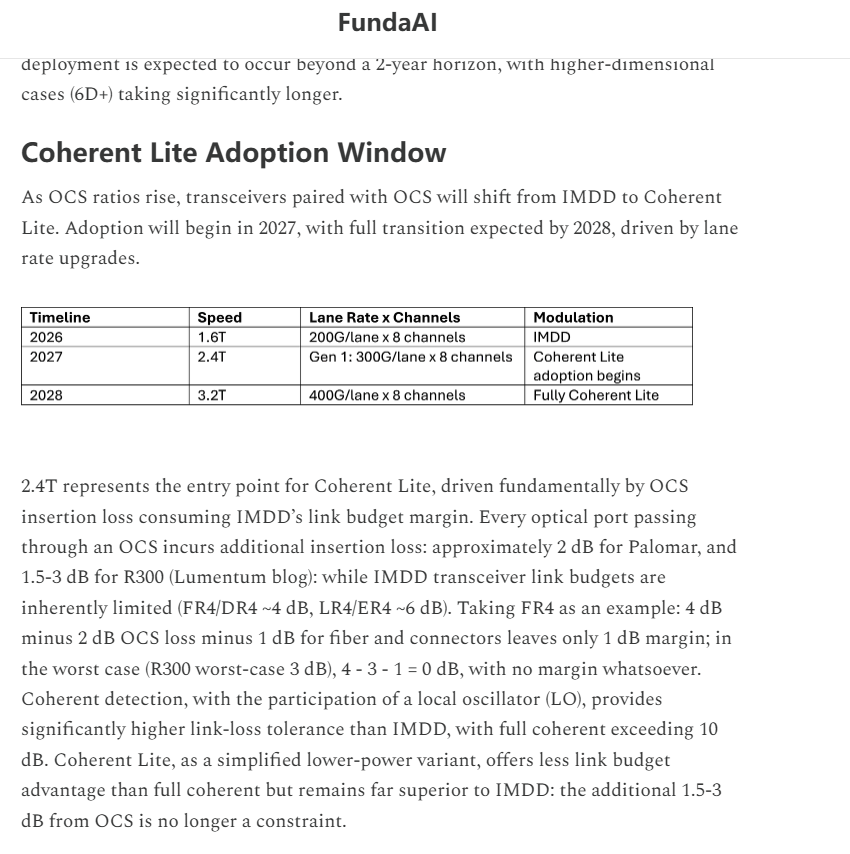
The sharp rally in $LITE and other optics names today was driven not only by QQQ 100 inclusion, but also, importantly, by Innolight mentioning 2.4T demand in their group call. We highlighted the 2.4T timeline in our most important TPU Report last month. We'll be publishing a quick take on this shortly.
FundaAI tweet media
FundaAI@FundaAI

Deep|AI Infra 2026: Shifting from "Brain Power" Competition to "Whole-Body" Evolution This is one of our most important reports this year, and our entire team invested a significant amount of time and effort into it. We observed that the OCS ratio in Scale Up scenarios is still rising rapidly, and we also found that $MRVL is involved not only in TPU but also in LPU. In 2026, the focus of AI development has pivoted from chasing high benchmark scores to pursuing AI Agents capable of multi-step reasoning and autonomous action. This infrastructure arms race is undergoing a transformation akin to biological evolution. If an AI system is viewed as an evolving organism: the GPU/TPU represents the calculating brain; Memory and Storage serve as the memory carriers for experience and context; the CPU acts as the hands coordinating tasks; while Optics and Networking function as the limbs supporting systemic data flow and response sensitivity. Under the framework of the Agent Scaling Law, the core bottleneck is no longer just the FLOPS of a single chip (brain power), but rather the communication efficiency (limbs), the memory wall (memory), and the Total Cost of Ownership (TCO). The “Brain” Idle Crisis: Even with the most powerful compute cores, if the “limbs” (communication) are underdeveloped, chips will sit idle for over 1/3 of the time waiting for data. The “Memory” Retrieval Bottleneck: Long-sequence reasoning for Agents imposes rigorous demands on KV Cache management; the performance of memory and storage components has become the deciding factor for an Agent’s logical depth. Dimensional Evolution of “Limbs”: To overcome the communication bottlenecks inherent in MoE architectures, infrastructure is moving from 3D Torus toward high-dimensional topologies (up to 10D). Networking investment weight is now matching or even surpassing that of compute chips. This report outlines the bottlenecks facing AI Agents and recent TPU progress, specifically exploring how Google TPU optimizes “whole-body” coordination through vertical integration. We argue that: Networking is the new core battlefield: To solve MoE All-to-All bottlenecks, Google is significantly expanding scale-out bandwidth and shifting from 3D Torus to higher dimensions. Unlocking TCO and Allocation Efficiency: Through proprietary architecture and vertical integration, the TPU v7 rack cost is significantly lower than the NVIDIA GB200. This efficiency gain frees up CapEx for growth in optical communications and memory. $LITE $NOK $CRDO Detailed Report fundaai.substack.com/p/deepai-infra…

English
5
23
221
168.2K
I stand with 804 ! retweetledi
FundaAI
FundaAI@FundaAI·
Deep|AI Infra 2026: Shifting from "Brain Power" Competition to "Whole-Body" Evolution This is one of our most important reports this year, and our entire team invested a significant amount of time and effort into it. We observed that the OCS ratio in Scale Up scenarios is still rising rapidly, and we also found that $MRVL is involved not only in TPU but also in LPU. In 2026, the focus of AI development has pivoted from chasing high benchmark scores to pursuing AI Agents capable of multi-step reasoning and autonomous action. This infrastructure arms race is undergoing a transformation akin to biological evolution. If an AI system is viewed as an evolving organism: the GPU/TPU represents the calculating brain; Memory and Storage serve as the memory carriers for experience and context; the CPU acts as the hands coordinating tasks; while Optics and Networking function as the limbs supporting systemic data flow and response sensitivity. Under the framework of the Agent Scaling Law, the core bottleneck is no longer just the FLOPS of a single chip (brain power), but rather the communication efficiency (limbs), the memory wall (memory), and the Total Cost of Ownership (TCO). The “Brain” Idle Crisis: Even with the most powerful compute cores, if the “limbs” (communication) are underdeveloped, chips will sit idle for over 1/3 of the time waiting for data. The “Memory” Retrieval Bottleneck: Long-sequence reasoning for Agents imposes rigorous demands on KV Cache management; the performance of memory and storage components has become the deciding factor for an Agent’s logical depth. Dimensional Evolution of “Limbs”: To overcome the communication bottlenecks inherent in MoE architectures, infrastructure is moving from 3D Torus toward high-dimensional topologies (up to 10D). Networking investment weight is now matching or even surpassing that of compute chips. This report outlines the bottlenecks facing AI Agents and recent TPU progress, specifically exploring how Google TPU optimizes “whole-body” coordination through vertical integration. We argue that: Networking is the new core battlefield: To solve MoE All-to-All bottlenecks, Google is significantly expanding scale-out bandwidth and shifting from 3D Torus to higher dimensions. Unlocking TCO and Allocation Efficiency: Through proprietary architecture and vertical integration, the TPU v7 rack cost is significantly lower than the NVIDIA GB200. This efficiency gain frees up CapEx for growth in optical communications and memory. $LITE $NOK $CRDO Detailed Report fundaai.substack.com/p/deepai-infra…
FundaAI tweet media
English
5
28
99
191.4K
I stand with 804 !
I stand with 804 !@TrdrForLife·
@coatuemgmt As the context gets larger and more people start using Ai tools the demand will continue to accelerate. Right now there are 8 billion people in this planet. How many are really using Ai tools and the LLMs are already compute restrained. The growth will be 5x might be 50x.
English
0
0
0
3.6K
COATUE
COATUE@coatuemgmt·
Memory is the new bottleneck. Nick Gagnet, Coatue Sector Head, on the AI infrastructure shift and why memory demand could 5x in 5 years.
English
99
250
2.4K
1.9M
AT
AT@ayeteas·
@coatuemgmt Which are the leading stocks to benefit from the AI infrastructure shift to memory
English
6
0
1
7.8K
I stand with 804 !
I stand with 804 !@TrdrForLife·
TheValueist@TheValueist

$VICR $CRBS Vicor–Cerebras Relationship and Business Exposure: Deep-Dive Analysis Executive Overview Vicor’s relationship with Cerebras appears to be one of the highest-quality strategic design-win exposures in the AI power-delivery ecosystem. The relationship is not a generic merchant-component supply arrangement. It is a deep architecture-level power-delivery collaboration that began with Cerebras’s first wafer-scale engine and has likely evolved into Vicor’s current “lead computing customer” ramp for vertical power delivery. The key confirmed fact is that Cerebras and Vicor jointly implemented a vertical power delivery architecture for the original Cerebras WSE, with Vicor-linked commentary stating that Cerebras’s 15kW wafer-scale processor required uniform high-current delivery and that the Cerebras/Vicor VPD approach reduced power delivery network resistance by more than 50%.  The key current inference is that Cerebras is almost certainly the unnamed “lead computing customer” referenced repeatedly by Vicor in late 2025 and Q1 2026. Vicor stated on its Q1 2026 call that its “lead computing customer is continuing a steep production ramp of its wafer-scale engine with best-in-class AI inference performance.” That language is highly specific and maps directly to Cerebras’s product branding and market positioning: Cerebras calls its core chip the Wafer Scale Engine, its CS-3 system is powered by a 4 trillion-transistor WSE-3, and AWS/Cerebras marketing describes CS-3 as optimized for decode and “the world’s fastest AI inference system.” Vicor has not explicitly named Cerebras in the 2026 call transcript, so this should be treated as a high-conviction inference rather than a legally confirmed customer-disclosure datapoint.  The investment implication is significant. If Cerebras converts its OpenAI, AWS, and sovereign AI demand pipeline into shipped CS-3 or next-generation systems, Vicor should participate through high-value power modules and potentially future licensing or second-source economics. The exact revenue contribution, bill-of-material content, pricing, and gross margin from Cerebras are not disclosed. However, the scale mismatch is clear: Cerebras is pursuing AI infrastructure commitments measured in hundreds of megawatts and billions of dollars, while Vicor’s total 2025 Advanced Products revenue was $248.6M, including $57.4M of royalties, and Q1 2026 Advanced Products plus royalty revenue was $64.9M. A successful Cerebras ramp can therefore be material to Vicor even if Vicor captures only a modest fraction of the CS-3 system value.  The risk is that Vicor’s current equity value already discounts a large AI/VPD inflection. At a market cap of approximately $12.1B and a P/E ratio of approximately 85.8x, Vicor is being valued far ahead of its historical power-module profile. On management’s nearly $570M 2026 revenue guide, the stock trades at roughly 21.3x forward revenue before any enterprise-value adjustment. That multiple can be justified only if Cerebras-like ramps broaden into a durable AI power-delivery platform with strong margins, capacity expansion, and licensing leverage. It is vulnerable if Cerebras deployment timing slips, if Vicor capacity becomes a bottleneck, if second sourcing dilutes economics, or if the company’s VPD advantage proves narrower than current market enthusiasm suggests.  What is confirmed versus what is inferred The confirmed relationship is clear at the first-generation WSE level. A Vicor-authored 2020 article stated that Cerebras’s WSE was composed of 84 processing cells spanning an entire wafer, functioned as a single chip, and was rated at 15kW, requiring “an advanced power architecture whereby power is applied uniformly to each cell at extremely high currents.” The same article stated that “Cerebras working in conjunction with Vicor implemented a Vertical Power Delivery (VPD) architecture,” and that this architecture reduced PDN resistance by more than 50%. This is the strongest primary-source evidence that Vicor was not merely an off-the-shelf supplier, but was involved in the power architecture enabling the WSE package.  A Vicor-hosted version of the same article also directly frames the relationship as Vicor “helping Cerebras achieve new levels of processing power,” while reiterating that the Cerebras WSE required uniform high-current delivery across the wafer. This is important because it confirms that Vicor itself has historically highlighted Cerebras as a reference customer for AI/HPC power-delivery innovation.  The inferred current relationship is based on Vicor’s latest customer language. In Q4 2025, Vicor said that a “lead customer for VPD solutions” was ramping a Gen 4 factorized power system before transitioning to a Gen 5-based solution with higher current density and performance, with the transition expected to start in H2 2026. In Q1 2026, Vicor sharpened that language, stating that the lead computing customer was ramping a “wafer-scale engine with best-in-class AI inference performance.” There are very few plausible companies that fit that wording. Cerebras is the company whose product is branded as the Wafer Scale Engine and whose current go-to-market messaging is centered on high-speed inference.  The missing datapoints are just as important. Vicor does not disclose Cerebras revenue, Cerebras backlog, per-system content, product SKUs, gross margin by customer, or whether revenue flows directly from Cerebras or through contract manufacturers. Vicor’s 10-K states that Advanced Products customers are concentrated in data center and hyperscaler enterprise computing and that a substantial portion of Advanced Products revenue has historically come from a limited number of customers, but it does not identify Cerebras. The 10-K also shows that one customer accounted for approximately 11.1% of total net revenues in 2025, but that customer is not named and should not be assumed to be Cerebras.  Why Vicor matters to Cerebras technically Cerebras’s architecture creates one of the most extreme power-delivery problems in commercial computing. The WSE-3 is not a conventional accelerator card with a GPU and HBM stack. It is a wafer-scale processor with 4 trillion transistors and 900,000 AI cores, and Cerebras describes the CS-3 as consuming up to 23kW. That is the power level of an entire high-density server concentrated around a single wafer-scale compute engine. Conventional lateral power delivery becomes increasingly inefficient and physically constrained when power must be delivered at sub-1V core voltages and very high current levels across a dense processor package.  Cerebras’s own system description reinforces the need for an unusual power architecture. The company describes the CS-3 “engine block” as a wafer packaging solution that delivers power “straight into the face of the wafer” to achieve power density that “could not be achieved with traditional packaging,” while also providing uniform cooling through a closed internal water loop. That description is highly consistent with Vicor’s VPD approach, which moves final-stage current multiplication vertically close to the load instead of routing massive low-voltage current laterally across a PCB or substrate.  Vicor’s technical architecture is based on Factorized Power Architecture, or FPA. In Vicor’s formulation, FPA separates the power-conversion process into regulation and current multiplication. Regulation occurs first, then a relatively high voltage is distributed across the board, and current multiplication occurs adjacent to the load. The advantage is that high voltage can be moved more efficiently over distance, while very high current is generated only at the point of load, minimizing distribution losses and reducing thermal and impedance challenges.  The power-delivery challenge becomes more severe as processors scale. Vicor’s 10-K states that the advantages of FPA are most evident in high-performance computing applications, where GPUs and AI ASICs require high average and peak current. Vicor’s Power-on-Package architecture places current multiplier modules directly on the substrate to reduce losses and free package pins for other functions, and its latest VPD innovation mounts high-performance solutions beneath the motherboard opposite the GPU or ASIC to further reduce distribution losses and improve power density.  Vicor’s own technical literature explicitly calls out Cerebras-like clustered ASIC architectures. Vicor states that tightly packed processor clusters leave little room for lateral power delivery and that VPD is “essential” to provide high currents. It also notes that clustered ASIC approaches from Cerebras and Tesla create significant power-delivery and thermal-management challenges, and that delivering peak currents above 1,500A per core can require more than 30 phases per AI ASIC or GPU under conventional multiphase designs, a number Vicor characterizes as difficult, if not impossible, with lateral power delivery.  This is the fundamental reason the relationship matters. Cerebras’s performance pitch depends not only on compute architecture but also on the ability to feed an enormous wafer-scale engine with stable, low-noise, high-density power while simultaneously cooling the wafer. Vicor is not a peripheral vendor in that system. It is likely part of the enabling architecture that allows Cerebras to turn a wafer-scale design into a deployable product. Why the relationship appears to be moving from validation to scale Historically, Cerebras was a highly differentiated but relatively low-volume customer. The earlier WSE systems were strategic proofs of concept, sovereign AI systems, national lab deployments, and select cloud offerings. That limited the immediate commercial scale for Vicor, even if the design win was technically important. The current setup is different because Cerebras now has large public demand signals: OpenAI, AWS, and a second IPO attempt tied to a much larger revenue base. Reuters reported that Cerebras revenue increased to $510M in 2025 from $290.3M in 2024, and that Cerebras has tied much of its growth to OpenAI through a $20B multi-year deal under which OpenAI will deploy 750MW of Cerebras chips. Reuters also reported that Cerebras is targeting a valuation of up to approximately $26.6B in its U.S. IPO by offering 28M shares at $115–$125, aiming to raise approximately $3.5B.  AWS is the second major validation point. AWS and Cerebras announced a March 2026 collaboration to deploy CS-3 systems inside AWS data centers and make the solution available through Amazon Bedrock. The architecture disaggregates inference into prefill and decode, with AWS Trainium optimized for prefill and Cerebras CS-3 optimized for decode. AWS’s David Brown said the system is designed to produce inference “an order of magnitude faster and higher performance than what’s available today.” This matters for Vicor because AWS hosting Cerebras hardware turns Cerebras from a specialty hardware vendor into a potentially scaled cloud infrastructure supplier.  Vicor’s 2026 commentary aligns with this Cerebras ramp. In Q1 2026, Vicor reported product and royalty revenue of $113M, up 20.2% year over year, and one-year backlog of $300.6M, up 70% sequentially. Management guided to nearly $126M of Q2 revenue and nearly $570M of 2026 revenue. In the same discussion, management linked strong bookings to high-performance computing and specifically cited the lead computing customer’s steep wafer-scale engine ramp.  The timing also lines up with Vicor’s product generation roadmap. In Q4 2025, Vicor said its lead VPD customer was ramping Gen 4 before transitioning to Gen 5 in H2 2026. In Q3 2025, Vicor said its Gen 5 VPD solution for the lead customer had met target specifications and was progressing to a Q1 2026 production launch. In Q1 2026, Vicor described a second-generation VPD solution with 3A/mm² current density, current multiplication up to 40, and a 1.5mm-thin package, with the next-generation transition expected to begin before year-end. The most coherent interpretation is that Vicor is currently shipping and ramping Gen 4 for Cerebras-like systems while preparing Gen 5/second-generation VPD for future Cerebras and other AI ASIC platforms.  Commercial model: how Cerebras likely monetizes for Vicor Vicor’s business with Cerebras likely has 3 monetization layers. The first is product revenue from high-density power modules or current-multiplier components used in Cerebras systems. The second is non-recurring engineering or design support tied to new WSE generations and package integration. The third is potential licensing or alternate-source economics if Vicor’s VPD IP becomes embedded in broader AI accelerator designs or if customers require licensed second sources. Product revenue is the most direct path. Vicor’s Advanced Products category is the relevant segment because it includes the proprietary FPA and power-delivery products used in high-performance computing. In 2025, Vicor reported $248.6M of Advanced Products revenue, including $151.5M from direct customers, contract manufacturers, and non-stocking distributors; $34.4M from stocking distributors; $4.2M from NRE; and $57.4M from royalties. This indicates that a large compute customer could show up in several buckets depending on purchasing structure, but most likely in direct/contract-manufacturer revenue and potentially NRE.  The second path is capacity utilization and manufacturing leverage. Vicor’s Q1 2026 backlog of $300.6M is nearly 70% higher than year-end 2025 backlog, and the company stated that the backlog represents orders scheduled within the next 12 months. Management also said Fab One had previously been earmarked for approximately a $1B annual revenue run rate, but now appears capable of supporting at least $1.5B through cycle-time and process-step improvements. If Cerebras is the lead ramp, Cerebras demand is helping Vicor move from a historically underutilized or unevenly utilized Advanced Products manufacturing model toward higher fab absorption and margin expansion.  The third path is licensing. This is less directly tied to Cerebras but strategically important. Vicor has stated that its existing licensing revenue does not yet include vertical power; it stems from asserted IP around earlier power-module patents. It also stated that it has “lots of patents with respect to VPD power package” and that those have not yet been asserted. In Q1 2026, management said licensing could eventually reach as much as 50% of product revenues and be nearly 100% margin. For Cerebras specifically, this matters because the Cerebras design win can serve as proof that Vicor’s VPD architecture works at the most demanding end of the AI power spectrum, strengthening Vicor’s leverage with hyperscalers, OEMs, and potential second-source partners.  Potential revenue magnitude The exact Vicor content per Cerebras system is not publicly disclosed. Any attempt to assign a precise dollar value per CS-3 would be speculative. The correct analytical approach is to frame scale sensitivity rather than assert a false precision estimate. The scale sensitivity is large. Cerebras says CS-3 consumes up to 23kW. Reuters reported that OpenAI’s Cerebras arrangement involves 750MW of Cerebras chips. A simple power-equivalent calculation implies that 750MW divided by 23kW per CS-3 equals approximately 32,609 CS-3-equivalent systems. A 2GW figure would equal approximately 86,957 CS-3-equivalent systems. These are not shipment forecasts because the 750MW commitment may refer to deployed compute capacity, could include non-CS-3 or future-generation systems, may be affected by PUE, rack-level infrastructure, redundancy, utilization, and contract timing, and does not identify the unit-level hardware mix. The calculation is still useful because it shows the order-of-magnitude mismatch between Cerebras’s planned deployment scale and the historical scale of Vicor’s Advanced Products business.  The more practical conclusion is that Vicor does not need to capture an extraordinary percentage of Cerebras system value for the relationship to matter. Vicor’s entire 2025 Advanced Products revenue was $248.6M, and total 2025 revenue was $407.7M. If Cerebras/OpenAI/AWS deployment demand becomes real production volume, even a low single-digit percentage value capture within the power-delivery subsystem could become a material revenue stream relative to Vicor’s current size. Conversely, if Cerebras deployment ramps slower than expected, Vicor’s backlog and AI-growth narrative could prove too optimistic relative to the current equity multiple. 

QME
0
0
0
127
Negligible Capital
Negligible Capital@negligible_cap·
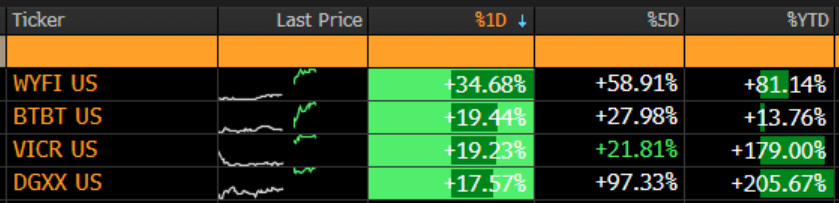
The $CBRS proxy trades are getting a little out of hand here. Could be some interesting sell-the-news shorts here on the CBRS IPO Thursday. Polymarket has Cerebras at a 90% chance of closing above a $50B market cap on IPO day, which should be around $240+ / share
Negligible Capital tweet media
English
13
9
162
16.8K
I stand with 804 !
I stand with 804 !@TrdrForLife·
@demian_ai The stack is so explosive that if an institution makes an ETF representing every layer that it will eclipse some of the largest ETFs currently trading on the stock market.
English
1
0
3
788
dylan ツ
dylan ツ@demian_ai·
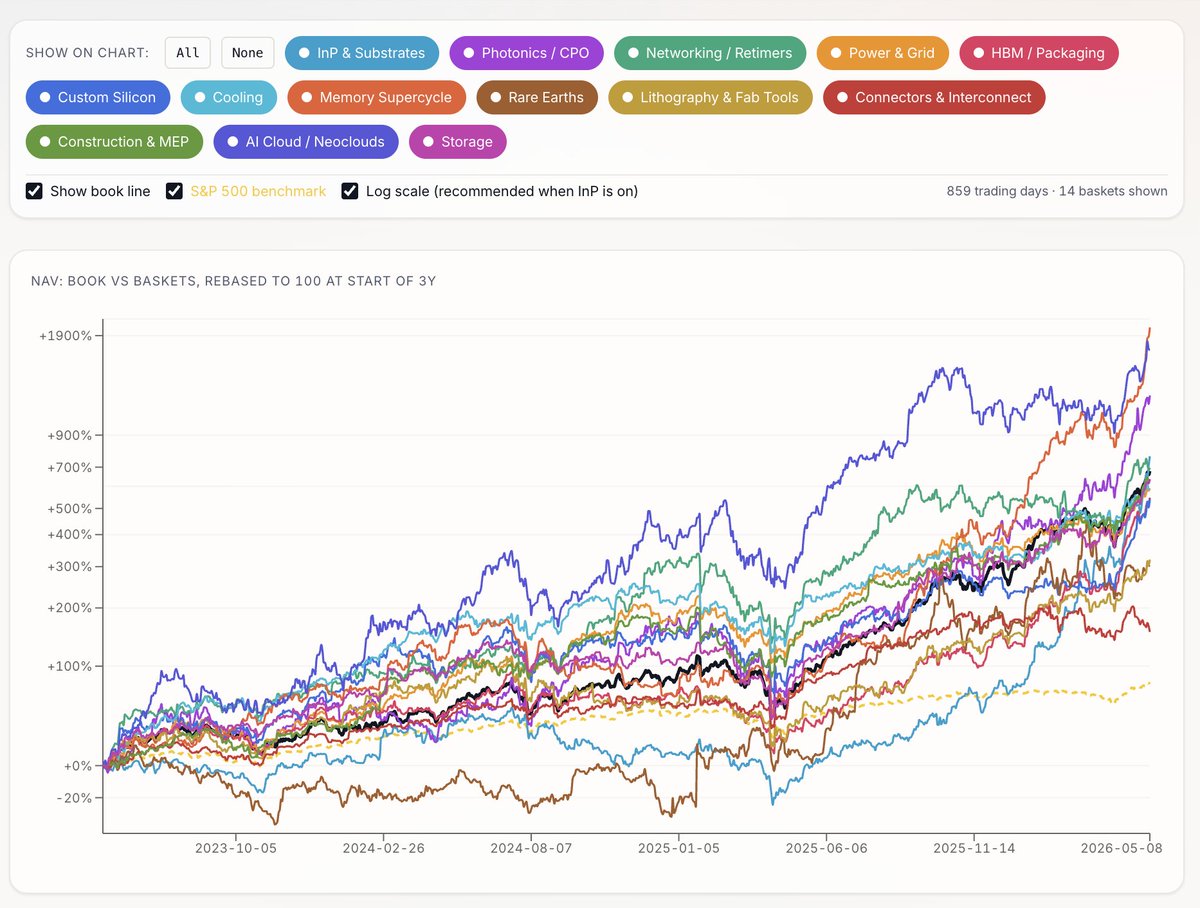
If AI keeps scaling, where does the factory break first? I built a public dashboard for that one question. S&P 500 (in yellow): +31% over the last year. The AI bottleneck book I have been keeping: +348%. All 96 names green. That is the gap between buying AI stocks and buying the parts AI cannot ship without. The market is starting to learn the physical bill of materials for intelligence. The companies are sorted into 14 baskets that map the physical AI stack: substrates, photonics, HBM, packaging, memory, power, cooling, storage, retimers, fab tools, construction, neoclouds, custom silicon, rare earths, and connectors. All of it built around one question: if AI keeps scaling, where does the factory break first? A year ago, the obvious AI trade was the visible part: GPUs, power, data centers, networking, maybe cooling. The tape has been moving somewhere more specific. Memory leads the 1Y. InP and substrates sit right behind it. Photonics/CPO and HBM/packaging follow. Then storage, custom silicon, fab tools, construction, power, cooling, retimers, connectors. The order matters more than the return. The market is no longer buying "AI infrastructure" as a single theme. It is ranking the layers that can make the AI factory late. That is the difference between AI beta and what is starting to look like bottleneck beta. AI beta asks: who sells into AI. Bottleneck beta asks: if this layer is late, does the factory stop. The first question fits a pitch deck. The second fits a route card. A month ago, the clean version of this was InP. GPUs need optical transceivers. Transceivers need lasers. Lasers need indium phosphide substrates. The substrate is a small physical disc sitting underneath one of the largest infrastructure builds in history. That was why $AXTI worked. Tiny disc. Huge system. Real bottleneck. But $AXTI did not stop mattering. It stopped being lonely. Over 3 months, InP led the tape. Over 1 month, InP is still leading, but memory, photonics, custom silicon, and HBM/packaging have clustered right behind it. The market is no longer only buying the raw ingredient. It is buying the stations that turn the ingredient into throughput. That is not a rotation out of InP. It is a rotation into the route card. Substrate to epi. Epi to laser. Laser to optical engine. Optical engine to package. Package to HBM. HBM to system. System to tokens. $AXTI is the substrate station. $VECO is the laser-tool station. $LITE, $COHR, $MXL, and $AAOI are the photonics layer. $MU, $SNDK, and SK Hynix are memory. $TSM is base dies and advanced packaging. $AMKR, ASE, and KYEC are OSAT. $ONTO and $CAMT are inspection and metrology. $BESIY, $KLIC, and TOWA are bonding, attachment, and molding. $ALAB and $CRDO are the retimer fabric that lets all of it talk. These are not separate stories. They are one object moving through the factory. The next layer is probably not just HBM. Everyone has found HBM. The next layer is what makes HBM usable. A stack of memory dies is not memory yet. It has to be bonded, molded, inspected, cooled, and tested. It has to survive heat, pressure, warpage, microbumps, underfill, substrate flatness, and burn-in. Before HBM becomes bandwidth, it has to become a manufactured object. That is where the watchlist is moving next. ABF substrates. T-glass. OSAT capacity. HBM base dies. Hybrid-bonding metrology. Bonders. Molders. Dicers. Thermal. And eventually EUV. The scarce thing keeps getting more specific. First the chip. Then the package. Then the memory. Then the optical link. Then the substrate under the laser. Next, the mold around the memory stack, the metrology tool checking the bump, the glass that keeps the package flat. The market is not walking from InP to HBM. It is walking with the part. Station by station. Dashboard is public, link below. (not financial advice)
dylan ツ tweet media
English
21
52
565
49.6K
Trading Warz
Trading Warz@TradingWarz·
BREAKING: My OPTIONS Trading University Completed 5 Courses + Scanners + Indicators NO CHARGE Comment " ME " and I will sent it directly on your DM
Trading Warz tweet mediaTrading Warz tweet media
English
572
28
276
43.5K
I stand with 804 !
I stand with 804 !@TrdrForLife·
@PDN_Gallagher @gnoble79 People had problems with Elon. He is a nut job. But… When he works with his team he does wonders. It’s his ability to break down everything to the core issues and then execute flawlessly to solve. Accept & agree to his quirky behavior and he will make you a very wealthy man.
English
1
0
0
29
gg
gg@PDN_Gallagher·
@TrdrForLife @gnoble79 You are arguing for any EV. They all save $ over ICE vehicles-- especially now. But that doesn't address the issues abt the company itself- esp in regard to the control its founder exerts on public discourse, political policy & soon- the entire market with the SpaceX valuation 👀
English
1
0
1
33
George Noble
George Noble@gnoble79·
Tesla is the most successful CON in the history of capital markets. Not because the cars are bad. But because the entire business is engineered to impress on first glance and collapse under scrutiny. And the culture around it has made facts completely IRRELEVANT. I've never seen a company where the gap between what is promised and what is delivered is this wide, for this long, with this little accountability. Tesla's Full Self-Driving system is marketed as autonomy. But it is not autonomy. It is a camera-only system running probabilistic inference. The car is making statistical guesses about what it sees, thousands of times per second, with no redundancy when those guesses are wrong. Probabilistic inference controlling a two-ton vehicle at highway speed with your family inside. NHTSA has two open investigations covering 3.2 million Tesla vehicles. One was escalated to a formal Engineering Analysis in March after 9 crashes, including a fatality, where the system FAILED to detect sun glare, fog, and dust. The cameras went blind and the car kept driving. In Austin, Tesla's robotaxi fleet has reported 15 crashes across roughly 800,000 miles. One crash every 57,000 miles. The average American driver has a police-reported crash every 500,000 miles. Tesla's robotaxis crash at roughly 4x the human rate, WITH a safety monitor sitting in the car whose only job is to prevent crashes. Waymo operates over 2,500 fully driverless vehicles across multiple cities with no human backup and maintains a crash rate 85% below human drivers across 127 million autonomous miles. Tesla has ONE unsupervised vehicle in a tiny section of Austin. But here's what really makes Tesla different from every overvalued company I've ever analyzed: The facts do not matter to the people who own this stock. Every missed deadline, every broken promise gets filtered through the same response: attack the messenger. Call them a short seller. Call them a hater. Anything to avoid looking at the actual numbers. It's an online ecosystem that has made itself completely immune to facts. And Musk baked that dynamic into the culture from the beginning. Every time the fundamentals deteriorate, the faithful don't sell. They double down. When your shareholder base treats every dip as a buying opportunity regardless of the data, the stock becomes untethered from reality entirely. That's literally a religion with a ticker symbol. I highly suggest you read Edward Niedermeyer's book Ludicrous on this. And now it even gets WORSE... CapeFearAdvisors published a piece this week that should be required reading. Tesla's 2025 CEO Performance Award contains a change-of-control provision: In the event of a change of control, ALL operational milestones are disregarded. No million robotaxis, Optimus robots, or $400 billion EBITDA. NONE of it. So if SpaceX acquires Tesla at $8.5 trillion, every tranche of Musk's 423 million share award vests immediately. A single acquisition at that price triggers the full vesting of both plans at once, with no way to claw them back. The milestones everyone argues about are just a distraction. The mechanism is the change-of-control language buried in the SEC filing. This is about engineering the largest personal wealth transfer in modern financial history and using the narrative machine to keep the price elevated long enough to execute it. I've seen every bust of the last four decades. But this one is different because the cult of personality is stronger than anything I've witnessed. The movement around this stock cannot be touched by facts, and that is what makes it so dangerous. But the math always wins. ALWAYS. It just takes longer when the con is this good.
English
271
566
2K
169.5K
American Populism
American Populism@KyleTrimbach·
@apocalypseos @WeTheBrandon The reason the US Dollar became the world’s reserve currency is because of the stability and ETHIC of America Since the 60’s, the globalists in concert with corporate America have worked tirelessly to destroy the economic stability and ethics of Americans. The weaponization /
English
3
1
6
821
🅰pocalypsis 🅰pocalypseos 🇷🇺 🇨🇳 🅉
China Will Eliminate Our Ability to Sanction Countries Col. Lawrence Wilkerson: And that means the renminbi being substituted for the dollar — in everything from oil sales to you name it — it will become the transactional and reserve currency. Already is, to a great extent, for about 40% of the world. They’re going to shoot for 60 to 70% of the world. They’re going to drive the Bretton Woods system back where it came from. They’re going to eliminate SWIFT. They’re going to eliminate our ability to sanction countries. That’s one of their major purposes. And that’s an altruistic purpose for them. They think eliminating our ability to put sanctions on other countries in the world — through which, since the turn of this century, we have killed 38 million people, mostly men, women, and children. China looks at us this way: as having done that damage in the world with our financial system, which allowed us to put primary and secondary sanctions on 30% of the world. Go to OFAC and see how many countries we have under sanction. It’s incredible. And these sanctions kill men, women, and children over time. We killed 500,000 in Saddam Hussein’s Iraq when we had the sanctions on him. Madeleine Albright said, when she was confronted with that statistic, “So what? It was worth it.” She wanted to join Hillary in the world of credence — and she did. This is a serious issue for China, and they want to stop it.
English
47
492
1.3K
65.2K
I stand with 804 ! retweetledi
TheValueist
TheValueist@TheValueist·
$PLTR KEY READ-THROUGHS FROM PALANTIR TECHNOLOGIES Q1 2026 EARNINGS CALL Palantir’s Q1 2026 call provided a high-signal read-through across AI infrastructure, software, defense, cybersecurity, industrial operations, financial services, insurance, telecom, and IT services. The core market implication is that enterprise AI demand is moving beyond demos and model experimentation into production-grade operational systems that require governance, ontology, permissioning, cost attribution, auditability, and deterministic execution. The quarter also reinforced a widening split between companies monetizing AI through mission-critical workflow transformation and companies exposed to commoditizing model access, legacy seat-based software, labor-intensive integration, or low-value workflow automation. The strongest positive read-throughs accrue to inference infrastructure, select hyperscale cloud consumption, defense production throughput, cyber remediation, and early enterprise AI adopters in operationally complex verticals. The strongest negative read-throughs accrue to legacy SaaS workflow vendors, IT services firms dependent on contractor labor, pure-play model monetization strategies, contact center/BPO vendors, and vertical software platforms whose application-layer control can be displaced by AI operating systems. AI SEMICONDUCTORS, NETWORKING AND DATA CENTER INFRASTRUCTURE (READ-THROUGH 1) Call support: Shyam Sankar stated that “GPT4 equivalent performance that cost $20 per million tokens in early 2023 is now approximately 1,000 times cheaper 3 years later,” but that “use-case demand for tokens is exploding.” He framed the dynamic explicitly as Jevons paradox: “Tokens are the new coal, AIP is the train.” He added that AIP workflows now use “vastly more tokens” across “agents orchestrating across the ontology, training, reasoning, tool use, retrieval and execution.” Affected companies: NVIDIA Corporation (NVDA: US), Broadcom Inc. (AVGO: US), Advanced Micro Devices, Inc. (AMD: US), Marvell Technology, Inc. (MRVL: US), Arista Networks, Inc. (ANET: US), Taiwan Semiconductor Manufacturing Company Limited (2330: Taiwan), SK hynix Inc. (000660: South Korea), Micron Technology, Inc. (MU: US), Vertiv Holdings Co. (VRT: US), Eaton Corporation plc (ETN: US), Schneider Electric SE (SU: France). Directional impact and magnitude: Positive, high magnitude for inference compute, custom silicon, networking, HBM/memory, optical/electrical interconnect, power, cooling, and data center infrastructure. Transmission mechanism: Palantir’s commentary argues that lower inference cost does not destroy AI infrastructure demand; it expands addressable use cases by making agentic workflows economically feasible. Each production AI workflow requires multiple calls for reasoning, retrieval, tool execution, self-correction, governance, audit logging, and output validation. As enterprises move from copilots and demos to agentic production workflows, aggregate inference consumption can rise faster than cost per token falls. This is particularly favorable for NVIDIA’s inference GPUs, AMD’s accelerator roadmap, Broadcom and Marvell’s custom ASIC/networking exposure, Arista’s data center switching exposure, TSMC’s leading-edge manufacturing, HBM suppliers such as SK hynix and Micron, and physical infrastructure suppliers such as Vertiv, Eaton, and Schneider. Near-term trading catalyst versus long-duration shift: The near-term catalyst is Palantir’s 85% revenue growth, 104% U.S. revenue growth, 133% U.S. commercial growth, and 71% FY 2026 revenue growth guidance, which provide concrete evidence that enterprise AI workloads are entering production at scale. The longer-duration shift is a structural transition from training-led AI infrastructure demand to recurring inference-led demand tied to operational workflows. The implication is that investors should not interpret token price deflation as automatically bearish for AI infrastructure. The more relevant variable is elasticity of use-case creation, and Palantir’s call strongly supports high elasticity. HYPERSCALE CLOUD AND AI PLATFORM CONTROL PLANES (READ-THROUGH 2) Call support: Management repeatedly argued that models alone are insufficient for production AI. Sankar stated: “For every agent action, our customers need to answer 3 questions. Who authorized this? What did it cost? Can I trust what it did?” He described AIP as “a true agent operating system” with “unified cost attribution per agent, per session, per workflow,” “full provenance,” and “security marking.” Karp added: “The appearance of software working is not software working.” Affected companies: Microsoft Corporation (MSFT: US), Amazon.com, Inc. (AMZN: US), Alphabet Inc. (GOOGL: US), Oracle Corporation (ORCL: US), Snowflake Inc. (SNOW: US), Datadog, Inc. (DDOG: US). Directional impact and magnitude: Mixed, medium-to-high magnitude. Positive for hyperscale infrastructure consumption; negative or limiting for hyperscaler-native AI platform attach if independent operating layers capture the enterprise control plane. Transmission mechanism: Palantir’s results are constructive for cloud consumption because production AI requires compute, storage, data movement, observability, security, and deployment infrastructure. However, the strategic control point is shifting toward the operational AI layer rather than the raw model or cloud platform. If enterprise customers standardize agent governance, ontology, provenance, and workflow execution in Palantir-like systems, hyperscalers may capture infrastructure revenue but lose some platform-level economics to independent AI operating systems. This is especially relevant for Microsoft Copilot/Power Platform/Fabric, AWS Bedrock, Google Vertex AI, Oracle’s enterprise AI stack, and Snowflake’s data application ambitions. Near-term trading catalyst versus long-duration shift: The near-term catalyst is a positive read-through to cloud AI consumption from Palantir’s large guidance raise and management’s claim that token demand is exploding. The longer-duration risk is that cloud vendors may not fully own the application and agent orchestration layer. That distinction matters because infrastructure consumption can grow while platform margin capture migrates elsewhere. MODEL LAYER AND CLOSED-MODEL MONETIZATION (READ-THROUGH 3) Call support: Sankar stated that “models are converging” and that “the cost per token continues to drop precipitously.” Karp said customers are asking, “can I have a cheaper model since they seem pretty similar.” Management also argued that AI labs see “limitless potential” but do not live “at the edge of where does it translate into economic value.” Affected companies: Microsoft Corporation (MSFT: US), Alphabet Inc. (GOOGL: US), Amazon.com, Inc. (AMZN: US), Meta Platforms, Inc. (META: US), Apple Inc. (AAPL: US). Private-market read-through also applies to OpenAI, Anthropic, xAI, Mistral AI, and other model labs. Directional impact and magnitude: Negative, medium magnitude for standalone model API pricing power and premium closed-model differentiation; mixed for public hyperscalers because infrastructure volume can offset model-margin pressure. Transmission mechanism: Palantir’s commentary implies that enterprises increasingly view models as interchangeable components once they are embedded into governed production workflows. The economic value shifts from the model endpoint to the system that decides what the agent can access, what it can do, how outputs are verified, who authorized an action, what the action cost, and whether the action can be audited. This compresses the strategic value of model differentiation unless the model provider also controls the enterprise workflow layer. For Microsoft, Alphabet, Amazon, and Meta, the issue is not whether AI demand exists; it is whether high-margin monetization accrues to model APIs, cloud compute, productivity bundles, or independent orchestration systems. Near-term trading catalyst versus long-duration shift: The near-term catalyst is likely pressure on market narratives that assume persistent premium pricing for frontier models. The longer-duration shift is a move toward model commoditization, model routing, cheaper inference substitution, and enterprise buyer preference for outcome-based platforms over raw model access. LEGACY SAAS, CRM, WORKFLOW SOFTWARE AND RPA (READ-THROUGH 4) Call support: Sankar said: “This is also why we are seeing the death of legacy software.” He added that “AIP replaces static workflows not by replicating the playbook, but by eliminating the need for one.” He cited Thomas Kavanaugh Construction, where “97% of their employees use Foundry every day and every other piece of software must now justify its existence.” He also disclosed that Palantir “replaced our old expensive CRM with an AI-first solution built on AIP in a few months.” Management described legacy thin software as built around “rent extraction and no outcome delivery.” Affected companies: Salesforce, Inc. (CRM: US), ServiceNow, Inc. (NOW: US), Workday, Inc. (WDAY: US), UiPath Inc. (PATH: US), Atlassian Corporation (TEAM: US), Adobe Inc. (ADBE: US), SAP SE (SAP: Germany), Microsoft Corporation (MSFT: US). Directional impact and magnitude: Negative, high magnitude for legacy seat-based workflow vendors, CRM vendors, RPA platforms, and application software companies whose value proposition is static workflow automation rather than AI-native operational control. Transmission mechanism: Palantir’s call suggests that AI-native platforms can rebuild, absorb, or bypass traditional application workflows. CRM is the most direct negative read-through because Palantir explicitly replaced its own legacy CRM with an AIP-based internal system. RPA is also exposed because agentic workflows can act directly through governed ontologies rather than brittle screen-scraping or scripted process automation. ServiceNow, Workday, Atlassian, SAP, and Microsoft Dynamics are exposed to the extent that customers view application workflows as replaceable front ends on top of an AI operating layer. Near-term trading catalyst versus long-duration shift: The near-term catalyst is sentiment pressure on software multiples, especially for vendors that have presented AI as an incremental feature rather than a core architecture shift. The longer-duration shift is more important: enterprise software value could migrate from systems of record and systems of engagement toward systems of action, governance, and autonomous workflow execution. Palantir’s quarter is one of the clearest data points that this migration is already monetizable. IT SERVICES, SYSTEM INTEGRATORS AND GOVERNMENT CONTRACTORS (READ-THROUGH 5) Call support: Sankar said AIP is becoming “the default builder platform in the Department of War,” with “thousands of developers using AIFD, migrating legacy systems, standing up new capabilities, solving problems that used to require contractor teams and months of lead-time.” Karp also emphasized the company’s ability to grow with a minimal sales force, stating: “We are doing what a normal company would do with 7,000 salespeople with 7 people.” Affected companies: Booz Allen Hamilton Holding Corporation (BAH: US), Leidos Holdings, Inc. (LDOS: US), Science Applications International Corporation (SAIC: US), CACI International Inc. (CACI: US), Accenture plc (ACN: US), IBM Corporation (IBM: US), CGI Inc. (GIB.A: Canada), Capgemini SE (CAP: France). Directional impact and magnitude: Negative, medium-to-high magnitude for labor-intensive government IT services, systems integration, custom application development, and contractor-heavy transformation programs. Transmission mechanism: The call indicates that AI platforms can reduce the need for large contractor teams by enabling internal developers, forward-deployed engineers, and operating units to build applications directly on a governed platform. In government, this threatens the traditional services model built around long-duration modernization programs, staff augmentation, and bespoke integration. In commercial markets, the same pattern can compress consulting scope as enterprises standardize on AI operating platforms rather than hiring large teams to stitch together data, workflow, governance, and application layers. Near-term trading catalyst versus long-duration shift: The near-term catalyst is relative share-shift concern in U.S. federal IT modernization budgets as Palantir’s U.S. government revenue grew 84% year over year and 21% sequentially. The longer-duration shift is margin and revenue pressure for services vendors if AI-native platforms convert multi-month or multi-year projects into productized deployments. DEFENSE INDUSTRIAL BASE, AEROSPACE AND SHIPBUILDING (READ-THROUGH 6) Call support: Management cited ShipOS with the Department of the Navy and said it had already produced “remarkable impact” at maritime industrial-base suppliers, including “dropping manufacturing bill of materials approval time from 200 hours to 15 seconds,” “increasing speed of contract review cycles by 57% to 73%,” and “reducing monthly material planning time by 94%.” Management also cited GE Aerospace, stating that on the back of a “26% increase in engine production with AIP,” GE deepened its partnership to deploy agentic AI-powered solutions across its production system and military aviation supply chain. Affected companies: GE Aerospace (GE: US), RTX Corporation (RTX: US), Lockheed Martin Corporation (LMT: US), Northrop Grumman Corporation (NOC: US), General Dynamics Corporation (GD: US), Huntington Ingalls Industries, Inc. (HII: US), The Boeing Company (BA: US), L3Harris Technologies, Inc. (LHX: US). Directional impact and magnitude: Positive, medium-to-high magnitude for defense and aerospace OEMs with production bottlenecks, sustainment constraints, complex supply chains, and readiness-driven demand. Mixed for cost-plus margin structures if AI improves government visibility into cost, cycle time, and supplier inefficiency. Transmission mechanism: Palantir’s data points imply that AI can unlock production capacity without proportional increases in labor or capex. For GE Aerospace, the 26% engine production uplift is a direct positive read-through to throughput, delivery schedules, aftermarket availability, and military readiness. For shipbuilders such as Huntington Ingalls and General Dynamics, ShipOS-type improvements could reduce administrative bottlenecks in bill-of-material approvals, contract reviews, material planning, and supplier coordination. For primes such as Lockheed, Northrop, RTX, and L3Harris, improved defense industrial-base throughput can support program execution and reduce supply-chain friction. Near-term trading catalyst versus long-duration shift: The near-term catalyst is positive sentiment around AI-enabled defense production, particularly where investors have been focused on supply constraints, backlog conversion, and working capital. The longer-duration shift is that defense procurement may increasingly favor primes and suppliers able to integrate real-time operational AI into production and sustainment. The risk is that government customers may also use these systems to demand better unit economics, reducing some cost-plus inefficiency that historically benefited incumbent contractor economics. CYBERSECURITY, VULNERABILITY MANAGEMENT AND REMEDIATION AUTOMATION (READ-THROUGH 7) Call support: Sankar stated that current-generation models with AIP are capable of finding “novel vulnerabilities in complex cyberkill chains” and have “discovered thousands of zero days in major operating systems and browsers.” He called this the “spudnick moment in the AI arms race” and said: “Finding the bugs is no longer the limiting factor, rapid-fire remediation with exact precision, immediacy and absolute certainty is a new hard problem.” He added that the task is “knowing exactly what versions of what software are running where and closing the remediation chain autonomously.” Affected companies: Palo Alto Networks, Inc. (PANW: US), CrowdStrike Holdings, Inc. (CRWD: US), Microsoft Corporation (MSFT: US), SentinelOne, Inc. (S: US), Zscaler, Inc. (ZS: US), Cloudflare, Inc. (NET: US), Tenable Holdings, Inc. (TENB: US), Qualys, Inc. (QLYS: US), Rapid7, Inc. (RPD: US). Directional impact and magnitude: Positive, high magnitude for cyber platforms with endpoint control, remediation automation, asset intelligence, policy enforcement, and integrated exposure management. Negative or mixed, medium magnitude for pure vulnerability scanning vendors if AI commoditizes vulnerability discovery and shifts value toward autonomous remediation. Transmission mechanism: Palantir’s commentary implies that AI will increase the volume and speed of vulnerability identification, compressing the time available for defenders to patch, test, deploy, and verify remediations. The scarce capability becomes knowing the software inventory, understanding exposure, prioritizing risk, and closing the remediation loop. This favors security platforms with broad telemetry, endpoint agents, cloud posture, identity context, and automated response. It pressures standalone scanners if their core value is finding vulnerabilities rather than orchestrating remediation. Near-term trading catalyst versus long-duration shift: The near-term catalyst is a narrative upgrade for cyber vendors positioned around exposure management, agentic remediation, and endpoint/cloud control. The longer-duration shift is a potential redefinition of cybersecurity from detection-and-response toward autonomous software supply-chain control. Palantir’s Apollo positioning is particularly relevant because it frames secure deployment and remediation as a core battleground in the AI era. INDUSTRIAL SOFTWARE, PLM, MES AND ERP (READ-THROUGH 8) Call support: Management emphasized manufacturing and operational workflows repeatedly. GE Aerospace was cited for a “26% increase in engine production with AIP.” ShipOS was cited for reducing bill-of-material approval time from “200 hours to 15 seconds.” Sankar stated that “AIP replaces static workflows” and that the real value is “doing what was previously impossible,” not simply automating existing processes. Affected companies: Siemens AG (SIE: Germany), Dassault Systèmes SE (DSY: France), PTC Inc. (PTC: US), Autodesk, Inc. (ADSK: US), SAP SE (SAP: Germany), Rockwell Automation, Inc. (ROK: US), Emerson Electric Co. (EMR: US). Directional impact and magnitude: Negative to mixed, medium-to-high magnitude for incumbent PLM, MES, ERP, and industrial workflow software vendors. Positive for vendors that can become systems of record integrated into an AI operating layer; negative for vendors whose workflow layer is displaced. Transmission mechanism: Palantir is positioning AIP and ontology as the operational backbone that sits above or across traditional industrial systems. If production planning, BOM approval, supplier coordination, contract review, and material planning move into an AI-native operating layer, incumbent PLM/MES/ERP vendors risk losing workflow control even if their databases remain in place. The software profit pool can shift upward from static systems of record toward AI decision and execution systems. This is particularly relevant for Siemens, Dassault, PTC, SAP, and Rockwell, which have substantial exposure to manufacturing digitization, production systems, and industrial workflow software. Near-term trading catalyst versus long-duration shift: The near-term catalyst is negative competitive read-through for industrial software vendors if investors begin to question whether AI overlays can absorb high-value workflows. The longer-duration shift is more nuanced: industrial software incumbents can remain important data and control systems, but the highest incremental value may accrue to AI operating platforms that orchestrate work across fragmented industrial stacks. INSURANCE UNDERWRITING, CLAIMS AND VERTICAL SOFTWARE (READ-THROUGH 9) Call support: Ryan Taylor cited AIG’s use of AIP, stating that AIG is deploying a “multi-agentic underwriting and claims solution comprised of purpose-built agents ingesting submissions, evaluating risk, benchmarking pricing and detecting fraud, all coordinated through the ontology.” Affected companies: American International Group, Inc. (AIG: US), Chubb Limited (CB: US), The Travelers Companies, Inc. (TRV: US), The Progressive Corporation (PGR: US), The Allstate Corporation (ALL: US), The Hartford Financial Services Group, Inc. (HIG: US), Guidewire Software, Inc. (GWRE: US). Directional impact and magnitude: Positive, medium magnitude for early AI adopters such as AIG and other carriers able to embed AI into underwriting, claims, pricing, and fraud workflows. Negative to mixed, medium magnitude for vertical insurance software vendors if AI platforms capture workflow orchestration above core systems. Transmission mechanism: Insurance is an information-processing business with large cost pools in underwriting, claims handling, pricing, compliance, and fraud detection. A multi-agentic platform coordinated through an ontology can improve submission intake, risk assessment, pricing accuracy, claims cycle time, fraud identification, and expense ratios. Early adopters can compound advantages in underwriting precision and operating efficiency. Laggards may face worsening adverse selection if competitors price and triage risk faster. For Guidewire, the read-through is mixed: core insurance systems can remain mission-critical, but AIP-like platforms can capture the differentiated workflow and decisioning layer if the core vendor does not keep pace. Near-term trading catalyst versus long-duration shift: The near-term catalyst is positive sentiment for AIG if investors view the deployment as a credible underwriting and expense-efficiency lever. The longer-duration shift is an insurance AI arms race in which carriers’ ability to operationalize proprietary data becomes a source of loss-ratio and expense-ratio differentiation.
English
3
2
6
2.9K
I stand with 804 !
I stand with 804 !@TrdrForLife·
@gnoble79 You do your math on your gas car. I bought my M3 for $40,000 and it is still worth $25,000. Total 3 years gas + maintenance cost $4,000. You loose !
English
3
0
1
166
I stand with 804 !
I stand with 804 !@TrdrForLife·
@PhotonCap I bought it from $5 to $12.35. I’m buying more. Every now and then you get a piece of tech that revolutionizes. POET ability to deliver copackaged optics with sub micron level alignment will be the rage tomorrow. Once you cross 1.6T data transfer speeds you must shift to POET.
English
0
0
1
747
Photon Capital
Photon Capital@PhotonCap·
$POET 주식은 현재 없지만, 쿨다운좀 하고, 사람들 사이에서 열기가 좀 식고 진정된 이후 언제든 제가 원하는 가격에 온다면 매수할 겁니다. 마벨이 계약 취소했다고, 엔지니어들의 optical interposer 결과물이 그냥 사라지는 것은 아니잖아요? 제 최근 아티클 - bonding - 에서도 예시로 POET의 optical interposer를 다뤘습니다. x.com/i/status/20501…
Photon Capital tweet media
Photon Capital@PhotonCap

@leadwithMMT 🫢 I am personally still supporting POET's optical interposer concept

한국어
29
28
360
256.7K
I stand with 804 ! retweetledi
Shay Boloor
Shay Boloor@StockSavvyShay·
Figure AI’s CEO says humanoid robotics could become “the biggest business in the world” because human labor represents roughly half of GDP and ~$40T in annual wages. Capturing a fraction of that labor market could create a multi-trillion-dollar robotics platform.
Shay Boloor@StockSavvyShay

10 WAYS ROBOTICS IS GETTING BUILT OUT ACROSS SECTORS 1. $NVDA is the infrastructure layer for the robotics stack where ever humanoid robot from Tesla Optimus to Boston Dynamics Atlas train in Nvidia’s Isaac Sim virtual environment before ever taking a real step. 2. $TSLA is the only company attempting humanoid robots at manufacturing scale with 1,000+ Optimus units already operating in factories & a long-term ~$25K target price. 3. $GOOGL, $MSFT, $META & $BIDU provide the foundation models that give robots the ability to reason, see & act. 4. $PLTR & $ORCL turn robot fleet sensor data into operational intelligence while $PANW & $CRWD secure the robot “nervous system” as fleets scale & the attack surface grows. 5. $ARM, $SNPS & $CDNS design the chips that power robot brains while $TSM manufactures the silicon & $INTC contributes both design + fabrication capacity for edge compute. 6. $XPEV, $BABA, $AMZN & $AAPL are building competing robotics ecosystems across consumer and logistics applications. 7. $HON & $ROK provide the industrial automation & control systems that integrate robots into existing factory infrastructure at scale. 8. $MP supplies the rare-earth magnets that power motors & actuators throughout the robot supply chain. 9. $ADI, $TXN, $ON & $STM provide the analog semiconductors that bridge the digital brain to the physical world by converting sensor signals, managing power & controlling motors with precision. 10. $QCOM Dragonwing chips handle 5G connectivity & on-device AI for robot coordination while $MBLY & $AMBA provide the vision & compute silicon enabling real-time perception.

English
26
51
259
71.9K
I stand with 804 ! retweetledi
Shay Boloor
Shay Boloor@StockSavvyShay·
10 WAYS ROBOTICS IS GETTING BUILT OUT ACROSS SECTORS 1. $NVDA is the infrastructure layer for the robotics stack where ever humanoid robot from Tesla Optimus to Boston Dynamics Atlas train in Nvidia’s Isaac Sim virtual environment before ever taking a real step. 2. $TSLA is the only company attempting humanoid robots at manufacturing scale with 1,000+ Optimus units already operating in factories & a long-term ~$25K target price. 3. $GOOGL, $MSFT, $META & $BIDU provide the foundation models that give robots the ability to reason, see & act. 4. $PLTR & $ORCL turn robot fleet sensor data into operational intelligence while $PANW & $CRWD secure the robot “nervous system” as fleets scale & the attack surface grows. 5. $ARM, $SNPS & $CDNS design the chips that power robot brains while $TSM manufactures the silicon & $INTC contributes both design + fabrication capacity for edge compute. 6. $XPEV, $BABA, $AMZN & $AAPL are building competing robotics ecosystems across consumer and logistics applications. 7. $HON & $ROK provide the industrial automation & control systems that integrate robots into existing factory infrastructure at scale. 8. $MP supplies the rare-earth magnets that power motors & actuators throughout the robot supply chain. 9. $ADI, $TXN, $ON & $STM provide the analog semiconductors that bridge the digital brain to the physical world by converting sensor signals, managing power & controlling motors with precision. 10. $QCOM Dragonwing chips handle 5G connectivity & on-device AI for robot coordination while $MBLY & $AMBA provide the vision & compute silicon enabling real-time perception.
Shay Boloor tweet media
English
60
251
981
162.9K
I stand with 804 ! retweetledi
Ritesh Jain
Ritesh Jain@riteshmjn·
This is probably my most important post. The FED stole your future and there is no going back "The system is rigged. The deep state does not want us to be free. The American dream is dead." Statements like these conjure images of deep pessimism, a worldview where you have no agency, where you are merely a puppet dancing for malignant powers you cannot see or touch. We are not people who live in that camp. But sometimes, certain data points are so damning that they leave us no choice but to admit: something is seriously wrong, and it needs to be laid out in the open. Every time I visit India now, I find people agitated. Even those in the top 10% of the income bracket, earning anywhere from ₹50 lakhs to a crore per year, feel like they are running on a treadmill that keeps accelerating. No matter how fast they move, it is never enough. At the ground level, the situation is far worse. It is the same story everywhere. In Canada, both partners in a household work full time and still fall short each month. In Australia, young professionals earn well and own nothing. In Germany, the middle class quietly shrinks. The geography changes. The exhaustion does not. And the origins of this mess are not in New Delhi or Ottawa or Berlin. They are in Washington D.C. All of us are paying the price for a policy disaster handed down from ivory towers, by people most of us never elected and, frankly, never even saw. Consider this: the U.S. money supply (M2) grew by 40% in just 2 years *The Federal Reserve United States Money Supply M2* January 1, 2020: $15.4 trillion January 1, 2022: $21.6 trillion A staggering ~40% increase As of Mar-26, $ 22.6 Tn ( so they never reversed the increased money supply although Covid got over) Unprecedented in the history of the Federal Reserve post-World War 2 era. (Source: FRED) This massive injection of liquidity created asset bubbles across the economy. Wages stayed stagnant. Those who owned capital benefited enormously. Everyone else got the inflation. Most people have not yet identified the cause of their frustration, but they have begun to feel its effects viscerally. And that feeling, that the system simply cannot deliver on their aspirations, has become the quiet tailwind driving a very dangerous behavioural shift. The more people sense that conventional paths are closed off, the more they reach for asymmetric bets, even knowing the odds are stacked heavily against them. The explosion of betting apps and prediction markets, Kalshi, Polymarket, Dream11 and their many cousins, are not trends. They are symptoms of a broken economy. The feverish rise in F&O trading and the massive uptick in exchange volumes are different expressions of the same underlying truth: when people stop trusting the system to reward honest effort, they start gambling on outcomes instead.
Ritesh Jain tweet media
English
56
223
922
136.8K