
TrevorT

1K posts

TrevorT

TrevorT

@TrevorTickner

Cape Town Katılım Ağustos 2009
97 Takip Edilen19 Takipçiler
TrevorT retweetledi
TrevorT retweetledi
Devon Eriksen
Devon Eriksen@Devon_Eriksen_·
He doesn't actually have all that much money. Compared to you or I, yeah, sure, but not compared to what you'd expect. What he has is ownership of some companies that some people think are insanely valuable. His near-trillionaire status is based entirely on what those people think those companies are worth. Middle-class, working-class, professional-class people like me — and probably you, too, because only a handful of my followers are billionaires — don't usually understand what a billionaire is. We tend to think of wealth as a measure of what you can afford to buy... this many dollars, you can have this and this, but not that. Because that's what we do with money. We earn it because we need it to live, we spend it on the things we need. Break even and you're okay for today. Get a little bit ahead and you're safe. Get a little further ahead and you can have some fun, press the hedonic lever a few times, snort some better quality cocaine off a prettier whore's tits. And that's what Bernie Sanders wants you to think a billionaire is. A guy who's got a billion dollars stashed away for hookers and blow. But that's not how it works. A billionaire's wealth isn't a bank account or even a stock portfolio. It's a valuation. An estimate. It doesn't even mean that he could sell Tesla and SpaceX and Starlink and whatnot for 800-someodd billion, either. Because 8?? billion is what all these things are worth based on the assumption that Elon Musk will continue running them. Were he to decide to sell, suddenly that confidence, and those estimates, and that selling price, would go way down, fast. So all those billions are less of reality and more like a description of what's going on, and how important we think it is. What's going on is that he's obsessed with space tech, he's leading some efforts to develop it, they're working so far, and people think that's important. And he's so obsessed with them that his house isn't the Chateau des Reves, it's just a box for him to sleep in, because that's all he does there. Some people like Bernie Sanders, see this high valuation as an opportunity to steal. I see it as a planetwide consensus that something important is going on here, and we shouldn't jostle the table or make loud noises.
Devon Eriksen tweet media
Dima Zeniuk@DimaZeniuk

Elon Musk's house in Boca Chica, Texas. No fancy things, only what's essential for living

English
236
389
4.6K
662.7K
TrevorT retweetledi
Lukasz Olejnik
Lukasz Olejnik@lukOlejnik·
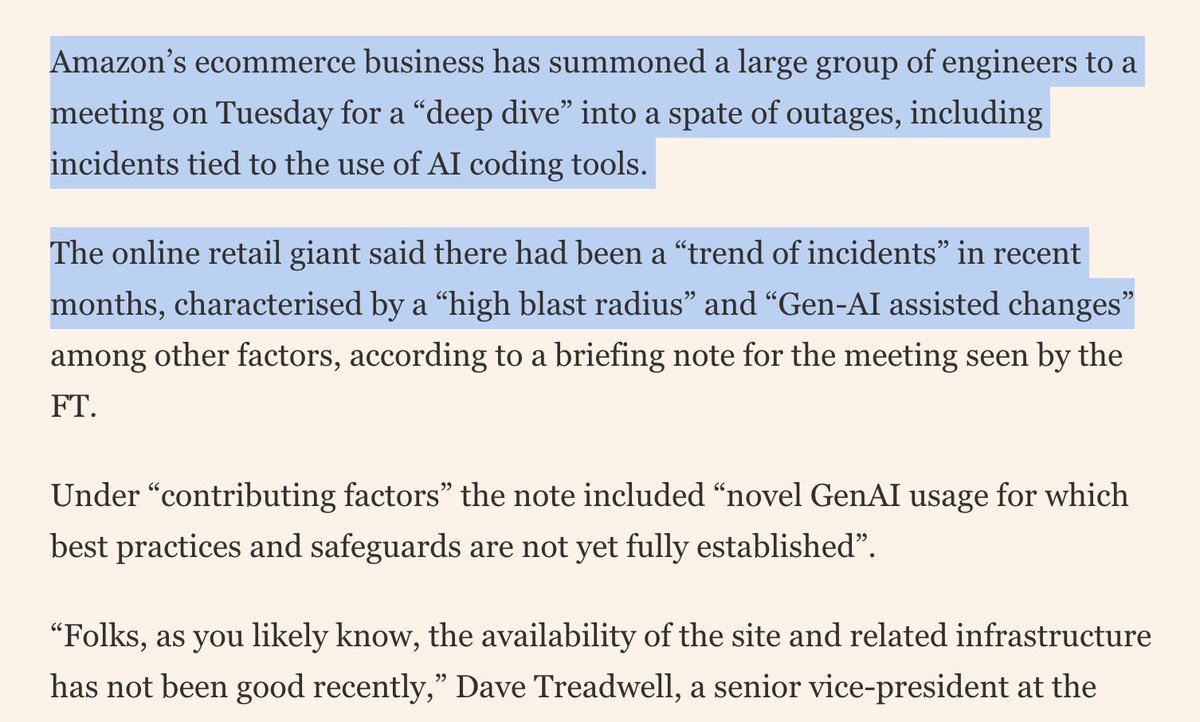
Amazon is holding a mandatory meeting about AI breaking its systems. The official framing is "part of normal business." The briefing note describes a trend of incidents with "high blast radius" caused by "Gen-AI assisted changes" for which "best practices and safeguards are not yet fully established." Translation to human language: we gave AI to engineers and things keep breaking? The response for now? Junior and mid-level engineers can no longer push AI-assisted code without a senior signing off. AWS spent 13 hours recovering after its own AI coding tool, asked to make some changes, decided instead to delete and recreate the environment (the software equivalent of fixing a leaky tap by knocking down the wall). Amazon called that an "extremely limited event" (the affected tool served customers in mainland China).
Lukasz Olejnik tweet media
English
967
3.2K
18.8K
29.8M
TrevorT retweetledi
TrevorT
TrevorT@TrevorTickner·
@bensmithrugby Ahh. So you think the Proteas, the the Springboks, are the best team in the world (in their sports) but tend to suffer from a little bit of bad luck. Could be.
English
0
0
0
81
Ben Smith
Ben Smith@bensmithrugby·
The Proteas getting klapped by the Black Caps in another ICC tournament… Honestly, the Springboks are just the Proteas with better ‘luck’. The ‘gold watch’ semi-final in 1995. Suzie the waitress in the final. The 2007 Steven Bradberry run. The 2019 cakewalk and then the 2023 charity event of the century, 15-on-14 final and only winning by a point. The Proteas just aren’t getting the same level of assistance, but make no mistake, they are the same.
English
109
2
56
15.9K
TrevorT retweetledi
Anish Moonka
Anish Moonka@anishmoonka·
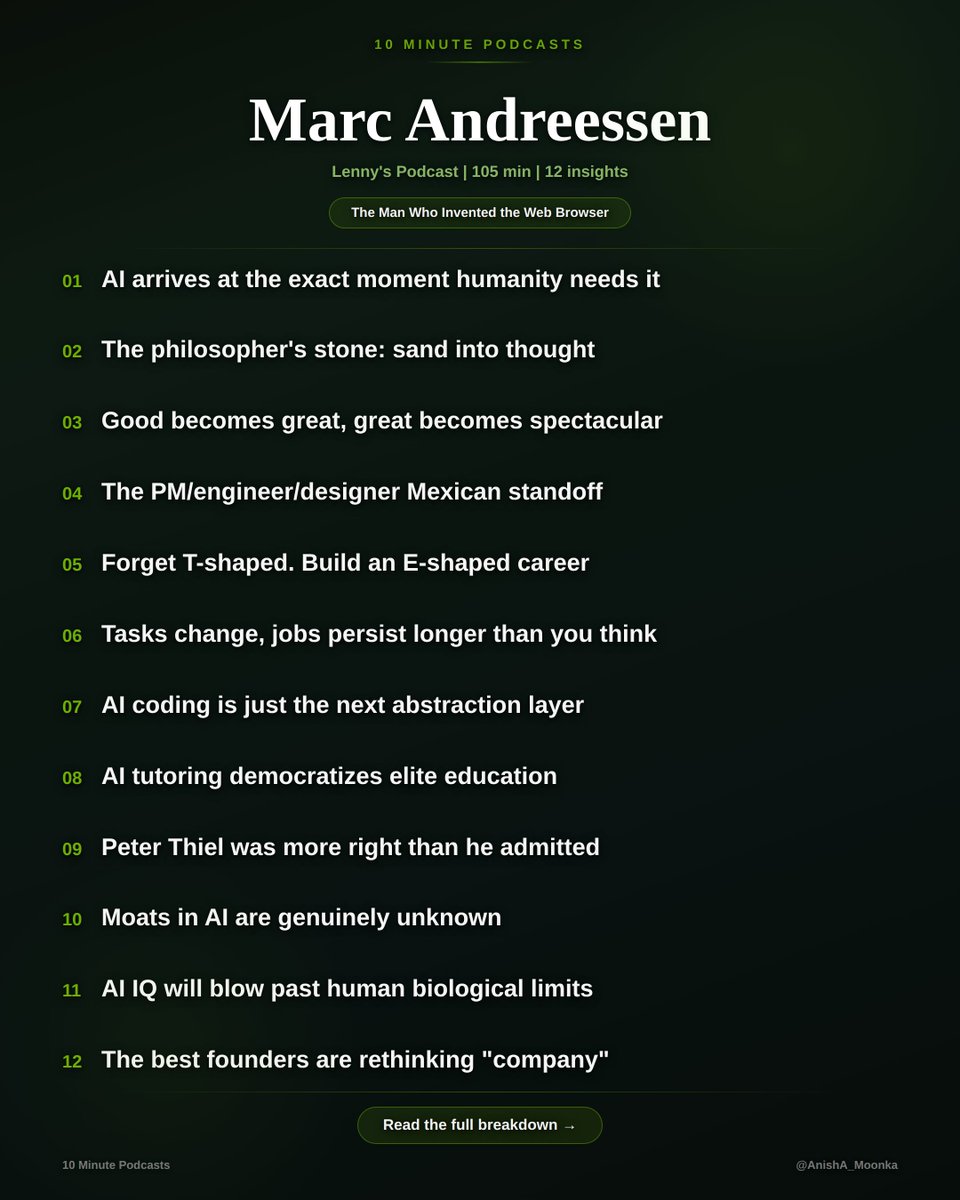
Marc Andreessen just dropped ~105 mins on Lenny's Podcast covering AI, jobs, careers, and why everyone is panicking about the wrong thing. Just the clearest macro framework I've heard on where AI actually lands. My notes: 𝟭. 𝗔𝗜 𝗶𝘀 𝗮𝗿𝗿𝗶𝘃𝗶𝗻𝗴 𝗮𝘁 𝘁𝗵𝗲 𝗲𝘅𝗮𝗰𝘁 𝗺𝗼𝗺𝗲𝗻𝘁 𝗵𝘂𝗺𝗮𝗻𝗶𝘁𝘆 𝗻𝗲𝗲𝗱𝘀 𝗶𝘁. US productivity growth has been running at half the rate of the 1940-1970 era and a third the rate of 1870-1940. The global population is declining below replacement in dozens of countries, including China. Without AI, we would be panicking about economies shrinking from depopulation, not job loss. The timing is almost miraculous. This is what Andreessen means when he says the real boom has not started yet. We have been in a 50-year productivity drought, and most people do not even realize it. 𝟮. 𝗔𝗜 𝗶𝘀 𝘁𝗵𝗲 𝗽𝗵𝗶𝗹𝗼𝘀𝗼𝗽𝗵𝗲𝗿'𝘀 𝘀𝘁𝗼𝗻𝗲. Isaac Newton spent decades trying to transmute lead into gold and never succeeded. AI does something more powerful: it converts sand (silicon) into thought. The most common material in the world is the rarest output. This one metaphor reframes the entire AI conversation. You do not have a job loss problem. You have a philosopher's stone sitting on your desk that you are not using enough. 𝟯. 𝗔𝗜 𝗺𝗮𝗸𝗲𝘀 𝗴𝗼𝗼𝗱 𝗽𝗲𝗼𝗽𝗹𝗲 𝘃𝗲𝗿𝘆 𝗴𝗼𝗼𝗱, 𝗮𝗻𝗱 𝘃𝗲𝗿𝘆 𝗴𝗼𝗼𝗱 𝗽𝗲𝗼𝗽𝗹𝗲 𝘀𝗽𝗲𝗰𝘁𝗮𝗰𝘂𝗹𝗮𝗿𝗹𝘆 𝗴𝗿𝗲𝗮𝘁. The best coders right now are not reporting 2x productivity. They are reporting 10x. The gap between "pretty good with AI" and "elite with AI" is widening, not narrowing. This is the most important signal for career planning right now. If you are just using AI to do the same job slightly faster, you are leaving the real leverage on the table. 𝟰. 𝗧𝗵𝗲𝗿𝗲'𝘀 𝗮 𝗠𝗲𝘅𝗶𝗰𝗮𝗻 𝘀𝘁𝗮𝗻𝗱𝗼𝗳𝗳 𝗯𝗲𝘁𝘄𝗲𝗲𝗻 𝗣𝗠𝘀, 𝗲𝗻𝗴𝗶𝗻𝗲𝗲𝗿𝘀, 𝗮𝗻𝗱 𝗱𝗲𝘀𝗶𝗴𝗻𝗲𝗿𝘀. Every engineer now thinks they can be a PM and designer. Every PM thinks they can code and design. Every designer knows they can do both. And they are all correct, because AI enables each role to absorb the tasks of the other two. I have seen this firsthand in the investing world. The analyst who can build models and write narratives is 5x more valuable than someone who can do only one. The same convergence is happening in the product. 𝟱. 𝗙𝗼𝗿𝗴𝗲𝘁 𝗧-𝘀𝗵𝗮𝗽𝗲𝗱. 𝗕𝘂𝗶𝗹𝗱 𝗮𝗻 𝗘-𝘀𝗵𝗮𝗽𝗲𝗱 𝗰𝗮𝗿𝗲𝗲𝗿. Scott Adams could not have created Dilbert by being the world's best cartoonist or the world's best business mind. He needed both. The additive effect of two skills is more than double. Three skills are more than triple. Larry Summers puts it differently: don't be fungible. The person who can code, design, and ship a product is no longer a unicorn. They are the new baseline for "extremely valuable." If you are only one of those three things, you are increasingly replaceable. 𝟲. 𝗝𝗼𝗯𝘀 𝗮𝗿𝗲 𝗯𝘂𝗻𝗱𝗹𝗲𝘀 𝗼𝗳 𝘁𝗮𝘀𝗸𝘀. 𝗧𝗮𝘀𝗸𝘀 𝗰𝗵𝗮𝗻𝗴𝗲. 𝗝𝗼𝗯𝘀 𝗽𝗲𝗿𝘀𝗶𝘀𝘁. Executives never typed their own emails in the 1970s. Secretaries printed incoming emails and hand-delivered them. Both roles survived the transition, just with different task sets. The same will happen with AI and coding, PM work, and design. Everyone obsessing over "will my job disappear" is asking the wrong question. The right question is: which tasks in my job are about to rotate, and am I ready to pick up the new ones? 𝟳. 𝗔𝗜 𝗰𝗼𝗱𝗶𝗻𝗴 𝗶𝘀 𝗷𝘂𝘀𝘁 𝘁𝗵𝗲 𝗻𝗲𝘅𝘁 𝗮𝗯𝘀𝘁𝗿𝗮𝗰𝘁𝗶𝗼𝗻 𝗹𝗮𝘆𝗲𝗿. We went from human calculators to machine code to assembly to C to scripting languages. Each layer was dismissed by the previous generation. Each time, the new layer won, and total coding employment grew. AI coding is the same pattern, not a rupture. The Perl programmers of 2005, laughing at JavaScript, are the C programmers of 1995, laughing at scripting. History rhymes, and it always rewards the people who adopt the next abstraction first. 𝟴. 𝗔𝗜 𝘁𝘂𝘁𝗼𝗿𝗶𝗻𝗴 𝗱𝗲𝗺𝗼𝗰𝗿𝗮𝘁𝗶𝘇𝗲𝘀 𝗲𝗹𝗶𝘁𝗲 𝗲𝗱𝘂𝗰𝗮𝘁𝗶𝗼𝗻. One-on-one tutoring is the only method proven to move a student from the 50th to the 99th percentile (Bloom's two sigma effect). It used to require being born into royalty. Alexander the Great was tutored by Aristotle. Now, any kid with a phone can access the same quality of personalized instruction. This is the most under-discussed consequence of AI. Every parent reading this should be supplementing their kid's education with structured AI tutoring right now. Not next year. Now. 𝟵. 𝗣𝗲𝘁𝗲𝗿 𝗧𝗵𝗶𝗲𝗹 𝘄𝗮𝘀 𝗺𝗼𝗿𝗲 𝗿𝗶𝗴𝗵𝘁 𝘁𝗵𝗮𝗻 𝗔𝗻𝗱𝗿𝗲𝗲𝘀𝘀𝗲𝗻 𝗼𝗿𝗶𝗴𝗶𝗻𝗮𝗹𝗹𝘆 𝗮𝗱𝗺𝗶𝘁𝘁𝗲𝗱. Progress in bits masked stagnation in atoms. The built world is barely different from 50 years ago. Same bridges from the 1930s, same dams from the 1910s. Cartels, monopolies, unions, and regulations prevent the rate of change that people had 100 years ago. This is also why AI will not transform everything overnight. Institutional sclerosis is real. Healthcare alone could take a generation. If you are building in atoms, budget for a war of attrition, not a blitzkrieg. 𝟭𝟬. 𝗠𝗼𝗮𝘁𝘀 𝗶𝗻 𝗔𝗜 𝗮𝗿𝗲 𝗴𝗲𝗻𝘂𝗶𝗻𝗲𝗹𝘆 𝘂𝗻𝗸𝗻𝗼𝘄𝗻. Within a year of ChatGPT's launch, five American companies, five Chinese companies, and open-source all had roughly equivalent models. DeepSeek emerged from a hedge fund in China and basically replicated the American labs' work. The smartest AI insiders privately admit there aren't many real secrets among the big labs. This is the most honest take I have heard from a top-tier VC. No one knows if the value accrues to models, apps, or infrastructure. Anyone who tells you otherwise is selling you certainty they do not have. 𝟭𝟭. 𝗔𝗜 𝗜𝗤 𝘄𝗶𝗹𝗹 𝗯𝗹𝗼𝘄 𝗽𝗮𝘀𝘁 𝗵𝘂𝗺𝗮𝗻 𝗹𝗶𝗺𝗶𝘁𝘀. Human IQ caps around 160 because of biology. Current AI models test around 130-140. There is no theoretical ceiling stopping AI from reaching 200, 250, or 300. The concept of AGI as a "human equivalent" will be a footnote because AI will race past that threshold. This is the frame that makes the "will AI take my job" debate feel small. We are not building a replacement for human thought. We are building something that will be better than the best human thought has ever been. 𝟭𝟮. 𝗧𝗵𝗲 𝗯𝗲𝘀𝘁 𝗳𝗼𝘂𝗻𝗱𝗲𝗿𝘀 𝗮𝗿𝗲 𝗿𝗲𝘁𝗵𝗶𝗻𝗸𝗶𝗻𝗴 𝘄𝗵𝗮𝘁 𝗮 𝗰𝗼𝗺𝗽𝗮𝗻𝘆 𝗲𝘃𝗲𝗻 𝗶𝘀. Layer one: AI redefines products. Layer two: AI redefines jobs within companies. Layer three, which has not dropped yet: AI redefines the very concept of having a company. The holy grail is the one-person, billion-dollar outcome, and the best founders are chasing it. Satoshi did it with Bitcoin. Instagram and WhatsApp came close with tiny teams. The question is no longer if this is possible with software. The question is how many of these we will see in the next five years. AI is the philosopher's stone. The question is whether you pick it up. The full podcast is worth your time. Link in replies.
Anish Moonka tweet media
English
88
564
3K
829.5K
Hemant Mehta
Hemant Mehta@hemantmehta·
I will never understand how right-wing commentators can say all kinds of insane things without consequence, but left-wing commentators have to be absolutely perfect or they’ll be destroyed online.
Aaron Rupar@atrupar

MARKWAYNE MULLIN: Iraq-- or Iran HUNT: Doesn't that slip you made underscore exactly why the American people are telling us they don't want this -- the memory of Iraq? MULLIN: Well, this isn't Iraq. Secretary Hegseth made that very clear.

English
13
54
257
27.8K
Stephen Knight 🎙️
Stephen Knight 🎙️@GSpellchecker·
So, if John Davidson had ran on stage and bludgeoned Alan Cumming to death with a 14 inch dildo whilst throwing his own feces at the front row, would you have defended him then? Huh? Didn't think so. USA! USA!
English
191
9
318
74.1K
TrevorT retweetledi
Mark Gadala-Maria
Mark Gadala-Maria@markgadala·
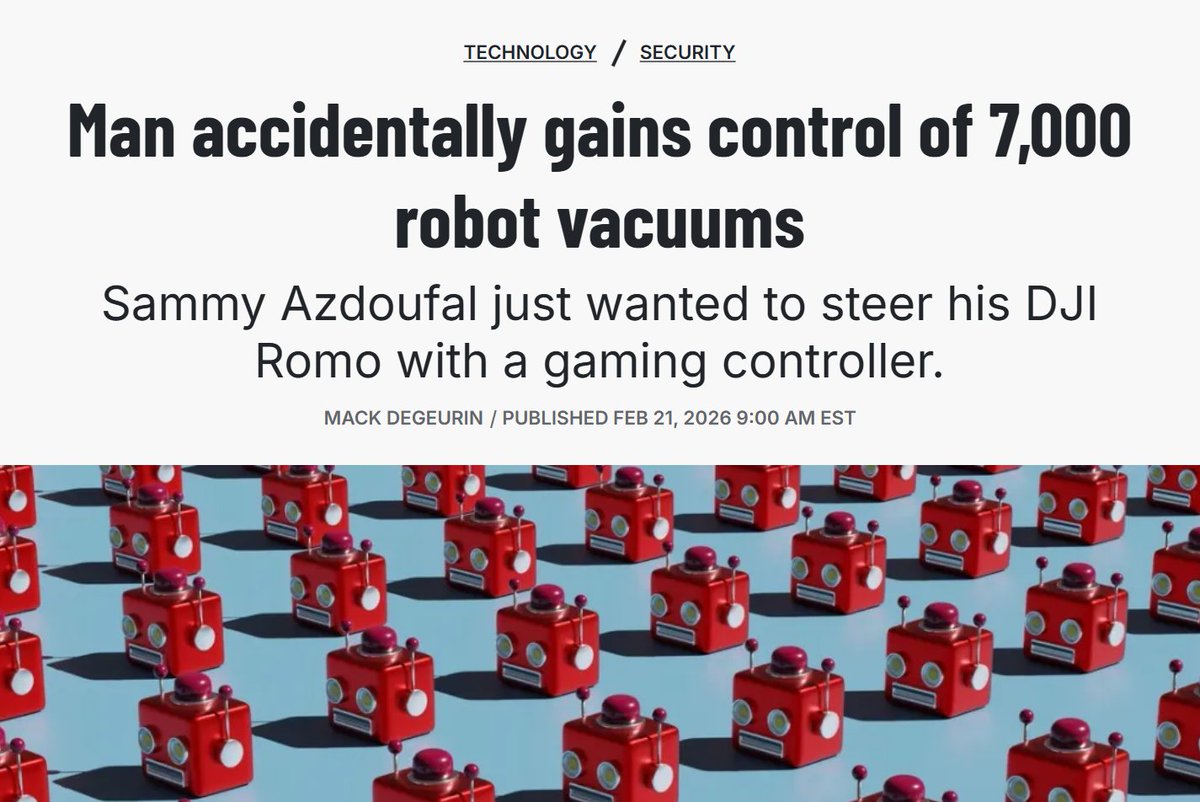
This story is actually insane: • dude drops $2000 on a DJI robot vacuum like a lunatic • refuses to use the normal app like a peasant • Sammy Azdoufal fires up Claude to crack the API so he can drive it with an xbox controller • Claude delivers the goods • pulls an auth token from their servers, connects successfully • except the system thinks he controls 7000 vacuums • checks again • yep, seven thousand • DJI built authentication with zero device ownership verification • any valid token works for any unit on the planet • Sammy now has eyes inside homes across 24 countries • live vacuum camera feeds everywhere • full floor plans from the mapping data • some guy in germany eating cereal at 3am, unaware his roomba is snitching • one API call away from being the most informed burglar in history • all he wanted was to steer his vacuum with a joystick • does the right thing and reports it • DJI fixes it in two days • back to normal life with his stupidly expensive floor cleaner • IoT companies stay undefeated at shipping garbage security
Mark Gadala-Maria tweet media
English
1.1K
9.8K
64.1K
8.6M
TrevorT retweetledi
Stephen Knight 🎙️
Stephen Knight 🎙️@GSpellchecker·
If you ever wondered how the intersectional loons would come down on the issue of "life-ruining neurological condition" versus "mean words", you now have your answer. These are not serious adults.
English
15
179
1.8K
37.1K
TrevorT
TrevorT@TrevorTickner·
@janeclarejones @carlgomb Guessing you've never listened to him talk about engineering, or business, or any relevant subject. Or perhaps have and it all went over your head.
English
0
0
0
1
TrevorT
TrevorT@TrevorTickner·
@hemantmehta You know the cringe feeling when someone in class asks a question that the teacher answered 2 paragraphs ago? That's you. Musk always talks like this, so clearly you fragrantly criticize what you don't know. You're in a cult.
English
2
0
0
40
TrevorT retweetledi
Ming
Ming@tslaming·
READ IT TO BELIEVE IT 🚨 TESLA HAS ENGINEERED A "THERMAL ARMOR" THAT ALLOWS SILICON CARBIDE CHIPS TO SURVIVE 800V SURGES ⚡️ Under the hood of Tesla’s next-gen powertrain lies a heavy copper secret. While most chip innovations focus on the microscopic silicon inside, Tesla’s latest breakthrough completely reimagines the protective shell around it. Originally revealed in late 2024 (Patent WO 2024/197013) and confirmed by a new European filing published just days ago on January 28, 2026 (EP4684423), this novel "hybrid" package architecture turns the chip's casing into an active thermal battery. The invention is known as a "Semiconductor Package with Top-Side Heat Spreader". It uses a massive, stepped-copper block that occupies nearly the entire top surface of the device. This architecture allows the chip (Silicon Carbide chip) to absorb the instantaneous heat of a 0-60 launch or a Supercharging session. By doing so, it protects the delicate electronics inside without the need for exotic cooling systems. Before diving deeper, it is critical to distinguish this technology from the "advanced packaging" often associated with Tesla's AI hardware. While chips like the AI5 computer are the vehicle's "brain", the technology in this patent represents the vehicle's "muscle". The AI chips are delicate supercomputers packaged by TSMC to move massive amounts of data. In contrast, the chips in this patent are rugged power switches responsible for moving energy to the motors and accessories. They require a completely different architectural approach. This approach focuses on raw survival rather than just speed. To understand why this radical redesign is necessary, we first need to look at the invisible physical wall that these standard automotive chips have hit. ⚖️ The problem: Standard chips can't handle 2026-era power density In 2026, the Power Dual Flat No-lead (PDFN) package remains the unglamorous workhorse of the automotive industry. This is due to its low cost and compact footprint. However, as electric vehicles aggressively move toward 800V architectures and silicon carbide chips, this standard design has hit a physical limit. These packages lack the internal thermal mass to absorb the massive "surge loads" generated when a motor accelerates or a heat pump kicks in. This causes chips to hit their thermal limits milliseconds before the vehicle's cooling system can even react. Compounding this thermal bottleneck is the legacy "gull wing" lead design still common in automotive chips. These conductors bend up and out like a bird's wings. This shape introduces unnecessary length to the electrical path. In the era of high-speed switching, this extra length creates parasitic inductance. This is a form of electrical friction that generates noise and wastes battery range. While suitable for older and slower electronics, this geometry acts as a drag on the efficiency of modern wide-bandgap semiconductors that need to switch thousands of times per second. Finally, the manufacturing process for these power chips has failed to keep pace with the efficiency demanded by the rest of the vehicle production line. The industry currently relies on a "messy" traditional method. This involves encapsulating chips in plastic blocks and then grinding them down to expose the metal. This process is inherently wasteful and slow. Tesla faced a gap in the market. They needed a solution as rugged and cheap as a standard PDFN, but with the thermal resilience of a heavy-duty power module. Here is how they engineered that exact contradiction. 💡 Tesla's solution: A hybrid design with a massive thermal roof and a flat electrical floor Tesla’s engineers have developed a semiconductor package that fundamentally changes the ratio of materials used. This package is the protective casing that connects the delicate silicon chip to the rest of the vehicle's electronics. Instead of keeping the materials at a uniform thickness throughout the device, the design places a massive "die paddle" or heat spreader on the top of the chip. This paddle functions like a heavy copper roof that draws heat away from the sensitive electronics. This structure creates a device that is optimized for two different functions simultaneously. The top section is a heavy thermal sink designed to absorb heat shocks. You can think of this as a thermal sponge that soaks up sudden bursts of temperature before they can damage the chip. On the bottom, the design utilizes very thin and flat leads to create a streamlined electrical path designed for speed and efficiency. Crucially, the design is "molded to net shape". This manufacturing term means the part comes out of the mold in its final ready-to-use form. This effectively eliminates the need for expensive post-processing steps like grinding or sawing. The most visible part of this new architecture is the sheer volume of copper on top. This serves a critical protective purpose. 🧱 The heat spreader acts as a thermal battery for surge loads The defining feature of this patent is the thickness of the top-side heat spreader. This component is a solid block of metal designed to pull heat away from the chip's hot core. Tesla specifies that this copper block must be at least 1.5 times thicker than the electrical leads. These leads are the thin metal pins that carry current in and out of the device. In some embodiments, the block is up to 3 times thicker than these connections. Crucially, this is not a small insert. The patent mandates that the exposed heat spreader occupies at least two-thirds and potentially up to 80% of the package's entire top surface. When a power surge occurs, this thick block of copper acts like a buffer. A power surge is a sudden and intense spike in electricity that generates immediate heat. The copper absorbs this spike in thermal energy instantly. It does this in the same way a thick stone wall absorbs the heat of the sun without getting hot on the inside. This prevents the temperature of the delicate silicon chip from skyrocketing. This architecture enables true "Top-Side Cooling". This is a method where heat is pulled off the top of the chip rather than the bottom. It allows Tesla to dissipate heat directly into a heatsink. A heatsink is a metal radiator that disperses the heat into the air or cooling fluid. This is much more efficient than forcing the heat down through the crowded circuit board. But sheer mass isn't enough. The internal geometry of that copper needs to be precisely sculpted to ensure the device survives years of operation. 🧩 Internal architecture: Grooves, forks, and cutaways Tesla’s engineers didn’t just place a block of copper on top. They sculpted the internal surfaces to manage the flow of liquid metal during assembly. The patent details a specific "groove" etched into the inner surface of the heat spreader. This groove acts as a "solder stop". It functions like a microscopic dam that prevents the molten attachment material or metal glue from bleeding out into unwanted areas. Additionally, the die paddle features a specific cutaway region or stepped profile. This shape resembles a staircase. It allows the copper to overhang the chip edges for maximum volume while still locking securely into the molding compound. The molding compound is the hard plastic shell that encases the electronic components. Furthermore, the patent introduces a "forked" lead frame design. In this configuration, the copper connections do not just sit next to the chip. They "straddle" or fork around the sides of the silicon die. The silicon die is the tiny square of silicon that performs the actual switching. This geometry allows Tesla to wrap the die in "thermal mass". This refers to the material's ability to absorb and store heat energy from the sides as well as the top. This creates a "conductive brim" that acts like a heat-absorbing rim around the chip. It squeezes every bit of capacity out of the small package footprint. While the top of the package manages the thermal load, the bottom attacks a completely different foe: electrical inefficiency. ⚡ Flat leads significantly reduce parasitic inductance To solve the electrical efficiency problem, Tesla has ditched the "gull wing" design entirely. This is a traditional shape where the metal connectors bend up and out like the wings of a seagull. Instead, they utilize a lead frame with flat and stamped leads that sit flush with the bottom of the package. The lead frame is the metal skeleton that supports the chip and carries the current. By removing the bends and loops found in traditional connectors, they have shortened the physical distance the current must travel. This reduction in path length directly lowers the parasitic inductance. This is a form of unwanted magnetic energy or "electrical inertia" that builds up when electricity travels through long loops. It resists rapid changes in current. In power electronics, lower inductance reduces the loop area. This allows the switch to turn on and off faster with less energy loss. The patent explicitly notes that this architecture is desirable for "wide-bandgap semiconductors". These are advanced materials that can operate at higher voltages and frequencies than standard silicon. Specifically, the patent mentions "bidirectional GaN HEMTs" or Gallium Nitride High Electron Mobility Transistors. This hints that Tesla is optimizing these packages for the next generation of high-speed and high-efficiency switches. Achieving these complex internal shapes usually requires expensive and slow manufacturing techniques. However, Tesla found a shortcut. 🏭 Stamping technology replaces complex etching and grinding The patent reveals a focus on high-volume manufacturability. This is the ability to mass-produce millions of units quickly and reliably. Rather than using chemical etching or grinding, Tesla is using stamped metal frames. Chemical etching is a slow process that uses acid to dissolve metal into specific shapes. Grinding is a wasteful technique that mechanically sands away excess plastic to expose the metal. The top heat spreader and the bottom leads are stamped from metal sheets using a machine that works like an industrial cookie cutter. This creates a "stepped" profile. This is a three-dimensional shape with different height levels similar to a staircase. These pre-formed shapes allow the components to lock together during the molding process. The design includes "mold locks" and grooves. These act as mechanical anchors to prevent the plastic and metal from delaminating, or peeling apart like layers of old plywood. Because the parts are stamped to the exact right height, the package creates a tight seal against the mold tool. The mold tool is the hollow metal cavity where the liquid plastic is injected. This results in a finished part that needs minimal cleanup and generates very little waste. Once these stamped parts are made, they still need to be put together without microscopic errors. 🧘 Smart assembly: Tolerance-absorbing construction One of the hardest parts of chip packaging is dealing with tolerance. This refers to the permissible limit of variation in the physical dimensions of a manufactured part. Specifically, it refers to the microscopic height differences in the components. Tesla’s solution utilizes a "stepped height" design where the components are stacked with a compliant paste or solder. This is a soft and pliable bonding material that acts like a mechanical suspension system to cushion the parts. The patent describes a process where the assembly stack is designed to "float" slightly. This allows the layers to shift and settle naturally before being permanently locked in place. When clamped in the fixture, the compliant bonding material compresses elastically. The fixture is the rigid metal tool used to hold the assembly steady. This means the material squishes down like a spring to absorb the tiny height variances of the die and the copper frames. This action allows the stack to "self gap-fill". This is a mechanism where the material automatically expands or contracts to bridge any empty spaces between the layers. This ensures that every single package comes out of the machine with the exact same total height. This precision eliminates "flash". Flash is the thin layer of excess plastic leakage that often seeps out of the mold defects and plagues traditional molding processes. But precision manufacturing is useless if you cannot verify it quickly on the production line. 🔍 Dimples and flanks allow for easy inspection A subtle but important detail in the design is the inclusion of "wettable flanks" and stamped "dimples" on the flat leads. A dimple is a small indentation pressed into the metal that provides a dedicated cavity for solder to flow into. Solder is the conductive metal alloy that melts to glue the electronic components together. The wettable flank is an exposed metal side that allows the solder to "wick" up the side of the chip. This means the liquid metal flows upwards against gravity. It is similar to how oil travels up a lamp wick to create a visible fillet on the side of the connection. This feature is vital for automotive reliability. It allows "automated optical inspection systems" to easily verify that a chip is soldered correctly. These systems are high-speed robotic cameras that scan the manufacturing line for defects. It also strengthens the physical bond between the heavy copper package and the circuit board. This ensures the chip does not shake loose due to the constant mechanical vibrations of the road. So, what does this specific piece of copper and silicon actually allow Tesla to do in the real world? 🚀 How this patent contributes to Tesla's now and future This patent serves as a "unifying architecture" for Tesla’s entire power electronics strategy. It effectively reinvents the standard PDFN package to solve the thermal and electrical bottlenecks that constrain 2026-era vehicles. By retaining the compact footprint and low cost of the commodity PDFN but gutting its internal structure, Tesla allows the company to solve two different problems. They solve ruggedness for high-voltage traction and efficiency for low-voltage control using a single and scalable packaging platform. First, it directly addresses the "thermal surge" limit that plagues standard PDFN chips in 800V traction inverters. By replacing the thin and heat-choking lead frame of the legacy design with the massive copper heat spreader described in the solution, Tesla creates a thermal buffer. This buffer absorbs millisecond-long heat spikes before they can damage the die. This allows Tesla to utilize these compact and cost-effective packages for the heavy-duty powertrains of the Cybertruck and Semi. It allows them to push these vehicles harder during acceleration without hitting the thermal safety limits that would normally require expensive and bulky power modules. Simultaneously, the patent’s "flat lead" geometry eliminates the "gull wing" inefficiencies of the traditional PDFN. This solves the parasitic inductance issue for the 48V architecture used in steering and auxiliary systems. These systems rely on Gallium Nitride (GaN) chips that switch at blinding speeds. The removal of the old gull-wing loops provides the clean electrical path these chips need to operate without interference. This enables Tesla to strip copper weight out of the wiring harness while still using a mass-producible package. It proves that they don't need exotic new formats to innovate. They just needed to perfect the one everyone else was already using.
Ming tweet media
English
90
242
3.2K
293.1K
TrevorT retweetledi
Sawyer Merritt
Sawyer Merritt@SawyerMerritt·
NEWS: Sales of fully electric cars surpassed those of petrol vehicles in the European Union for ‌the first time in December, even as policymakers proposed to loosen emissions regulations, data from the auto industry group ACEA showed.
Sawyer Merritt tweet media
English
46
129
1.1K
59.1K
TrevorT retweetledi
Boring_Business
Boring_Business@BoringBiz_·
State of AI right now > Anthropic CEO talking about AI winning nobel prizes and taking over the world within the span of 5 years > Elon talking about AI making money completely useless and creating infinite prosperity for humanity > Google using AI to solve quantum computing and drug discovery > OpenAI is talking about adding ads to their LLM The discrepancy is uncanny. OpenAI might be this generation’s Netscape
English
399
431
9.4K
619K
TrevorT
TrevorT@TrevorTickner·
@billmaher @ageofdisclosure @disclosureday The position many scientists (that I've heard) have is (a) it is very unlikely we are alone in the universe & (b) we are not being visited by aliens. Why? Aliens visiting would be equivalent of us flying across the world check if (say) a kitchen is clean. You don't fly. You phone
English
0
0
1
11
TrevorT
TrevorT@TrevorTickner·
@hemantmehta Anything in the world you just slightly dislike, or is it hyperbole all the way down with you?
English
2
0
1
66