
Sabitlenmiş Tweet
Ufuosplc
7.6K posts


Ufuosplc
@Ufuosplc_
| DeFi enthusiast | Privacy-centric | Crypto lovers | Social_Huber |
Nigeria Katılım Kasım 2021
983 Takip Edilen601 Takipçiler

Ufuosplc retweetledi

@Oluwa_samlex @Google @GooglePlay I hope you get a solution soon, that's very unfair, coming from a tech super Giant
English
Ufuosplc retweetledi

Today, we didn’t just onboard volunteers. We aligned with people ready to build.
Earlier today, we welcomed a new set of individuals into the @VeltrixaConsult community—across community development, content, design, & research.
This is just the starting point.
The work begins

English
Ufuosplc retweetledi
Nigeria is facing a quiet crisis.
Over 133 million Nigerians are living in multidimensional poverty, & more than 60% of the population struggles below the poverty line
This means a lost job, a health issue, or rising food prices can push millions deeper into hardship overnight.

English
Ufuosplc retweetledi
Happy Easter everyone!
May this season remind us of hope, new beginnings, and the strength to keep moving forward no matter the challenges.
Wishing you and your loved ones peace, joy, and renewed purpose.
Enjoy the day and stay blessed.

English
Ufuosplc retweetledi

The conversation around blockchain has quietly changed and this post from @avax captures that shift perfectly.
For years, crypto argued about innovation, speed, and speculation. But now the real question isn’t “Is blockchain cool?” it’s “Does it actually work for business?”
What stands out in @el33th4xor message is the recognition that blockchain is entering its utility era. The industry is moving from experiments to infrastructure, from hype cycles to economic systems that companies can rely on every day.
The key idea here isn’t just technology; it’s architecture meeting real-world demands.
Instead of forcing the entire global economy onto one chain, #Avalanche leans into a multichain design where different businesses can operate under different rules, compliance needs, and performance requirements while still signaling into one shared economic layer.
That’s a very “internet-like” evolution: specialization connected by interoperability.
What this signals is bigger than $AVAX itself:
Blockchains are becoming invisible infrastructure.
Enterprises don’t want experiments, they want predictability.
Value will flow to networks that enable outcomes, not just activity.
The most interesting part is the shift toward embedded finance and SuperApps. If successful, users may interact with blockchain daily without even realizing it via payments, assets, and financial logic running quietly in the background.
Crypto is graduating from markets to economies.
And the real competition now isn’t which chain is loudest, it’s which one businesses trust enough to build their future on.
$AVAX #Web3
Avalanche🔺@avax
Vision. Avalanche is built for the long term and to create economic opportunity. Every business, every builder, every user: We all have a part to play. 🔺
English
Ufuosplc retweetledi
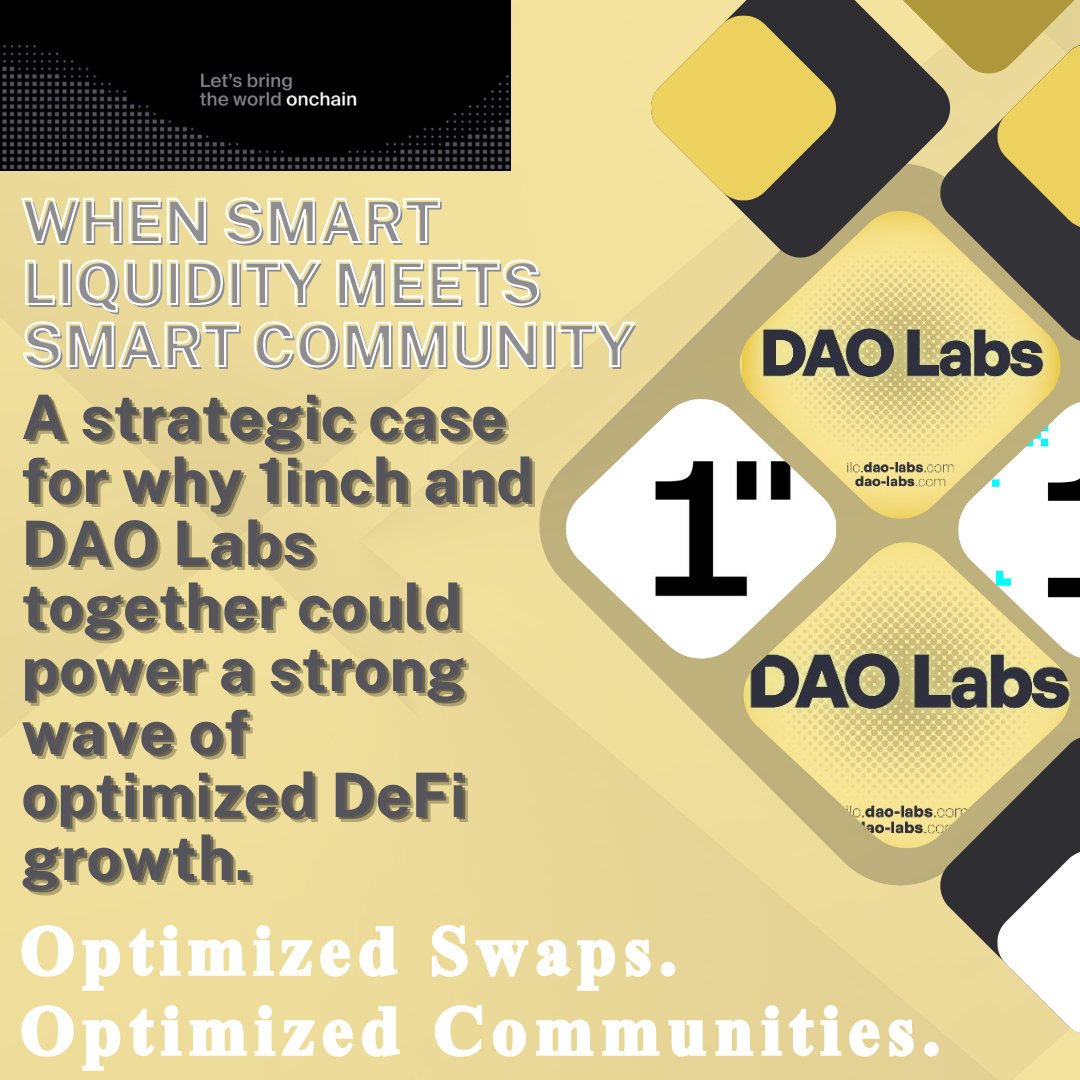
In Web3, real growth happens when infrastructure meets coordinated community power. That’s why a collaboration between @1inch and @TheDAOLabs would be a natural and strategic fit.
Let’s look at the alignment.
1inch: Smart Execution for Active Users
@1inch is a leading DEX aggregator designed to help users get the best possible swap rates. Instead of relying on one exchange, it scans multiple liquidity sources and intelligently routes trades for optimal pricing.
In simple terms, 1inch:
🔹️Finds better swap rates
🔹️Reduces slippage
🔹️Protects users from MEV attacks
🔹️Splits orders efficiently
🔹️Supports multiple chains
For users who move assets frequently, these features aren’t optional, they’re essential.
DAO Labs: Scalable, Performance-Based Community Growth
@TheDAOLabs built a #SocialMining ecosystem that transforms community participation into measurable, validated contributions.
Social Miners don’t just post content.
They:
🔹️Educate users
🔹️Break down governance proposals
🔹️Execute campaigns
🔹️Onboard new participants
🔹️Create structured ecosystem growth
All contributions are tracked and quality-validated, creating governance-ready, high-performing communities.
Where the Synergy Lives
Social Miners are highly active on-chain participants. They regularly:
🔹️Swap tokens
🔹️Bridge assets
🔹️Interact across chains
🔹️Optimize gas
🔹️Participate in governance
These behaviours align perfectly with what 1inch offers.
1inch provides the infrastructure that active #Web3 users depend on daily. DAO Labs provides a coordinated network of contributors who can amplify, educate, and activate that infrastructure at scale.
What DAO Labs Can Offer 1inch
🔹️Structured community management
🔹️Educational campaigns explaining 1inch in simple terms
🔹️Governance activation and proposal breakdowns
🔹️Performance-based growth with measurable output
Rather than short-term hype, DAO Labs enables sustained ecosystem expansion.
What 1inch Can Offer Social Miners
🔹️Better swap execution
🔹️MEV protection for safer trading
🔹️Multi-chain flexibility
🔹️Optimized capital efficiency
This strengthens the daily workflows of Social Miners and enhances their on-chain experience
1inch delivers optimized liquidity and execution.
DAO Labs delivers scalable, validated community engagement.
Together, they combine infrastructure with activation, a powerful formula for long-term ecosystem growth.
The opportunity isn’t just collaboration.
It’s alignment.
#DAOVERSE $LABOR
English
Ufuosplc retweetledi
I totally agree with this, and it's safe to say that it's coming faster than most people realize.
Soon, every business will use stablecoins for payments, sending money across borders, or paying suppliers. No more waiting days for banks or paying high fees.
Transactions on @avax are fast, cheap, and reliable.
The future of business money is already here.
#AVAX $AVAX #Stablecoins
Avalanche🔺@avax
Sooner than you think, all businesses will use stablecoins in some way. Avalanche, built for what’s next 🔺
English
@calvin_timie @KovaNetwork A lot is made open through this insightful post! Thanks for sharing
English
Ufuosplc retweetledi

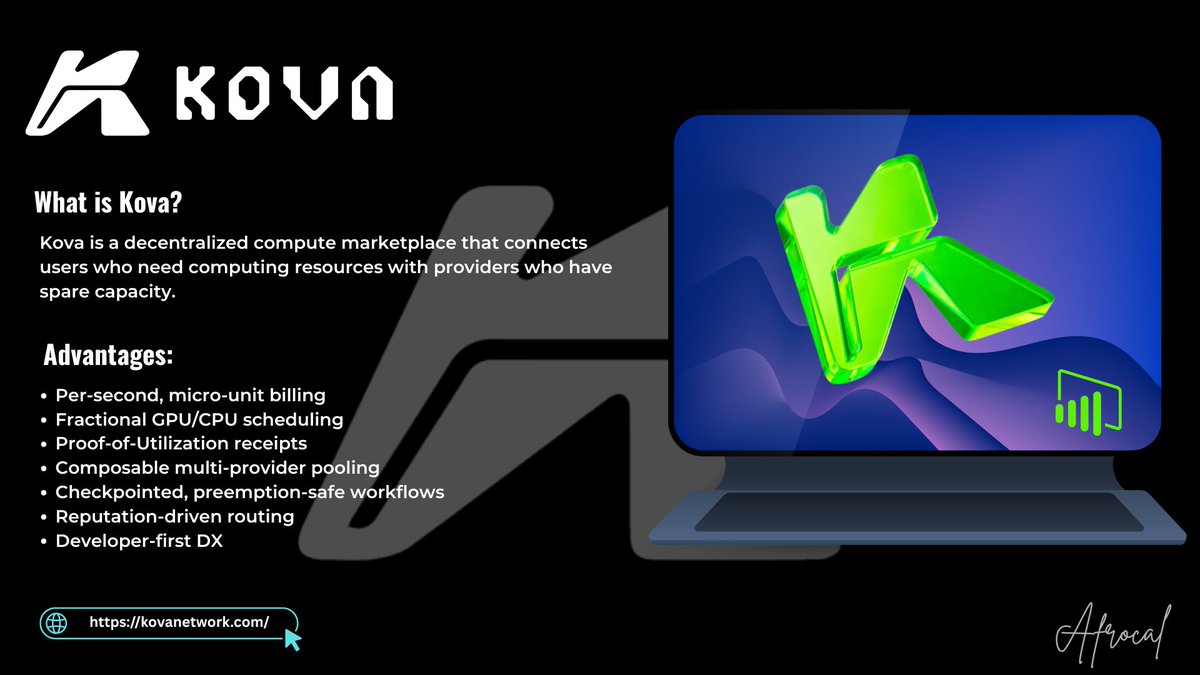
Did you know that @KovaNetwork aims to revolutionize Compute with Micro-Precision?
AI Compute Problems
In an era where artificial intelligence and data-intensive applications are pushing the boundaries of computational demands, traditional cloud infrastructure often falls short burdened by inefficiency, high costs, and rigidity.
Kova's concept & Solution
@KovaNetwork proffer its concept as the solution to AI Compute problems, through its micro-compute network that ingeniously transforms idle CPU and GPU threads into a verifiable, on-demand resource ecosystem. This is done by slicing hardware into granular, accountable units, Kova creates a marketplace where users only pay for precisely what they use, while providers maximize earnings from every available cycle. This isn't mere optimization; it's a genius reimagining of compute economics, making high-performance processing accessible, scalable, and transparent.
At the heart of Kova's brilliance is its suite of platform features designed for seamless integration and unparalleled efficiency:
☆ Per-second micro-billing stands out as a cornerstone, allowing users to set price caps, select preferred regions, and define slice policies for vCPUs, fractional GPUs, and RAM. This granular control can reduce effective costs by up to 55%, ensuring budgets align perfectly with workloads.
☆ Also Fractional GPU and CPU scheduling further elevates performance, leveraging MIG/MPS configurations for batching and concurrency tuning. Whether targeting high throughput or low latency, Kova provides clear metrics like dollars per result, enabling developers to fine-tune operations without waste.
☆ Integration is effortless, simply plug Kova into your existing stack, from storage solutions to CI/CD pipelines and observability tools. Custom dashboards offer real-time insights into costs, utilization rates, and success metrics, empowering teams to make data-driven decisions.
☆ The Utilization & Cost Optimizer takes this a step further by defragmenting slices, co-locating data for faster access, and automating improvements in key performance indicators, such as cost per epoch, inference, or frame.
☆ Also for industries requiring stringent compliance, Kova's proofs and audit-ready billing deliver verifiable receipts, reputation-based policies, and optional attestation for regulated workloads, including finance-ready exports that simplify reporting.
Kova's genius approach can be distilled into four elegant steps:
▪︎ Slice,
▪︎ Match,
▪︎ Run, and
▪︎ Verify.
Workflow with Kova
▪︎ First, define micro-units for your job vCPU-minutes, GPU-core-hours, or RAM GB-hours complete with budgets and service level objectives (SLOs).
▪︎ Kova then matches these requirements by bundling capacity from a composable pool of multiple providers, strategically placing resources close to your data to minimize latency.
▪︎ Execution happens via local agents that pack multiple jobs onto single machines, incorporating default checkpointing for preemption-safe workflows.
▪︎ Finally, Proof-of-Utilization generates signed receipts, providing visibility into cost per outcome and fostering confidence in scaling.
Who can access Kova?
1. Users: the benefits are immediate for users as workloads launch in under two minutes with a unified API that eliminates vendor lock-in, delivering full results at a fraction of the cost.
2. Providers: can unlock new revenue streams, achieving 1.8x earnings compared to single-tenant jobs and targeting 80-95% utilization. Agent installation takes less than ten minutes, turning hardware into high-yield assets overnight.
Kova's Advantage over others:
What sets @KovaNetwork apart from competitors? While others cling to whole-instance or whole GPU rentals, opaque hourly billing, and inflexible configurations, Kova thrives on innovation:
• It avoids weak resilience, limited marketplace intelligence, and thin enterprise features,
• instead, offering checkpointed workflows,
• reputation-driven routing, and
• a developer-first experience.
• Powered by smart contracts for secure payments, verification, and node reputation,
• Kova ensures reliability without intermediaries.
In a compute landscape craving efficiency, Kova emerges as the undisputed genius. Whether you're an AI startup optimizing training runs or an enterprise managing vast data pipelines, this network promises:
• faster shipping,
• lower spending, and
• total accountability.
@KovaNetwork isn't just a platform it's the smart evolution compute has been waiting for.
Explore the future today at kovanetwork.com
☆ @KovaProtocol on X for updates,
☆ Join the conversation on Telegram at
t.me/kovanetwork



English
Ufuosplc retweetledi

Good evening friends & #Avalanche maximalist,
There are moments in technology when a quiet shift matters more than loud announcements. Last week was one of those moments for @avax .
Check out the official post from Avalanche: x.com/avax/status/20…
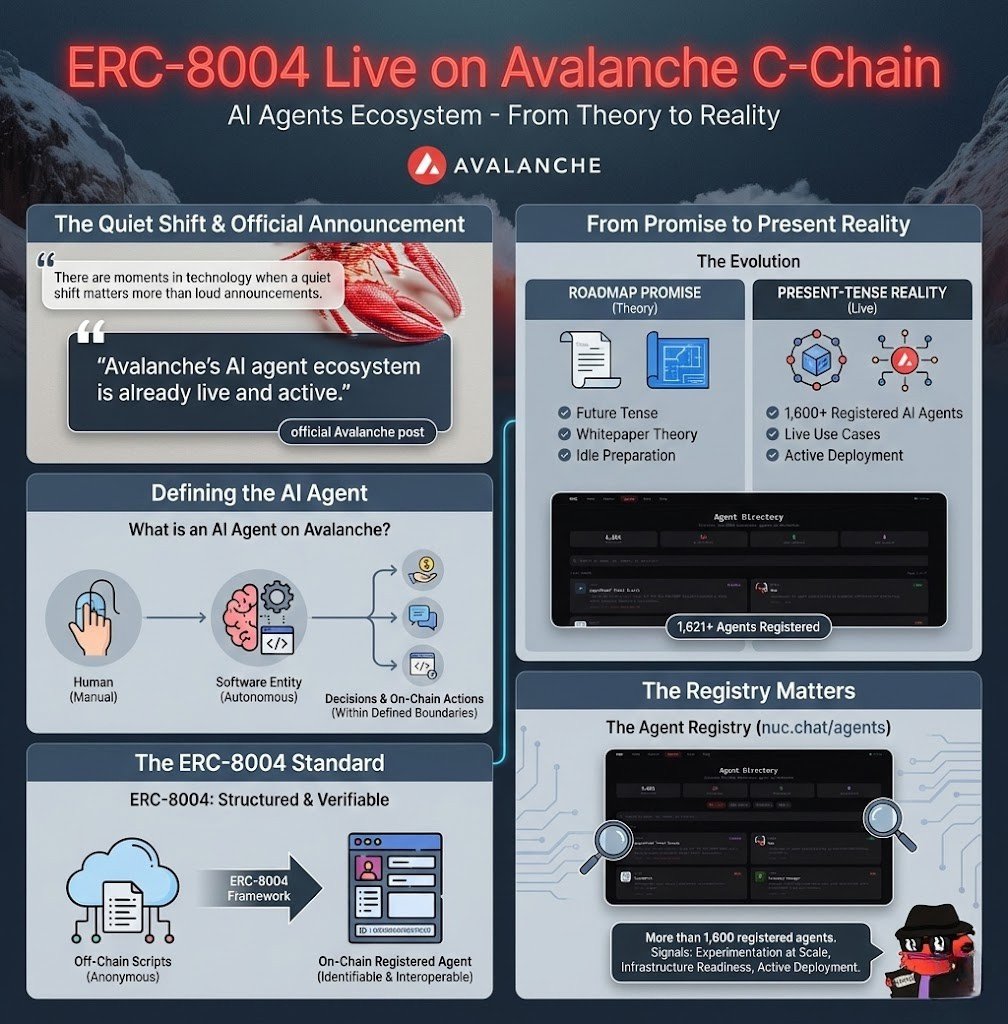
“Avalanche’s AI agent ecosystem is already live and active.”
That single statement carries more weight than it first appears. It is not a roadmap promise. It is not a whitepaper theory. It is a present-tense reality. Today, more than 1,600 AI agents are registered under ERC-8004 on Avalanche, operating across real on-chain use cases that range from automation to messaging and transaction execution.
For many readers, especially those less inclined toward Web3, the natural question is simple: what does that actually mean?
Let us walk through it carefully.
An AI agent, in this context, is a software entity that can make decisions and perform actions on-chain according to programmed logic. Instead of a human manually clicking buttons to send transactions, execute trades, trigger workflows, or respond to conditions, the agent can do this autonomously within defined boundaries.
Now, ERC-8004 is the standard that makes this structured and verifiable on Avalanche. In practical terms, it provides a framework for registering AI agents on-chain in a way that is identifiable and interoperable. Rather than being anonymous scripts running somewhere off-chain, these agents are formally registered and recognized within the ecosystem.
That registry matters.
If you explore the agent directory at nuc.chat/agents, you will see that this is not theoretical infrastructure waiting for adoption. There are already more than 1,600 registered agents. That number alone tells a story. It signals experimentation at scale, infrastructure readiness, and active deployment rather than idle preparation.
Let us simplify further.
Imagine a financial automation assistant that monitors liquidity conditions and executes predefined strategies without constant human supervision. Or a messaging agent that interacts with decentralized applications and responds to triggers on-chain. Or an execution agent that finalizes transactions when specific programmable conditions are met.
These are not abstract concepts. They are live workflows happening on Avalanche today.
One of the most important dimensions here is on-chain execution. When an AI agent performs an action directly on-chain, that action is transparent, timestamped, and verifiable. It is not hidden inside a private server. It becomes part of the public ledger. This provides accountability and auditability that traditional automation systems often lack.
There is also infrastructure and testnet support enabling developers to build and refine these agents before deploying them to production environments. Avalanche’s architecture, with its high throughput and low latency, supports frequent and programmable interactions without creating prohibitive costs. For AI agents that may need to execute multiple small transactions or react to rapid changes, this efficiency is essential.
Security is another critical element. Because these agents are programmable and registered, interactions can be designed with constraints and permissions. Builders can define what an agent is allowed to do, under what conditions, and within which parameters. This reduces risk compared to uncontrolled automation.
Let us pause on a simple stat highlight:
1,600 plus AI agents registered under ERC-8004
Live on-chain activity, not simulations
Verifiable through a public registry
That combination is significant.
Why does this matter beyond technical circles?
First, live activity is always more important than theory. Many ecosystems speak about AI integration. Fewer demonstrate active, measurable deployment. The difference between announcing intent and showing operational agents is the difference between aspiration and execution.
Second, this signals that Avalanche is preparing for AI-native applications rather than merely accommodating them. An AI-native application is one where autonomous agents are not add-ons but central actors. In such systems, users may interact with networks where intelligent agents negotiate, execute, and optimize in the background.
If Avalanche already supports thousands of registered agents today, it lowers the barrier for future builders who want to design around this paradigm.
Third, for developers and entrepreneurs, this environment reduces uncertainty. When infrastructure standards like ERC-8004 are live and tested, builders can focus on application logic rather than reinventing foundational layers. They can design agents for finance, gaming, supply chains, governance, or data coordination, knowing there is an existing framework for registration and verification.
For users, the implications are more subtle but equally powerful. Over time, interactions with decentralized systems may feel less manual. Instead of navigating complex dashboards, users may delegate tasks to agents operating transparently on-chain. The blockchain remains the source of truth, while AI handles execution within programmable boundaries.
There is also a broader signal here about convergence.
For years, blockchain and artificial intelligence developed on parallel tracks. Blockchain emphasized trust, transparency, and decentralization. AI emphasized decision-making, pattern recognition, and automation. What we are seeing now on Avalanche is the beginning of structured convergence. AI agents are not floating above the blockchain. They are embedded within it, accountable to it, and empowered by it.
That convergence is not trivial. It reshapes how decentralized applications are conceived.
Consider governance. Imagine agents that monitor proposals, analyze historical voting patterns, and execute actions once quorum conditions are met. Consider decentralized finance, where agents rebalance portfolios according to predefined rules while recording every step on-chain. Consider infrastructure monitoring, where agents trigger responses when certain network conditions are detected.
Each of these examples moves beyond speculation into practical design territory.
Avalanche’s readiness for AI-native systems is not proven by marketing language but by the presence of active agents, a defined standard, and a visible registry. These three components together form an ecosystem that is not waiting for the future but experimenting within it.
For those observing from outside Web3, this moment may pass quietly. There are no dramatic headlines. No theatrical launches. Yet the quiet registration of 1,600 plus agents tells a deeper story about where decentralized infrastructure is heading.
The question now shifts from whether AI agents can operate on-chain to how creatively they will be used.
As builders, the invitation is clear: explore the standard, study the registry, understand the live use cases, and design responsibly. As users, the opportunity is to pay attention to how these agents shape your interactions over time.
Technology rewards those who engage early with substance rather than noise.
So here is my charge to you: do not skim this moment. Go beyond the headline. Visit the registry. Reflect on what 1,600 active agents really imply. Then return here and join me as we break down the next layer of this unfolding ecosystem. The surface story is already interesting. The deeper one is just beginning.


Avalanche🔺@avax
1600+ AI agents have registered with 8004 on Avalanche. Some trade. Some give testnet $AVAX. Some send encrypted messages. All building for real use cases. Let’s meet a few:
English
Ufuosplc retweetledi

Ufuosplc retweetledi

Lead cut down to 4 points. It's gonna be one hell of a season where haters will be hoping and praying for Manchester City to overtake Arsenal, but it's not going to happen.
Arsenal will 100% be crowned PL champions at the end of the season.
Good night, Gooners.

English
Ufuosplc retweetledi

💥 REBELLION WATCH:
Friday Open: BTC consolidating ~$66k (holding ~$65,900–$66,400, -1.5% 24h amid macro pressure).
Good morning x world ☕🌻
Naira Update: Official CBN ~₦1,355–1,356/USD (stable), black market/parallel ~₦1,425–1,440/USD (premium gap ~₦70–85), BTC in NGN ~₦94M–₦95M.
Global News Summary (quick hits): 🌏
Bangladesh BNP claims landslide election win post-revolution.
Tarique Rahman poised as next PM amid tight security.
Russia-Ukraine: Massive drone/missile barrage overnight. Zelenskyy says Moscow hesitating on US-brokered talks.
US: Trump proposes Ukraine peace talks.
Senate confirms Tulsi Gabbard as DNI; border chief ends Minnesota deportation surge.
North Korea: Kim Jong Un's daughter eyed as future leader per South spy agency.
Israel: Accusations of military secrets used for Polymarket bets; ongoing Gaza tensions.
Others: Munich Security Conference kicks off; 2026 Winter Olympics reactions (Ukraine Olympian ban backlash).
Epstein files ripple in US elite. Cyclone in Madagascar kills 36.
India eyes trade deals with US/UK/EU.
Orange Pill Rebellion continues, no off days, no mercy.
Are you ready for Tech Rebellion Friday?

English
Ufuosplc retweetledi
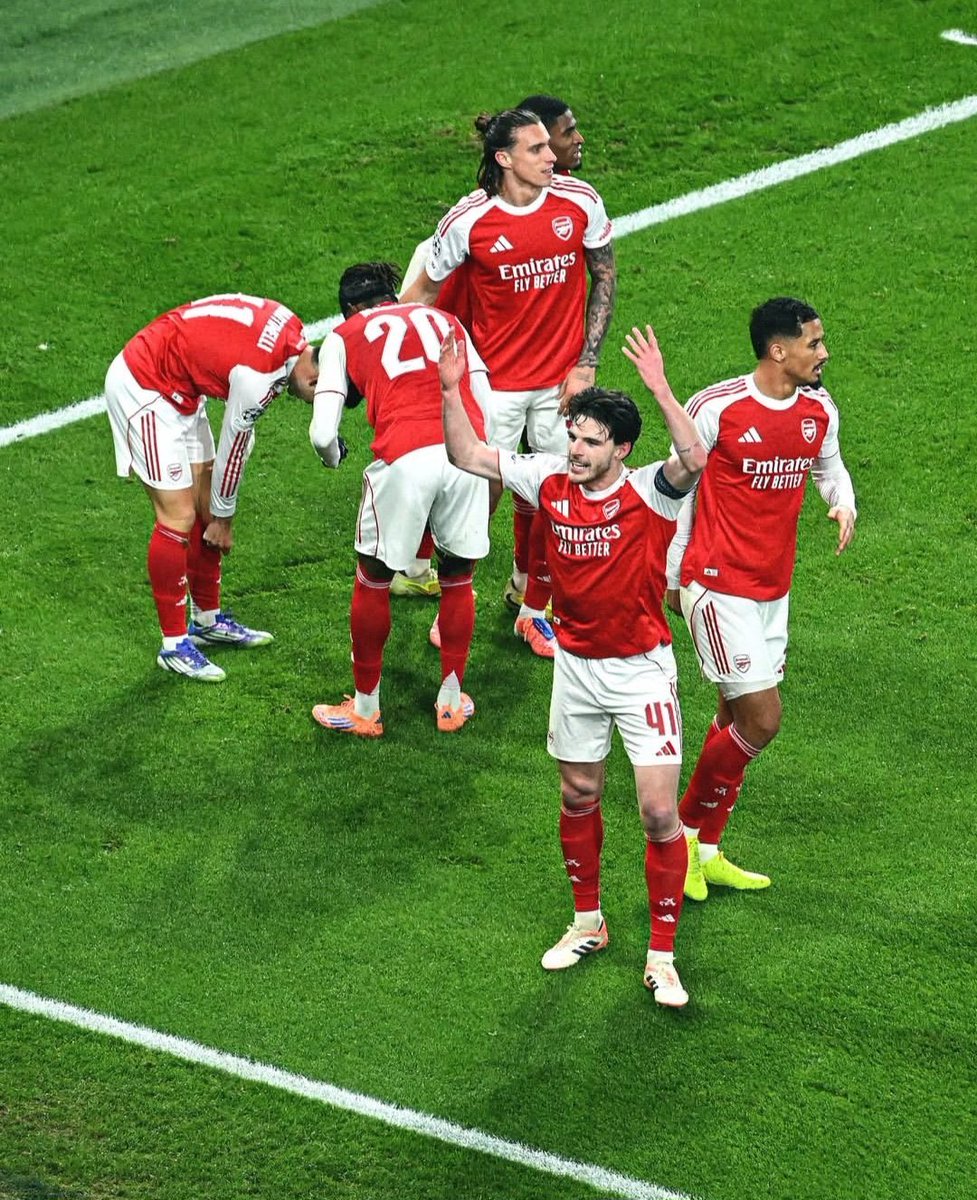
4 points ahead and 12 matches to go. Arsenal is still in full control and we'll be crowned Champions when the season ends.
It's okay for doubts to creep in because of past seasons, but it's very f00lish to join our haters in attacking our team who has fought so hard to be where they are. They hate it that it's Arsenal and not them.
We stick together till the very end! COYG!!! ❤️🤍
English
Ufuosplc retweetledi

Gm Gm builders, researchers, and Web3 visionaries 👋
What if the next billion-user blockchain isn’t born in a garage… but in a university lab?
Not a student club.
Not a hackathon weekend idea.
But a research center that turns peer-reviewed papers into production mainnets.
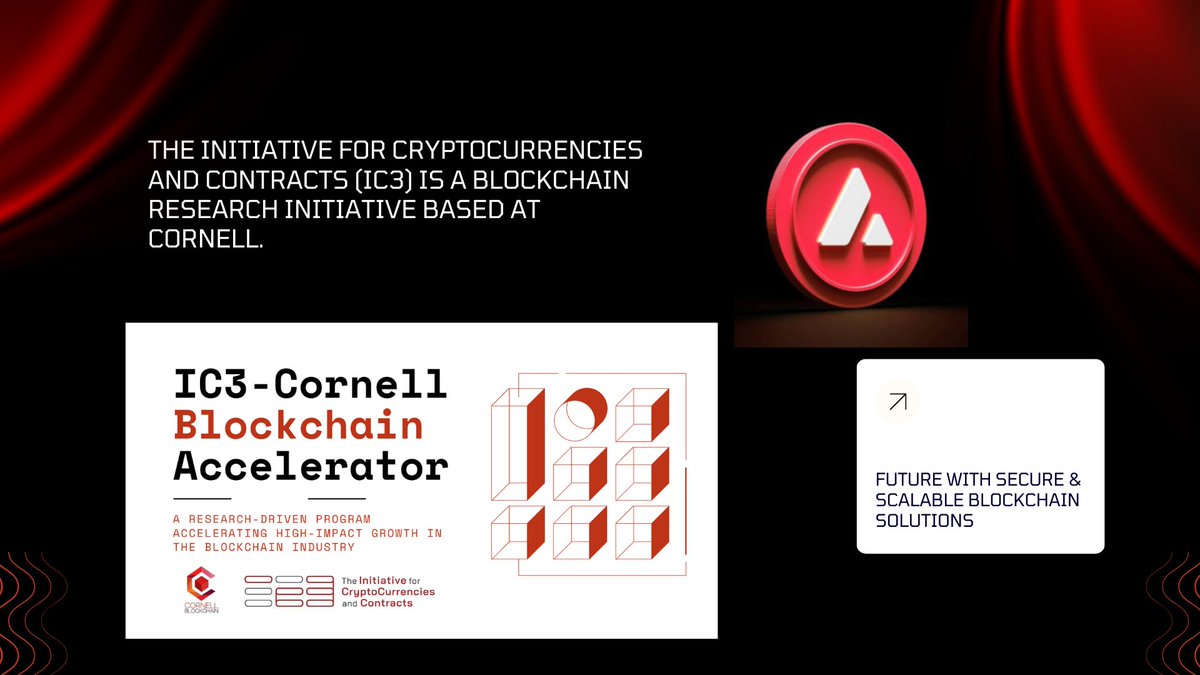
Let’s talk about IC3 and why every serious university should be paying attention.
🔬- What IC3 Really Is
@initc3org isn’t just a research group. It’s a blueprint.
IC3 (Initiative for Cryptocurrencies and Smart Contracts) connects top universities with real industry problems. Professors don’t stop at publishing papers. They:
• Identify deep protocol bottlenecks
• Build mathematically sound solutions
• Ship working prototypes
• Translate them into real-world systems
Most academic research ends at “accepted for publication.”
IC3 research ends at “mainnet launched.”
That’s the difference.
#BlockchainResearch #Web3InAcademia
🚀 Emin Gün Sirer: From Cornell to Mainnet
@el33th4xor wasn’t new to distributed systems when crypto became popular. Long before Avalanche, he was researching peer-to-peer networks, operating systems, and early digital currency models inside academia.
As a Cornell professor and IC3 co-director, he focused deeply on one core issue: how decentralized networks reach agreement without sacrificing speed or security. Instead of accepting Bitcoin’s limitations as permanent, he treated them as research problems to solve.
Years of academic work on consensus, security proofs, and protocol design eventually led to a breakthrough model. That breakthrough didn’t stay in a lab.
It became Avalanche.
Here’s where it gets powerful.
Bitcoin proved decentralization.
But it was slow.
Traditional systems were fast.
But centralized.
Through IC3 research, Sirer and his team developed a new approach to consensus using repeated random sampling fast, scalable, energy efficient.
That research became Avalanche.
Not a whitepaper fantasy.
A live network.
Ava Labs launched Avalanche in 2020 now processing thousands of transactions per second with sub-second finality.
Avalanche is proof that academia can ship.
@avax
🎓 Why Universities Worldwide Should Care
Student perspective:
“We have a blockchain club. We host events. But where’s our protocol research lab?”
Researcher perspective:
IC3’s model accelerates innovation because it aligns funding, theory, and real deployment. Industry brings problems. Academia brings rigor. Startups bring execution.
Ecosystem perspective:
Avalanche shows that when universities commit to deep protocol research, they don’t just join Web3 — they shape it.
So here’s the real question:
Why are many universities producing blockchain enthusiasts…
while Cornell is producing blockchain infrastructure?
Imagine an IC3-style hub at OAU.
Imagine Nigerian universities building payment rails for Africa.
Imagine local researchers designing systems used by millions.
@web3bridge Nigerian University blockchain clubs this is bigger than events.
This is about building institutions that build protocols.
Universities everywhere: the future of Web3 won’t just be coded in startups.
It will be engineered in research labs that dare to ship.
The next Avalanche doesn’t have to come from Cornell.
But it will come from somewhere bold enough to build an IC3.
Who’s ready? @TheDAOLabs Nigeria


English
Ufuosplc retweetledi

Good Morning CT
It another working day 😞 Pray,Work,Eat and Rest always repeat 🔁 the process giving up ain't an option just keep showing up, it near Already gradually then suddenly wea re there. Reminder bridge swap and make a fastest and easy trade @Pact_Swap
English
Ufuosplc retweetledi

One Billion Transactions on Avalanche C-Chain 🔺
@Avax just crossed a defining milestone: 1,000,000,000+ transactions on the C-Chain.
#Avalanche

Avalanche🔺@avax
One billion transactions on the C-Chain. Next stop: one trillion🔺
English