

Richardddss
2.5K posts

Richardddss
@VncngHa7
The web3 is a place of freedom. Contributor @get_optimum
Katılım Eylül 2022
678 Takip Edilen327 Takipçiler

Post-Quantum Security Is Coming. But Can Blockchains Survive It?
Most people hear “post-quantum security” and think it’s a problem for the future.
The reality?
Teams building serious infrastructure are already preparing for it today.

English

𝟑 𝐭𝐡𝐢𝐧𝐠𝐬 𝐭𝐡𝐚𝐭 𝐦𝐚𝐤𝐞 @get_optimum 𝐞𝐱𝐜𝐞𝐩𝐭𝐢𝐨𝐧𝐚𝐥:
✦ Faster data propagation across networks
✦ Memory infrastructure built for blockchain scalability
✦ Deep research foundation with advanced RLNC tech

English
English

Another week, another group of dedicated contributors stepping into the Refined role
@blockchainjeff
@shariaronchain

English
English

English
Gmum !! A joyful and wonderful day for me. @get_optimum
I received the Refined role.
It's truly wonderful, and I will strive to continue contributing in order to reach higher roles.

Richardddss@VncngHa7
Gmum , Wishing you all a new week filled with emotions and enthusiasm! I parachuted down at a speed of 200ms.🤣 Perhaps I'm sending Optimum up into the sky so that everyone can look towards Optimum. Everything will be successfully parachuted in.
English
English

@VncngHa7 @get_optimum @cryptooflashh @CryptoSundayz @tgogayi @aqccapital Congratulations Richardddss
English
English
@VncngHa7 @get_optimum @cryptooflashh @CryptoSundayz @tgogayi @aqccapital Congrs mate you deserve that
English

Gmum 🙌
Everyone talks about faster blockchains.
Fewer people talk about the economics of moving information across them.
Today, Moritz Grundei will present:
"Pricing Innovation Under Latency Constraints: A Mean-Field Analysis of Coded Payload Delivery"
👉with Muriel Médard(Co-Founder of Optimum), Tarun Chitra, and Sajid Azouarhi.
The paper examines a question that will become increasingly important as decentralized networks grow:
How do we efficiently price data delivery when latency directly affects network performance?
Key themes include:
• Latency-aware data rate pricing
• Coded payload delivery
• Propagation efficiency
• Blockchain network economics
As networks scale to support millions of users, validators, AI agents, and onchain applications, propagation is no longer just a technical issue.
It's an economic one.
Because every millisecond of delay carries a cost.
Excited to see the discussion from today's Blockchain Networking session👇
@get_optimum.
@blockchainjeff.
@aqccapital.

Moritz Grundei@GrundeiMoritz
On June 2, I will present “Pricing Innovation Under Latency Constraints: A Mean-Field Analysis of Coded Payload Delivery” in the Blockchain Networking session. The paper is joint work with @MurielMedard , @tarunchitra , and @sajidazouarhi. arxiv.org/pdf/2603.20426
English

why RLNC doesn’t like repetition
in most networks
the same data gets sent again and again
→ same packets
→ same retries
→ same bandwidth being used repeatedly
the network spends a lot of energy repeating itself
@get_optimum takes a different approach
through RLNC, data is encoded and mixed
so instead of endlessly retransmitting identical information
each transmission carries something useful
every new piece helps move reconstruction forward
which means:
> less redundant traffic
> fewer unnecessary retries
> more efficient use of bandwidth
the goal is simple
make every connection productive
because stronger networks are not built on repetition
they are built on useful information flow

English
Indonesia

Indonesia
Gmum , Wishing you all a new week filled with emotions and enthusiasm!
I parachuted down at a speed of 200ms.🤣
Perhaps I'm sending Optimum up into the sky so that everyone can look towards Optimum.
Everything will be successfully parachuted in.

Richardddss@VncngHa7
The race has started. @get_optimum Optimum Transmit less Deliver More Mump2p 6-20x Faster 90-95% less bandwidth
English

Most decentralized networks gossip data.
Optimum codes it.
Coded shards. Instant recoding. Zero redundant retransmissions. mump2p delivers blocks and transactions the way the network layer always should have, fast, efficient, and loss-tolerant by design.
This is RLNC. This is Optimum.

English

Reliability Becomes Alpha at Scale
my gosh one thing that's easy to overlook in blockchain infrastructure
speed gets all the attention
reliability is what keeps the network performing under pressure
in large decentralized systems, packet loss is simply part of reality
nodes are distributed everywhere
network conditions vary constantly
information doesn't always arrive perfectly
that's exactly why RLNC catches my attention
instead of treating packet loss as a problem to react to later, RLNC is designed around unreliable environments from day one
which makes it a surprisingly natural fit for blockchains
> better data delivery across the network
> fewer retransmission bottlenecks
> faster block propagation
> stronger validator coordination
> more consistent network performance
the deeper i look into @get_optimum, the more it feels like they're applying decades of distributed systems research to one of crypto's most important challenges
moving information efficiently at global scale
@blockchainjeff
@shariaronchain
English

GMum! @get_optimum
A lot of people think network latency is just a technical metric.
But in Ethereum, latency can directly impact revenue.
Every validator operates under strict timing constraints. When proposing a block, there is a constant tradeoff: propose early and maximize propagation safety, or wait longer and potentially receive a higher-value MEV bid.
The challenge is that every millisecond spent waiting increases the risk of missing important network deadlines.
That means faster propagation doesn't simply make the network faster. It creates additional usable slot time.
And that extra time has measurable economic value.
Research from Optimum found that reducing propagation latency by 50-150ms could translate into roughly 0.66%-1.97% higher validator APR.
Not because Ethereum changes its reward structure. But because faster propagation effectively gives validators more usable slot time, allowing them to observe and capture higher-value MEV bids before committing to a block.
The same principle applies at the consensus layer. Faster block propagation improves head vote accuracy, helping validators earn rewards that might otherwise be lost to network delays.
Viewed through that lens, latency is no longer just a networking metric. It's an economic variable.
And that may be one of the most interesting ideas behind Optimum's work.
Because once milliseconds start affecting APR, MEV capture, and validator rewards, the equation becomes surprisingly simple:
Speed is money.
@blockchainjeff @cryptooflashh @aqccapital @shariaronchain @CryptoSundayz

Caz@Cazzsann
GMum! @get_optimum A lot of post-quantum discussions today focus on replacing signatures and encryption schemes. But Muriel Médard’s recent explanation points to a deeper problem: what if the real issue is not only cryptographic keys, but the structure of the data itself? Today, most cryptographic systems protect massive amounts of data using relatively small keys. Under classical computing assumptions, that works well because attackers are forced to break the lock itself to access the protected data behind it. But quantum systems change the model. A quantum attacker may not need to attack the key directly. Instead, they can probe different parts of the system non-deterministically, searching for weaknesses across the broader data structure itself. That’s why simply replacing existing cryptographic primitives may not fully solve the long-term problem. And this is where coding theory becomes incredibly interesting. Instead of encrypting the entire payload at massive computational cost, HUNCC uses coded data structures where only a very small portion requires heavy post-quantum protection. The remaining data stays mathematically protected through the coded system itself. Meaning: security is no longer concentrated only around the cryptographic key, but distributed throughout the structure of the data itself. What makes this even more interesting is that the same mathematical foundation also appears across Optimum’s broader infrastructure work: • RLNC • network coding • distributed coordination • efficient propagation systems The same coding principles helping decentralized networks move information more efficiently may also become important for securing data in a post-quantum environment. That’s what makes Muriel Médard’s explanation around coding theory so interesting. @CryptoSundayz @blockchainjeff
English

Before Optimum was focused on propagation performance there was a more fundamental challenge:
how do you improve communication across a network without introducing more coordination?
Traditional systems often depend on predefined paths rules or coordination between participants.
Random Linear Network Coding (RLNC) approached the problem differently.
According to Optimum's RLNC timeline nodes can create new coded combinations from information they have already received.
~ useful data can be generated throughout the network
~ not only at the source
That idea helped turn network coding from a theoretical concept into a practical decentralized system.
The goal was not simply moving information from point A to point B.
It was enabling information to keep moving efficiently without relying on central control.
More than two decades later that same foundation sits underneath what Optimum is building today.

English

The slowness of blockchain networks is often misunderstood. We tend to think, If the network is slow, it must need more powerful hardware.
But the reality is different. Imagine a designer who can create designs quickly, but every time they need a specific tool, they have to search the entire workshop. The work slows down, but the problem isn’t their skill.
In the same way, no matter how powerful the hardware of validators is, they spend time retrieving data from large databases. As the network grows, finding the right information itself becomes a type of overhead.
This is where Optimum’s DeRAM concept stands out. It doesn’t confine memory to individual machines; instead, it turns all available memory across the network into a shared resource. Computation may not be faster, but data access becomes quicker.
The result?
The network isn’t slow, information is easily accessible. The future of blockchain will depend not just on processor speed, but on the efficiency of reaching information. Optimum is making this vision a reality.
@get_optimum

English

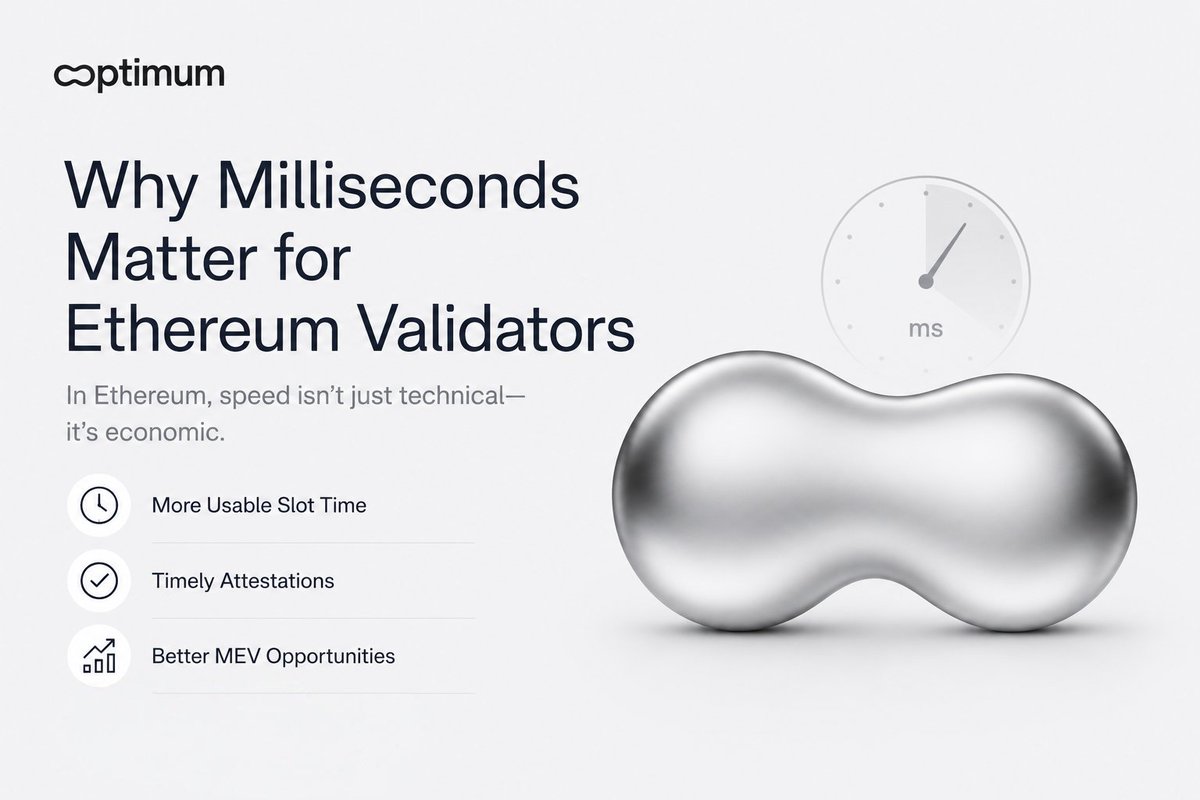
Why Milliseconds Matter for Ethereum Validators
Not all validator revenue losses are visible.
Some happen in milliseconds.
Every time a new block is propagated across Ethereum, validators are racing against the clock. The faster they receive and process information, the more effectively they can participate in consensus, submit timely attestations, and maximize available opportunities.
Propagation lag may seem like a small technical issue, but over time it can reduce usable slot time, impact validator efficiency, and limit reward optimization across the network.
This is where infrastructure becomes critical.
@get_optimum is building a low-latency propagation layer powered by RLNC, designed to accelerate how blockchain data moves between validators. By reducing propagation delays and improving data delivery, it helps create more time for block processing, attestation accuracy, and opportunity capture.
In Ethereum, milliseconds aren't just a measure of speed.
They're a measure of validator performance, efficiency, and rewards.
@TheBl0ckBoy @blockchainjeff
English

𝗚𝗠𝗨𝗠 𝗘𝘃𝗲𝗿𝘆𝗼𝗻𝗲 @get_optimum
𝗧𝗼𝗱𝗮𝘆'𝘀 𝗻𝗲𝘄 𝗠𝗨𝗠 𝗮𝘃𝗮𝘁𝗮𝗿 𝗶𝘀 𝗳𝗼𝗿 @cryptooflashh
𝗦𝗰𝗮𝗹𝗶𝗻𝗴 𝗜𝘀𝗻’𝘁 𝗝𝘂𝘀𝘁 𝗔𝗯𝗼𝘂𝘁 𝗙𝗮𝘀𝘁𝗲𝗿 𝗖𝗵𝗮𝗶𝗻𝘀
Crypto loves talking about:
▪︎ Higher TPS
▪︎ Bigger blocks
▪︎ More blobs
▪︎ Faster execution
But none of it matters if data can't move across the network efficiently.
As blockchains scale: → latency grows → bandwidth pressure increases → validators fall behind → network performance suffers.
That's why @get_optimum is focused on the networking layer. Using RLNC, nodes exchange coded packets instead of repeatedly sending duplicate data, making propagation faster and more efficient under heavy load.
The goal isn't just faster chains. It's making sure blockchain networks can actually keep up with the scale they're aiming for. @blockchainjeff

English

∞ For those who don't know yet - @get_optimum is currently in a private testnet.
➥ This is the stage where the system is being tested under real load conditions and with a large number of validators.
✦ Why does this matter?
🧱 Because before scaling something big, it is necessary to ensure the underlying layer works reliably.
In most blockchains, the problem is the same: data is often transmitted with redundant repetitions. This creates unnecessary load on the network and becomes a bottleneck when the system starts to scale.
🔍 This is exactly what is being tested in Optimum's private testnet - how removing this bottleneck unlocks the path to real network scalability.
➤ Fix the foundation. Scale higher. Move data.

English
At the core of Optimum is an idea that changed how network coding works:
Random Linear Network Coding (RLNC) was designed so nodes do not need central coordination to generate useful coded data.
According to Optimum's RLNC timeline this was one of the key breakthroughs behind RLNC when Muriel Médard and colleagues introduced it at MIT in 2003.
~ nodes independently generate random linear combinations of received packets
~ no coordination
~ no central authority
That idea matters because large distributed networks become harder to manage when every participant depends on fixed assignments or tightly coordinated transmission paths.
RLNC approaches the problem differently.
Instead of treating intermediate nodes as simple forwarding points nodes can generate new coded combinations from the information they already received.
Optimum's propagation layer is built on that foundation.The interesting part is that the goal was never only moving data across a network.
It was creating a system where propagation could remain decentralized while still making efficient use of the information flowing through it.
That design principle has been part of RLNC since the beginning and remains one of the core ideas behind what Optimum is building today.

English