William David

81 posts

William David

William David

@WDChokepoint

Research at the intersection of supply chains, energy, and defense. Writing at The Chokepoint on Substack.

Katılım Mayıs 2026
49 Takip Edilen13 Takipçiler
Sabitlenmiş Tweet
William David
William David@WDChokepoint·
Most investors approach critical minerals the wrong way. They focus on the resource. The returns don't come from the rock.
English
1
0
0
32
William David
William David@WDChokepoint·
@roblun1 Appreciate you carrying this forward — the four-barrier framework is exactly what’s missing from most of the DFARS coverage. More coming on what the deadline actually requires at the supply chain level.
English
1
0
2
27
⚗️ NdPr DyTb | REO Analyst 🧲⭐
The Idaho National Laboratory (INL/RPT-26-91489, May 2026) is a Department of Energy-commissioned report that does something rare in Washington: it tells the truth about why the US government's own critical minerals strategy isn't working. It identifies four structural barriers — a deliberate Chinese price weapon that makes Western processing uneconomic, a policy bridge (45X credits) with an expiration date before most facilities even reach full capacity, a NORM/TENORM radioactivity regulatory standard that is scientifically unjustified and functioning as a de facto processing ban, and a workforce gap that capital alone cannot compress. These are not future risks — they are operating constraints right now, and the INL report says so plainly. Policy Reforms to Unleash Domestic Critical Minerals Mining and Processing INL/RPT-26-91489, May 2026 Establishing Domestic Supply Chains in Support of American Economic and National Security👇 inl.gov/content/upload… What makes William David's analysis, Substack, so valuable is the connection to the commodity supercycle thesis — Jeff Currie at Carlyle and Goldman's own commodity models are repricing the physical materials layer in real time, but the INL report documents exactly why the Western processing layer cannot capture that repricing without structural policy reform. Twenty-seven reforms are prescribed. Nine require Congress. The 45X bridge ends in 2033, not 2040 as the capital cycle requires. The TENORM standard — lower than the radiation you absorb going for a walk outside — hasn't moved. The workforce gap outlasts every other fix. The diagnosis has been correct for years. The execution has not followed. 🧵 The US government just published a report explaining why its own critical minerals strategy doesn't work. Most investors haven't read it. Here's what it says — and why it matters right now. Source: INL/RPT-26-91489 — Idaho National Laboratory, commissioned by the Department of Energy, May 2026. This isn't a think-tank paper. It's the government's own scientists telling the government what's broken. 📋 Barrier 1: The Price Weapon 🎯 NdPr oxide trades at ~$65/kg today. Non-Chinese break-even for a new processing facility: $140–$150/kg. That gap is not a market inefficiency. It is a deliberate weapon. Barrier 2: The Numbers Already Prove It 📉 Strip MP Materials' $42.3M from electricity sales back to the grid — a power purchase agreement, not rare earth revenue — and the processing operation posts a loss. The government price floor produced positive EBITDA for the first time in Q1 2026. Barrier 3: The Bridge With an Expiration Date ⏳ The IRA's Section 45X manufacturing credit was the policy bridge to commercial viability. The One Big Beautiful Bill phases 45X to zero after 2033. Barrier 4: The Regulation That Isn't Really About Safety ☢️ This is the one almost nobody in the investment community has picked up. Rare earth processing waste is classified NORM/TENORM. US regulatory allowable dose: 10–25 millirem per year. Barrier 5: The People Problem Capital Can't Fix 🧠 Cyclic Materials — one of the best-funded rare earth recyclers in North America — produced recycled mixed REO and shipped it to France. To Solvay's La Rochelle plant. Operating since the 1970s. Cyclic could recycle the magnets. It couldn't separate to specification without 50 years of Solvay's process knowledge. 27 reforms prescribed. 9 require Congress. None passed. The 2019 Executive Order, 2021 Supply Chain Review, 2022 Critical Minerals Strategy — all correctly named the problem. All went nowhere. The INL report joins that shelf. The difference now: the commodity supercycle has arrived. The diplomatic pathway to Chinese supply normalisation has failed twice. DFARS 2027 is six months away. The reports used to describe a future problem. This one is describing a present one. ⏰ The investment implication: Every Western processor needs to be stress-tested against all four barriers — not just commodity prices. The 45X bridge expires. The TENORM standard is immovable. The workforce gap outlasts every fix. The price weapon is structural. The only credible path runs through companies with technology that works at commercially validated scale, government-audited grants, allied jurisdiction permitting, and counterparty programmes where partners put their own capital in — not conditional loan announcements. 🏭🇺🇸🧲 Primary source: William David Substack — "The Government Just Told Itself What's Wrong" (May 2026) | INL/RPT-26-91489 #RareEarths #CriticalMinerals #INL #DFARS2027 #45X #NdPr #SupplyChain #Defence #NationalSecurity #EnergyTransition #ChinaSupplyChain #MPMaterials #Lynas #Onshoring #REE #MineToMagnet #Pentagon #DOE
William David@WDChokepoint

The US government just published a report explaining why its own critical minerals strategy doesn't work. The problem isn't mining. It's: — Prices set below break-even — Subsidies that expire before projects do — Regulations stricter than background radiation — A workforce that doesn't exist yet Most investors haven't read it. They should. williamdavid.substack.com/p/the-governme…

English
1
1
5
506
William David
William David@WDChokepoint·
The US government just published a report explaining why its own critical minerals strategy doesn't work. The problem isn't mining. It's: — Prices set below break-even — Subsidies that expire before projects do — Regulations stricter than background radiation — A workforce that doesn't exist yet Most investors haven't read it. They should. williamdavid.substack.com/p/the-governme…
William David tweet media
English
2
1
3
1.3K
William David
William David@WDChokepoint·
Every industrial revolution had a physical substrate most people ignored until it became a constraint. Steam needed coal and iron. Electrification needed copper. Semiconductors needed silicon. This one needs rare earths, lithium, cobalt and copper — concentrated in fewer hands than any prior revolution’s inputs. The magical powers depend on a supply chain most people aren’t thinking about.
English
0
0
0
17
Object Zero
Object Zero@Object_Zero_·
We are in the early stage of an industrial revolution, first one was steam and lasted 80years, second electricity 50yrs, third semiconductors lasted 40. The period of disruption gets shorter so current one might last into 2040s. Also, the first one was substantially missed by those who lived through it, the second one had partial awareness “age of invention” and third was largely anticipated. History suggests people get the direction correct, but the institutional shape and economic winners are harder to forecast. For most people the best way to think beyond any industrial revolution from the “before” side, is to try and imagine a world where everyone around you gains magical powers. If you are lazy, your laziness will be empowered, if you want to build, create, or do something all of these things will be empowered. The results of your choices get amplified. Mechanisation, electrification, computers, every prior industrial revolution did this. But these new magical powers very quickly become normal, become mundane and are just another part of the substrate. It’s not so long ago that when nighttime came it was dark and there were no lights, and everyone just sat in the dark. That’s incomprehensible today. x.com/nvidia/status/…
English
11
11
159
4.9K
William David
William David@WDChokepoint·
@hcssnl The map shows where deposits and processing sit. The harder question is the gap between them — most Western deposits still ship to China for processing. The chokepoint isn't the geology. It's the separation capacity that doesn't exist yet outside China.
English
0
0
0
14
William David
William David@WDChokepoint·
@patrick_oshag The lasers are already on every Starlink — the connectivity problem is solved. What scales with the racks is the optical inter-satellite link supply chain. SpaceX’s S-1 this morning confirms orbital compute satellites starting 2028. Further along than most realize.
English
1
0
1
661
Patrick OShaughnessy
Patrick OShaughnessy@patrick_oshag·
In our last conversation, Gavin said data centers in space will be the most important thing in 3-4 years. He explains that means "racks in space" and thinks orbital compute will solve the watts shortage: "When people hear data centers in space, they picture a Pentagon-sized building in space. That's not what it is. A Blackwell rack weighs 3,000 pounds. It's eight feet high. Four feet deep. Three feet wide. It's racks in space. It has these solar wings that are probably 500 feet long on each side. You keep it in a Sun-synchronous orbit, so those solar panels are always in the sun. And then because it's in an exactly Sun-synchronous orbit, the radiator, which extends behind it for hundreds of feet is in the shade. You link these racks using lasers traveling through vacuum which are already on every Starlink. SpaceX operates the world's largest satellite fleet, which is 98 or 99% of all satellites in orbit. Every Starlink, they're cooling it today. I think Starlink V3 is going to operate at 20 kilowatts. A Blackwell rack is only 100 kilowatts. And people talk a lot about density. Well, if you're connecting the racks with lasers through vacuum, you can make the rack bigger physically. In space, there's all sorts of things that SpaceX can do. They also now operate the largest data center on Earth. I've spent a lot of time at Starbase over the years, and I've talked to a lot of SpaceX engineers. It is the most talented group of engineers on planet Earth, and they're very confident they have solved this."
Patrick OShaughnessy@patrick_oshag

This is my sixth conversation with @GavinSBaker. As always with Gavin, the conversation covers a lot of ground, but we spend the most time on watts and wafers. We discuss: - Why the wafer shortage may prevent an AI bubble - Data centers in space (reframed) - Elon's Terafab and the new chip companies challenging Nvidia - Usage-based pricing - The disaggregation of GPUs - DRAM, frontier tokens, and open source Enjoy! Timestamps: 0:00 Intro 7:55 Anthropic and OpenAI Valuations 12:58 Watts, Wafers, and Infrastructure 14:39 Orbital Compute and Data Centers in Space 22:49 Avoiding the AI Bubble 28:26 Terafab and the Future of US Manufacturing 32:16 Returns to the Frontier 37:23 Continual Learning 42:03 New Chip Companies 48:52 Extending GPU Lifespans and Private Credit 51:22 The Application Layer 57:32 The Token Path and Open-Source Dynamics 1:01:37 Cybersecurity 1:05:46 Diversity Breakdown 1:11:59 Assessing the Big Tech Players in AI 1:19:02 Geopolitics, Personal Safety, and the AI Horizon

English
23
76
601
258.9K
William David
William David@WDChokepoint·
@Teslaconomics The orbital compute constellation starting 2028 is the detail most will skip. Every satellite needs optical inter-satellite links — a supply chain almost nobody is discussing. Anthropic at $1.25B/month confirms it: SpaceX is now the infrastructure layer the AI stack depends on.
English
0
0
0
305
Teslaconomics
Teslaconomics@Teslaconomics·
SpaceX (ticker will be SPCX) just dropped its preliminary prospectus S-1! Here are the TOP 10 most important pieces from the filing. 1/ The IPO • SpaceX is registering an IPO of Class A Common Stock. • Price range is still placeholder ($[ ] – $[ ] per share). • Underwriters are led by Goldman Sachs, Morgan Stanley, BofA, Citigroup, J.P. Morgan, Barclays and a full syndicate. Underwriters have a 30-day option to buy more shares. 2/ Financials (2025 + Q1 2026) • Full-year 2025 revenue: $18.674 billion. • Q1 2026 revenue: $4.694 billion. • Adjusted EBITDA (2025): $6.584 billion. • Still showing operating losses (Q1 2026 ops loss ~$1.94B) due to massive investments in AI compute and Starship. • No cash dividends ever paid and none planned. 3/ Starlink • 9,600 satellites in low-Earth orbit as of Mar 31, 2026. • ~10.3 million subscribers across 164 countries. • Starlink Mobile: ~7.4 million monthly unique devices. • Median download speed ~225 Mbps. • This segment is profitable and the biggest revenue driver (roughly $3.26B of Q1 revenue). ARPU around $66/month. 4/ Space Launch Business • Falcon family (9 + Heavy) has launched hundreds of times with >99% success rate and dominates global mass-to-orbit. • Dragon spacecraft has flown crews from 20+ countries. • Starship has completed 11 test flights (booster catches achieved). Payload delivery operations targeted for second half of 2026. This is the next-gen vehicle for Mars, lunar economy, and point-to-point Earth transport. 5/ AI Segment • Acquired xAI Holdings effective Feb 2, 2026 (plus X Holdings earlier). Now includes Grok models, the X platform, and massive AI compute. • Building COLOSSUS superclusters (gigawatt-scale). Plans for orbital AI compute satellites in Sun-synchronous orbit starting 2028. • Q1 2026 AI revenue already $818 million. Partnerships include Anthropic paying $1.25 billion per month for compute (through 2029) and an option to acquire Cursor at $60 billion implied valuation. 6/ Governance & Elon’s Control of Dual-class stock • Class A (public shares) = 1 vote per share. • Class B (mostly held by Musk) = 10 votes per share.
• Elon remains Founder, CEO, CTO, and Chairman. Post-IPO he will retain majority voting power and the company qualifies as a “controlled company” under Nasdaq rules (exempt from certain independent board requirements). 7/ Capex, Balance Sheet & Use of Proceeds • Heavy investing: Q1 2026 total capex ~$10.1B (AI ~$7.7B, Starlink ~$1.3B, Space ~$1.05B). • Proceeds from the IPO will fund: AI infrastructure expansion, Starship development, more Starlink satellites/capacity, and general corporate purposes. • No near-term liquidity issues flagged. 8/ Recent Corporate Moves • 5-for-1 stock split effective May 4, 2026. • Reincorporated in Texas. • Full integration of xAI and X under common control. • Collaboration with Tesla/Intel on “Terafab” for next-gen chip manufacturing (goal: terawatt-scale compute hardware per year). 9/ Vision & Market Opportunity Mission • Make humanity multiplanetary, understand the universe, and extend consciousness to the stars. • Total addressable market cited: enormous (hundreds of billions in space + connectivity, trillions in AI compute). • Future bets: Lunar economy, Mars city, orbital data centers powered by solar, point-to-point Starship travel. 10/ Key Risks • Execution risk on Starship timeline and reliability. • Heavy dependence on Elon’s leadership and vision. • Regulatory hurdles (FCC spectrum, export controls, government contracts). • Intense competition in launch, satellite internet, and AI. • Continued operating losses while scaling AI and space tech. • Market volatility for a high-growth, high-capex company. One of the biggest IPOs in history is officially happening! Full S-1 here: sec.gov/Archives/edgar…
Teslaconomics tweet media
English
9
68
300
27.3K
William David
William David@WDChokepoint·
@TheRocketMediaX India holds 5.3% of global rare earth reserves but imports 60-80% of its permanent magnets. Private sector mining was only permitted from March 2025. The Atmanirbhar destination is right — the build timeline is 5-10 years minimum. The dependency window is the risk.
English
0
0
1
10
The Rocket Media
The Rocket Media@TheRocketMediaX·
What if China stops exporting rare earth materials? Well, if we look at the India-China trade deficit, a large part of what we import is electronic items and key components. And rare earths have tremendous applications across consumer goods, electronics, EVs, clean energy, and defence systems. India truly needs to become Atmanirbhar in this space.
English
2
5
16
577
William David
William David@WDChokepoint·
The OPEC comparison undersells the concentration risk. OPEC’s peak share was ~35% of oil production, set by an unruly cartel whose interests diverged publicly. China controls 90% of rare earth refining through a single centralized state. That’s not just more concentrated — it’s qualitatively different. One decision-maker, no internal dissent, no coordination problems.
English
0
0
0
4
Foreign Affairs
Foreign Affairs@ForeignAffairs·
In the years ahead, growing demand for critical minerals could trigger “a new round of resource curses in countries lacking the institutions to properly manage sudden mineral wealth,” warn @rabah_arezki, Frederick van der Ploeg, and Michael Ross. foreignaffairs.com/united-states/…
English
2
2
3
2.3K
William David
William David@WDChokepoint·
@Jordan_W_Taylor The abbey is the perfect foil. Centuries of stone with not an ounce of anything-ium in it — and the thing photographing it couldn't exist without a global supply chain most people will never think about. This is how you make the invisible visible.
English
0
0
1
7
Jordan Taylor
Jordan Taylor@Jordan_W_Taylor·
Rare Earths, China and flying with Neodymium. From the moment I set my little red drone on the ground and switch it on, a vast global supply chain scoops it up gently, netting it with minerals I can barely pronounce, let alone remember. It's a sunny day and I push the control stick upwards. It beep-boop-beeps like a parody of life, briefly checks out its surroundings, links up with GPS satellites and starts the motors. With a buzz like a gang of angry hornets it takes to the skies, checking me out with two cute little eyes -collision avoidance cameras-, set over a gimbal-mounted main camera which records with easy arrogance. With insect enthusiasm it turns on a dime and makes for the old abandoned abbey, stood crumbling in glorious, brief Tipperary sunshine. The drone orbits the moss-patina'd stone tower and I concentrate. None of this would be possible without the Chinese rare earth magicians. The little motors run off powerful, -and tiny- Neodymium-ion-boron permanent magnets, alloyed with Praseodymium and Dysprosium for good measure. Yttrium and Europium also feature in the camera and display system for improved colour accuracy. And it doesn't end there! Before my little hornet even took to the air it spent a productive few seconds getting signals from constellations of global positioning satellites, in order to know exactly where it was on the globe. It talked to the American GPS constellation, the Russian Glonass and perhaps the European Galileo and mushed all that tasty space-delivered data into a yummy coordinate feed. The satellites themselves, also in the grip of the rare earth supply chain, have Neodymium permanent magnets in reaction-wheels and gyroscopes, Samarium-cobalt magnets in the ion thrusters for station-keeping & adjustment and Terbium for high temperature sensors. And all to photograph a collapsing Abbey dating many centuries before any of this: Simply Tipperary stone with not an ounce of anything-ium in it, basting slightly in the cool sunlight. The pictures looked quite nice in the end. It didn't occur to me to think of the ramifications, because where one camera drone can pootle around getting nice sunset shots, a swarm could move with purpose and swift malice. Where GPS and collision avoidance sensors let my toy track a shot on autopilot, a grimmer intelligence could send them searching and buzzing through tight corridors. And where my drone’s camera locked-on to me for a clever air-delivered selfie, a blacker AI could track and chase fleeing targets, the sole focus of silicon intelligence. A squat robot can deliver pizza, or ordnance. The wheels that bring wonder can become the gears of war. And so it's little wonder that the liberal market powers in the world woke up recently when China put the squeeze on rare earth exports, and realised that in the pursuit of economic efficiency we've left ourselves wide open.
Jordan Taylor tweet media
English
3
3
26
3K
William David
William David@WDChokepoint·
@roblun1 The magnet vs oxide split changes how you read everything else. Finished magnets keep flowing so Western OEMs never have enough pain to qualify domestic separators. The controls aren't retaliatory. They're architectural.
English
1
0
1
43
⚗️ NdPr DyTb | REO Analyst 🧲⭐
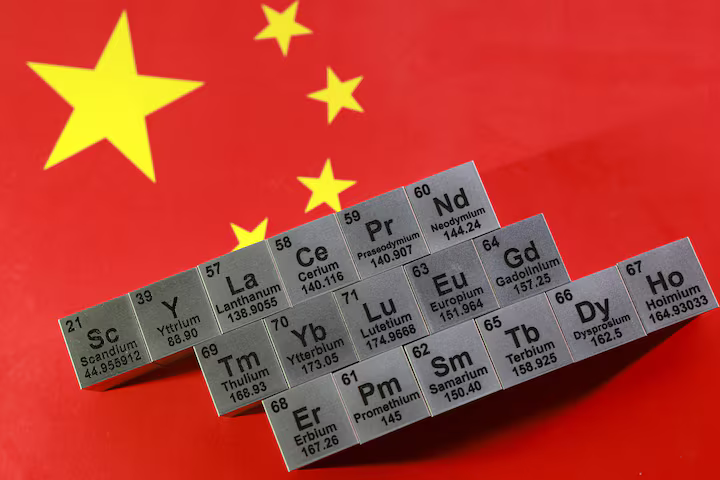
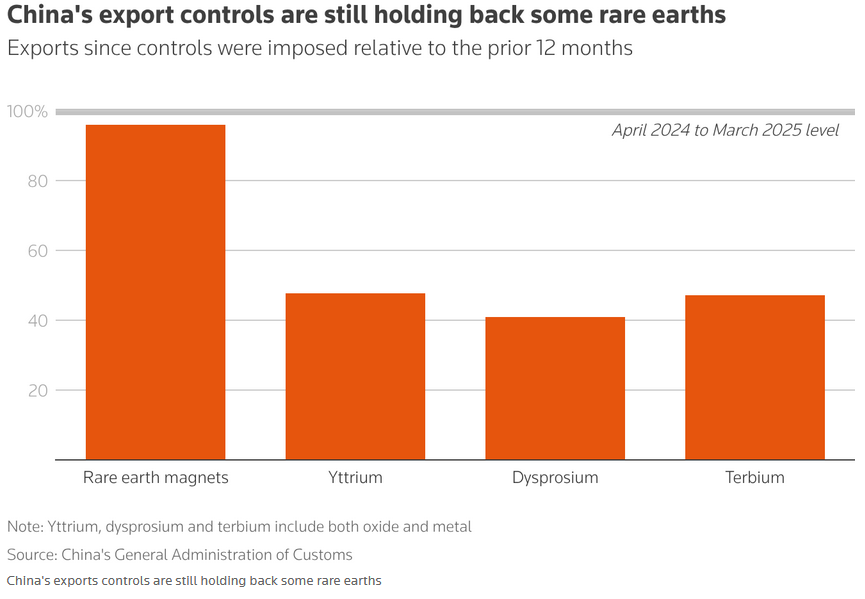
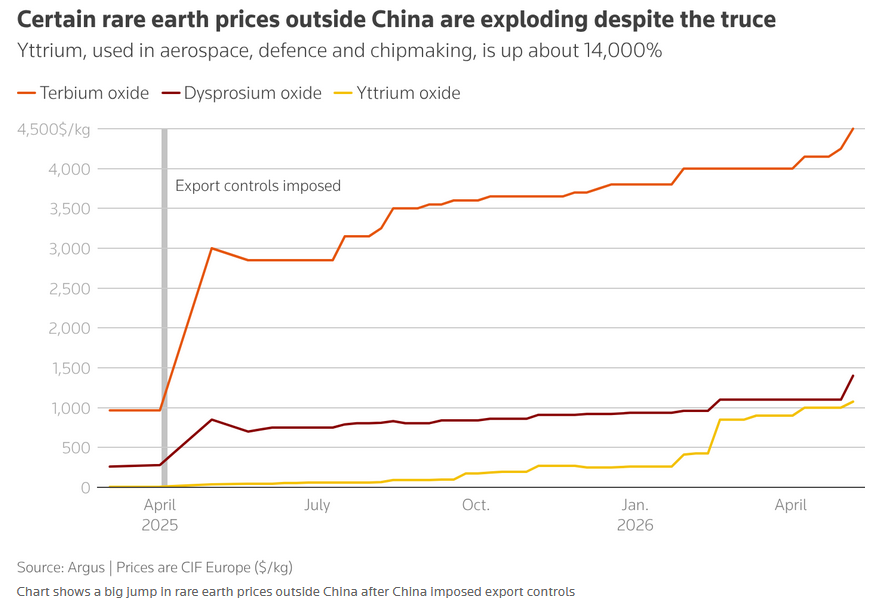
📉🔴 "China Will Address US Concerns." Sure it will. The White House just released its Beijing Summit fact sheet. On rare earths, here is the full extent of what was agreed: "China will address US concerns regarding supply chain shortages related to rare earths and other critical minerals, including yttrium, scandium, neodymium, and indium." That's it. No timeline. No mechanism. No enforcement. No removal of export controls. 📋 THE SCOREBOARD — SUMMIT TO SUMMIT 🔵 Busan Summit, October 2025: White House: "China agreed to effectively eliminate its current and proposed controls on rare earth elements." China: rolled back a wider set of restrictions — but left the April 2025 heavy REE controls in place 🔵 Beijing Summit, May 2026: White House: "China will address US concerns." China: has not confirmed the White House's account Status of April 2025 export controls: unchanged Two summits. Two deals. Zero removal of the controls that actually matter. The White House's latest statement tacitly acknowledges what nobody in Washington wants to say out loud: China's heavy rare earth export control regime is here to stay. 📊 CHART 1 — What "Here to Stay" Looks Like in Price Terms Since export controls were imposed in April 2025 (grey vertical line): 🟠 Terbium oxide CIF Europe: $1,000/kg → $4,500/kg — up 350% 🟤 Dysprosium oxide CIF Europe: $250/kg → $1,450/kg — up 480% 🟡 Yttrium oxide CIF Europe: ~$0/kg (near zero) → $1,100/kg — up ~14,000% (Source: Argus Media — Prices are CIF Europe $/kg) Yttrium. Up. Fourteen. Thousand. Percent. And the summit produced: "China will address concerns." 🫠 🔍 THE DETAIL THAT EVERYONE IS MISSING Look again at Chart 2. Rare earth magnets are at 96% — almost unaffected. Why? Because China is strategically allowing finished magnets to flow freely — while choking the raw oxides and metals that would let Western countries make their own magnets. This is not a blunt export ban. This is precision industrial policy — designed to keep Western OEMs dependent on Chinese finished products, not on Chinese raw materials they could process themselves. The message to the West: "Buy our magnets. Don't build your own separation capacity." And the White House responded with: "China will address concerns." 💡 WHAT THIS MEANS FOR WESTERN SUPPLY CHAIN BUILDERS Every day the controls stay: ✅ Western CIF prices for Tb and Dy continue diverging from Chinese domestic prices ✅ The economic case for Western separation infrastructure gets stronger, not weaker ✅ OEMs and defence contractors get more desperate for non-Chinese supply ✅ The October truce one-year extension (due November 2026) becomes less certain ✅ Recycled REO supply — not subject to Chinese export controls — becomes more strategically valuable by the week The companies building sovereign Western separation capacity today — government-backed, OEM-qualified, with demonstrated Dy and Tb purity — are not waiting for diplomacy to solve this. Diplomacy has now had two summit attempts. The Argus price chart shows you what diplomacy delivered. As a reminder ✅ The October truce one-year extension (due November 2026) and what it is ✅ The Situation The story is more nuanced and more alarming than what I summarised earlier. Here is the precise timeline: April 2025 — China imposes its first wave of export controls specifically targeting heavy rare earths Dy, Tb, Sm, Gd, Y, Lu and magnets. These were never suspended. They are still fully in force today. October 9, 2025 — China announces a second, broader wave of export controls — targeting rare earth processing equipment, overseas use of Chinese REEs, and battery production equipment. November 2025 — Busan/Seoul Summit — Trump and Xi agree to a one-year truce. China suspends the October 2025 second wave only — issuing general export licences for the broader basket. The April 2025 heavy REE controls (Dy, Tb, Y) were explicitly not altered and remain active. The suspended October controls expire: November 10, 2026. 🗓️ NOVEMBER 10, 2026 — THE DATE THAT MATTERS MORE THAN THE SUMMITLet's be precise about what is actually expiring on November 10, 2026: 📌 April 2025 controls (Dy, Tb, Sm, Gd, Y, Lu, magnets to defence): NEVER suspended. Still active right now. Exports down 52–59% 📌 October 2025 controls (processing equipment, overseas REE use, battery equipment): Suspended until November 10, 2026 only 📌 February 2026 expansion — China added 5 more elements to controls during the truce period 💡 Why the Magnet vs. Oxide Split Is the Killer Insight That Chart 2 observation — magnets at 96% vs. oxides at 41–48% — is genuinely the most strategically sophisticated point in this entire narrative, and it hasn't been widely written about. It shows China's controls are surgically targeted to maintain downstream dependency, not just a blunt retaliatory measure. That line alone will generate significant engagement from defence, automotive and industrial policy audiences who haven't framed it that way before. 📌 Sources: Reuters May 13 & 18 2026 | White House Beijing Summit Fact Sheet | Argus Media CIF Europe | China General Administration of Customs 🔗 reuters.com/business/aeros…... 🔗 reuters.com/business/aeros…... #RareEarths #CriticalMinerals #China #ExportControls #Dysprosium #Terbium #Yttrium #HeavyRareEarths #TrumpXi #BeijingSummit #WesternCIF #PriceDiscovery #SupplyChain #NationalSecurity #Defence #Magnets #NdFeB #EVs #Semiconductors #Aerospace #SovereignSupplyChain #Geopolitics #ChinaRareEarths #ExportRestrictions #Argus #Reuters
⚗️ NdPr DyTb | REO Analyst 🧲⭐ tweet media⚗️ NdPr DyTb | REO Analyst 🧲⭐ tweet media⚗️ NdPr DyTb | REO Analyst 🧲⭐ tweet media⚗️ NdPr DyTb | REO Analyst 🧲⭐ tweet media
English
1
1
10
449
William David
William David@WDChokepoint·
@TuttleCapital The turbine backlog is the part most people skip over. If GE Vernova and Siemens are booked to 2029, today’s hyperscaler power commitments don’t produce electrons for years. Everyone’s debating which energy source wins. Nobody’s asking when any of it actually arrives.
English
0
0
0
13
Matthew Tuttle
Matthew Tuttle@TuttleCapital·
SMRs are the 2030s story. The binding constraint for AI power demand sitting in front of every hyperscaler today is gas turbines — GE Vernova and Siemens Energy backlogs out to 2029 — plus grid interconnect queues already spanning 5-7 years. Watch the constraint chain, not the headline reactor.
American Conservation Coalition Action@ACCAction

Nuclear energy is essential to unleashing American energy dominance. And SMRs are one of the critical sources we need to meet demand. This news by the DOE ensures that America will be able to scale SMR construction faster and more efficiently.

English
1
3
18
1.4K
William David
William David@WDChokepoint·
@aaronburnett The analogy holds — and the missing variable is whether the energy layer scales fast enough to avoid becoming the binding constraint on intelligence growth. The industrial revolution worked because the fuel was abundant. The AI stack runs on electricity that isn’t.
English
0
0
0
5
Aaron Burnett
Aaron Burnett@aaronburnett·
the best mental model for SpaceX business right now comes from the industrial revolution, when productivity gains came from primarily infrastructure around capturing and refining oil. Rockets -> Railroads (access to the fields) Starlink -> Pipelines (moving the crude at scale) Compute (ground/space) -> Refineries (turning raw power + silicon into intelligence) Grok/Cursor -> Gasoline, jet fuel, plastics ( transformative end products) if you're fixated on any one line of business or as a conglomerate of disparate lines of business, you're missing it. some nuance exist here and the analogy like all analogies break down. One: oil is a limited resource. In this analogy intelligence has no definable upper limit, as it's limited primarily by energy access. Two: industrial era infrastructure took decades and iteration cycles were equally long. with AI end products iterate at software speeds and is self-improving. space 'refineries' and 'pipelines' can iterate in sub 5 year cycles.
English
5
10
84
3.6K
William David
William David@WDChokepoint·
@jackprandelli The trade map shift is also why China’s critical minerals leverage is more durable than most Western policy assumes. Processing capacity takes years to build. The commodity demand relationships across the Global South took 25. You can’t executive-order either one.
English
0
0
0
77
Jack Prandelli
Jack Prandelli@jackprandelli·
🌍 In 2000, the US was the dominant trading partner for most of the world. China now has become the primary trade partner across much of Asia, Africa, the Middle East, and South America. This is a shift in global economic gravity. China’s demand for commodities, energy, metals, and manufactured goods has rewired global supply chains over the past two decades. The map of trade is becoming the map of geopolitical influence.
Jack Prandelli tweet media
English
16
67
169
11.1K
William David
William David@WDChokepoint·
@cekdrew The extension lobbying is the key detail. A deadline contractors are already pushing to move signals the political will to force the issue may not be there. The stocks reflect the deadline. Not the extension risk.
English
0
0
1
397
cek
cek@cekdrew·
Today’s news is far bigger than most people realize. The United States doesn’t even have enough domestic magnet capacity for defense contractors… let alone the broader commercial market. $MP $USAR $ALOY Starting January 1, 2027, Chinese-sourced magnets will effectively be banned for U.S. defense supply chains, and contractors know there simply isn’t enough domestic supply to fill the gap. They’re already pushing the government to extend the deadline. This isn’t something that can just be reversed overnight with an executive order. Meanwhile, the few companies actually trying to solve this problem have been absolutely crushed in the market. Make it make sense.
cek@cekdrew

Defense Groups are Panicking About the Chinese Jan 1st 2027 Magnet Ban $MP $USAR $ALOY $AREC Defense companies are pushing Washington to delay a deadline, years in the making and now just months away, banning them from sourcing rare earth magnets from China for the US military. Some defense groups want more time to comply with the prohibition on using Chinese samarium cobalt magnets and neodymium iron boron magnets for defence department contracts from January 1, according to four people familiar with the matter. “Unless significantly more capacity comes online, adhering to the 2027 ban may not be feasible.” ft.com/content/4d6651…

English
15
12
139
49.7K
William David
William David@WDChokepoint·
@TuttleCapital Software-defined, autonomy-heavy architecture doesn't reward the primes — it rewards sensor fusion, battle management, and autonomous systems. DRS, KTOS, and PLTR fit that profile better than Lockheed or Northrop at this stage.
English
0
0
1
11
Matthew Tuttle
Matthew Tuttle@TuttleCapital·
CBO is estimating yesterday's missile defense. Golden Dome's architecture is software-defined and autonomy-heavy — the marginal dollar buys interceptors, sensors, and code, not primes. The real signal in this budget fight is who captures the reallocation, not the topline number.
Briana Reilly@briana_reilly

DOD's director of Golden Dome missile defense shield pushes back on CBO's $1.2T program price estimate w a familiar refrain - in short, "they’re not estimating what I’m building." He said the same thing when asked about other cost estimates in March. punchbowl.news/article/defens…

English
1
0
2
868
William David
William David@WDChokepoint·
@roblun1 The question nobody is asking is what happens to that bridge when inflation and debt service start crowding out the political cycle. Belfast works. But Belfast needs the contract pipeline to outlast it.
English
0
0
0
18
William David
William David@WDChokepoint·
@roblun1 Which means the Western separation buildout is being constructed ahead of the commercial demand that would make it self-sustaining. Government support is the bridge.
English
1
0
0
17
⚗️ NdPr DyTb | REO Analyst 🧲⭐
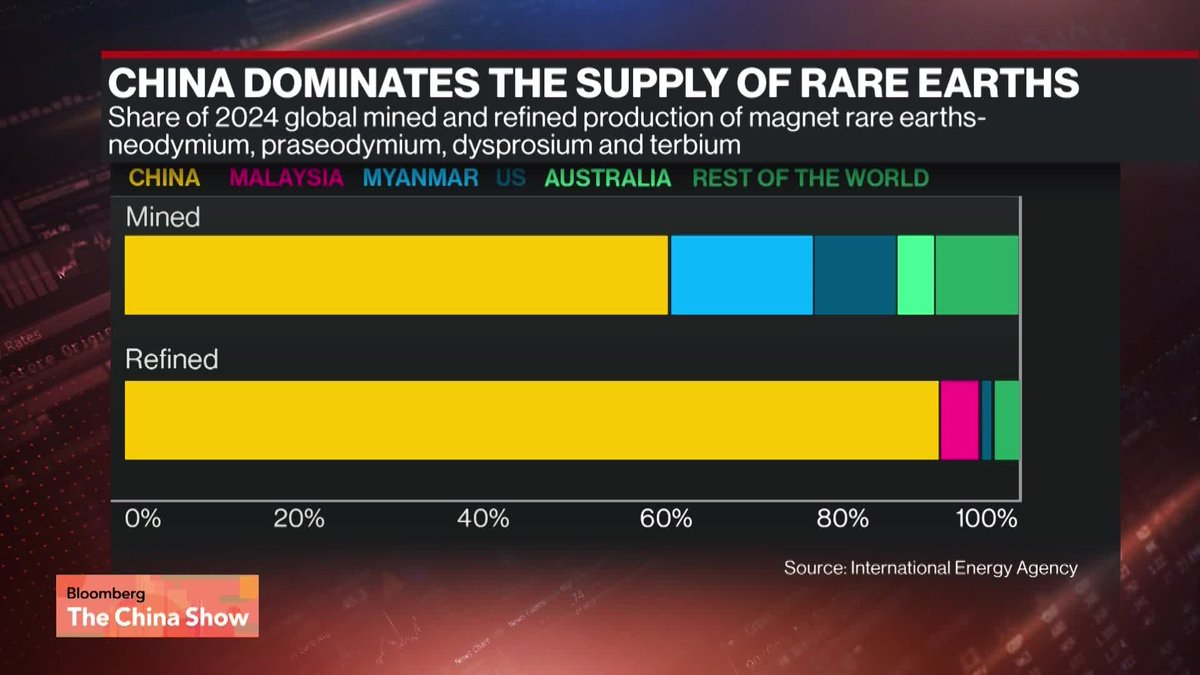
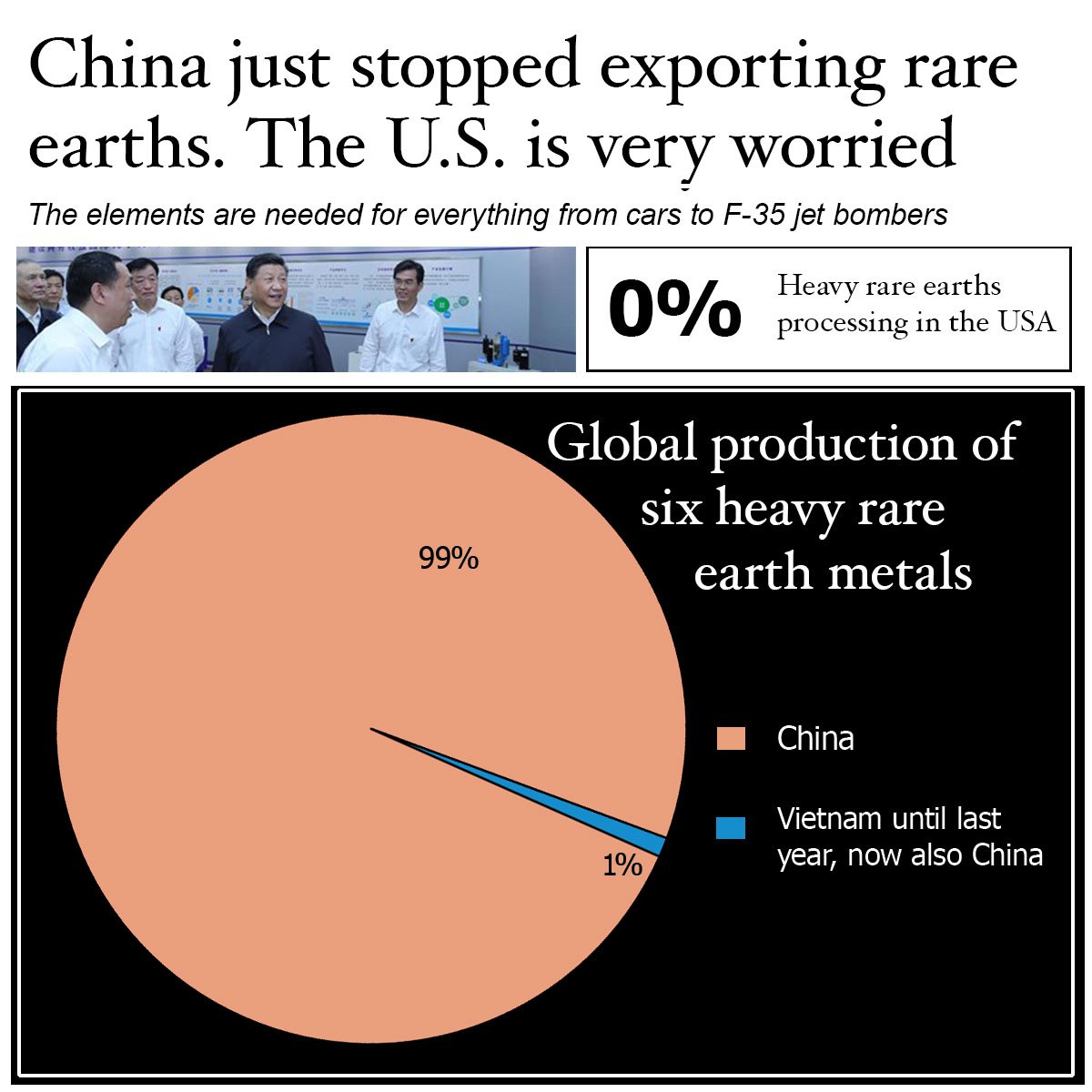
🚨 "Too Good to Be True" — Because It Is. Trump and Xi just concluded their Beijing summit. Both sides called it "positive." Trump gave it a 12 out of 10. On rare earths? 🦗 crickets 📋 WHAT ACTUALLY HAPPENED — THE FACTS ✅ White House statement: "China will address US concerns about potential supply bottlenecks in rare earths and critical minerals" ❌ China has not confirmed the White House's account ❌ Chinese state media response: considerably more muted than Washington's ❌ Zero new information on the rare earth export controls in place since April 2025 ❌ Even during the October 2025 Busan truce that reduced tariffs, China's export limitations on heavy rare earths and magnets were not lifted One BBC analyst called it perfectly: "This is not a diplomatic breakthrough — it's calendar management." 🃏 CHINA HOLDS ALL THE CARDS — AND KNOWS IT China controls: 🔴 59% of global rare earth mining (IEA 2024) 🔴 91% of global rare earth refining (IEA 2024) 🔴 ~99% of global Dy and Tb oxide separation 🔴 100% of the export licence approval process — active since April 2025 March 2026 customs data, just released: 🇨🇳 Terbium exported globally: 3 kg. Total. 🇨🇳 Dysprosium: 7,386 kg — still well below pre-restriction levels And Washington is asking Beijing to please be nice about it. 🎭 THE GEOPOLITICAL REALITY Foreign Policy wrote it plainly ahead of the summit: "China's Rare-Earth Card Looms Over Trump-Xi Summit. For all of the US leader's efforts, Washington remains deeply vulnerable." Bloomberg put the number on it: $1.2 trillion in US GDP exposed to rare earth supply disruption. The US needs another decade to fix it — even if China opened the taps tomorrow. China isn't going to open the taps. They just watched the US beg at a summit and got nothing concrete in return. Xi knows the leverage. The export controls stay until Beijing decides otherwise — not until Washington negotiates otherwise. 💡 WHAT THIS MEANS FOR WESTERN SUPPLY CHAIN INVESTORS The summit outcome — or rather the absence of one — is actually the most bullish possible signal for Western rare earth supply chain development: 📌 China will not voluntarily surrender its rare earth leverage 📌 Export controls on Dy, Tb and HREEs are structural, not temporary 📌 The only real solution is building Western separation capacity — not negotiating with Beijing 📌 The Bloomberg/McKinsey 82% HREE supply deficit by 2035 is now more likely, not less 📌 Adamas forecast of China becoming a net Dy and Tb importer by early 2030s remains intact 📌 Western CIF prices for Tb ($4,028/kg, +103% YTD) and Dy ($931/kg, +105% YTD) continue diverging from Chinese domestic prices Every month the talks produce nothing is another month the Western supply chain argument gets stronger. The companies building sovereign separation infrastructure — today, with government backing, with OEM qualification, with demonstrated purity — are building the only real answer to a problem that diplomacy has proven it cannot solve. 🇬🇧 While Washington talks, Belfast works. 📌 Sources: RawMaterials.net | BBC | CNBC | Bloomberg | Foreign Policy | Reuters | Discovery Alert | IEA #RareEarths #TrumpXi #China #CriticalMinerals #ExportControls #Dysprosium #Terbium #HeavyRareEarths #SupplyChain #Geopolitics #NationalSecurity #WesternCIF #UrbanMining #Separation #NdFeB #Magnets #EVs #Defence #Bloomberg #AdamasIntelligence #ChinaRareEarths #TradeWar #SovereignSupplyChain #CriticalMineralsStrategy
⚗️ NdPr DyTb | REO Analyst 🧲⭐ tweet media⚗️ NdPr DyTb | REO Analyst 🧲⭐ tweet media⚗️ NdPr DyTb | REO Analyst 🧲⭐ tweet media⚗️ NdPr DyTb | REO Analyst 🧲⭐ tweet media
English
1
3
16
2.2K