Will Kielm🌐🇺🇦

245 posts

Will Kielm🌐🇺🇦 banner
Will Kielm🌐🇺🇦

Will Kielm🌐🇺🇦

@WKielm

IR at @UChicago | Ex @DeptOfWar, @FDD, @TheStudyofWar, @TheWilsonCenter | Interest in IR theory, formal modeling, alliance politics, and crisis bargaining.

Katılım Ekim 2017
366 Takip Edilen225 Takipçiler
Sabitlenmiş Tweet
Will Kielm🌐🇺🇦
Will Kielm🌐🇺🇦@WKielm·
There has been a lot of talk about the theoretic (mis)application on assessing the risk of war between the U.S. and China. But what do major schools say about the causes of major wars? One world, many theories. (Table by yours truly) Small 🧵on the four big schools...
Will Kielm🌐🇺🇦 tweet media
English
3
4
20
7.1K
Will Kielm🌐🇺🇦
Will Kielm🌐🇺🇦@WKielm·
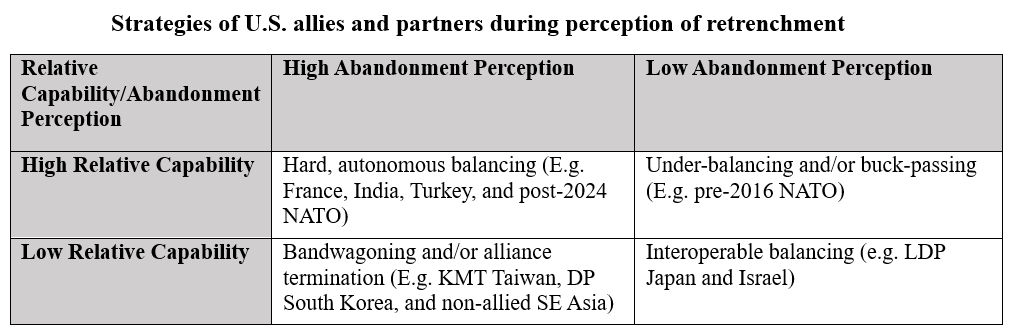
How will U.S. allies and partners respond to perceived retrenchment?
Will Kielm🌐🇺🇦 tweet media
English
0
1
4
542
Will Kielm🌐🇺🇦 retweetledi
Brian Blankenship
Brian Blankenship@BrianDBlank·
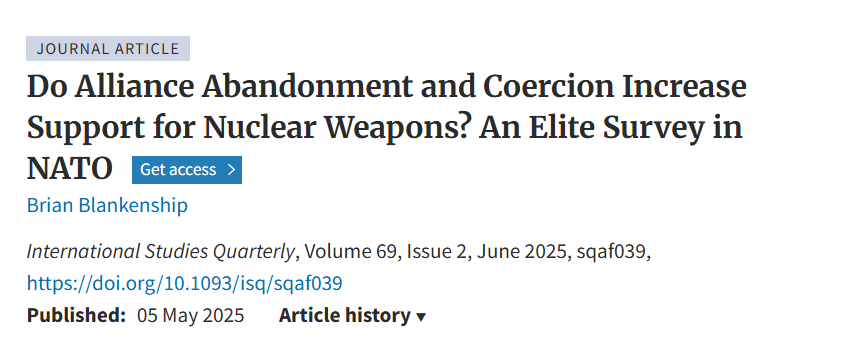
Very pleased to have a research note in the upcoming issue of @ISQ_Jrnl. The article explores a classic issue--nonproliferation & US alliances--using a new data source: a survey of elites (foreign & defense policy experts and policymakers) in European NATO countries.
Brian Blankenship tweet media
English
5
10
40
2.2K
Paul Poast
Paul Poast@ProfPaulPoast·
Today in Intro to International Relations, I'm teaching "IR Theory", specifically the "`isms". A key idea from the class is captured by Schmitt's famous observation that "All significant concepts of the modern theory of the state are secularized theological concepts"
English
9
46
354
28.5K
Will Kielm🌐🇺🇦 retweetledi
Professor Keren Yarhi-Milo
Professor Keren Yarhi-Milo@YarhiMilo·
This is the 3rd year we host a conference at @ColumbiaSIPA in honor of the late great Robert Jervis. Bob was one of the most incredible legends in the field of international relations - and he was my dear friend and mentor.
Professor Keren Yarhi-Milo tweet media
English
1
2
90
4.9K
Will Kielm🌐🇺🇦 retweetledi
Zack Cooper
Zack Cooper@ZackCooper·
I frequently get asked how Donald Trump's personal interactions might shape US relationships in Asia over the next four years. Here's my take for @RSIS_NTU: - Trump prizes "strong" (and conservative) leaders - Alignment with the US is not a precondition rsis.edu.sg/rsis-publicati…
Zack Cooper tweet media
English
0
4
18
2.7K
El Magnífico
El Magnífico@MagnificoIX·
@BillKristol Why do neoconservatives see the world through the lens of preparing for potential wars?
English
5
0
9
593
Bill Kristol
Bill Kristol@BillKristol·
Inviting Chinese dictator Xi Jinping to be a guest of honor at Trump's inauguration? The odds of the governments of Japan and South Korea deciding to quietly pursue nuclear weapons just went way up. And Taiwan?
English
226
304
1.1K
40.3K
Will Kielm🌐🇺🇦
Will Kielm🌐🇺🇦@WKielm·
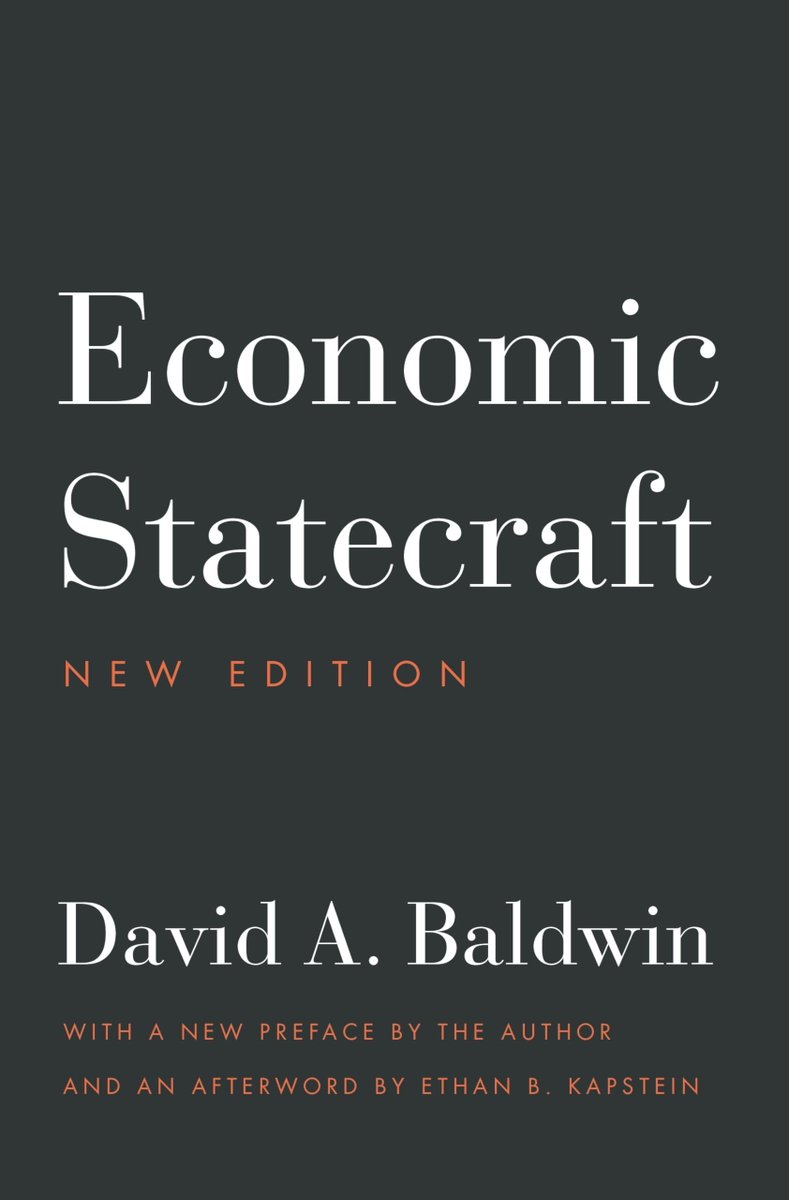
Precisely the debate that David Baldwin 1985 frames in Economic Statecraft. "Is the use of economic instruments of statecraft a sign of weak and pusillanimous statesmanship or an indication of firm commitment?" press.princeton.edu/books/paperbac…
Will Kielm🌐🇺🇦 tweet media
Walter Russell Mead@wrmead

Sanctions generally speaking aren't serious policy. They are what you do when you want to look like you care, but don't really plan to act. As more people notice this, they become even less effective.

English
0
0
3
547
Will Kielm🌐🇺🇦 retweetledi
Center for Maritime Strategy
Center for Maritime Strategy@CMS_Washington·
𝐏𝐚𝐫𝐭 𝐓𝐰𝐨: 𝐈𝐧 𝐃𝐞𝐟𝐞𝐧𝐬𝐞 𝐨𝐟 𝐂𝐨𝐧𝐯𝐞𝐧𝐭𝐢𝐨𝐧𝐚𝐥 𝐏𝐮𝐧𝐢𝐬𝐡𝐦𝐞𝐧𝐭: 𝐖𝐡𝐲 𝐉𝐚𝐩𝐚𝐧’𝐬 𝐃𝐞𝐟𝐞𝐧𝐬𝐢𝐯𝐞 𝐑𝐞𝐚𝐥𝐢𝐬𝐦 𝐑𝐞𝐪𝐮𝐢𝐫𝐞𝐬 𝐎𝐟𝐟𝐞𝐧𝐬𝐢𝐯𝐞 𝐂𝐚𝐩𝐚𝐛𝐢𝐥𝐢𝐭𝐲​ In the conclusion of this two-part series, @WKielm dives deeper into Japan's strategic shift and the broader security challenges in the Indo-Pacific. As the line between offensive and defensive capabilities blurs, Japan must enhance its deterrence posture to counter China's military expansion and ensure regional stability. Read part two now in The MOC: centerformaritimestrategy.org/publications/p…
Center for Maritime Strategy@CMS_Washington

𝐍𝐞𝐰 in the The MOC: In Defense of Conventional Punishment: Why Japan’s Defensive Realism Requires Offensive Capability In this two-part series, @WKielm explores Japan’s pivotal shift from its post-WWII self-defense posture with the introduction of its 2022 National Security Strategy. Japan is now committed to acquiring long-range counterstrike capabilities, traditionally seen as offensive, in response to security threats from China’s military modernization and North Korea’s nuclear provocations Read the full analysis in The MOC, and stay tuned for Part 2, coming Tuesday! centerformaritimestrategy.org/publications/i… #japan #nationalsecurity #northkorea #china

English
0
3
4
643
Reja Younis
Reja Younis@RejaYounis·
Hey #SecurityStudies folks! 👋 I'm diving into the roots of our field. Any must-read books/articles on the intellectual origins of security studies?📚 Would appreciate any recs!
English
17
6
43
9.1K
Elbridge Colby
Elbridge Colby@ElbridgeColby·
No. But the nuclear revolution means that nuclear weapons states - especially those with massive, diversified, and modern arsenals like America, Russia, and China - are different. That’s why nuclear proliferation is a big deal. An obvious threshold is not using our weapons against its sovereign recognized territory. We’ve never done that.
English
33
16
112
18K
Will Kielm🌐🇺🇦 retweetledi
Dale Copeland
Dale Copeland@Copela1492·
Part 4 of "Interacting Grand Strategies: U.S.-China Relations Going Forward." Today: What is Best U.S. Strategy for Dealing with Current Chinese Grand Strategy? @RushDoshi @ElbridgeColby @MearsheimerJ Sitting in a coffee shop in Richmond Va this morning, interacting with Rush Doshi on X about Chinese leaders' current thinking about the future, made me realize that the key question for U.S. policy makers right now is this: How should the United States adjust its grand strategy going forward when so much is up in the air about China's own future trajectory? Doing grand strategic policy planning in the midst of great uncertainty is always hard. In the 1943-45 period, for example, as I show in Chapter 6 of A World Safe for Commerce, American policy makers knew that Nazi Germany would indeed be defeated. But they didn't know what the relationship with the Soviet Union would be after the war ended and Moscow, by agreement at Teheran in late November 1943, would occupy half of Europe. The Soviets would certainly rebuild their industrial base and seek to modernize their weaponry (including acquiring missiles and atomic weapons through their own [and German] scientists). But would Stalin continue to be someone Washington could work with? In the face of this deep uncertainty, Roosevelt did the prudent thing of securing air bases around the Soviet perimeter (to project deterrent power into Russia); not sharing atomic secrets with Moscow; not promising a continuation of economic aid after the war; and the establishing of an arc of allies and aligned states from Britain through Mid-East to Southeast Asia/China. This grand strategy was a continuation of the "Grand Area" strategy that was formulated in the 1940-41 period, and made perfect sense for the new bipolar world that would emerge as Britain, France, Italy, and (eventually) Germany fell out as great powers after the devastation of the war. (See A World Safe for Commerce, pp. 235-53 and Stephen Wertheim's Tomorrow the World). It was FDR's policy shifts that set the stage for the full shift to containment and "Cold War" from 1945-47 (AWSFC, pp. 253-85). In Parts 1 and 2 of the "Interacting Grand Strategies", I sought to show that while China and the United States since 2006-07 have both moved toward the harder-line end of the spectrum on both military and commercial policies, neither state is yet in a "Cold War" posture, and that especially on the commercial front, there is a strong desire on the part of both states to keep the relationship from "decoupling." Chinese leaders in particular have realized over the last year that their economy has some deep structural problems -- specifically lower growth rates in consumption and investment that are having to be offset by continued dependence on high exports. Thus for the near term at least, China will be forced to keep finding markets and suppliers of cheap raw materials in order to get the 3-5% GDP growth needed for CCP legitimacy and domestic stability. The four main realist theories I've outlined have different takes on "what the U.S. should do" given the current situation (made even more uncertain by the continued Russia-Urkaine war and Beijing's propping up of Russia's economy and munitions production even as it avoids formally violating the West's sanctions regime). Defensive realists, given their focus on the security dilemma, would emphasize a U.S. grand strategy of moderate but not provocative military buildup to ensure deterrence in East Asia without causing a spiral of mistrust and hostility. Offensive realists and neoclassical realists, given their stress on the need to assume that Xi's intentions may indeed be aggressive (toward Taiwan and beyond), would emphasize the need for a U.S. "preponderance of power" to ensure the U.S. deterrence posture is indeed "robust" (that China "can't possibly doubt" that the costs to Beijing of military expansionism would be far greater than any possible benefits). An offensive realist such as Bridge Colby may prioritize East Asia over Europe and the Mid-East, but as my posting earlier today suggested, he is willing to see a degree of U.S. involvement in NATO and Europe more generally, given that Putin does seem to be expansionistic. John Mearsheimer likewise wants a grand strategic focus on the Indo-Pacific, but sees the U.S. having an "off-shore balancing" role in Europe, namely, being a part of NATO and signaling to Putin that he must curtail his expansionist impulses, even if Washington should avoid escalation through overcommitment. As you can guess, I believe a mixing of the insights of these other three realist camps is in order. We have two simultaneous objectives to achieve here: (1) a signaling of U.S. power and resolve in order to convince Chinese leaders not to press their luck and to realize that the U.S. will indeed be "ready" in the future should China continue to spend heavily on military and to position itself for attacks or coercive moves on U.S. interests. (Taiwan, but also Philippines and Southeast Asia, and of course the eastern Pacific, Atlantic, Indian, and Arctic Oceans.) And (2) an avoidance of a spiraling to superpower crises and war. Achieving a balance between readiness/deterrence and avoiding spirals to crisis and war has always been the hardest nut to crack in International Relations. So let me discuss briefly how a dynamic realist approach to grand strategy might be able to square this circle (to use another metaphor). Dynamic realism (explained in chapters 1-2 of A World Safe for Commerce) argues that rational security-maximizing states will be aware of the trade-offs entailed by leaning more heavily toward either the soft-line or the hard-line ends of the policy spectrum. (Recall from Parts 1 and 2 that policies wary on both the intensity of military policy toward the adversary and the intensity of commercial-economic policy.) It made sense for the U.S. in the 1996-2007 period to lean to the soft-line end, simply because China had a long way to go to catch up in GDP and was relatively moderate in policy. Thus it made sense to avoid a security-dilemma spiral even at the expense of future readiness. But after 2007, as China's GDP and military growth continued, and it became more assertive in the South China Sea, it made sense for both GOP and Democratic administrations to shift grand strategy toward the "maintain preponderance" end of the spectrum -- including "pivoting" to Asia, increasing military spending, and imposing restrictions on the highest of high tech goods going into China (e.g., under 15 nanometer chips) or out of China (e.g., Huawei 5G network systems). But unlike the 1943-53 period, the United States does not need to switch to an all-out "containment" grand strategic logic to achieve its ends. Xi Jinping, for all his faults, is not Stalin. He does not seek to spread a universal ideology (China's CCP no longer has such an ideology, since it does not espouse the mobilization of the masses against elites, but rather the acceptance of hierarchical order). Moreover, China since 1981 has accepted the need for China's integration into the global economic system (vs. Mao's autarchy). Indeed, growth through trade (as other great power did before it), is a core pillar of China's grand strategy and essential for the CCP's legitimacy at home. This gives Washington the opportunity to moderate Beijing's behavior through the dangling of trade carrots but also the possibility of using trade sticks (the severing of trade in certain key sectors) to show Chinese leaders the costs of aggression. Dynamic realism, in short, suggests that a Goldilocks formula of mixing high levels of trade (and positive trade expectations) with the maintenance of a strong deterrence posture can indeed both convince China to be moderate in its foreign policies in the short term (including over Taiwan) even as it ensures CCP leaders that China will grow enough over the long term as to avoid the traditional problem of "peaking and declining" that has got great powers into crises and wars on so many occasions in history (1914, 1941, Cuban Missile Crisis 1962). There is a lot more I could discuss, including different types of scenarios that could emerge in the future to change the U.S.'s "best mix" of carrots and sticks (soft-line and hard-line). Much of this is in chapter 10 of A World Safe for Commerce. But for some hints, see my reply to Rush Doshi this morning (link below). I'll try to say more in future posts about the specific aspects of this "Goldilocks" grand strategy that ensures deterrence for the long term and avoidance of war.
Dale Copeland tweet media
English
3
8
27
6.6K