
Yasmeen ياسمين
710 posts

@YEryani
PhD Candidate | Conflict Resolution & Peace Mediation | Exec. Director @SanaaCenter | PeaceTech Consultant | Researching peacebuilding & diplomacy in Yemen


At the start of the war, Gulf states were trying to prevent further escalation. But as Iran strikes civilian infrastructure across the Gulf, the space for stopping the war is shrinking. “I highly doubt we’re going to see an off-ramp through negotiations anytime soon.” — Lina Al-Khatib @LinaKhatibUK, Associate Fellow at Chatham House’s Middle East and North Africa Programme.

🎧The EI Podcast: The Houthis’ forever war @Dr_E_Kendall speaks to @jackfdickens about what motivates the Islamist group. audioboom.com/posts/8882640-…

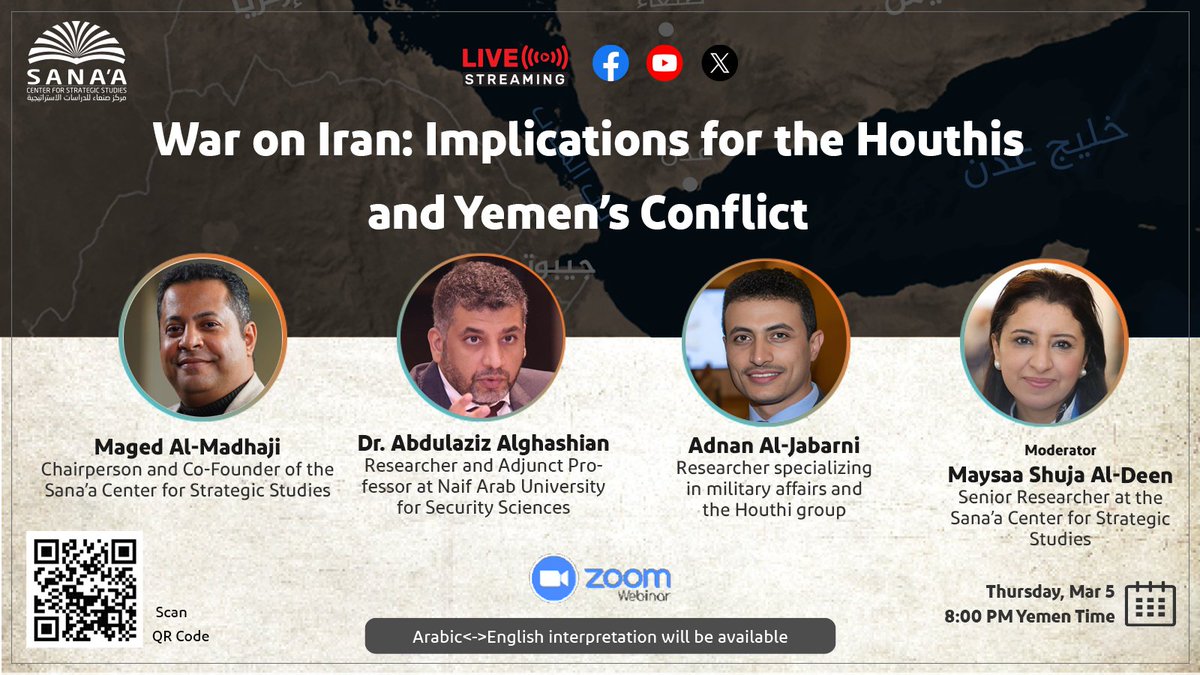
Upcoming Webinar | The Houthis Enter the War: What Lies Ahead for Iran’s Proxies? The Sana’a Center is hosting a panel tomorrow on the Houthis’ entry into the Iran war, which raises urgent questions about timing, escalation, and how Tehran may be using its proxies to reshape regional military dynamics. Speakers: • Maysaa Shuja Al-Deen @maysaashujaa, Senior Researcher at the Sana’a Center for Strategic Studies • Dr. Thomas Juneau @thomasjuneau, Professor at the University of Ottawa and Non-Resident Fellow at the Sana’a Center for Strategic Studies • Dr. Lina Khatib @LinaKhatibUK, Associate Fellow at the Middle East and North Africa Programme at Chatham House • Hayder Al-Shakeri @HayderSH, Research Fellow with the Middle East and North Africa programme at Chatham House Moderator: • Yasmeen Al-Eryani @YEryani, Executive Director for Knowledge Production at the Sana’a Center for Strategic Studies 🗓️ Tuesday, March 31 ⏰ 4:00–5:15 PM (Yemen time) | 2:00–3:15 PM (CET) 🔗 Register: sanaa-center.zoom.us/webinar/regist…


🎙️ In the latest @ECFR WOMENP podcast episode, @Cinzia_Bianco speaks to @YEryani @maysaashujaa about Yemen as the latest battlefield for UAE-Saudi rivalry, and what the next stage of US-Iran escalation could mean for the Houthis 👇 buff.ly/KCY9fCg

Yasmin Farouk @YasFarouk noted that developments in #AlMahra and #Hadramout have shifted #Oman from a quiet mediator to a party directly concerned with its own national security. Tribal and political understandings are no longer sufficient to ensure stability, and the military factor is now part of the calculations. This explains Oman’s heightened state of alert and its intensified diplomacy with both #Riyadh and #AbuDhabi to protect its direct security interests.

A brand new episode of our podcast series The New Arab Voice is now out! This week, we unpack the STC's offensive in Yemen and the change in the balance of power 🎧⬇️ newarab.com/podcast/new-ye…

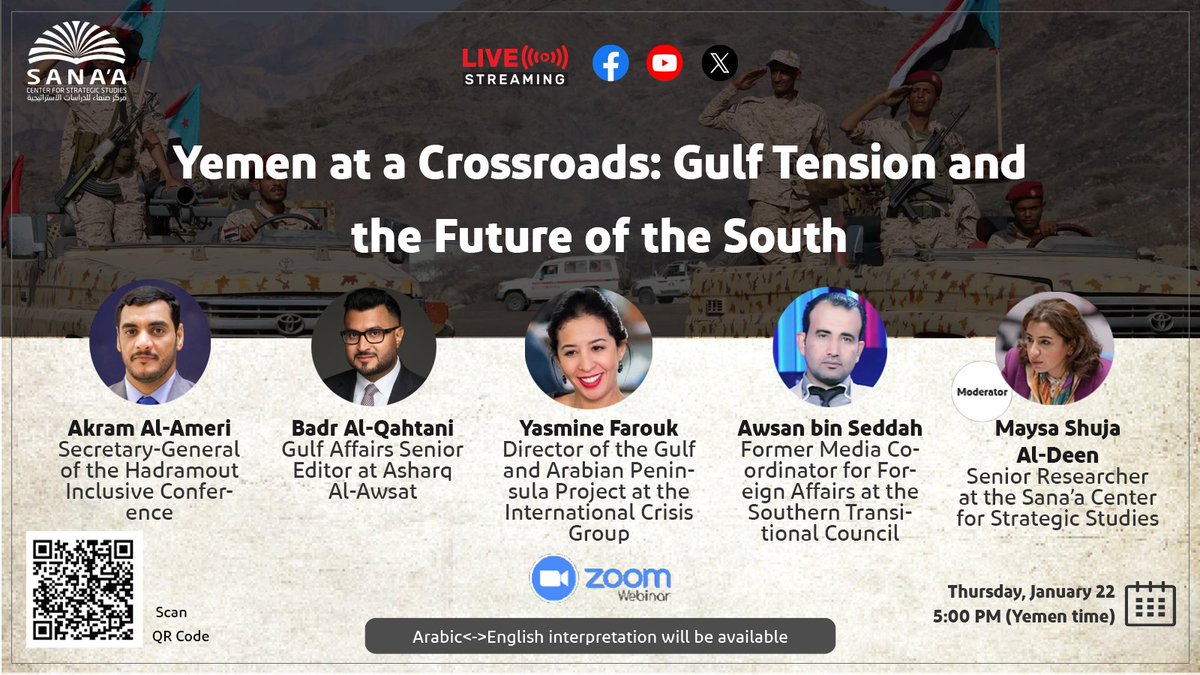
Happening tomorrow! Join our webinar: Yemen at a Crossroads: Gulf Tension and the Future of the South. Thu, 22 Jan | PM Yemen Speakers: • Akram Al-Ameri @akramalamri1984, Secretary-General of the Hadramout Inclusive Conference. • Badr Al-Qahtani @BadrAlQahtani, Gulf Affairs Senior Editor at Asharq Al-Awsat @aawsat_News. • Yasmine Farouk @YasFarouk, Director of the Gulf and Arabian Peninsula Project at the International Crisis Group @CrisisGroup. • Awsan bin Seddah @OsanBinsiddh, Former Media Coordinator for Foreign Affairs at the Southern Transitional Council. Moderator: Maysa Shuja Al-Deen @maysaashujaa, Senior Researcher at the Sana’a Center for Strategic Studies


And @SanaaCenter's @YEryani argued that the current moment represents a critical and possibly final opportunity for the internationally recognized government of Yemen to reassert itself and restore public confidence. With full Saudi backing now in place, the government can no longer attribute its failures to internal fragmentation or competing power centers. Yemen is no longer viewed as solely a Saudi issue, but as a matter of broader regional concern, which increases Saudi Arabia’s stake in ensuring the government succeeds. This moment, Yasmeen stressed, is not only about saving the government, but about salvaging Yemen itself. Public expectations are high, particularly around restoring legitimacy in practical terms. Legitimacy must be demonstrated through action, including paying salaries, addressing the economic vacuum, creating basic economic opportunities, filling security gaps created by recent upheavals, and restoring a sense of confidence and forward momentum among the population. The speaker noted that Yemenis across the country are searching for a viable governance model that can deliver stability, with Hadramawt often cited as a potential example. However, the demand for a model extends nationwide. The responsibility now lies with the government to present such a model despite severe economic, security, and political challenges. While the conditions for success exist, there are also actors with vested interests in disrupting the transition. The government and its regional partners must anticipate these risks and respond proactively. The path forward will not be easy, but Yasmeen emphasized that opportunities of this magnitude do not recur indefinitely. Past chances have been squandered, and failure now may leave no alternative opening. Immediate priorities are clear: preventing security and economic collapse, ensuring no actor is excluded, offering reassurances against retaliation, and fostering inclusive dialogue. While a broader political settlement remains a longer-term goal, addressing these immediate challenges is essential to stabilizing the country and laying the groundwork for lasting peace.