Violet X.

114 posts

Violet X. banner
Violet X.

Violet X.

@ZiyuX

PhD student @Stanford. Working on LLM-based agents

United States Katılım Ekim 2011
367 Takip Edilen240 Takipçiler
Sabitlenmiş Tweet
Violet X.
Violet X.@ZiyuX·
🧵(1/9) Sparse RL for reasoning has an exploration problem. It can only reward solutions the model already stumbles into. On hard problems, that means lots of zeros and very little signal. SFT and self-distillation attack this with reference solutions as targets to match. Instead, we use them as reward scaffolds: a dense signal at both the outcome and process level. Introducing ExpRL: RL-based mid-training that improves exploration by scoring the model’s own attempts against the reference via an LLM judge. What we find: • A stronger policy straight out of mid-training (higher pass@1 and pass@k) • Still ahead after downstream sparse-reward RL • Holds across domains – math & STEM • Scales to a larger policy graded by a smaller judge
Violet X. tweet media
English
3
32
133
12.6K
Violet X. retweetledi
Emily Jin
Emily Jin@emilyzjin·
During long-horizon task planning, a robot must decide what to do, while ensuring each action is geometrically feasible. To this end, we propose 𝗽𝗹𝗮𝗻𝗻𝗶𝗻𝗴 𝘄𝗶𝘁𝗵 𝗶𝗻𝘁𝗲𝗿𝗹𝗲𝗮𝘃𝗲𝗱 𝘃𝗶𝘀𝗶𝗼𝗻-𝗹𝗮𝗻𝗴𝘂𝗮𝗴𝗲 𝘁𝗵𝗼𝘂𝗴𝗵𝘁𝘀.
English
3
16
103
14.7K
Violet X. retweetledi
Michael Y. Li
Michael Y. Li@michaelyli_·
You're wasting FLOPs when scaling inference compute: by independently sampling parallel attempts, you burn compute rediscovering the same solutions. Introducing QuasiMoTTo: we scale parallel sampling with correlated samples instead! These samples have higher coverage, are marginally exact draws from the LLM, and can be generated in parallel. Result: same performance with 25-47% fewer samples in test-time scaling + 50% fewer training steps in RL! In our new paper, we explore the design space of correlated samplers. Work with co-authors @probablynotaz9 (co-lead), @gandhikanishk, @noahdgoodman, and Emily Fox!
Michael Y. Li tweet media
English
14
69
281
70.6K
Violet X. retweetledi
Jubayer Ibn Hamid
Jubayer Ibn Hamid@jubayer_hamid·
The most capable reasoning systems in AI scale inference compute along several axes: sequential compute to think longer, parallel compute to sample many independent attempts, and aggregative compute to synthesize prior traces into a new improved one. But during training, we only optimize how models use sequential compute. This creates a fundamental mismatch between how we ultimately deploy these systems and how we train them, leaving much of search and synthesis unoptimized. We introduce SPIRAL, an RL framework for making all inference-compute primitives end-to-end learnable: models learn to coordinate sequential, parallel, and aggregative reasoning using only the reward of the final output. Work with @ifdita_hasan (co-lead), @michaelyli_ , @oshaikh13 , @yoonholeee , @DorsaSadigh , @chelseabfinn , @noahdgoodman 🧵
Jubayer Ibn Hamid tweet media
English
15
93
436
182.2K
Violet X.
Violet X.@ZiyuX·
🧵(1/9) Sparse RL for reasoning has an exploration problem. It can only reward solutions the model already stumbles into. On hard problems, that means lots of zeros and very little signal. SFT and self-distillation attack this with reference solutions as targets to match. Instead, we use them as reward scaffolds: a dense signal at both the outcome and process level. Introducing ExpRL: RL-based mid-training that improves exploration by scoring the model’s own attempts against the reference via an LLM judge. What we find: • A stronger policy straight out of mid-training (higher pass@1 and pass@k) • Still ahead after downstream sparse-reward RL • Holds across domains – math & STEM • Scales to a larger policy graded by a smaller judge
Violet X. tweet media
English
3
32
133
12.6K
Eric Nguyen
Eric Nguyen@exnx·
Together with my co-founders Michael @MichaelPoli6, Stefano @Massastrello and Armin @athmsx, I am excited to announce @RadicalNumerics is emerging from stealth with a $50M seed round to build general biological intelligence. We’re also sharing an early preview of our new model Omnii, the most powerful genome language model to date. Omnii preview link: radicalnumerics.ai/blog/radical-n… At Radical Numerics, our mission is to master the code of life, and to drive the frontier of biological AI for both design and defense. This is our dual mandate, which comes from something our own team helped make possible. Our founding team trained Evo and Evo 2, the largest biological AI models (40B params) trained on DNA sequences. Trillions of tokens across all of life, from microbes to mammals. It’s fully open source, and created the field now known as generative genomics. Last year, scientists used Evo to generate the world’s first complete genome from scratch using AI. Turns out it was a bacteriophage—a type of virus. It functioned in the real world, and in this case it was harmless. But for us, it was a clear turning point. It showed that AI is no longer just analyzing biology. It is on the cusp of generating functional lifeforms. Eventually, AI will have the power to design and control life itself. That should make all of us incredibly excited, and incredibly uneasy. (Anyone can design DNA with a new function, and have it synthesized and delivered, like something from Amazon Prime). The same technology that will help us cure cancer is the very technology that might create the next global pandemic, or worse, allow the creation of bioweapons that can wipe out populations. We believe these forces are inseparable. If you work on the frontier of biology, you have to build technology to safeguard it from its misuse. Existing biosecurity tools are sorely losing the arms race, relying on outdated “have I seen this exact thing before?” style algorithms. We founded Radical Numerics to turn the tide. And we can’t do that by training on textbooks and natural language. We must understand the language of biology from the raw physical data itself, to reason across every molecule and modality, from DNA to proteins. The next frontier for AI goes far beyond chatbots or video generators to models that can understand and engineer life. Today, we’re previewing Omnii, which is already far surpassing Evo 2, and will continue improving as we scale and add new modalities (training now). 1. For human health, Omnii can read and write whole genomes (more on writing later). It’s state of the art (SOTA) on detecting causal variants for disease, and can rank Alzheimer's mutations zero-shot. We’re partnering with a diagnostics company to use Omnii for early cancer detection (pancreatic and multi-cancer). 2. For defense, Omnii is SOTA at detecting AI-generated pathogens. We benchmarked existing detection tools, and they simply can’t detect the AI-generated ones (“deepfake viruses”). We’re partnering with a US national lab to pilot Omnii for detecting the next pandemic, both natural and AI-generated. We have a data center full of Blackwells in construction now to build the most powerful biological AI models ever. This mission takes a new kind of AI lab that can actually scale on physical, biological data: new alignment research (mid/post training), scaling long context, building out mech interp teams to dissect what these models learn, new architectures and systems designs, all from the ground up. Our team is made up of AI researchers and scientists from top labs and institutions (e.g. Stanford, MIT, Google DeepMind), but more importantly, we all share the belief that this is the most important challenge of our lifetime. If you feel similarly, we are hiring. We aim to bring the brightest minds in AI and science together to save lives. Thanks to our partners on this journey, led by Emergence Capital @emergencecap, with Obvious Ventures @obviousvc, Triatomic @TriatomicCap , and Patrick Collison @patrickc. Our advisors include Eric Horvitz @erichorvitz, CSO of Microsoft, Chris Re @HazyResearch of Stanford, George Church @geochurch of Harvard, and Andrew Weber @AndyWeberNCB, former Assistant Secretary of Defense for Nuclear, Chemical and Biological Defense Programs. Fortune article: fortune.com/2026/06/15/exc… Jobs: radicalnumerics.ai/join-us
Eric Nguyen tweet media
English
157
307
1.4K
2.6M
Violet X. retweetledi
Anikait Singh
Anikait Singh@Anikait_Singh_·
🚨🚨New Paper: Generative Insight Anticipation from Scientific Literature Human scientists achieve breakthroughs by "standing on the shoulders of giants," synthesizing profound insights from disparate sources. While LMs show promise in scientific discovery, they currently struggle to reliably generate ideas of true impact, diversity, and feasibility. Introducing "insight anticipation," a novel task challenging LLMs to generate a downstream paper's core scientific contribution directly from its foundational prior works. We also introduce GIANTS-4B, an RL-trained model that significantly outperforms frontier models at this task! 🧵⬇️
Anikait Singh tweet media
English
3
14
65
8.6K
Shirley Wu
Shirley Wu@ShirleyYXWu·
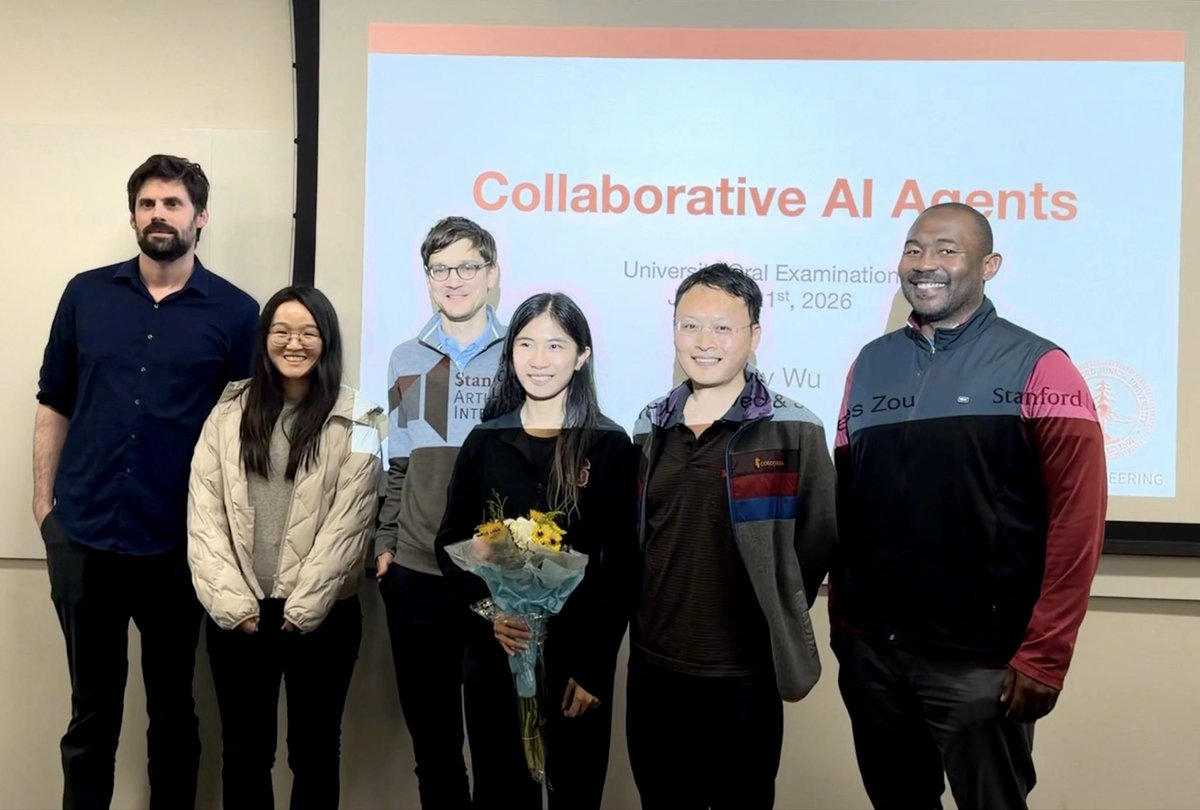
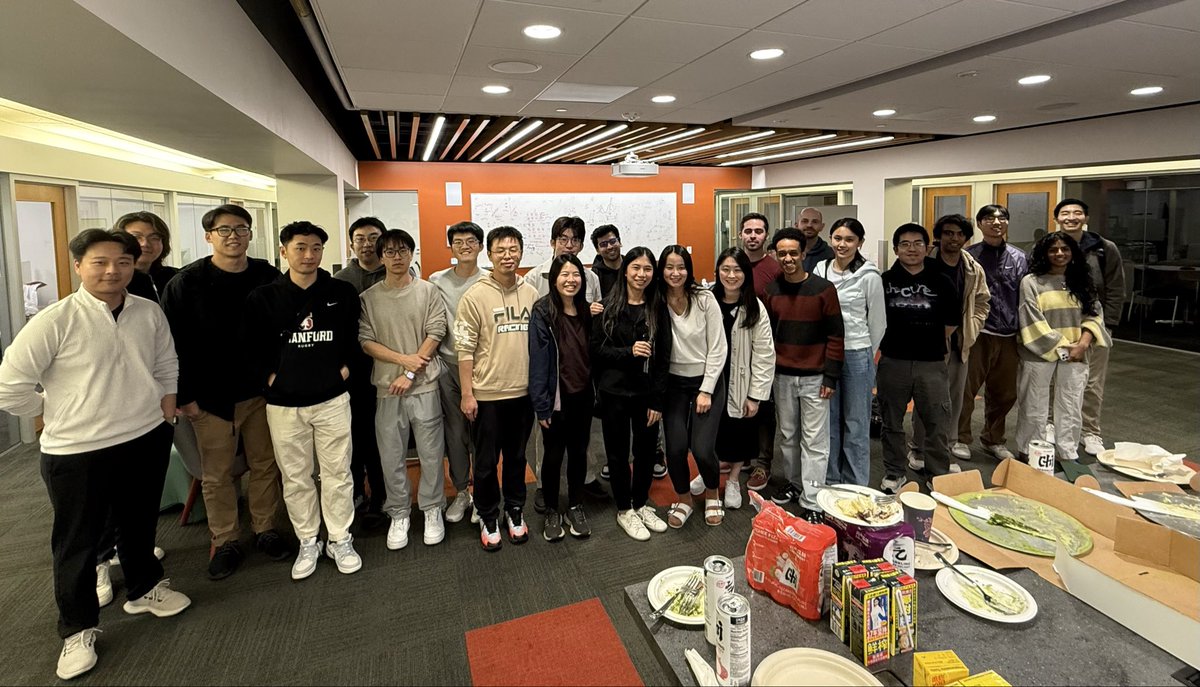
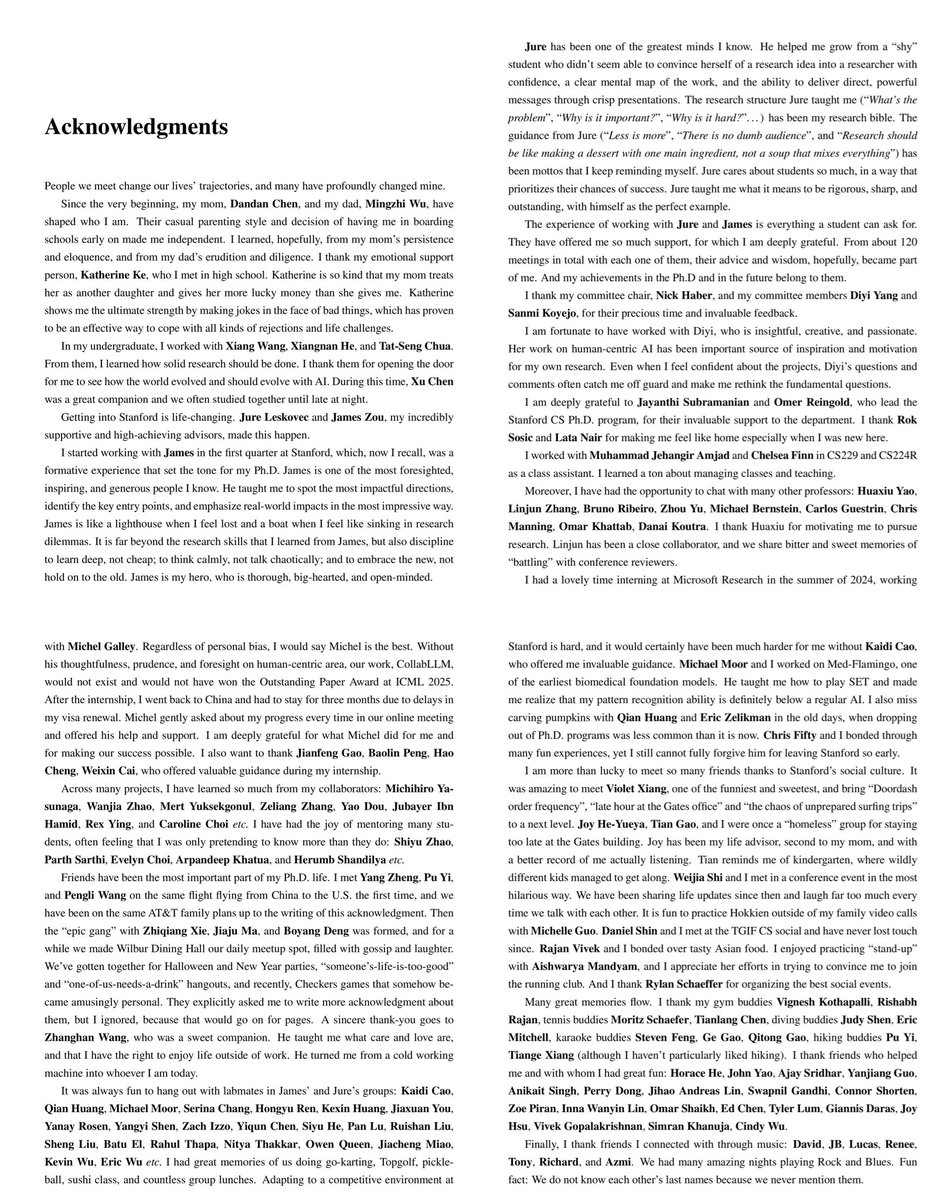
To the best PhD years at Stanford To all who have carried my learning and lit the way for my growth ❤️ Thank you is hardly enough
Shirley Wu tweet mediaShirley Wu tweet mediaShirley Wu tweet mediaShirley Wu tweet media
English
47
7
374
32.3K
Violet X. retweetledi
Aviral Kumar
Aviral Kumar@aviral_kumar2·
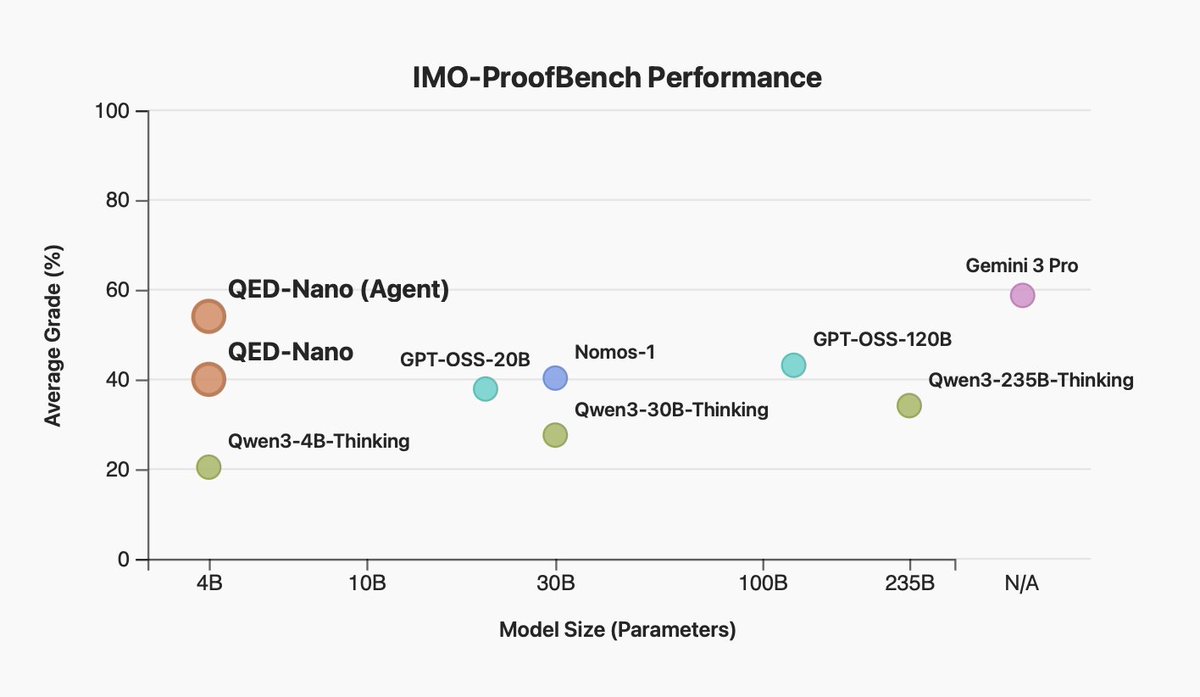
Can just a 4B model solve IMO-level proof problems at the level of much stronger LLMs like Gemini 3 Pro? Yes, if you can train the LLM to scale test-time compute well! We're very excited to release our 4B model "QED-Nano", built via an awesome open collab! Details below🧵⬇️
Aviral Kumar tweet media
English
8
26
167
22.1K